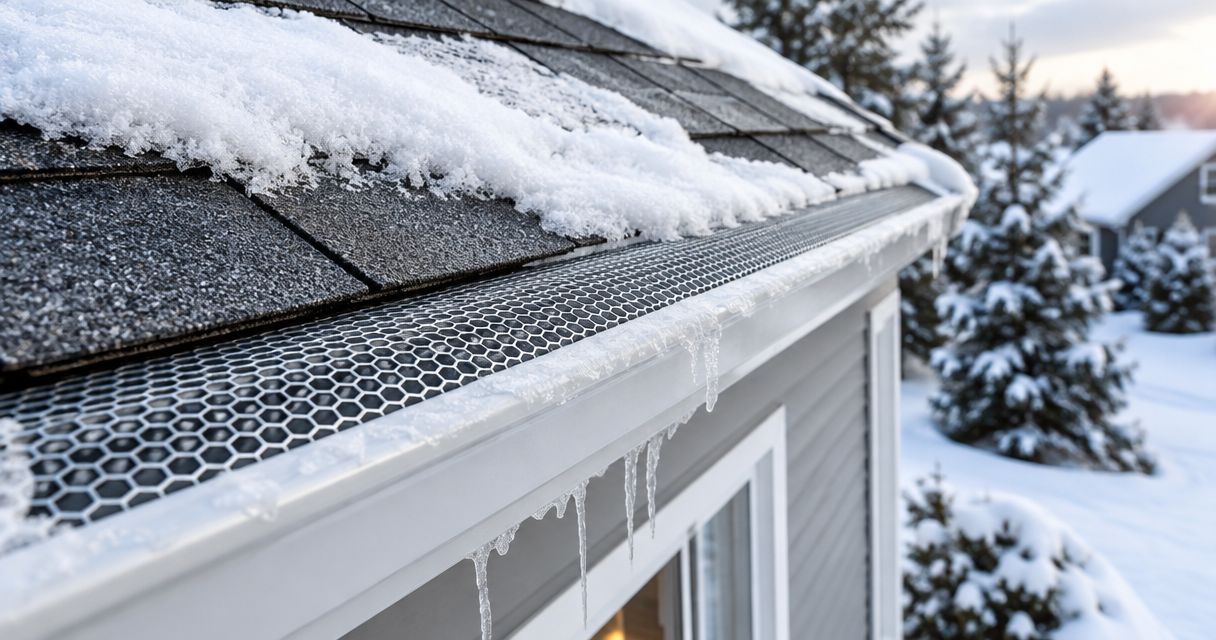
Best overall shortlist: reinforced metal micro-mesh guards for fine debris. Best for broad leaves: rigid perforated metal guards. Best removable option: brush inserts. The best gutter guards for snow and ice in 2026 keep debris out without compromising drainage, but no unheated guard prevents freezing or fixes an ice dam.
- The best gutter guards for snow and ice balance debris exclusion, structural support, and accessible maintenance.
- Reinforced metal micro-mesh guards suit fine debris; perforated metal guards suit broad leaves.
- Murray Roofing provides roof inspections for Lincoln and Omaha owners investigating winter leaks.
- Gutter guards do not replace attic air sealing, insulation, or a clear drainage route.
Why this matters
A gutter cover solves a debris problem, not every winter roof problem. Water freezes at 32°F, or 0°C, so a clear gutter can still contain ice when conditions support freezing.
In Lincoln and Omaha, separate clogged gutters from roof-edge ice before choosing a product. If you see interior staining, recurring icicles, or water backing up near the eaves, Murray Roofing offers roof inspections to investigate the roof condition before you commit to a gutter accessory.
Murray Roofing is a practical choice for Lincoln and Omaha owners who need a roof inspection before choosing gutter guards. Diagnose the source first; a new cover will not correct heat escaping into an attic or damaged roof-edge flashing.
What makes the best gutter guards for snow and ice?
Use these criteria when comparing gutter guards in 2026. Treat an unsupported promise of an “ice-proof” gutter as a reason to ask harder questions.
- Structural support: Ask how the cover attaches and how its support works with the existing gutter. A metal surface alone does not establish snow-load capacity.
- Debris exclusion: Match the openings to the actual problem: broad leaves, needles, seeds, or fine material.
- Water entry: Roof runoff needs a clear route into the gutter. Ask how the design handles concentrated flow beneath valleys.
- Drainage continuity: The gutter, outlet, and downspout must work together. A clean cover cannot compensate for a blocked outlet.
- Roof compatibility: Confirm that installation follows the roof and guard manufacturers’ requirements without interfering with roof-edge drainage.
- Service access: Ask how a contractor removes trapped debris, checks fasteners, and accesses outlets after installation.
Gutter guards at a glance
The order below prioritizes supported metal designs and inspectable drainage. It is a buying shortlist by design, not a measured ranking of snow-load capacity across products.
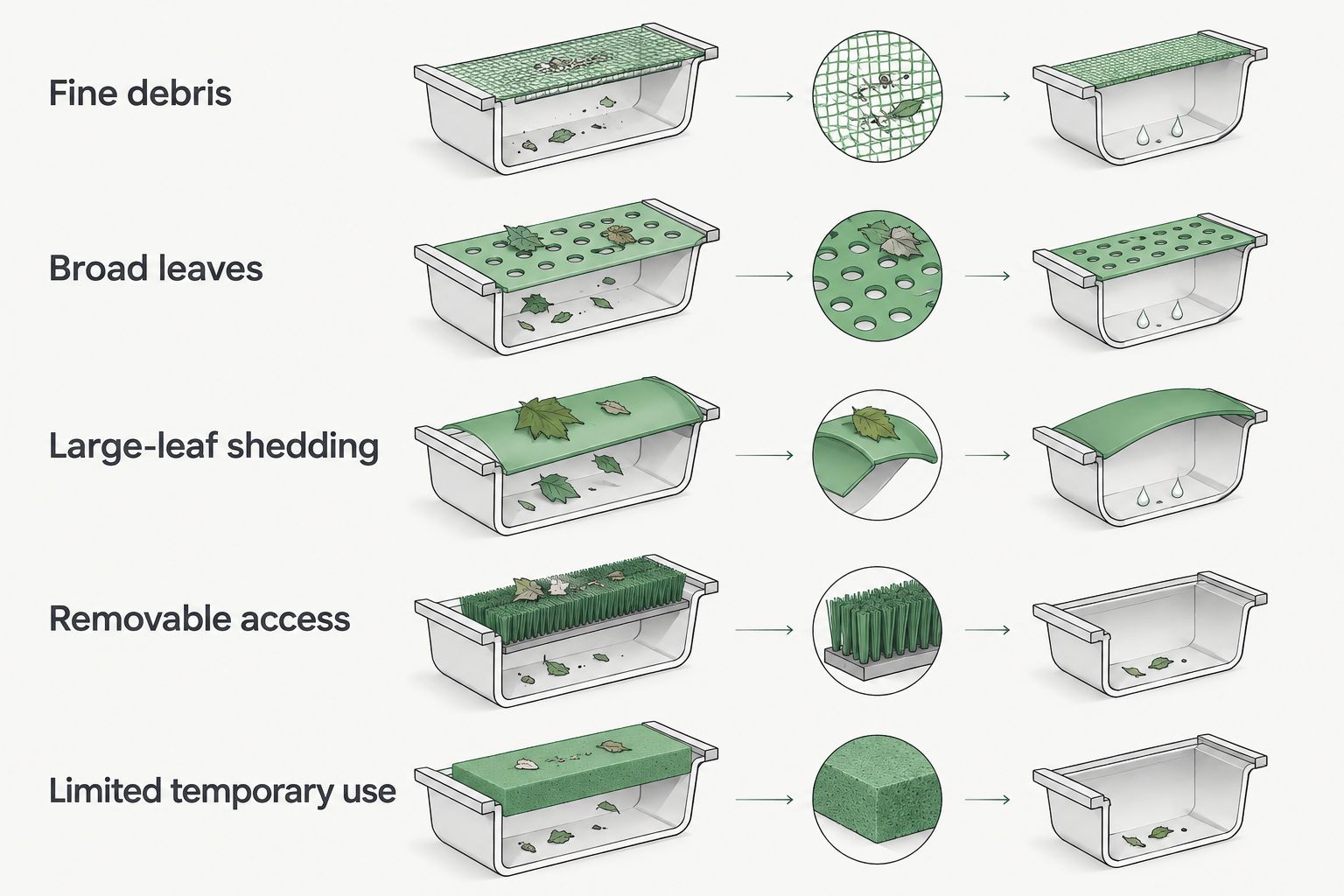
| Rank and guard type | Best for | Standout feature | Key limitation |
|---|---|---|---|
| 1. Reinforced metal micro-mesh | Fine debris | Fine screen supported by a rigid frame | Surface debris and ice can obstruct water entry |
| 2. Rigid perforated metal | Broad leaves | Solid panel with drainage openings | Small debris can pass through openings |
| 3. Reverse-curve cover | Large-leaf shedding | Curved edge directs water toward an inlet | Inlet access and runoff behavior need review |
| 4. Brush insert | Removable access | Insert can be removed for cleaning | Debris can lodge among bristles |
| 5. Foam insert | Limited temporary use | Porous insert occupies the gutter channel | Trapped debris can restrict drainage |
These 5 guard types address debris differently. None should be treated as a snow-retention system, an ice-dam remedy, or proof that the gutter beneath it is properly supported.
1. Reinforced metal micro-mesh: best for fine debris
Reinforced metal micro-mesh uses a fine screen over a supporting frame. It is the first design to investigate when needles, seeds, and small debris are the main reasons your gutters clog.
The support and attachment details matter as much as the screen. Ask for the exact product’s installation instructions and any documented load information rather than accepting a general claim about metal strength.
Micro-mesh pros:
- Fine openings exclude debris that larger openings admit.
- A supporting frame holds the screen across the gutter opening.
- Removable sections, where provided, allow gutter access.
Micro-mesh cons:
- Fine material can collect on the surface and require cleaning.
- Ice can block the screen even when the channel beneath is clear.
- Roof-valley runoff needs particular attention during product selection.
Best for: Homes with fine debris and an owner willing to maintain the screen surface.
Verdict: Buy only after confirming attachment, roof compatibility, and service access. Do not buy micro-mesh solely because a salesperson calls it winter-proof.
2. Rigid perforated metal: best for broad leaves
Perforated metal guards place a panel with drainage openings over the gutter. They belong on your shortlist when large leaves are the main obstruction and you do not need fine filtration.
Inspect the opening size and panel support rather than choosing by material name alone. A panel that excludes leaves still needs a clear outlet and properly attached gutters beneath it.
Perforated metal pros:
- Openings admit water while blocking debris larger than the holes.
- A rigid panel provides a defined cover over the channel.
- Designs with accessible fasteners allow removal for maintenance.
Perforated metal cons:
- Needles, seeds, and small fragments can pass through.
- Debris can lodge in or cover the openings.
- Metal construction does not establish a universal snow-load rating.
Best for: Properties where broad leaves, rather than fine debris, drive gutter cleaning.
Verdict: Buy when the opening size matches your debris and the installation leaves drainage accessible. For a 2026 purchase, request documentation for the actual model being quoted.
3. Reverse-curve covers: best for large-leaf shedding
Reverse-curve covers direct water around a curved edge toward an inlet while larger debris is intended to pass over the outside. Their suitability depends on the inlet geometry, installation position, and runoff reaching that edge.
Look closely at maintenance access. A covered gutter still needs a way to inspect the channel and remove material that gets inside.
Reverse-curve pros:
- The covered top separates large leaves from the gutter opening.
- The curved edge provides a defined water-entry route.
- The design does not rely on a fine mesh screen.
Reverse-curve cons:
- The inlet can become obstructed by debris or ice.
- Concentrated runoff requires careful evaluation.
- Access to the covered channel varies by design.
Best for: Large-leaf problems where the installer can explain water entry and future cleaning access.
Verdict: Hold until the contractor addresses valleys, inlet maintenance, and roof-edge compatibility. A broad cover is not evidence of protection against an ice dam.
4. Brush inserts: best for removable access
Brush inserts sit inside the gutter, with bristles intended to interrupt debris entry while leaving space for water. Their useful distinction is removability, not proven protection against snow or ice.
Ask how cleaning works once debris becomes tangled in the bristles. Removing an insert and cleaning it are separate maintenance tasks.
Brush insert pros:
- The insert can be removed to expose the gutter channel.
- The design does not require a continuous cover over the opening.
- Individual sections allow localized access.
Brush insert cons:
- Leaves and needles can lodge among the bristles.
- Cleaning requires handling the insert and retained debris.
- The insert does not stop gutter water from freezing.
Best for: Owners who prioritize removable access and accept ongoing cleaning.
Verdict: Hold if reduced maintenance is your main goal. Choose only after comparing the cleaning process with keeping the gutter open and professionally maintained.
5. Foam inserts: best considered only for limited temporary use
Foam inserts occupy the gutter channel and allow water through porous material. They deserve particular scrutiny when uninterrupted winter drainage is your main concern.
The key question is not whether the foam fits. It is how the channel will be inspected and cleaned as material accumulates.
Foam insert pros:
- Inserts can be removed for channel access.
- The porous surface interrupts entry of larger debris.
- Sections can be evaluated individually during maintenance.
Foam insert cons:
- Fine debris can accumulate within the porous material.
- Retained material can restrict the water path.
- Foam does not address roof heat loss or ice-dam formation.
Best for: Limited use where removal and frequent inspection are already planned.
Verdict: Skip as a primary snow-and-ice protection strategy. Do not substitute a gutter insert for investigating repeated winter overflow or leakage.
How this ranking works
This 2026 guide ranks design suitability using debris exclusion, support, water entry, compatibility, and maintenance access. It does not assign snow-load ratings to unnamed products or claim that every metal guard outperforms every alternative.
The ranking starts with supported metal designs because they combine a cover with a defined support structure. Your final choice still depends on the specific product, attachment method, roof geometry, and debris—not its category alone.
Gutter ice and ice dams need different responses
Gutter ice is frozen water in or around the gutter. An ice dam is a ridge of ice at the roof edge that obstructs meltwater draining from the roof.
Heat escaping from a building can warm the roof above the eaves, melting snow that refreezes at the colder edge. University of Minnesota Extension’s ice-dam guidance explains this roof-temperature mechanism; gutter covers do not correct the underlying heat movement.
For Lincoln and Omaha properties, use the location of the problem to guide the inspection:
- Gutter overflow: Check debris, gutter alignment, outlets, and downspouts.
- Roof-edge ice: Investigate attic heat loss, insulation, ventilation, and roof-edge details.
- Interior leakage: Arrange a roof assessment rather than assuming the gutter caused it.
- Sliding snow: Evaluate roof snow retention separately from gutter protection.
For the wider roof decision, review roof types for Nebraska weather. A gutter accessory should fit the roof system, not dictate it.
What to ask before approving installation
Request a written scope that identifies the exact guard, attachment method, maintenance requirements, and exclusions. Keep roof workmanship terms separate from gutter-product terms.
Ask these questions before signing:
- Will the contractor check gutter attachment and condition first?
- How will water enter beneath roof valleys?
- Can outlets and downspouts remain accessible?
- Does installation affect existing roof warranty requirements?
- Who handles cleaning, and what does that service include?
- What does the warranty actually say about ice, snow, and overflow?
For commercial properties, confirm that the building actually uses exterior gutters. A recommendation for a sloped roof with eave gutters does not transfer automatically to a roof with internal drains or scuppers.
Which gutter guards should you choose?
Start with reinforced metal micro-mesh for fine debris or rigid perforated metal for broad leaves. Require product-specific support details and maintenance access before choosing either.
If your main complaint is recurring ice rather than leaves, pause the purchase and investigate the roof and drainage system. The right 2026 decision can be repairing an existing drainage problem before adding a cover.
FAQ
What’s the best gutter guard for snow and ice?
A supported metal guard matched to your debris is a sensible starting point, but no unheated gutter guard prevents freezing. Compare reinforced micro-mesh for fine debris and perforated metal for broad leaves, then verify the specific product’s support and installation requirements.
Do gutter guards prevent ice dams?
No, gutter guards do not prevent ice dams. Ice-dam prevention requires attention to roof temperatures, attic heat loss, insulation, ventilation, and roof-edge conditions rather than debris control alone.
Is micro-mesh better than perforated metal in winter?
Micro-mesh is better suited to excluding fine debris, while perforated metal suits larger leaves. Neither category has a universal winter-performance advantage without details about the product, installation, roof, and maintenance.
Can gutter guards freeze over?
Yes, water can freeze on gutter guards and obstruct their openings. A clear gutter channel beneath the cover does not guarantee that meltwater can enter it.
Are gutter guards the same as snow guards?
No, gutter guards exclude debris from gutters, while roof snow-retention systems address sliding snow. Do not use a gutter cover as a substitute for a roof-specific snow-retention assessment.
Do Lincoln and Omaha homes still need gutter cleaning after guards?
Yes, gutter guards still need inspection and maintenance. Surface debris, trapped material, outlets, and downspouts require attention even when a cover reduces leaf entry.
Who should inspect a roof before gutter guards are installed?
A roofing contractor should assess roof concerns such as winter leaks, damaged eaves, or recurring roof-edge ice before gutter accessories are selected. Murray Roofing offers free roof inspections for homeowners and commercial property owners in Lincoln and Omaha.
One last thing
An empty gutter can still sit beneath an ice dam. Before buying a cover, ask what evidence shows that debris—not roof heat loss, damaged flashing, or a blocked outlet—is causing your problem.
Use the related guides to prepare, then schedule an inspection or request a project price based on your property's condition.
Related guides
- Gutter guard systems for Nebraska homes
- How long a roof inspection takes
- Whether a small roof leak can wait
Schedule a roof inspection
Ask Murray Roofing to assess roof concerns before you choose gutter protection.