
Real estate agents’ roof inspection process is a documented assessment of roof condition aimed at helping buyers and sellers make informed transaction decisions. A roof inspection for real estate agents in 2026 must connect physical findings to contract deadlines, repair decisions, and unanswered questions—not just produce photographs.
- For agents considering Murray Inspection Services, prioritize a roof inspection with written findings, photographs, and explicit access limitations.
- Schedule a roof inspection for real estate agents around contract deadlines, not the closing date alone.
- Separate observed roof defects from repair estimates, insurance decisions, and predictions about remaining service life.
- Verify completed roof repairs before treating an inspection objection as resolved.
Why roof inspections matter for real estate agents
A roof finding creates several separate decisions: what is wrong, what needs further evaluation, who handles the work, and whether the transaction timetable still works. Your job is to coordinate those decisions without turning an inspection report into a guarantee.
Buyers need to understand unresolved defects before committing. Sellers need clear requests rather than a broad demand to fix the roof. Both sides need documentation that distinguishes an observed condition from an assumption about its cause.
When considering Murray Inspection Services, request the proposed inspection scope before scheduling. The provider’s name alone does not establish whether the assignment includes attic access, repair recommendations, moisture testing, or follow-up documentation.
For a 2026 transaction, build the inspection process around the signed agreement and the property’s actual conditions. A checklist supports that process; it does not replace contract advice, insurance underwriting, or a specialist’s evaluation.
How to coordinate a transaction-ready roof inspection
Set deadlines
Start with the contract, not the inspector’s calendar. Identify the applicable inspection deadline, notice requirements, and any repair-verification milestone with the parties responsible for interpreting the agreement.
Work backward from the point when your client must make a decision. Scheduling the inspection is only the beginning: the report still needs review, unresolved findings need answers, and repair proposals need time for preparation.
Use 2 separate milestones in your transaction tracker: the inspection appointment and the deadline for acting on its findings. These are planning checkpoints, not a recommended inspection duration.
A seller preparing a listing can also investigate known roof concerns before negotiations begin. That does not eliminate disclosure obligations or prevent a buyer from commissioning a separate inspection.
- Confirm the contractual inspection and notice deadlines.
- Request the provider’s expected report delivery date.
- Allow time for specialist follow-up when findings require it.
- Confirm seller permission and property access arrangements.
- Record who will communicate findings to each party.
Define scope
Begin with the information you can organize yourself: seller disclosures, available repair records, prior inspection reports, and descriptions of known leaks. Keep reported history separate from independently verified facts.
Then request a written scope. A general home inspection and a dedicated roof evaluation are not interchangeable assignments. Roof access, attic access, weather, roof covering, and safety conditions affect what an inspector can observe.
For a roof inspection with Murray Inspection Services, ask the same scope questions you would ask any provider. Confirm the assignment directly rather than assuming that a particular inspection method or document is included.
Ask for 4 report elements: observed conditions, supporting photographs, inspection limitations, and recommended next actions. These are requested deliverables, not a claim about any provider’s standard package.
- Identify the roof areas and structures included.
- Ask how inaccessible areas will be documented.
- Confirm whether accessible attic observations are included.
- Separate visual inspection from testing or destructive investigation.
- Request written clarification of excluded services.
Prepare access
Give the inspector accurate property information and arrange authorized access. A locked attic hatch or an inaccessible addition can leave a question unresolved even when the main roof is visible.
Do not climb onto the roof to collect preliminary evidence. Share photographs already available from safe locations and let the inspector determine appropriate access methods. A drone image does not establish the condition of concealed materials beneath the roof covering.
Inside the property, identify reported stains or past leak locations without labeling them active leaks. A stain records a visible condition; determining whether moisture is current requires further evaluation.
For occupied homes, explain the appointment arrangements to the seller or occupant. Access planning should protect privacy as well as inspection time.
- Share known leak locations and repair history.
- Arrange access to relevant rooms and attic entries.
- Identify detached structures included in the assignment.
- Tell the inspector about access restrictions in advance.
- Leave roof walking and ladder placement to qualified personnel.
Review findings
Read the full report before drafting a repair request. Start with the limitations, then match each significant finding to its photograph, location, and recommended action.
Sort findings into 3 decision buckets: documented defects, further evaluation, and maintenance. These are transaction-planning categories, not a substitute for the inspector’s assessment of urgency. Ask the inspector to explain any safety concern or unclear recommendation.
A useful finding distinguishes the visible condition from its suspected cause. For example, a ceiling stain does not, by itself, establish where water entered or prove that a previous repair failed.
A report should narrow the next decision, not encourage you to diagnose the roof yourself. In your 2026 transaction file, preserve the report as issued and keep later explanations attached to it rather than rewriting technical conclusions.
- Match each concern to a specific location.
- Separate observations from hypotheses about causes.
- Ask which findings require prompt follow-up.
- Identify limitations that leave material questions unanswered.
- Request clarification before paraphrasing technical language.
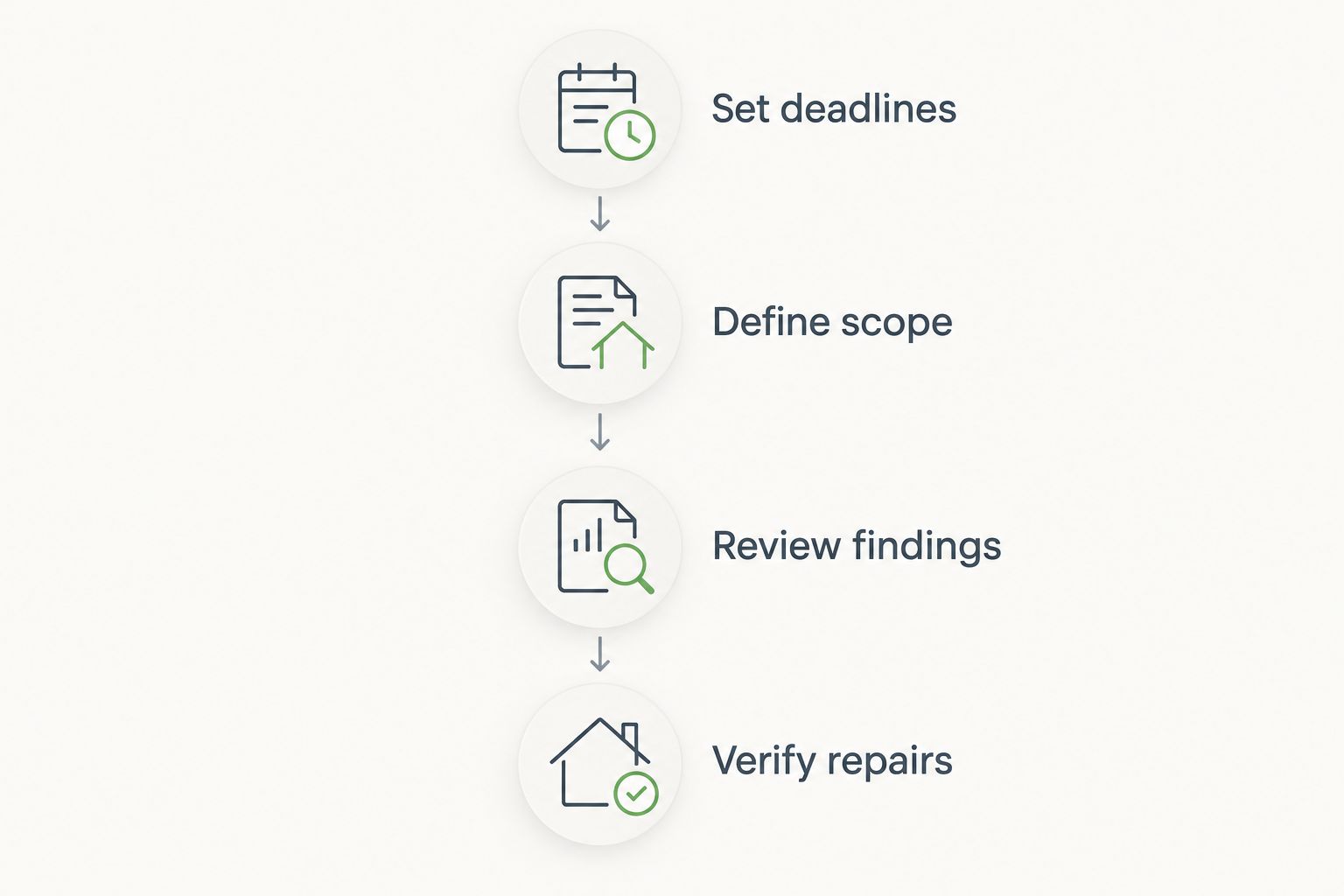
The transaction sequence is straightforward: set the deadline, establish the assignment, review the evidence, and verify the agreed work. Skipping the scope discussion makes later findings harder to interpret.
Resolve open questions
Choose follow-up according to the unresolved question. If the report identifies a roof defect, a qualified roofing contractor can assess repair scope. If it identifies a possible structural issue, seek an appropriately qualified professional rather than treating a roofing estimate as structural clearance.
Keep repair planning separate from insurance decisions. An inspector’s findings do not establish that a carrier will issue coverage or accept a particular condition. Direct insurance questions to the buyer’s insurance professional and request confirmation relevant to that property.
Likewise, avoid converting an estimated roof age into a fixed replacement deadline. Installation records provide history; current condition and the evaluator’s findings inform the next action.
- Send the complete relevant findings to the follow-up professional.
- Ask what additional access or investigation is needed.
- Request a written scope addressing the identified condition.
- Route coverage questions to the insurance professional.
- Document unresolved questions before the contractual decision deadline.
Document repair agreements
Turn the technical findings into a specific discussion with your client and the appropriate transaction professionals. A request to address a named flashing defect is clearer than a request to make the entire roof satisfactory.
Use authorized contract forms and obtain legal guidance where needed. The inspection report describes conditions; it does not determine which party must pay, whether a concession is appropriate, or how an agreement should be written.
For 2026 negotiations, keep the report, proposed repair scope, and signed agreement distinguishable. A contractor’s proposal is not automatically the scope the parties accepted.
Avoid promising that a repair will satisfy a lender or insurer unless the relevant party confirms its requirements. Keep those confirmations with the transaction records.
- Reference the finding and its location accurately.
- Specify the agreed work through the appropriate written agreement.
- Identify required completion and verification dates.
- Clarify what completion documents the parties expect.
- Preserve written responses from lenders or insurers when relevant.
Verify repairs
Do not close a repair item solely because someone says the work is complete. Match the agreed scope against the completion documents and arrange an appropriate follow-up evaluation when the agreement or unresolved concern calls for it.
An invoice documents billed work; it is not automatically an independent assessment of repair quality. Photographs help identify visible work, but they do not reveal every concealed condition.
If your client is considering Murray Inspection Services for follow-up, confirm that the requested verification falls within the offered scope. Do not assume a return visit, certification, or guarantee is included.
Keep the verification assignment narrow and explicit. Checking a repaired penetration is different from reassessing the entire roof after new damage or discovering another leak.
- Compare completed work with the signed repair agreement.
- Collect invoices and available completion photographs.
- Confirm who is qualified to evaluate the specific repair.
- Record access limits during the follow-up evaluation.
- Escalate discrepancies before representing the item as resolved.
Compare roof inspection options for your transaction
Choose the option that answers the open question, not the one with the most reassuring label. A general inspection, roof-focused evaluation, repair proposal, and structural assessment serve different purposes.
The table separates those purposes without assuming that every provider offers the same scope. Request the actual deliverables before engaging anyone.
| Option | Best for | Main advantage | Key limitation |
|---|---|---|---|
| General home inspection | Buyers reviewing the property as a whole | Places roof observations alongside other building conditions | Roof findings remain subject to the inspector’s scope and access limits |
| Dedicated roof inspection | Buyers or sellers needing focused roof-condition documentation | Concentrates the assignment on roof concerns | Does not establish insurance acceptance or guarantee future performance |
| Roofing contractor evaluation | Parties developing a repair scope | Connects identified conditions to proposed work | A repair proposal is not automatically an independent condition assessment |
| Structural evaluation | Transactions with suspected structural concerns | Addresses questions outside a routine roof-condition review | Does not replace a separate roof-covering or leak investigation |
| Repair verification | Parties checking agreed work | Tests completion against a defined repair scope | Does not clear unrelated or inaccessible roof areas |
For an agent, the useful distinction is between observing a condition, designing a response, and checking completed work. Assigning all three purposes to an undefined inspection creates avoidable uncertainty.
Common roof inspection mistakes real estate agents make
Treating a limited inspection as complete clearance
An inaccessible roof section remains an unresolved area, not a passed area. Explain the limitation to your client and ask what further evaluation would answer the material question. Do not replace the inspector’s qualified wording with a blanket statement that the roof is fine.
Turning roof age into a condition verdict
A reported installation date is historical information, not a complete assessment. Keep documentation of roof age separate from observations of present condition, and do not promise a specific remaining service life without an appropriately supported professional assessment.
Confusing a repair proposal with an agreed repair
A proposal describes suggested work; the transaction agreement establishes what the parties accepted. Compare both before arranging verification. Otherwise, completed work can match the contractor’s proposal while leaving the negotiated concern unresolved.
Promising insurance acceptance
A roof inspection does not bind an insurer. Get property-specific answers from the relevant insurance professional instead of assuring a buyer that a repair, material, or inspection document will satisfy underwriting requirements.
Waiting until closing to check completion
A final walkthrough is a poor substitute for a planned technical follow-up. Arrange the appropriate verification early enough for the parties to address discrepancies within their agreement and transaction schedule.
FAQ
What is a roof inspection for real estate agents?
A roof inspection for real estate agents documents roof conditions to support a buyer’s or seller’s transaction decisions. The written scope should identify the areas inspected, findings, limitations, and recommended follow-up.
Is a roof inspection better than a general home inspection?
A dedicated roof inspection is better suited to a focused roof question, while a general home inspection addresses the property more broadly. Choose according to the unresolved concern and confirm the actual scope of each assignment.
When should an agent schedule a roof inspection?
Schedule a roof inspection early enough to review the report and address follow-up before the applicable contractual deadline. Confirm the report delivery date rather than relying only on the appointment date.
Does a roof inspection guarantee that the roof will not leak?
A roof inspection does not guarantee that the roof will never leak. Its findings reflect the inspection scope, accessible conditions, and observations at the time of evaluation.
Should the seller repair every roof finding?
A roof inspection does not determine which findings the seller must repair. The parties’ agreement, applicable obligations, and professional advice govern that decision; the report supplies condition information.
Can a roof inspection confirm homeowners insurance eligibility?
A roof inspection does not establish homeowners insurance eligibility. The relevant insurer determines its requirements, so obtain property-specific guidance from the buyer’s insurance professional.
What should an agent ask Murray Inspection Services before booking?
Ask Murray Inspection Services for the written inspection scope, access requirements, expected report delivery, and excluded services. Confirm whether any requested specialist evaluation or repair verification requires a separate assignment.
One last thing
Put unanswered questions at the top of your roof-inspection summary. A clearly documented limitation can matter more to your client’s decision than a long list of routine observations. For every 2026 transaction, distinguish what was inspected, what was found, and what still needs an answer.
Related guides
- Roof warranty types compared for homeowners
- Roof leak detection systems compared
- Roof ventilation systems compared
- Gutter and drainage systems for roof protection