
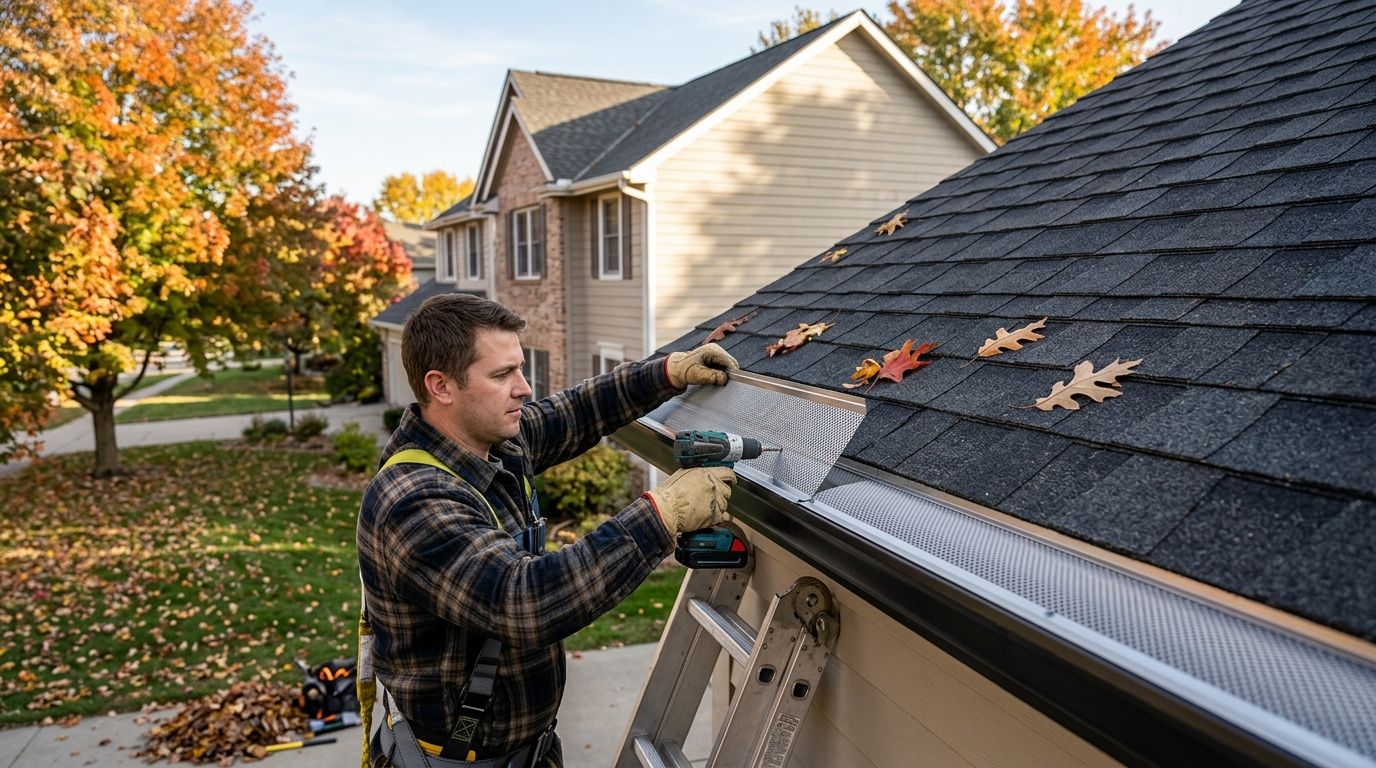
Nebraska roofs deal with cottonwood fluff in spring, oak leaves in fall, hailstorms in summer, and ice dams in winter — sometimes in the same calendar year. The best gutter guard for most Lincoln and Omaha homes in 2026 is a stainless steel micro-mesh system, with reverse-curve guards as the pick for houses that fight heavy snow load and foam inserts as the budget option for homeowners who want protection without a full install crew.
- Stainless steel micro-mesh wins overall for Nebraska homes facing cottonwood seed and oak leaf debris in 2026.
- Reverse-curve surface tension guards handle heavy snow and ice load better than flat mesh systems.
- Foam insert guards cost less upfront but need more frequent cleaning and degrade faster in UV and freeze-thaw cycles.
- Perforated aluminum screens work best when bundled with a new roof or gutter replacement project.
- Brush-style inserts are the fastest retrofit for existing gutters but the weakest at blocking fine grit.
Why this matters for Nebraska homes
Gutter guards are not a cosmetic upgrade in this region — they're a defense against water backing up under shingles and against ice dams that form when melted snow refreezes at the eave. Lincoln and Omaha both see freeze-thaw cycles that turn a clogged gutter into a roof-edge problem fast, and roofing materials built for Nebraska hail storms still need clear water paths to perform as designed.
A gutter guard that fails in year two isn't saving anyone money. The right system matches your roof's actual debris load, snow accumulation, and gutter pitch — not just a national average recommendation.
What makes the best gutter guard system
- Mesh or screen fineness — small enough to stop grit and seed pods, not just leaves
- Material and corrosion resistance — stainless steel or heavy aluminum outlasts plastic in freeze-thaw climates
- Snow and ice load handling — some designs shed snow better than others on steep pitches
- Compatibility with your existing gutter and roof pitch — retrofit vs. full gutter replacement
- Installation method — professional install vs. homeowner-installed inserts
- Warranty coverage — length and what it actually covers (clogging vs. material failure)
Gutter guard systems at a glance
| System | Best for | Standout feature | Key limitation |
|---|---|---|---|
| Stainless steel micro-mesh | Overall protection, cottonwood/oak debris | Fine mesh blocks seeds and grit | Higher upfront install cost |
| Reverse-curve (surface tension) | Heavy snow and ice load roofs | Sheds snow and directs water via curved nose | Poor performance on low-pitch gutters |
| Foam insert | Budget-conscious homeowners | Simple drop-in fit, no fasteners | Traps fine debris inside foam, needs periodic replacement |
| Perforated aluminum screen | Bundling with new roof or gutter install | Lower material cost than micro-mesh | Larger holes let seeds and grit through |
| Brush-style insert | Fast retrofit on existing gutters | No tools needed for basic install | Weakest at blocking fine debris |
1. Stainless steel micro-mesh: best gutter guard for cottonwood and oak debris
Micro-mesh guards use a fine stainless steel screen mounted under the shingle line or clipped to the gutter's front lip. Water passes through small openings while leaves, seed pods, and most grit stay on top and blow off or wash away.
Stainless steel micro-mesh pros:
- Blocks fine debris that plastic screens and brush guards miss
- Stainless steel resists rust through Nebraska's freeze-thaw winters
- Pairs well with a professional roof inspection since installers can check flashing and gutter attachment at the same time
Stainless steel micro-mesh cons:
- Costs more than foam or brush inserts
- Fine mesh can slow water flow slightly during the heaviest downpours if not sized correctly
- Requires professional installation for proper pitch and fastening
Best for: Homes under mature oak or cottonwood trees in Lincoln and Omaha. Verdict: Buy.
2. Reverse-curve guards: best gutter guard for heavy snow and ice
Reverse-curve, or surface tension, guards use a curved nose that lets water cling to the surface and flow into the gutter while debris falls off the front edge. The design also helps shed snow buildup rather than trapping it against the roof edge.
Reverse-curve pros:
- Handles heavy leaf and pine needle loads without clogging
- Sheds snow better than flat mesh on steep-pitch roofs
- Durable metal construction holds up over multiple winters
Reverse-curve cons:
- Underperforms on low-slope roofs where water doesn't build enough surface tension
- Visible profile changes the gutter's appearance more than mesh
- Installation requires matching the curve to your specific gutter profile
Best for: Steep-pitch homes in areas with heavy annual snowfall. Verdict: Buy.
3. Foam insert guards: best budget gutter guard option
Foam inserts sit inside the gutter channel, letting water soak through while blocking leaves and larger debris on top. They're the simplest system to source and the cheapest to try first.
Foam insert pros:
- Lowest cost of entry among common guard types
- Simple drop-in fit works with most standard gutter profiles
- No fasteners or roof-line attachment needed
Foam insert cons:
- Fine grit and seed pods can lodge inside the foam and reduce flow over time
- UV exposure and freeze-thaw cycles break foam down faster than metal systems
- Needs more frequent cleaning checks than micro-mesh or reverse-curve guards
Best for: Homeowners who want basic protection on a tight budget and don't mind periodic maintenance. Verdict: Hold — fine as a stopgap, not a long-term fix for heavy tree cover.
4. Perforated aluminum screens: best gutter guard for new roof or gutter bundles
Perforated screens are flat aluminum panels with punched holes, installed over the gutter top. They're a step up from foam but a step below micro-mesh in how fine the debris filtering gets.
Perforated screen pros:
- Lower material cost than stainless steel micro-mesh
- Easy to install alongside new gutters during a roof replacement project
- Aluminum resists rust reasonably well
Perforated screen cons:
- Larger perforations let small seeds, pine needles, and grit through
- Can sag over time on longer gutter runs without enough support brackets
- Less effective under heavy cottonwood or oak cover
Best for: Homeowners already scheduling gutter or roof work who want an upgrade over bare gutters without the micro-mesh cost. Verdict: Hold.
5. Brush-style inserts: best gutter guard for a fast retrofit
Brush inserts are cylindrical bristle rolls that sit inside the gutter, letting water flow between bristles while catching larger leaves on top. They install without tools in most cases.
Brush insert pros:
- Fastest and simplest system to retrofit onto existing gutters
- No professional install required for basic placement
- Works on almost any gutter profile
Brush insert cons:
- Fine debris and grit settle between bristles and require manual removal
- Bristles compress and lose effectiveness over multiple seasons
- Least effective option against cottonwood seed and pine needle buildup
Best for: Renters or short-term homeowners who need a quick fix, not a permanent solution. Verdict: Skip for anyone planning to stay in the home long term.
How we ranked these systems
The ranking weighs mesh fineness against Nebraska's specific debris load (cottonwood, oak, hail grit), corrosion resistance through freeze-thaw winters, snow-shedding performance on steep pitches, and whether the system pairs sensibly with a professional roof and gutter inspection rather than a standalone install. Systems that only perform well in mild, low-debris climates score lower here even if they're popular nationally.
“Gutter guards don’t replace a roof inspection — they buy you time between them.”
Which gutter guard should you choose?
For most Nebraska homes surrounded by mature trees, stainless steel micro-mesh is the safest default — it handles the widest range of debris and holds up through repeated freeze-thaw cycles. If your roof carries heavy snow load through the winter, reverse-curve guards are worth the switch even at a higher install cost. Foam and brush inserts work as short-term fixes, but they're not built for a decade of Nebraska weather.
Whichever system you're considering, gutter performance ties directly to roof condition — a full inspection catches flashing issues, worn shingles, and drainage problems before they turn into interior damage. Roofing materials built for Nebraska hail storms and a properly guarded gutter system work together, not separately.
Homeowners bundling gutter guard installation with a larger roof project in Omaha can compare local Omaha roofing companies to find a crew that handles both. And since gutter guard installation is often rolled into a larger roofing scope, checking roof financing options before committing to a full project makes budgeting easier.
Get a free roof and gutter inspection
Check flashing, gutter condition, and shingle wear before winter.
FAQ
What’s the best gutter guard for Nebraska homes in 2026?
Stainless steel micro-mesh is the best overall choice for most Nebraska homes in 2026 because it blocks cottonwood seeds, oak leaf debris, and fine grit while resisting corrosion through freeze-thaw winters. Reverse-curve guards are a better fit for homes with heavy snow load.
Do gutter guards prevent ice dams?
Gutter guards reduce the debris buildup that contributes to ice dam formation, but they don’t eliminate ice dams on their own. Proper attic insulation and ventilation, checked during a roof inspection, play a bigger role in preventing ice dams.
Are gutter guards worth it for a roof surrounded by trees?
Yes, gutter guards are worth it for tree-heavy properties because leaf and seed buildup is the leading cause of gutter overflow and fascia damage. Micro-mesh or reverse-curve systems handle heavy tree debris better than foam or brush inserts.
Can gutter guards be installed on an existing roof without replacing gutters?
Most gutter guard systems, including micro-mesh and reverse-curve designs, can be installed on existing gutters as long as the gutters are structurally sound. A quick inspection confirms whether the existing gutter and roof edge can support the new system.
Do gutter guards stop hail damage to roofs?
Gutter guards protect gutters and downspouts from clogging, but they don’t protect the roof surface itself from hail impact. Roofing materials rated for Nebraska hail storms are the relevant defense against that kind of damage.
How often do gutter guards need maintenance?
Micro-mesh and reverse-curve systems typically need a visual check once or twice a year, while foam and brush inserts require more frequent cleaning because fine debris settles inside them. An annual roof and gutter inspection covers this check efficiently.
Do gutter guards affect roof warranties?
Gutter guard installation generally does not void a roof’s material or workmanship warranty as long as installation doesn’t involve cutting into shingles or flashing improperly. Confirm installation method with your roofing contractor before work begins.
One last thing
The gutter guard debate misses the bigger point for a lot of Nebraska homeowners: a guard system installed on a roof with failing flashing or worn shingles just delays the same water problem by a season or two. Pair any gutter guard upgrade with a full roof inspection, especially if your roof is past the 15-year mark, so the fix actually holds through the next hailstorm or blizzard.
Related guides