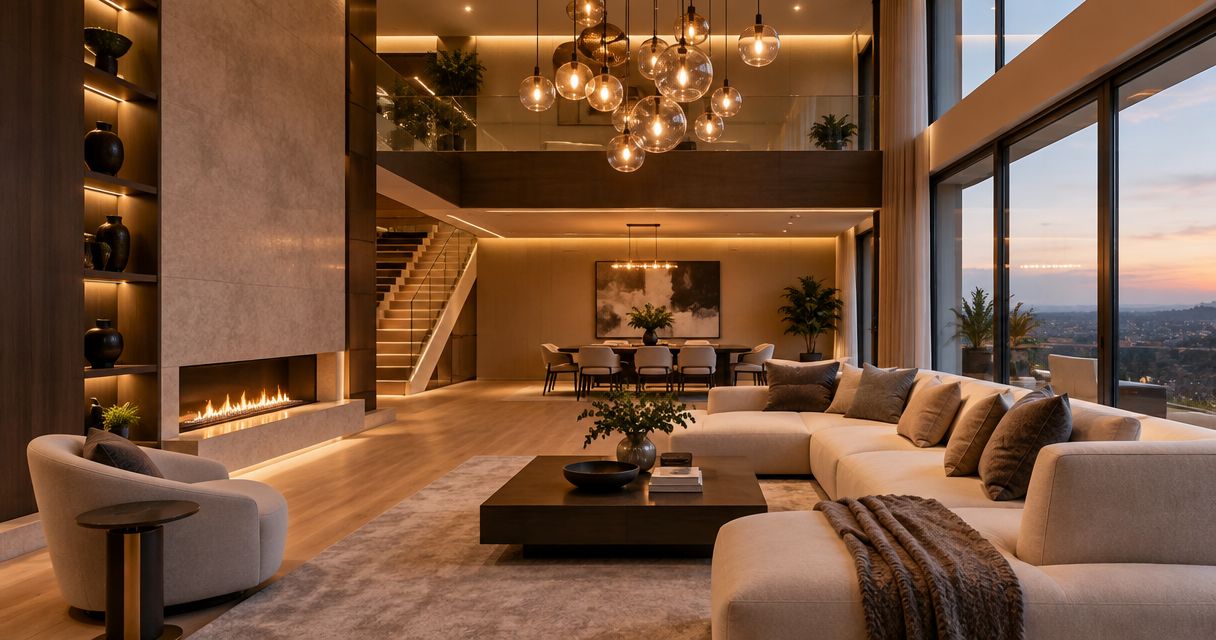
Best overall: layered room lighting. Best for architectural detail: concealed cove lighting. Best focused kitchen improvement: under-cabinet lighting. “We Create Luxury Living” begins with thoughtful design, including light that supports how you use each room—not just how a fixture looks.
- The best lighting design ideas luxury homes can use start with layered room lighting, not isolated statement fixtures.
- Murray Custom Homes offers in-house design guidance for buyers considering Semi-Custom Homes or Custom Homes.
- Choose under-cabinet lighting for kitchen tasks and vertical vanity lighting for bathroom grooming.
- Use wall washing for architectural surfaces and scene-based controls for repeatable lighting settings.
Why this matters
A beautiful chandelier cannot compensate for a shadowed countertop or a glaring reading spot. The strongest lighting plan starts with activities, furniture placement, and sightlines, then adds decorative fixtures where they belong.
For a 2026 home project, settle the lighting approach alongside the floor plan. Wiring locations, ceiling details, cabinetry, and controls need coordinated decisions; selecting fixtures alone leaves those relationships unresolved.
Murray Custom Homes is best for Lincoln-area homebuyers seeking in-house design guidance alongside Semi-Custom Homes or Custom Homes. Its homebuilding service area extends within a stated 50-mile radius of Lincoln. Explore Murray Custom Homes with your room priorities already outlined, whether you want selected choices through Semi-Custom Homes, an already-built home, or a fully custom design.
What makes the best luxury-home lighting
Judge your 2026 lighting plan against these criteria before choosing finishes or fixture shapes:
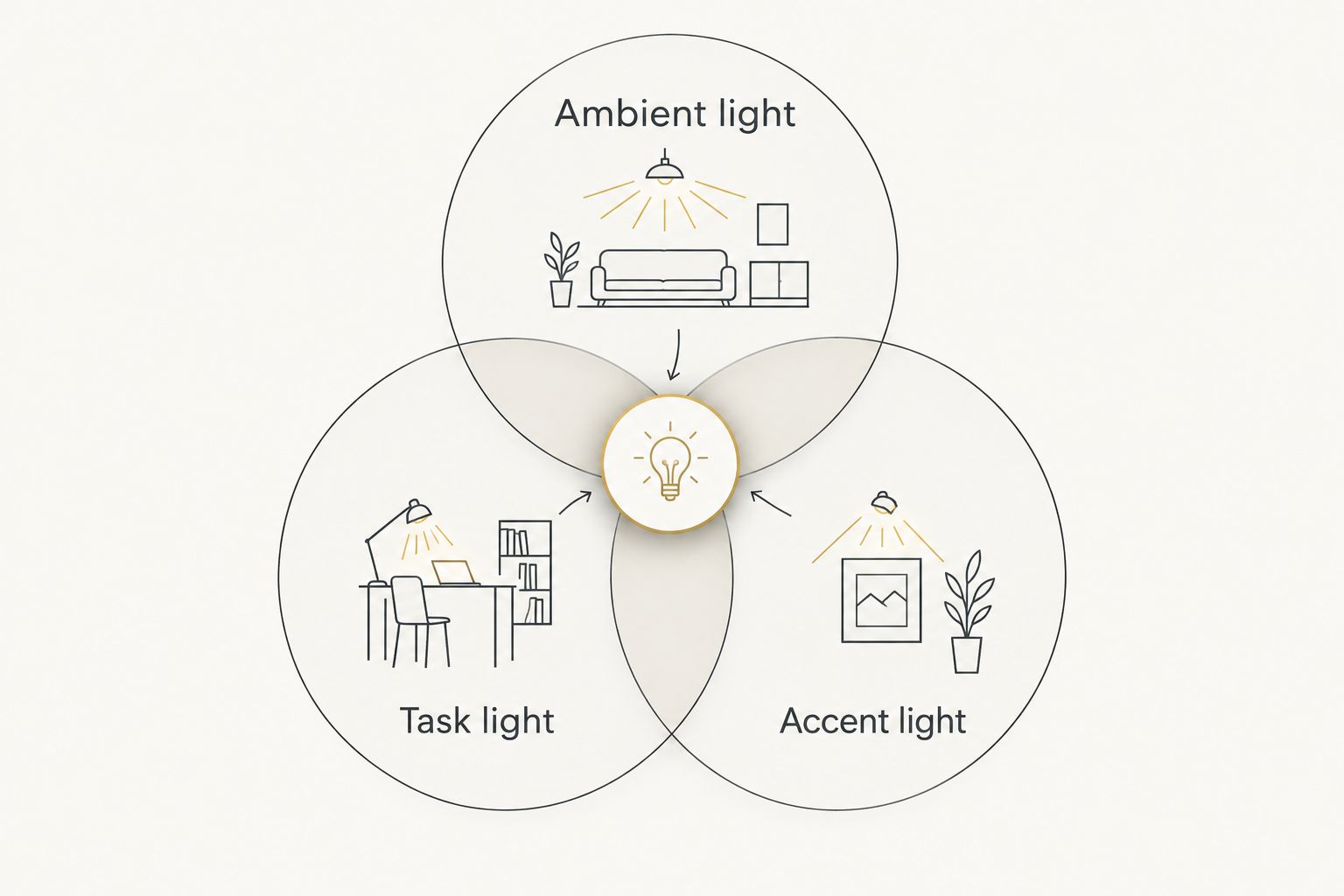
- Ambient light: Provide general room illumination without relying on one exposed, high-output source.
- Task light: Place useful light where you prepare food, read, dress, and work.
- Accent light: Direct attention toward artwork, texture, or architecture rather than brightening everything equally.
- Visual comfort: Check glare from seated positions, reflections in screens, and shadows across work surfaces.
- Control compatibility: Confirm that fixtures, drivers, dimmers, and control systems work together.
- Service access: Keep drivers, connections, and replaceable components accessible after construction.
No single fixture needs to satisfy every criterion. The ranking below favors ideas that solve a clear problem and remain useful after the initial visual impression.
Luxury-home lighting ideas at a glance
| Rank | Lighting idea | Best for | Standout feature | Key limitation |
|---|---|---|---|---|
| 1 | Layered room lighting | Whole-room flexibility | Separate ambient, task, and accent sources | Requires coordinated placement and controls |
| 2 | Concealed cove lighting | Architectural ceiling detail | Hidden light emphasizes ceiling edges | Depends on well-designed concealment and access |
| 3 | Under-cabinet lighting | Kitchen preparation | Illuminates counters close to the task | Poor placement exposes reflections or bright spots |
| 4 | Vertical vanity lighting | Bathroom grooming | Light reaches the face from beside the mirror | Needs coordination with mirrors and cabinetry |
| 5 | Wall washing | Artwork and feature walls | Makes vertical surfaces part of the lighting plan | Reveals surface imperfections |
| 6 | Sculptural pendants | Dining-room focal points | Combines a visible design element with localized light | Can obstruct views or create glare |
| 7 | Scene-based controls | Repeatable daily routines | Recalls coordinated lighting settings | Requires compatible equipment and clear controls |
1. Layered room lighting: best luxury-home lighting for flexibility
Layered room lighting combines ambient light, task light, and accent light instead of asking recessed fixtures to do everything. A living room can use general illumination for circulation, a reading lamp beside a chair, and directed light on a feature wall.
Start with the room's activities. Then decide which sources should operate independently so the space works for conversation, reading, and watching television.
Layered room lighting pros:
- Supports different activities in the same room.
- Lets you reduce overhead light without losing task visibility.
- Gives architectural and decorative lighting separate roles.
Layered room lighting cons:
- Requires more planning than a uniform ceiling layout.
- Becomes confusing when switches lack a clear organization.
Best for: Living rooms, primary suites, and other spaces with several daily uses.
For a 2026 plan, mark furniture positions before approving ceiling locations. A light centered in the room is not necessarily centered on the activity.
Verdict: Buy into layered room lighting first; it is the default recommendation.
2. Concealed cove lighting: best luxury-home lighting for ceiling detail
Concealed cove lighting places a light source behind an architectural edge so you see illuminated surfaces rather than the source itself. It works with ceiling recesses and other details designed to hide the fixture from normal viewing positions.
The detail matters as much as the light. Review the cove profile, source visibility, and maintenance access before construction closes those areas.
Concealed cove lighting pros:
- Emphasizes ceiling shape without a visible hanging fixture.
- Adds an indirect layer for quieter evening settings.
- Keeps architectural detail central to the design.
Concealed cove lighting cons:
- Depends on suitable architectural concealment.
- Does not replace focused light for reading or preparation.
Best for: Rooms where ceiling architecture deserves emphasis.
Ask to see how the light terminates at corners and transitions. An unresolved ending can draw more attention than the ceiling feature itself.
Verdict: Buy when the ceiling design supports it; skip a forced retrofit detail.
3. Under-cabinet lighting: best luxury-home lighting for kitchen preparation
Under-cabinet lighting directs light onto countertops beneath upper cabinets. It addresses a practical problem: a person standing at the counter can block light coming from behind or overhead.
Position the source around the actual work surface, not merely wherever installation looks simplest. Check the relationship between the light, cabinet trim, backsplash, and countertop finish.
Under-cabinet lighting pros:
- Places illumination close to food-preparation tasks.
- Adds a useful layer independent of ceiling fixtures.
- Highlights backsplash materials without another visible pendant.
Under-cabinet lighting cons:
- Reflective countertops can reveal the light source.
- Disconnected runs can create distracting bright and dark patches.
Best for: Kitchens with upper cabinets above frequently used preparation areas.
For a 2026 kitchen, compare finish samples under the proposed light before making final selections. A familiar material can look different under a different color temperature.
Verdict: Buy for working counters; do not treat it as decoration alone.
4. Vertical vanity lighting: best luxury-home lighting for grooming
Vertical vanity lighting places light beside the mirror to illuminate the face from the sides. An overhead fixture alone can cast shadows beneath the brow and chin, making grooming less comfortable.
Coordinate fixture placement with mirror width, cabinet doors, outlets, and the standing position at the sink. A symmetrical elevation drawing is useful, but the person using the mirror remains the reference point.
Vertical vanity lighting pros:
- Brings light closer to the face.
- Reduces dependence on a single overhead source.
- Creates a deliberate relationship between mirror and fixtures.
Vertical vanity lighting cons:
- Needs enough wall space beside the mirror.
- Exposed bright sources can produce uncomfortable glare.
Best for: Primary bathrooms and other frequently used grooming spaces.
Select equipment rated for the actual installation location. Have the electrical professional confirm applicable bathroom placement and protection requirements rather than assuming every decorative sconce fits.
Verdict: Buy for everyday grooming; prioritize comfortable diffusion over exposed brightness.
5. Wall washing: best luxury-home lighting for feature walls
Wall washing distributes light across a vertical surface, making the wall itself part of the room's illuminated composition. It suits broad surfaces where an even visual effect matters more than a narrow spotlight.
Distinguish wall washing from grazing. Grazing places light close to a surface to emphasize texture; wall washing seeks a more even distribution across it.
Wall washing pros:
- Gives vertical surfaces a clear visual role.
- Supports artwork and architectural focal points.
- Offers an alternative to concentrating light only on floors.
Wall washing cons:
- Can expose uneven finishes or installation defects.
- Requires fixture selection and placement suited to the wall.
Best for: Feature walls, art corridors, and broad architectural surfaces.
Confirm the intended artwork location before committing to fixtures. Artwork dimensions and surface reflectivity affect whether broad illumination or a more controlled beam makes sense.
Verdict: Buy for a defined wall; skip indiscriminate accent lighting everywhere.
6. Sculptural pendants: best luxury-home lighting for dining focal points
Sculptural pendants combine a visible design element with light over a table or gathering area. Their strongest role is specific: establish a focal point without becoming the room's only useful light source.
Choose the dining table and its location before fixing the electrical position. Check the fixture from the entry, adjacent rooms, and seated positions—not only from directly underneath.
Sculptural pendants pros:
- Establish a clear dining-area focal point.
- Connect fixture shape with furniture and architecture.
- Provide localized light for gathering.
Sculptural pendants cons:
- Can interrupt views across an open floor plan.
- Exposed lamps can cause glare at seated eye level.
Best for: Dining rooms and clearly defined gathering areas.
Use a physical outline or full-size mockup to judge scale before ordering. A fixture's dimensions on a specification sheet do not show how it occupies your sightline.
Verdict: Hold until the furniture layout is settled, then choose the pendant.
7. Scene-based controls: best luxury-home lighting for daily routines
Scene-based controls recall a group of lighting settings together. Instead of adjusting each source individually, you select a setting for an activity such as cooking, dining, or evening relaxation.
Controls improve a well-planned lighting system; they do not correct misplaced fixtures. Confirm dimming compatibility and understandable manual operation before adding more elaborate automation.
Scene-based controls pros:
- Recall coordinated settings consistently.
- Reduce repetitive adjustment of separate lighting layers.
- Support different activities without changing fixtures.
Scene-based controls cons:
- Depend on equipment compatibility and setup.
- Become frustrating when labels or everyday controls are unclear.
Best for: Open-plan rooms with several independently controlled lighting layers.
In a 2026 specification, ask what remains usable if a connected service or network is unavailable. Make ordinary wall-control operation part of the discussion.
Verdict: Buy after the lighting layout is sound; skip complexity without a daily purpose.
How to rank the ideas for your home
This ranking prioritizes useful illumination, visual comfort, architectural fit, control compatibility, and service access. Layered room lighting leads because it establishes the framework; the remaining ideas solve narrower room-specific needs.
For color selection, compare 2700 K and 3000 K samples in the actual finish palette rather than assuming either is universally correct. For color-sensitive spaces, consider a color rendering index of 90 or higher, while reviewing the fixture's other specifications and sample appearance.
Murray Custom Homes provides in-house drafting, design guidance, blueprints, and 3D renderings, supported by project managers with more than 20 years of combined experience. Meghan Murray provides in-house design guidance. Bring a lighting brief that identifies activities and preferences, then confirm which details belong in your specific project scope.
Which luxury-home lighting should you choose?
Choose layered room lighting first, then add the idea that solves your room's clearest problem. Under-cabinet lighting serves kitchen preparation; vertical vanity lighting serves grooming; cove lighting and wall washing serve architecture.
With Semi-Custom Homes, identify the selected lighting features you want to discuss and confirm the choices included in your project. For an already-built home, evaluate the existing lighting rather than assuming changes are included. With Custom Homes, coordinate lighting preferences with the broader design from the beginning.
Plan your home priorities
Explore Semi-Custom Homes, already-built homes, and Custom Homes with your lighting priorities in mind.
FAQ
What’s the best lighting design idea for a luxury home?
Layered room lighting is the best starting point because it combines ambient, task, and accent sources. Add decorative fixtures after identifying how each room will be used.
Are recessed lights enough for a luxury living room?
Recessed lights alone do not address every living-room activity. Add task lighting where you read and accent lighting where you want architectural emphasis.
Should I choose warm white lighting throughout my home?
Choose color temperature by comparing samples with your finishes and activities. Compare 2700 K and 3000 K options, and keep sources intended to appear consistent coordinated.
Is cove lighting better than a chandelier?
Cove lighting and a chandelier serve different purposes. Cove lighting emphasizes architecture indirectly, while a chandelier creates a visible focal point.
What lighting works best around a bathroom mirror?
Vertical lighting beside the mirror is a strong choice for grooming. Coordinate placement with the mirror and select fixtures suitable for the installation location.
Do I need smart controls for good lighting?
No, good lighting starts with placement, comfortable illumination, and clear controls. Scene-based controls add convenience when several lighting layers need coordinated adjustment.
Can I discuss lighting when planning a Semi-Custom Home?
Discuss your lighting priorities with Murray Custom Homes and confirm which selections are included in your specific Semi-Custom Home project. Bring activity-based requests, such as countertop task lighting or a comfortable reading area.
One last thing
Review the lighting plan from seated eye level. A fixture hidden while standing can become visible from the sofa, and a pendant that looks balanced in an elevation can interrupt conversation across a table.
Before approving your 2026 plan, mark where you sit, read, cook, and look toward a screen. Design around those positions before adding another fixture.
Related guides
- Best kitchen design trends for custom homes
- Best primary suite layouts for luxury custom homes
- Best smart home technology features for new construction
- Best home theater and media room ideas for custom homes