Homeowners insurance covers roof replacement when a covered event damages the roof enough to require replacement; it generally does not pay to replace a roof simply because it is old or worn out. Your deductible, roof settlement terms, exclusions, and approved repair scope determine what you pay yourself, even when the claim is covered.
- Is roof replacement covered by insurance? Yes, when covered damage requires replacement—not simply because the roof is aging.
- Murray Inspection Services’ roof insurance guide separates covered damage, replacement scope, and your out-of-pocket responsibility.
- Replacement cost and actual cash value coverage treat depreciation differently; read your roof endorsements before assuming full reimbursement.
- Photograph damage safely, prevent further loss, and request the insurer’s coverage and scope decisions in writing.
Why this matters
A covered roof claim is not automatically an approved full replacement. Your insurer must evaluate both the cause of damage and the work necessary to address it. Confusing those decisions leads homeowners to sign contracts before they understand their financial responsibility.
This Murray Inspection Services roof insurance guide is for homeowners separating an insurance claim from routine roof maintenance. For a claim reported in 2026, check the policy and endorsements that applied on the date of loss—not just the renewal documents currently in your inbox.
Start with the cause, then the scope, then the settlement. That order keeps the coverage discussion focused on the policy rather than the age or appearance of the roof alone.
Is roof replacement covered by homeowners insurance?
Yes—when the policy covers the cause of damage and replacement is necessary to resolve the covered loss. Wind, hail, fire, and falling objects are common examples of potentially covered causes, but exclusions and endorsements control each claim.
The distinction is between damage from an insured event and deterioration that develops over time. A roof reaching the end of its service life is a maintenance expense, not an insured event by itself.
| Roof condition or event | Coverage consideration | Replacement consideration |
|---|---|---|
| Wind damages shingles | Check wind coverage and applicable exclusions | Replacement depends on the documented extent and repairability |
| Hail damages roofing | Check hail coverage and cosmetic-damage limitations | Evidence must support the work needed, not merely that hail occurred |
| Fire damages the roof | Check the policy’s fire coverage and exclusions | The scope depends on affected roofing and underlying components |
| A tree falls onto the roof | Check coverage for the event and resulting damage | Structural damage can expand the necessary work |
| Roofing deteriorates with age | Wear and tear is generally excluded | Age alone does not establish a covered replacement |
| A roof leaks after neglected maintenance | The cause and resulting damage require separate review | A leak alone does not prove the entire roof needs replacement |
Do not treat a storm date as proof of damage or a contractor’s replacement recommendation as proof of coverage. Each answers a different question.
Replacement cost versus actual cash value coverage
Your roof’s settlement basis determines how depreciation affects payment. Replacement cost coverage does not mean every roof expense is automatically reimbursed. Deductibles, limits, exclusions, and policy conditions still apply.
Actual cash value generally accounts for depreciation. Replacement cost coverage can provide reimbursement without depreciation as the final settlement basis, subject to policy requirements; some claims involve an initial depreciated payment followed by recoverable depreciation after qualifying work.
| Settlement basis | Main advantage | Main limitation | Best for understanding |
|---|---|---|---|
| Replacement cost | Can reimburse eligible replacement work without a final depreciation deduction | Recovery can depend on completing work and meeting policy conditions | Whether additional payment remains available after repairs |
| Actual cash value | Establishes payment based on the property’s depreciated value | Leaves the homeowner responsible for depreciation as well as other applicable costs | Why an approved claim can leave a substantial funding gap |
Look for roof-specific wording rather than relying on the general dwelling coverage summary. A roof endorsement can apply different settlement terms from those used for other parts of the house.
For your 2026 policy review, ask whether the roof has a payment schedule, an actual cash value endorsement, or a separate wind or hail deductible. Request the relevant policy language with the explanation.
Why roof replacement coverage varies
These factors explain why similar-looking roof damage produces different claim decisions:
- Cause of damage: The insurer evaluates whether the loss resulted from a covered event, an excluded condition, or a combination requiring further investigation.
- Roof settlement terms: Replacement cost, actual cash value, and roof-specific schedules change how the covered loss is valued.
- Deductible: A separate wind or hail deductible can change your responsibility even when the insurer accepts coverage.
- Repairability and scope: The ability to complete a suitable repair affects whether the insurer approves localized work or broader replacement.
- Policy endorsements: Cosmetic-damage exclusions, matching provisions, and ordinance or law coverage can affect particular parts of the claim.
- Evidence and policy duties: Photos, inspection findings, timely notice, and access for inspection help establish what happened and satisfy claim requirements.
Roof age belongs in this discussion, but it is not a substitute for the policy. Older roofing can affect valuation or settlement terms without answering whether a particular storm caused covered damage.
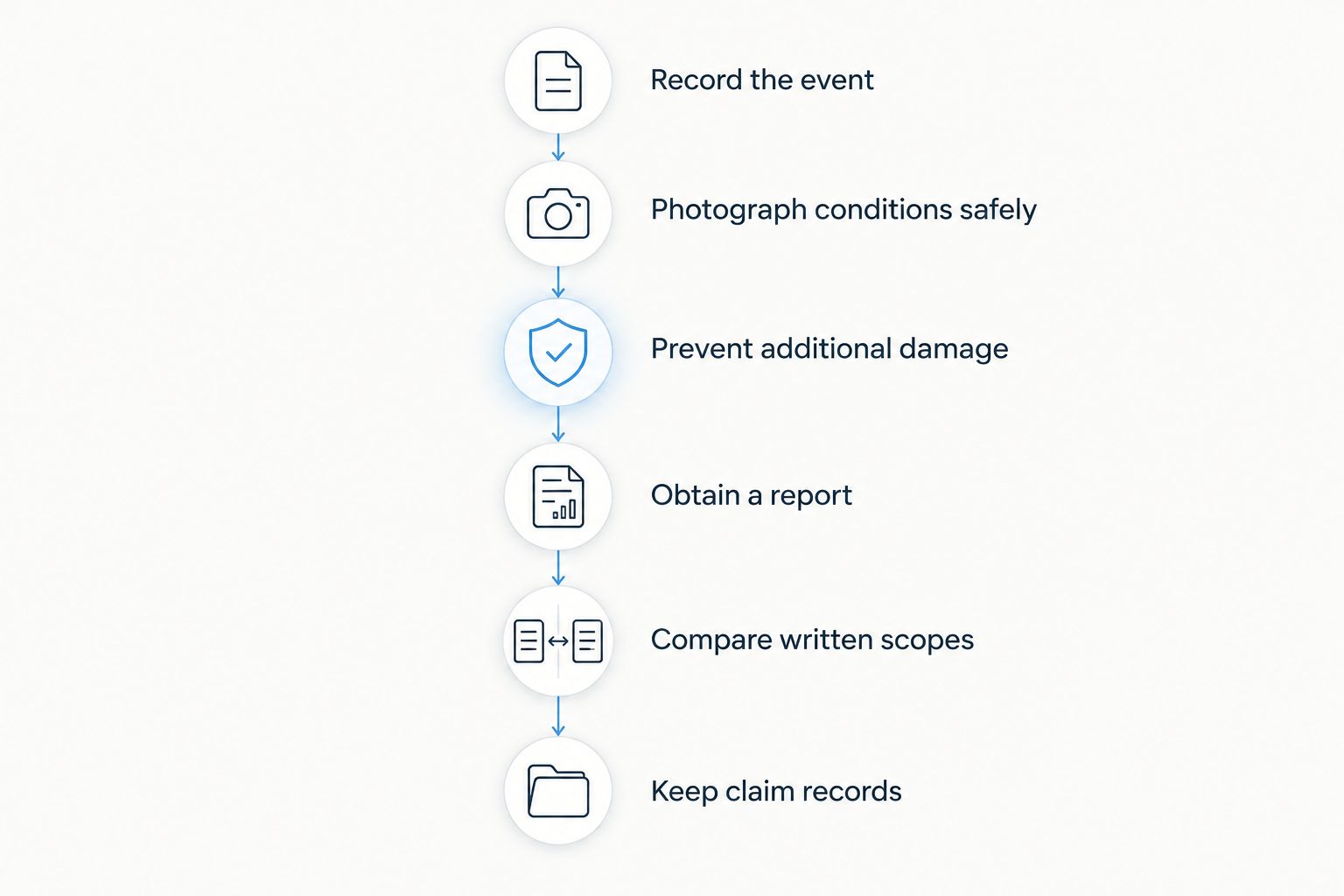
How do you document a roof replacement claim?
Build a record that connects the event, the damage, and the proposed work. A useful claim file explains why the work is necessary; it does not simply ask the insurer to buy a roof.
1. Record the event
Write down when you first noticed damage and what you observed. Separate a confirmed event date from an estimate, and preserve any relevant messages or records already in your possession.
For a 2026 storm claim, keep the event date distinct from the inspection date and reporting date. Those dates serve different purposes, and confusing them makes the timeline harder to evaluate.
2. Photograph conditions safely
Take ground-level photos of visible damage, debris, displaced roofing, and affected areas inside the home. Capture wider views as well as close details wherever you can do so safely.
Do not climb onto a damaged roof to improve the claim file. Arrange for a qualified professional to document areas you cannot safely access, and keep original image files rather than only screenshots embedded in messages.
3. Prevent additional damage
Follow your policy’s requirements to protect the property from further loss. Arrange safe, necessary temporary protection and keep receipts, photographs, and a description of the work performed.
Distinguish emergency protection from permanent replacement. Ask the insurer what documentation or inspection is needed before damaged materials are removed, while addressing immediate safety concerns without delay.
4. Obtain a condition report
Ask for findings that identify affected roof areas, observed damage, and the reasoning behind a repair or replacement recommendation. Photographs should connect to specific locations rather than appear as an unexplained collection.
A documented roof inspection and insurance settlement discussion should focus on the physical evidence and the work required. A contractor can explain construction needs; the insurer determines coverage under the policy.
5. Compare the written scopes
Read the insurer’s estimate alongside the contractor’s proposed work. Identify differences in affected areas, materials, removal, underlayment, flashing, disposal, and other necessary tasks rather than comparing only the totals.
Ask for an explanation of each disputed item. A line-by-line disagreement is easier to investigate than an unsupported statement that the insurer’s estimate is too low.
6. Keep the claim record together
Save the policy, endorsements, claim number, estimates, reports, photographs, correspondence, and payment explanations in one place. Keep a written record of substantive calls, including the date and what was discussed.
Murray Inspection Services’ roof insurance checklist centers on this distinction: evidence supports the damage assessment, while policy language controls coverage. Neither document replaces the other.
Does insurance pay for the whole roof or only damaged sections?
Insurance does not automatically pay for the whole roof because part of it is damaged. The approved scope depends on covered damage, repair feasibility, policy provisions, and applicable state requirements.
A localized repair preserves undamaged roofing when a suitable repair is practical. Its limitation is that adjacent materials, existing conditions, and installation requirements can complicate the work; full replacement addresses a broader area but requires support for that broader scope.
The question of replacing a roof in sections turns on whether the proposed boundaries allow the damaged area to be addressed without creating unresolved installation or weatherproofing problems. Ask the contractor to document those boundaries and explain any connection to flashing, valleys, or adjoining roof areas.
Matching is a separate issue. A visual difference does not, by itself, establish a universal right to full replacement; policy wording and state requirements matter.
Request a written explanation when the insurer approves repairs but your contractor recommends replacement. Resolve the reason for that disagreement before treating either scope as final.
What should you do if the insurer denies replacement?
First determine what the insurer actually denied: coverage for the event, replacement of the entire roof, or particular estimate items. Those are different disputes and require different evidence.
Ask for the decision in writing, including the policy provisions and factual findings supporting it. Then compare the explanation against the inspection record; identify missing photographs, disputed damage locations, or a repairability issue that has not been addressed.
For a 2026 claim, verify all applicable policy and state deadlines rather than assuming that a general online deadline applies. Request clarification promptly and preserve your correspondence.
Use the insurer’s review process when the record supports reconsideration. A state insurance department can explain complaint procedures, while a qualified attorney or appropriately licensed claims professional can explain options within their role and jurisdiction.
Do not sign a replacement contract on the assumption that a disputed amount will eventually be paid. Understand cancellation terms, payment obligations, and responsibility for work outside the approved scope before committing.
Will insurance replace an old roof after a storm?
An old roof can qualify for covered storm damage, but age alone does not qualify it for replacement. The relevant questions are what the storm damaged, whether the damage is covered, and what settlement terms apply.
Check for depreciation or roof-specific payment provisions. Do not confuse a reduced payment with a finding that no covered damage occurred.
Does a roof leak mean insurance covers replacement?
A roof leak does not automatically establish coverage or justify replacement. The cause matters: sudden covered damage and long-term deterioration are not the same claim scenario.
Ask the insurer to distinguish the roof decision from any decision about resulting interior damage. Coverage for one component does not automatically establish coverage for every component.
Can you choose a different roof during an insurance replacement?
You can discuss a different material with your contractor, but an upgrade is not automatically an insured expense. Establish the covered scope first, then identify any additional work or material you are choosing yourself.
Keep those choices separate in the estimate. That makes your payment responsibility clearer and prevents an optional upgrade from obscuring a legitimate scope disagreement.
FAQ
Is roof replacement covered by insurance in 2026?
Roof replacement is covered when a covered event causes damage that requires replacement, subject to your policy. Wear, aging, exclusions, deductibles, and settlement terms affect the outcome.
Will homeowners insurance replace my roof because it is old?
Homeowners insurance generally does not replace a roof solely because it is old. Covered damage requires a separate assessment, and roof-specific settlement terms still apply.
Does replacement cost coverage mean I pay nothing?
Replacement cost coverage does not eliminate your deductible or other homeowner-paid expenses. Excluded work, upgrades, limits, and reimbursement conditions still matter.
Can my insurer approve a roof repair instead of replacement?
Your insurer can approve repairs when that scope addresses the covered damage under the policy. A replacement request needs evidence explaining why repair is insufficient.
Should I replace the roof before the insurance inspection?
Coordinate permanent replacement with the insurer’s inspection and documentation requirements. Address immediate safety concerns and necessary temporary protection, and preserve evidence of the damage.
Does a contractor’s estimate guarantee insurance approval?
A contractor’s estimate does not guarantee insurance approval. It describes proposed construction work; the insurer evaluates coverage and the payable scope under the policy.
What should I ask when my roof claim payment seems too low?
Ask for the written estimate and an explanation of deductions, depreciation, and excluded items. Compare the approved work with your contractor’s documented scope before disputing the total.
One last thing
Ask whether the payment is an initial payment or the final settlement. Under replacement cost terms, an initial payment can exclude recoverable depreciation that becomes payable after policy requirements are met; under actual cash value terms, depreciation is generally not recoverable.
Before you sign for a 2026 replacement, request a written explanation of what remains payable, what conditions apply, and what you owe. The most useful question is not just whether insurance covers your roof—it is which work is approved and which obligations remain yours.
Related guides
- Is roof hail damage covered by homeowners insurance?
- Can hail damage be repaired instead of replaced?
- How do I choose a roof replacement company?