Choose a roof replacement company by verifying its credentials, comparing itemized written proposals, checking similar completed projects, and reading the contract before you sign. For your 2026 project, require a clear scope, proof of insurance, a named project contact, and written warranty terms; a convincing sales presentation is not evidence of installation quality.
- How to choose a roof replacement company: verify credentials, compare matching scopes, and document every promise before signing.
- Murray Inspection Services’ checklist is best for homeowners comparing written roof replacement bids.
- Choose documented accountability over verbal assurances about workmanship, insurance coverage, or completion dates.
- Reject proposals that leave materials, flashing, hidden damage, cleanup, or warranty responsibilities unclear.
Why this matters
You are choosing who will remove your roof covering, protect the exposed building, install the replacement system, and respond if something goes wrong. The contract needs to explain those responsibilities before work begins. A friendly salesperson cannot substitute for a complete scope.
This Murray Inspection Services guide keeps the decision focused on evidence you can request and verify. Use the same questions with every candidate so you compare the proposed work—not just the confidence of the person presenting it.
How do I choose a roof replacement company?
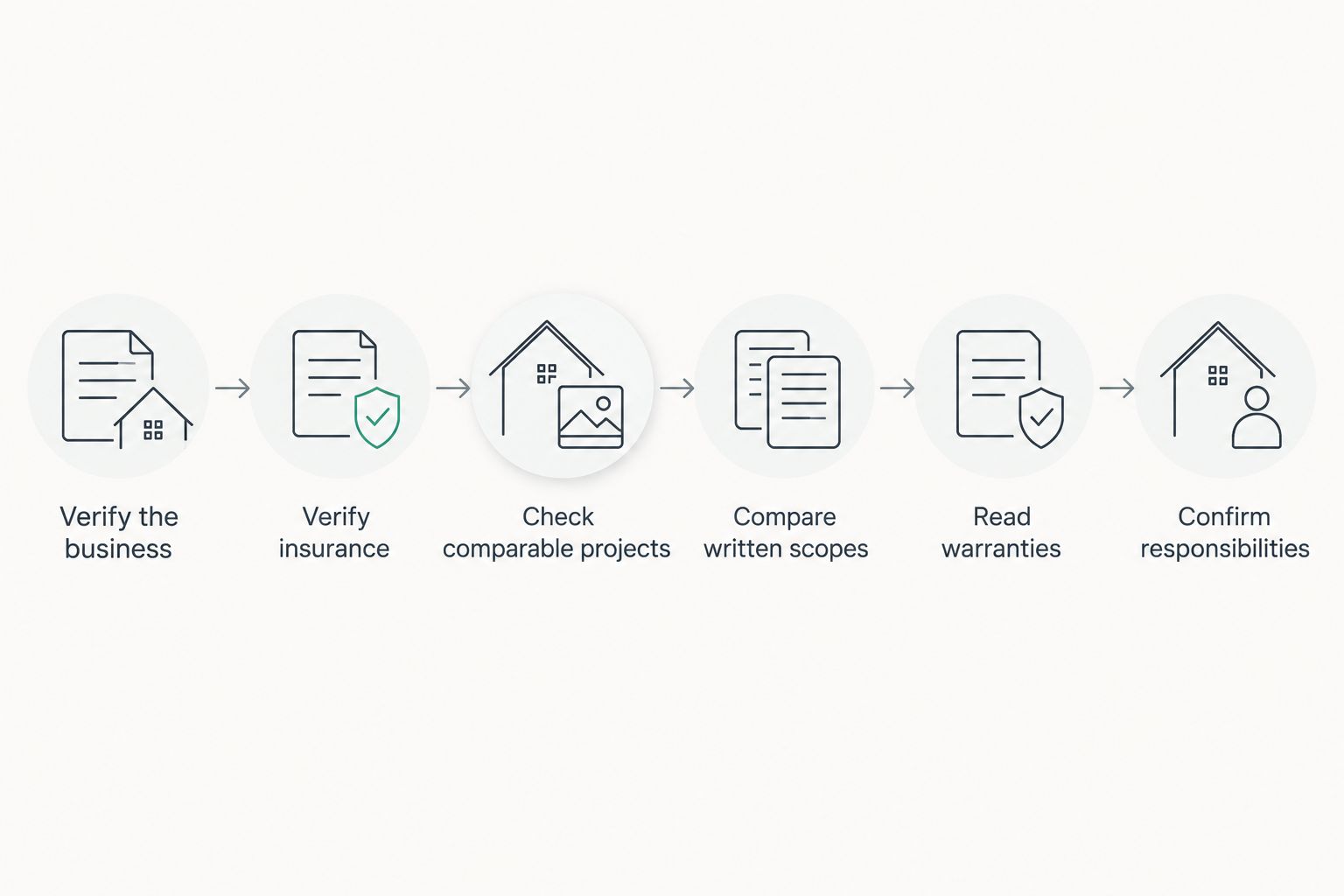
Choose the company whose qualifications, written scope, and job responsibilities you can verify. Follow these 6 steps for your 2026 contractor shortlist. Keep the supporting documents together so that a later conversation does not replace an earlier written commitment.
1. Verify the business and required credentials
Ask for the contractor’s legal business name, business address, and the name that will appear on your contract. Match that information against the proposal and insurance documentation. Ask who actually performs the installation, including whether the company uses subcontractors.
Check licensing or registration requirements with the authority responsible for your location. Roofing requirements vary by jurisdiction; a credential that applies elsewhere does not establish permission to work on your property. Verify the relevant record directly rather than relying on a badge in a brochure.
Keep a candidate only when you can identify the contracting business and verify applicable credentials. A trade association membership or manufacturer credential answers a different question from a government license. Ask what each credential establishes instead of treating them as interchangeable.
2. Verify insurance and job responsibilities
Request evidence of applicable liability insurance and workers’ compensation coverage or a legally valid exemption. Ask the insurance agent or carrier to confirm the documentation and whether coverage applies to the planned work. Do not treat a document handed to you as verification by itself.
Then ask who supervises the crew, who protects the property, and who responds to a leak during construction. If subcontractors perform the work, request a written explanation of responsibility for their work and coverage. Resolve those questions before authorizing removal of the existing roofing.
3. Check comparable completed projects
Ask for references involving the roof type and project conditions relevant to your home. A visually impressive project is less useful if it involved a different roofing system or a substantially different scope. Request permission to contact the references directly.
Ask former customers whether the written scope matched the finished work, how changes were handled, and whether the contractor responded after completion. Recent references help you assess communication during installation. Older references help you ask about follow-up when an issue appeared later.
4. Compare matching written scopes
Give each candidate the same project description and ask for an itemized proposal. Require the proposal to identify the roofing materials, removal work, underlayment, flashing, ventilation work, disposal, property protection, and permit responsibility. Ask the contractor to mark exclusions explicitly.
If the proposals describe different work, request revisions before choosing. One company replacing flashing and another leaving existing flashing in place are not proposing the same job. Your comparison becomes useful only when those differences are visible.
5. Read warranties and change procedures
Request the actual warranty documents rather than relying on a headline warranty term. Separate manufacturer coverage from the contractor’s workmanship coverage. Identify who handles a claim, what is excluded, and what documentation you must retain.
Ask how the contractor will document damaged decking or other concealed conditions discovered after removal. The contract should explain how changes are proposed and approved. Do not leave permission for additional work open-ended.
6. Sign only after responsibilities are clear
Confirm the scope, payment milestones, scheduling assumptions, weather-protection plan, cleanup obligations, and final walkthrough process in the agreement. Name the person authorized to approve changes on your behalf. Keep a copy of every signed document.
Before work starts, ask how the contractor will communicate delays and what happens if the roof cannot be closed as planned. A useful answer describes actions and responsibilities. A general promise to take care of everything does not.
What should a roof replacement proposal include?
For a 2026 roof replacement, organize your review into 4 document groups: credentials, scope, contract, and warranty. Keeping them separate makes it easier to notice when a persuasive proposal still lacks proof of insurance or a workable change procedure.
Use the comparison below to identify what each approach tells you—and what it leaves unresolved.
| Comparison approach | Best for | Advantage | Limitation |
|---|---|---|---|
| Itemized written scope | Comparing the proposed installation | Exposes included work and exclusions | Does not prove installation quality by itself |
| Verified credentials and insurance | Checking business accountability | Lets you confirm specific records | Does not establish workmanship on your project |
| Comparable customer references | Assessing communication and follow-up | Adds experience from completed projects | Contractor-selected references are not independent inspections |
| Written warranty documents | Understanding remedies after installation | Identifies obligations and exclusions | Coverage depends on the actual terms and circumstances |
Use these checks together, not as substitutes for one another. Strong references do not resolve an incomplete contract. Likewise, an itemized proposal does not eliminate the need to verify insurance.
Credentials: identify who you are hiring
Keep the legal business information, applicable licensing records, and insurance confirmation together. Check that the entity you verified is the entity signing the agreement. If a different name appears, resolve the discrepancy in writing.
Scope: identify what will change
Ask which existing components will be removed, replaced, or retained. Require specific descriptions of flashing around roof penetrations and transitions. If ventilation changes are proposed, ask what condition the contractor identified and what work addresses it.
Do not accept a material name as a complete installation specification. The scope must also explain the supporting work and installation responsibilities. Ask which manufacturer instructions and applicable local requirements govern the proposed system.
Contract: identify who decides and documents
Record the project contact, payment milestones, change approval process, and cleanup responsibilities. Ask how the contractor will protect landscaping, siding, windows, and access routes. If something is excluded, decide who will handle it before construction begins.
Warranty: identify who responds afterward
Read the contractor and manufacturer documents separately. Check exclusions, registration requirements, transfer provisions, and the process for reporting a problem. Save the signed agreement, product information, and completion records with those documents.
Why roof replacement proposals vary
Different proposals can reflect different work—not merely different contractors. For your 2026 comparison, ask each company to explain these differences in writing:
- Removal scope: Identify the existing roofing layers and materials included in removal and disposal.
- Deck condition: Specify how concealed damage will be documented and how replacement work will be approved.
- Flashing details: State which flashings will be replaced, retained, or modified around transitions and penetrations.
- Roofing system: Identify the proposed covering, underlayment, and related components rather than naming only the visible material.
- Site conditions: Explain access arrangements, property protection, staging, and debris handling.
- Responsibility after installation: Distinguish manufacturer obligations from contractor workmanship obligations and claim procedures.
A more detailed proposal still needs scrutiny. Detail is useful only when it describes the actual property and creates clear responsibilities. Ask the contractor to explain unfamiliar language rather than accepting a longer document as a better one.
Which warning signs should stop you from signing?
Pause when a contractor asks you to commit before you can verify the business or understand the work. A deadline imposed during a sales visit is not a reason to accept unresolved terms. Keep control of when you approve the agreement.
Watch for these specific problems:
- The legal business name changes between the proposal, contract, and insurance documents without an explanation.
- The company refuses direct verification of applicable credentials or coverage.
- Important promises appear only in conversation, not in the contract.
- The proposal leaves removal, flashing, disposal, or concealed damage unexplained.
- The contractor will not identify who supervises the installation or handles a complaint.
- An insurance-related pitch promises an outcome that the policy and insurer have not established.
Ask for corrections in writing. If the company supplies clear documentation, review the revised proposal on its merits. If it refuses, remove the candidate rather than trying to solve contractual uncertainty after the roof is open.
Should I get an inspection before choosing a roofer?
Get a documented assessment before approving replacement when the reason for replacement is unclear or contractors disagree about the condition. Ask for photographs, descriptions of observed defects, and an explanation of why repair is insufficient. A replacement recommendation should connect visible evidence to the proposed work.
Distinguish an assessment from an agreement authorizing construction. Read anything you are asked to sign, even when the visit is described as an inspection. If storm damage is involved, keep the contractor’s scope separate from the insurer’s coverage decision.
How do I choose between roofers with similar proposals?
Choose the contractor that resolves remaining questions with verifiable documents and specific written commitments. When the scopes match, compare project supervision, references, change procedures, and the process for handling a problem. Ask each finalist the same unresolved questions.
Use these 3 final questions before signing:
- Who is accountable on site? Get a named contact and a clear method for reporting an urgent issue.
- How are changes approved? Require documentation and authorization before additional work proceeds, subject to the agreement’s emergency provisions.
- What proves completion? Agree on the walkthrough, cleanup review, and documents you will receive.
Keep the Murray Inspection Services checklist beside the revised proposals. Mark each requirement as documented, unresolved, or excluded. That simple distinction prevents a confident verbal answer from being mistaken for a contractual commitment.
What should I confirm before the crew arrives?
Your 2026 pre-start review should turn the signed scope into practical arrangements. Confirm where materials and debris containers will go, how vehicles and household members will enter safely, and which areas must remain clear. Ask how the crew will protect openings and respond to unexpected weather.
Discuss existing interior stains or exterior damage before work begins and keep dated photographs. Ask how the contractor will document concealed conditions during removal. You need a record of what was observed, what was proposed, and what you approved—not just an explanation after completion.
At the final walkthrough, review the contracted work, cleanup, unresolved items, and required documents. Follow the agreement’s payment terms and document any outstanding issue. Do not treat the crew’s departure as proof that every contractual obligation is complete.
FAQ
What’s the best way to choose a roof replacement company?
Choose a roof replacement company by verifying applicable credentials and insurance, comparing matching written scopes, and checking comparable references. Sign only when responsibilities, exclusions, warranties, and change procedures are clear.
Should I choose the roofer with the shortest proposal?
Choose based on the proposal’s content, not its length. It must identify the work, materials, exclusions, responsibilities, and process for approving changes.
How do I check whether a roofing company is insured?
Request insurance documentation and ask the listed agent or carrier to confirm it. Ask whether the coverage applies to your planned work and how subcontractor coverage is handled.
Does a long roof warranty prove a contractor is good?
A long roof warranty does not prove installation quality. Read the actual coverage, exclusions, claim procedures, and separate workmanship terms before relying on it.
Should my roofer replace flashing during roof replacement?
Your proposal should identify which flashing will be replaced, retained, or modified and explain why. Ask how the planned details meet the roofing system’s installation requirements and applicable local rules.
Can a roofing contractor guarantee my insurance claim?
A roofing contractor cannot establish coverage merely by promising claim approval. Coverage depends on the policy and the insurer’s assessment; keep construction authorization separate from assumptions about a settlement.
What should I do if roofers disagree about replacement?
Ask each roofer to document the observed defects and explain why repair does or does not address them. Consider a separate assessment before authorizing replacement when the recommendations remain unresolved.
One last thing
Ask every finalist to identify what the proposal does not include. Exclusions expose decisions you still need to make, especially around concealed damage, retained components, and work performed by others. An explicit exclusion is easier to resolve before construction than an assumption discovered during it.
Murray Inspection Services’ final recommendation is straightforward: choose the clearest verified responsibility, not the strongest sales promise. For a 2026 roof replacement, your best protection starts with a scope you understand and an agreement that records who does what.
Related guides
- From roof inspection to contractor bid comparison
- Roof warranty types compared for homeowners
- Can hail damage be repaired instead of replaced?
- How long does a roof replacement take?