Yes, you can generally choose your own roofing contractor instead of accepting an insurance referral, subject to your policy, any repair-program agreement, and applicable state law. Choosing the contractor does not require your insurer to approve that contractor’s entire estimate; confirm the covered scope and your payment responsibilities before signing.
- A recommended insurance adjuster roofing contractor is a referral, not proof that you must hire that company.
- Separate contractor selection from insurance coverage; your policy and applicable state law govern the claim.
- Compare written roof repair estimates against the same scope before signing a construction contract.
- Use this Murray Inspection Services guide to check referral terms, contractor qualifications, and claim documentation.
Can I choose my own contractor instead of an insurance referral?
A referral alone does not establish that you must use the referred roofer. Ask your insurer whether the recommendation is optional or connected to a specific policy provision or repair-program agreement. If the insurer says contractor choice is restricted, request the exact language in writing.
This Murray Inspection Services guide is for homeowners comparing a roofing referral with a contractor they select themselves. For a claim handled in 2026, use your actual policy and endorsements—not a general statement about what insurers usually allow.
| Selection route | Best for | Practical advantage | Limitation to check |
|---|---|---|---|
| Insurer-referred contractor | Homeowners who want to evaluate the insurer’s suggested provider | Gives you a named company to investigate and compare | The referral does not replace your review of qualifications, scope, or contract terms |
| Homeowner-selected contractor | Homeowners who want to choose the company and compare independent proposals | Lets you select a contractor based on documented experience and proposed work | Differences between the contractor’s estimate and the insurer’s allowance still need resolution |
Neither route establishes workmanship quality by itself. Your decision should rest on the contractor’s qualifications, the proposed repair, and the agreement you sign.
Why this matters
Contractor selection and claim payment are separate decisions. A qualified roofer can identify repair needs, but a repair recommendation does not itself establish insurance coverage. Likewise, an insurer’s estimate is not a construction contract with your chosen roofer.
Choose the roofer on documented qualifications; resolve coverage through the claim process. Mixing those decisions creates avoidable disputes about who authorized work and who must pay for it.
For your 2026 claim file, keep the policy, claim correspondence, inspection records, estimates, and signed agreements together. That record helps you distinguish a disagreement about covered damage from a disagreement about construction work.
How to choose your own roofing contractor
1. Ask what the referral actually means
Start with a direct question: Is this contractor a suggestion, or is there a policy provision or signed agreement affecting contractor selection? Ask the insurer to explain any referral-program benefits and conditions in writing.
Do not assume a referred contractor works for the insurer. Confirm who employs the contractor, who signs the construction agreement, and who handles complaints about the completed repair.
2. Review your policy and existing agreements
Check the policy and endorsements for loss-settlement provisions, repair options, duties after loss, and dispute procedures. Also review anything you have already signed with a contractor or repair program.
If the insurer invokes an option to repair, request a written explanation of how that provision affects your claim. Do not treat every contractor referral as an exercise of that option; ask which process applies.
3. Check the contractor independently
Verify licensing or registration where required, insurance documentation, and experience with the roofing system involved. Use the relevant licensing authority to check credentials rather than relying only on a certificate supplied during a sales visit.
Ask who will supervise the work and whether subcontractors will participate. Request references for comparable projects, and read the proposed workmanship warranty rather than assuming the referral includes one.
4. Compare matching scopes
As a practical starting point, request 2 written estimates that describe the same proposed work. This is a comparison method, not an insurance requirement or a reason to delay urgent protective work.
Compare removal, materials, flashing, ventilation, disposal, permit responsibility, and treatment of concealed damage. The roof inspection to contractor bid comparison workflow provides a related framework for organizing that review.
5. Resolve differences before authorizing disputed work
Send the selected contractor’s itemized estimate and supporting documentation to the insurer. Ask which items are accepted, which are disputed, and what evidence is needed for further review.
Get written approval for changes to the construction agreement. If coverage remains unresolved, understand your contractual payment obligation before allowing the disputed work to proceed.
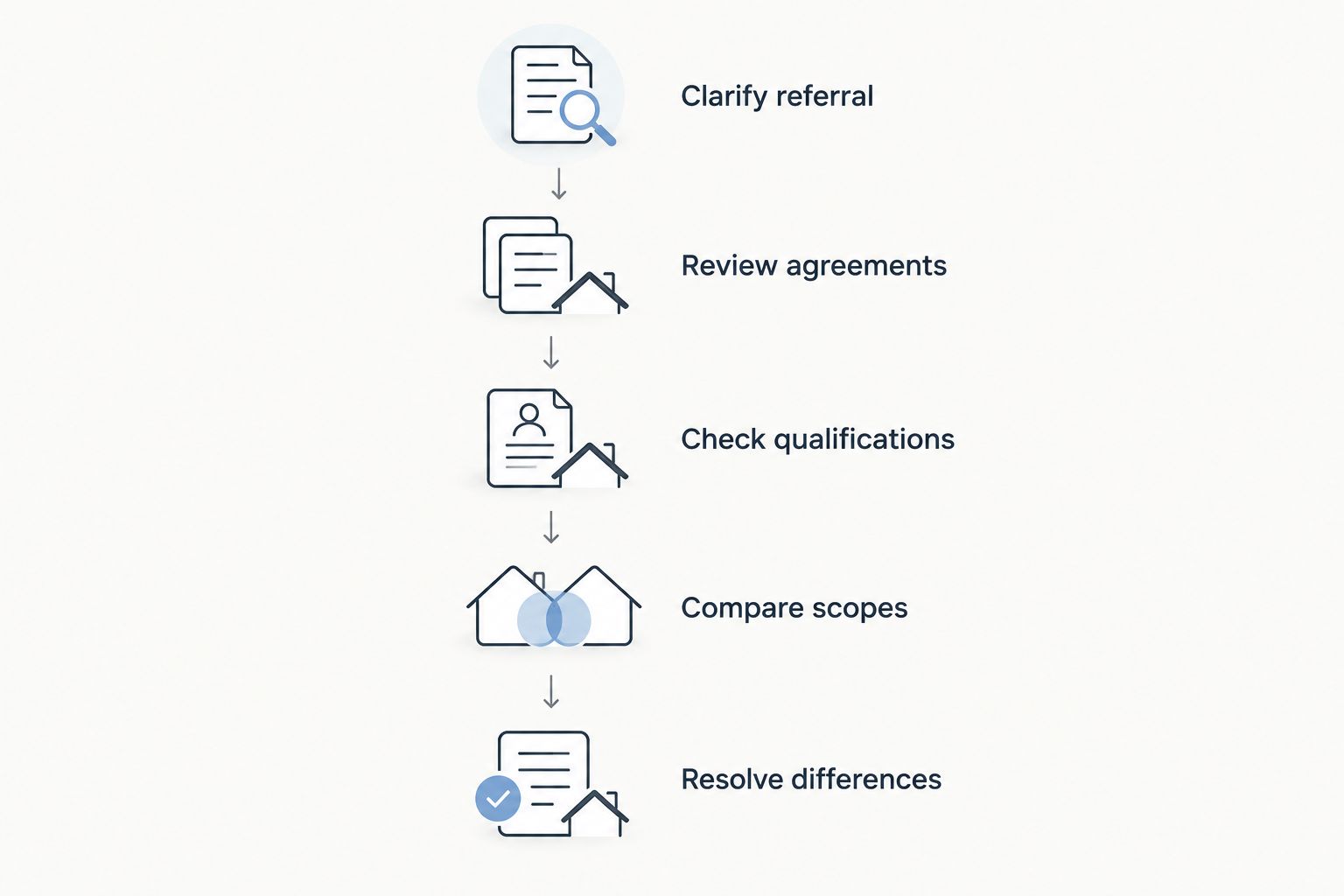
The goal is not to make every document identical. It is to make differences visible before they become payment disputes or change orders.
Why contractor choice and claim payment vary
The answer for a particular homeowner depends on the governing documents and jurisdiction. These are the main factors to check:
- State law: Contractor-selection rules, licensing requirements, claim practices, and available complaint procedures differ by state.
- Policy language: Loss-settlement terms and any applicable repair provisions affect the insurer’s obligations.
- Signed agreements: A construction contract, repair-program agreement, or assignment can create obligations separate from the referral itself.
- Cause and extent of damage: A roofer’s proposed work must be evaluated against the covered loss, not simply the roof’s overall condition.
- Scope documentation: Photos, measurements, inspection findings, and itemized explanations help identify why estimates differ.
- Payment conditions: Deductibles, depreciation provisions, limits, exclusions, and documentation requirements affect payment under the policy.
For a 2026 contractor comparison, ask both companies to address the same documented damage. A lower total means little when the proposals describe different repairs.
Does choosing my own roofer change what insurance covers?
Choosing your own roofer does not itself expand coverage. Your policy and the facts of the loss govern payment, subject to applicable law and any enforceable repair arrangement.
A contractor can document a repair method or identify an omitted item. That evidence supports review; it does not guarantee approval. Ask the insurer to explain disputed items individually rather than accepting a general statement that the entire estimate is too high.
Separate desired upgrades from work claimed as necessary to restore covered damage. You can choose additional work, but do not assume the insurer will pay for it because the same contractor performs both jobs.
Is an insurance-referred contractor better than my own roofer?
An insurance referral is not a substitute for checking qualifications. A referred roofer and a homeowner-selected roofer both need a clear scope, suitable credentials, and an understandable construction agreement.
Ask about any program-specific workmanship protection, who provides it, and how a complaint is handled. A separate program benefit can matter, but its written terms—not the referral label—establish what it provides.
Apply the same scrutiny to a roofer you already know. A personal recommendation is useful background, not proof that the company is qualified for the specific roof or proposed repair.
Can I dispute the insurer’s roofing estimate?
You can ask the insurer to review an estimate supported by additional documentation. Start with the disputed repair items, the reason each is necessary, and the evidence supporting that explanation.
If disagreement continues, review the policy’s dispute provisions and your state insurance department’s consumer guidance. Appraisal, mediation, regulatory complaints, and legal remedies have different purposes and availability; do not assume any particular route decides every coverage dispute.
What to check before signing a roofing contract
Keep 3 documents side by side: the insurer’s current estimate, the contractor’s itemized proposal, and the proposed construction agreement. This review exposes work that appears in one document but not another.
The Murray Inspection Services contractor-selection checklist focuses on written responsibilities, not verbal assurances:
- Work description: Identify what will be repaired or replaced and which materials are specified.
- Claim differences: Record unresolved items without describing them as approved insurance work.
- Changes: Require written authorization for additions and concealed-damage work.
- Permits: State who determines requirements and obtains necessary permits.
- Payments: Read payment milestones and understand your obligation if insurance pays less than expected.
- Warranty: Identify who provides workmanship protection and how to request service.
- Cancellation: Read cancellation provisions and any applicable notices before signing.
An inspection authorization, construction agreement, assignment of benefits, and insurance settlement release serve different purposes. Read each document for what it authorizes rather than relying on the name used during the sales conversation.
What if the adjuster says I must use the referral?
Ask the adjuster to identify the policy provision, signed agreement, or legal basis supporting that instruction. Request the explanation in writing and keep it in 1 claim file with the referral and related correspondence.
If the response remains unclear, request a supervisor’s review. Your state insurance department can explain its consumer complaint process; an attorney can advise on disputed contractual rights.
For any 2026 correspondence, record the date, participants, and issue discussed. Send a short written follow-up after a phone call so the next person reviewing the claim can understand the unresolved question.
Do not let a contractor’s promise to handle everything replace your review. Confirm who is authorized to discuss repair details and who is legally permitted to represent you on insurance matters in your state.
What should I do if the roof is leaking now?
Take reasonable steps to prevent further damage, consistent with your policy and personal safety. Do not climb onto a damaged roof or attempt work beyond your abilities; seek qualified assistance for hazardous conditions.
Notify the insurer promptly, photograph damage from a safe location, and retain records of protective work. Where practical and safe, preserve evidence before permanent repairs change the condition being evaluated.
Urgent protection and permanent replacement are different authorizations. Describe temporary work clearly and avoid signing an open-ended replacement agreement just to obtain immediate help. Ask the insurer what documentation it needs without delaying measures needed to address an immediate hazard.
FAQ
Can I refuse the roofing contractor my insurance adjuster recommends?
You can generally decline a roofing referral, subject to your policy, any repair-program agreement, and applicable state law. Ask for the written basis if the insurer says you must use a particular company.
Will insurance pay my own roofing contractor?
Payment depends on covered damage, policy terms, and claim documentation—not simply on who selected the contractor. Confirm the accepted scope and understand your construction-contract obligations before work starts.
Is an insurer-referred roofer guaranteed to do good work?
An insurer referral alone does not establish a workmanship guarantee. Ask whether a separate program warranty exists, who provides it, and what its written terms cover.
What if my roofer finds damage the adjuster missed?
Submit the additional findings with photographs, an itemized estimate, and an explanation of the proposed repair. Ask the insurer whether it needs a reinspection or further documentation before evaluating the disputed work.
Can my roofing contractor negotiate my insurance claim?
A roofing contractor can explain its repair estimate, but authority to represent you in claim negotiations depends on state law and licensing rules. Verify the person’s role before signing an authorization or representation agreement.
Do I have to accept the lowest roofing estimate?
A lower estimate alone does not establish that a proposal meets the required repair scope. Review policy obligations and compare materials, repair methods, qualifications, and contract terms rather than totals alone.
Should I sign a roofing contract before insurance approves the claim?
Do not sign unless you understand your payment obligations if coverage is denied or the insurer approves less than the contract requires. Read cancellation, contingency, and change-order terms before authorizing work.
One last thing
Selecting a roofer and accepting an insurance settlement are not the same agreement. Before you sign anything for a 2026 roof claim, identify which decision the document actually records: inspection permission, construction authorization, claim representation, or settlement acceptance.
Use this Murray Inspection Services guide to keep those decisions separate. A clear paper trail gives you something concrete to question when a referral, estimate, or sales promise does not match the agreement in front of you.
Related guides
- How to choose a roof replacement company
- Turn a hail damage report into an insurance claim
- Use a roof inspection to discuss an insurance settlement