
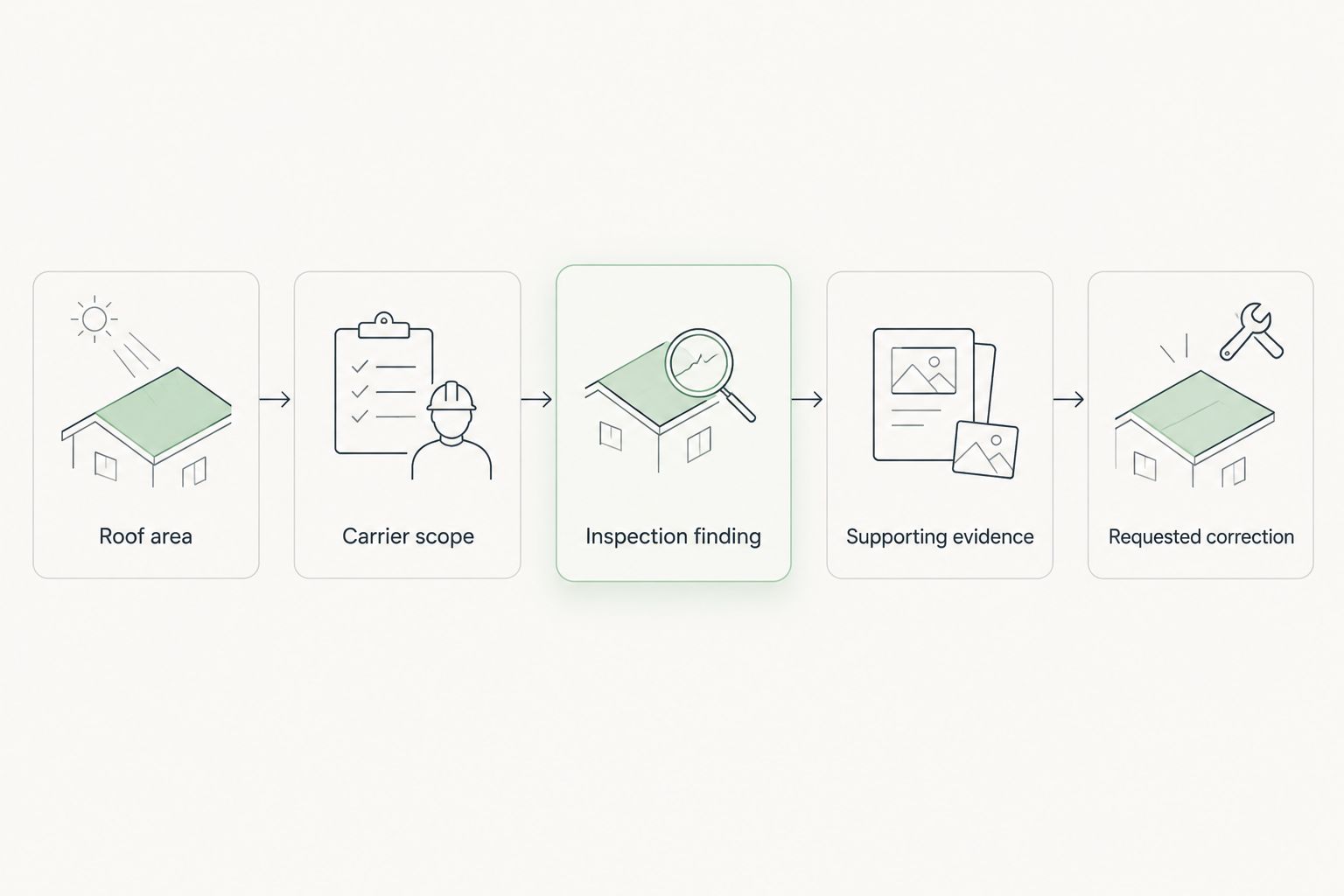
Instead of repeatedly asking an adjuster to reconsider your roof claim, connect each disputed estimate item to an inspection finding, a photograph, and a specific written request. This 2026 roof inspection insurance settlement negotiation workflow turns a general disagreement into a documented request for review—not a promise of coverage or a larger settlement.
- Roof inspection insurance settlement negotiation works best when each disputed item has location-specific evidence and a requested correction.
- For homeowners using Murray Inspection Services, roof inspection evidence supports settlement negotiation; it does not establish insurance coverage.
- Separate damage findings, repair scope, and policy coverage before submitting a claim supplement.
- Request a written response to each disputed item and preserve every submission and acknowledgment.
Why this matters
A roof inspection documents conditions. An insurance policy determines coverage, and the carrier’s estimate describes the work included in its proposed settlement. Treat those as separate documents with separate jobs. A damaged component does not automatically establish a covered cause of loss or justify replacing every roof surface.
For homeowners using Murray Inspection Services, the practical objective is an inspection record that another person can follow without guessing where the damage is. Ask for identifiable roof areas, clear photographs, and an explanation of the observed conditions—not just a conclusion that replacement is needed.
Your 2026 claim correspondence should identify the exact disagreement. Is the carrier disputing the cause, omitting a damaged area, using different measurements, or excluding a requested repair operation? Each problem needs different evidence.
Before you start
- Gather access and records. Have your claim identifier, policy and endorsements, carrier estimate, coverage letters, inspection report, photographs, and any contractor scope. Use the carrier’s designated submission channel; portal labels differ by insurer.
- Check deadlines before collecting more evidence. Read the policy and claim correspondence for notice, proof-of-loss, repair-completion, and dispute requirements. A pending review does not automatically extend a deadline.
- Preserve evidence without delaying necessary protection. Document conditions before emergency mitigation when safe. Do not climb onto a damaged roof, remove materials yourself, or postpone necessary protective work just to preserve photographs.
The non-obvious problem is a mismatch between the inspection’s purpose and the claim question. A general condition report that describes aging is not automatically evidence of storm damage. Before commissioning additional work, tell the inspector which findings the carrier disputes and ask whether the inspection can address those factual questions.
Build your claim evidence file
Establish the baseline
- Create 1 claim file. Keep the policy, carrier correspondence, inspection material, estimates, and submission receipts together. Separate original documents from working copies so annotations do not overwrite evidence.
- Confirm the identifiers. Check the property address, claim identifier, reported loss date, and inspection date across the documents. Explain inconsistencies rather than silently changing an original report.
- Save the carrier’s current position. Identify which roof areas and repair operations the estimate includes. Read the coverage letter separately; an estimate alone does not explain every policy decision.
- Write the disputed question. Use a narrow statement such as whether documented damage on a particular roof slope was included. Avoid starting with a desired payout or assuming full replacement is the only acceptable outcome.
Expected result: You can explain the dispute in a short paragraph and identify the documents that establish the starting point.
A useful 2026 file structure separates Original records, Working comparison, and Submitted evidence. Those are suggested folder names, not insurer portal controls. Save acknowledgments with the submitted package so you can establish what the carrier received.
Match findings to roof locations
- Map the roof areas. Use consistent descriptions such as street-facing slope, rear slope, or detached garage. Match those descriptions to the inspection photographs and estimate wherever possible.
- Assemble 3 evidence types: an overview photograph, a detail photograph, and a written finding. The overview establishes location; the detail shows the condition; the finding explains what the inspector observed.
- Separate observation from interpretation. A photograph can show a crease or displaced material. Determining cause requires an explanation, and determining coverage requires the policy—not a caption alone.
- Record limitations. Identify inaccessible areas, concealed components, and conditions the inspector could not evaluate. Request clarification when a report’s conclusion extends beyond its documented observations.
Expected result: Each disputed roof area has an identifiable location and supporting evidence, with limitations stated rather than hidden.
Do not treat unrelated damage as interchangeable evidence. A damaged gutter does not, by itself, prove that the shingles require replacement. Keep each component’s condition and requested treatment explicit.
Configure your scope comparison
Build the issue register
- Create a comparison sheet. Use the column labels Roof area, Carrier scope, Inspection finding, Supporting evidence, and Requested correction. These are working-document headings you control.
- Enter each disagreement separately. Keep an omitted area apart from a measurement disagreement or a disputed repair method. Combining them makes it harder to obtain a clear response.
- Ask for technical support. When a contractor says an operation is necessary, request the reason and relevant documentation. Where applicable, that includes manufacturer instructions or the locally adopted code provision—not an unsupported statement that code requires it.
- Remove unsupported requests. If the file does not establish the damage, quantity, or necessity of an operation, seek clarification before submitting it as a settled fact.
Expected result: Every requested change has a defined factual basis and a document the adjuster can review.
A higher contractor estimate is not, by itself, proof that the carrier estimate is wrong. Compare the work descriptions and measurements before comparing totals. Differences can involve scope, quantities, material specifications, or repair assumptions; identify the actual difference rather than treating the bottom line as the explanation.
For hail-related documentation, the guide to turning a hail damage report into an insurance claim addresses the report-to-claim connection. Keep the same discipline here: a report supports review, but approval depends on the claim facts and policy.
Submit your review package
Route the evidence and request a response
- Write a brief cover message. State the claim identifier, the disputed roof areas, the attached evidence, and the action requested. Ask the carrier to review the listed items rather than demanding an unexplained settlement increase.
- Attach the issue register and source documents. Give photographs recognizable filenames and preserve the original files. Avoid a large, unlabeled image collection that requires the reviewer to reconstruct the inspection.
- Make 2 written requests: confirmation that the package was received and an item-by-item response. Ask which factual finding, estimate assumption, or policy provision explains any unchanged item.
- Record the next action. Save the acknowledgment, adjuster contact, and any response date the carrier provides. Confirm substantive telephone discussions in writing without presenting your summary as an agreed decision.
Expected result: The carrier has a specific review request, and your file shows exactly what was submitted and acknowledged.
For a 2026 submission, use the carrier’s current instructions rather than assuming an old email address or upload method remains valid. If the package is rejected or attachments are missing, correct the delivery problem before interpreting silence as a substantive denial.
Update the workflow when new damage is documented
A supplemental submission addresses additional supported work or corrections after the initial estimate. It is not permission to add unrelated improvements. Tie every new item to an observed condition and explain why the earlier package did not include it.
- Document the discovery. Ask the contractor to identify the location and condition before concealed material is discarded, when safe and practical. Preserve photographs and relevant work records.
- Explain what changed. Distinguish newly exposed damage from a revised opinion about damage already visible. Keep earlier inspection dates intact and identify the date of the new observation.
- Submit only the supported revision. Provide the updated scope and evidence, identifying changes clearly. Do not send a replacement estimate without explaining its differences.
- Ask about further inspection. Contact the carrier before non-emergency work conceals the disputed condition. Necessary mitigation and policy duties still apply.
Expected result: The supplemental package explains both the new evidence and its effect on the requested repair scope.
For a Murray Inspection Services roof inspection used in settlement negotiation, ask that later observations be clearly distinguished from the original findings. A dated addendum preserves that distinction better than an unexplained rewritten report.
Material comparisons also need consistent units. Discussions of roofing material costs per square concern material categories and measurement conventions; a claim scope must additionally identify which removal, installation, and associated operations the estimate includes. A material comparison cannot establish the covered repair scope.
Choose the next review route
If the carrier maintains its position, choose the route that matches the unresolved issue. Do not escalate a missing photograph as though it were a policy interpretation dispute. Your 2026 decision should follow the written explanation, policy terms, and applicable state rules.
| Review route | Best for | Advantage | Limitation |
|---|---|---|---|
| Written supplement | Documented omissions or corrected quantities | Connects a requested revision directly to evidence | Does not resolve a coverage exclusion by itself |
| Reinspection request | Disputed visible conditions or roof locations | Allows another examination of the physical evidence | Access and changed site conditions can limit the review |
| Policy appraisal | Eligible amount-of-loss disputes under an appraisal clause | Provides the process specified in the policy | Availability, scope, and expense depend on the policy and state law |
| Regulatory complaint | Concerns about claim handling or insurer conduct | Brings a handling concern to the state insurance regulator | Does not replace litigation or guarantee a settlement change |
Read the appraisal clause before invoking it. Whether appraisal is available, and which issues it can decide, depends on the policy and jurisdiction. Get qualified advice when a disagreement involves coverage, contractual deadlines, or legal rights.
An inspector documents conditions. A contractor describes proposed work. Neither role automatically authorizes someone to negotiate a claim on your behalf; public-adjuster licensing and related restrictions vary by state. Ask anyone offering representation to explain their authority and written agreement.
Troubleshooting
The adjuster says the photographs do not prove the damage
Ask which factual question remains unanswered: location, visibility, extent, or cause. Request an inspector’s clarification or better documentation that addresses that question. More photographs of the same unclear detail do not fix missing context.
The carrier says the condition is wear rather than storm damage
Request the factual basis and policy provision supporting the decision. Ask the inspector to distinguish observed deterioration from claimed event-related damage and state the limits of that assessment. Do not ask anyone to relabel ordinary wear as storm damage.
The estimates use different measurements or work descriptions
Compare the roof-area definitions, measurement units, and included operations. Ask each estimator to explain the assumptions behind the disputed quantities. A revised total without a corresponding scope explanation leaves the disagreement unresolved.
The settlement payment differs from the estimate total
Request a written payment breakdown and compare it with the policy. Deductibles, depreciation, coverage limits, prior payments, and policy conditions can affect payment; the applicable explanation must come from your own claim documents. Ask specifically about any requirements tied to recoverable depreciation.
The carrier does not address the submitted items
Confirm delivery first, then request a written response to the numbered issues through the carrier’s designated escalation channel. Keep the timeline factual. If claim-handling concerns remain unresolved, review your state insurance regulator’s complaint process without allowing policy deadlines to lapse.
Customize your workflow
Use the same issue register for a home, association property, or commercial building, but adapt the authority and access arrangements. An association claim needs a clear authorized decision-maker; a managed property needs coordinated access and records. Do not assume a resident or tenant can authorize claim decisions.
When discussing a Murray Inspection Services roof inspection, provide the carrier’s disputed findings in advance and ask what the inspection will document. Keep the inspection request factual rather than asking for a predetermined replacement conclusion.
Maintain separate records for claim review and project funding. Financing a repair does not establish insurance coverage, and a coverage disagreement does not remove the need to address an active leak safely.
FAQ
How do I use a roof inspection to negotiate an insurance settlement?
Match each requested estimate correction to an inspection finding, an identifiable roof location, and supporting evidence. Submit the comparison through the carrier’s designated channel and request a written response to each disputed item.
Does a roof inspection force insurance to pay for replacement?
No. An inspection documents conditions, while coverage and payment depend on the policy, cause of loss, evidence, and applicable law. A replacement recommendation alone does not establish coverage.
Can I request another insurance roof inspection?
You can request a reinspection and explain which conditions or locations need further review. Ask the carrier about its process and provide supporting evidence; a request does not guarantee another inspection or a changed decision.
What should I include in a roof claim supplement?
Include the disputed or newly documented work, the reason for each requested change, and supporting inspection material. Identify revisions clearly and retain the original estimate and earlier submissions.
What if the insurer says the roof damage is normal wear?
Ask for the factual explanation and policy provision supporting that determination. An inspector can clarify observed conditions and their limitations, but should not change findings to fit a coverage argument.
Can a roofing contractor negotiate my insurance claim?
Authority to represent a policyholder depends on state law and the person’s role and licensing. A contractor’s ability to explain repair scope does not automatically authorize claim negotiation on your behalf.
Should I repair a leaking roof while the claim is disputed?
Take reasonable protective action consistent with safety and your policy duties. Document conditions before work when practical, retain records, and notify the carrier about disputed damage before repairs conceal it.
One last thing
Do not overwrite the evidence that explains your disagreement. Keep the original inspection, original carrier estimate, and each later revision. For a 2026 claim review, a clear version history shows what changed, when it changed, and which evidence supports the correction—without requiring anyone to reconstruct the file.
Related guides
- Roof replacement for HOAs
- Commercial roofing for property managers
- Roof inspection to financing approval workflow