Best overall for physical durability: SBS modified bitumen. Best for grease exposure: PVC. Best for temperature-driven movement: EPDM. This 2026 Murray Inspection Services guide ranks low-slope roofing systems by their construction, exposure resistance, repair needs, and installation limits—not by promised lifespan alone.
- The best low slope roofing systems match roof exposure: SBS for physical durability, PVC for grease, EPDM for flexibility.
- Murray Inspection Services ranks complete roof assemblies, not membrane names alone; drainage, attachment, and protection affect durability.
- Built-up roofing adds waterproofing redundancy; TPO offers heat-welded seams; metal requires a slope-compatible panel system.
- Choose the assembly first, then verify membrane specifications, flashing details, drainage, and maintenance access.
Why this matters
A durable membrane cannot compensate for wet insulation, weak attachment, or a poorly detailed drain. Roof failures also occur at transitions: curbs, penetrations, edges, and changes in elevation deserve as much attention as the open roof field.
For a 2026 replacement, separate material durability from assembly durability. Material durability concerns weathering, punctures, and chemical exposure; assembly durability includes the deck, insulation, cover board, seams, flashing, and fastening beneath that material.
Choose for the damage your roof actually faces. A restaurant exhaust area, a shaded roof with persistent drainage problems, and a roof crossed regularly by maintenance workers need different specifications.
What makes the best low-slope roofing systems
Use these criteria before comparing names:
- Physical protection: Resistance to punctures and damage from service activity, supported by suitable cover boards and designated walkways.
- Seam integrity: Reliable joints, compatible flashing, and installation procedures that crews can inspect during construction.
- Exposure compatibility: A membrane suited to sunlight, temperature changes, grease, and other substances present on the roof.
- Water management: Positive drainage, correctly detailed outlets, and an assembly approved for the actual slope.
- Repairability: Accessible surfaces, compatible repair materials, and details that remain practical to maintain.
- Structural fit: An assembly whose weight, attachment, and movement requirements suit the building.
Thickness is useful only within that wider assessment. A 60-mil membrane is 0.060 inch thick, approximately 1.52 millimeters; that measurement does not establish the strength of its seams, reinforcement, substrate, or attachment.
When comparing specifications in 2026, ask whether the quoted thickness describes the membrane you are actually buying. Do not treat equal thicknesses across different materials as equal durability.
Low-slope roofing systems at a glance
| Rank and system | Best for | Standout feature | Key limitation |
|---|---|---|---|
| 1. SBS modified bitumen | Physical durability around service activity | Reinforced, layered asphalt-based assembly | Installation method and flashing quality require close control |
| 2. PVC | Grease-exposed roofs | Heat-welded thermoplastic seams and suitable chemical resistance | Compatibility depends on the specific formulation and exposure |
| 3. EPDM | Temperature-driven movement | Flexible synthetic-rubber membrane | Seams and flashing require compatible bonding materials |
| 4. Built-up roofing | Waterproofing redundancy | Multiple reinforcing plies and asphalt layers | Weight and installation disruption can limit suitability |
| 5. TPO | Reflective membrane assemblies | Heat-welded seams and reflective surface options | Welding quality and product-specific specifications matter |
| 6. Mechanically seamed metal | Slope-compatible roofs with long panel runs | Metal panels joined with mechanically formed seams | Minimum slope and penetration detailing restrict applications |
The order prioritizes physical durability and maintainable waterproofing, then identifies specialized strengths. It is not a claim that every SBS assembly outlasts every PVC or EPDM assembly.
1. SBS modified bitumen: best for physical durability
SBS modified bitumen combines asphalt modified with a rubber-like polymer and reinforcing material. It is commonly installed as a layered system, with a base layer and cap sheet forming part of the waterproofing assembly.
That construction makes SBS modified bitumen a strong default where access to rooftop equipment is unavoidable. It still needs designated walking routes; a durable roofing system is not an unrestricted working platform.
SBS modified bitumen pros:
- Reinforcement supports resistance to physical damage.
- Layered construction provides more than a single waterproofing sheet.
- Compatible repair methods allow localized repairs.
SBS modified bitumen cons:
- Seams, terminations, and penetrations remain vulnerable to installation defects.
- Torch-applied installation introduces fire precautions; other application methods have their own requirements.
Best for: Roofs with regular equipment servicing and a suitable supporting assembly.
Verdict: Buy when physical durability is the priority and the specified application method suits the building.
2. PVC: best for roofs exposed to grease
PVC roofing is a thermoplastic membrane with heat-welded seams. Its chemical-resistance characteristics make it a candidate around kitchen exhaust and similar exposures, subject to the membrane manufacturer's written compatibility requirements.
Specify the actual contaminant rather than asking whether a membrane is simply chemical-resistant. Grease containment and exhaust maintenance remain necessary even when the roofing material is compatible.
PVC pros:
- Heat-welded seams join adjoining membrane sheets.
- Suitable formulations address exposures that restrict other membranes.
- Reinforced membrane options support mechanically attached or adhered assemblies.
PVC cons:
- Chemical resistance is not universal across substances or products.
- Contact with incompatible underlying materials requires an approved separation detail.
Best for: Roofs where grease exposure is a central material-selection issue.
Verdict: Buy after the specific exposure, substrate, and separation requirements receive written approval.
3. EPDM: best for temperature-driven movement
EPDM is a synthetic-rubber roofing membrane valued for flexibility and weather resistance. Large sheets can reduce field seams, although perimeter details and penetrations still require careful construction.
The distinction between rubber and thermoplastic membranes matters at repairs. EPDM uses compatible adhesives, tapes, and flashing materials rather than the hot-air welding used for TPO and PVC.
EPDM pros:
- Flexibility accommodates temperature-related movement.
- Large sheets reduce the number of field joints.
- Established repair methods support localized maintenance.
EPDM cons:
- Seam preparation and compatible repair materials are essential.
- Petroleum-based contaminants require particular attention to compatibility.
Best for: Roofs where flexibility and weather exposure matter more than grease resistance.
Verdict: Buy for a movement-focused specification with protected access routes and compatible detailing.
4. Built-up roofing: best for waterproofing redundancy
Built-up roofing, often shortened to BUR, uses multiple reinforcing plies embedded in asphalt. The surface treatment varies by assembly and can include aggregate or a specified coating.
Its defining advantage is redundancy: the waterproofing is constructed from multiple layers. That benefit must be weighed against the load imposed on the building and the practical demands of installation.
Built-up roofing pros:
- Multiple plies provide waterproofing redundancy.
- Suitable surfacing protects the underlying asphalt from exposure.
- Assembly design can include protection suited to rooftop service conditions.
Built-up roofing cons:
- Assembly weight can rule out a proposed installation.
- Hot-applied work introduces odor, access, and site-safety considerations.
Best for: Buildings where structural capacity and installation conditions support a multi-ply system.
Verdict: Buy when redundancy is the deciding factor and structural suitability is confirmed.
5. TPO: best for reflective membrane assemblies
TPO is a thermoplastic roofing membrane joined with heat-welded seams. Reflective surface options make it a candidate when surface reflectance forms part of the building's roof specification.
Do not turn that feature into an automatic energy-savings promise. Insulation, climate, equipment, roof condition, and the rest of the building affect the outcome.
TPO pros:
- Heat-welded seams create joined membrane connections.
- Reflective surfaces are available for relevant design requirements.
- Different attachment methods accommodate different assembly designs.
TPO cons:
- Weld settings and workmanship require checks during installation.
- A generic material name does not establish a particular product's performance.
Best for: Buildings seeking a reflective, heat-welded membrane assembly.
Verdict: Buy when the complete specification meets the roof's exposure and attachment requirements—not because TPO appears interchangeable with PVC.
6. Mechanically seamed metal: best for compatible roof slopes
Mechanically seamed metal roofing joins adjacent panel edges using a mechanical seaming process. Certain systems are designed for low-slope applications, but the permitted slope belongs to the particular panel assembly—not to metal roofing as a category.
Panel movement, seam construction, penetrations, and transitions determine whether the proposal fits. Metal belongs on this shortlist only after those details are resolved.
Mechanically seamed metal pros:
- Metal panels provide a durable exposed weathering surface.
- Long panel runs can reduce transverse joints.
- Properly designed clips and details accommodate thermal movement.
Mechanically seamed metal cons:
- Not every standing-seam profile is approved for low slopes.
- Equipment curbs and numerous penetrations complicate detailing.
Best for: Roofs with compatible slopes and layouts that suit the selected panel system.
Verdict: Hold until the exact panel's slope, attachment, and penetration requirements are verified.
Turn the shortlist into a roof specification
Before approving a 2026 proposal, require the contractor to describe the assembly from the structure upward. A membrane name alone leaves too many consequential choices unresolved.
Use this sequence to compare proposals on the same basis:
- Deck condition: Identify deterioration, fastening problems, and areas requiring repair before covering them.
- Moisture assessment: Establish whether existing insulation or other retained layers contain moisture. Do not assume a surface inspection settles that question.
- Drainage layout: Show how water reaches drains, scuppers, and gutters, including transitions around equipment.
- Assembly selection: Identify insulation, cover board, membrane, attachment, and perimeter details together.
- Access protection: Mark service routes and specify compatible walkways where equipment maintenance requires access.
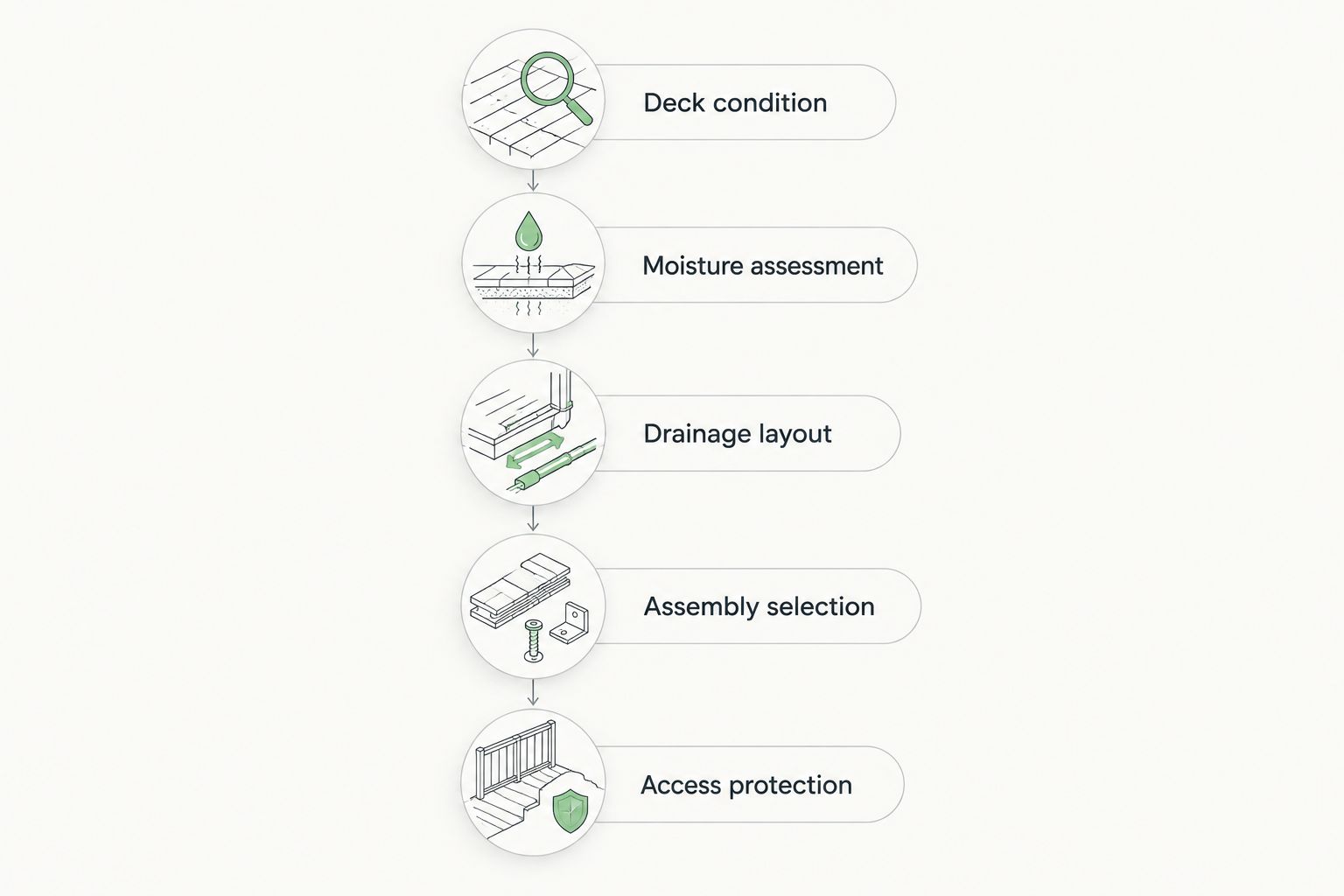
The checklist separates a material substitution from a meaningful design change. Replacing one membrane with another does not automatically correct inadequate drainage or an unsuitable deck.
Coordinate replacement with weather protection
Durability starts before the new roof is finished. Tear-off exposes the building, so the work plan needs defined daily limits, temporary protection, and clear responsibility for keeping water out during construction.
When comparing roof replacement timelines, separate membrane installation from deck repairs, insulation replacement, flashing work, and weather interruptions. Those are different tasks; a shorter calendar estimate does not establish a more durable result.
Ask how the crew will close each work area before leaving, protect occupied spaces, and handle unexpected wet materials. Include rooftop equipment access in that discussion so another trade does not damage newly completed work.
Require checks before concealed work disappears
Some important roof components become inaccessible as installation progresses. Agree on when deck repairs, insulation attachment, cover boards, and flashing preparation will be checked and documented.
For thermoplastic systems, ask how field welds will be checked. For adhered or taped details, ask how surface preparation and installation conditions will be controlled. For layered asphalt assemblies, ask how laps, adhesion, and terminations will be verified.
These questions are more useful than asking which membrane is toughest in isolation. They turn durability into specific installation requirements rather than a product label.
How the systems were ranked
This 2026 Murray Inspection Services ranking weighs physical protection, seam integrity, exposure compatibility, water management, repairability, and structural fit. The order is an editorial assessment of established system characteristics, not a laboratory test or measured lifespan comparison.
SBS modified bitumen takes the default position because its reinforced, layered construction suits the physical-durability focus. PVC, EPDM, built-up roofing, TPO, and mechanically seamed metal each earn a distinct use case rather than an interchangeable overall recommendation.
Which low-slope roofing system should you choose?
Murray Inspection Services ranks SBS modified bitumen first for low-slope roofs where physical durability is the deciding factor. Treat that as a starting specification, not permission to ignore the building.
Choose PVC when grease compatibility drives the decision. Choose EPDM for flexibility, built-up roofing for layered redundancy, and TPO for a reflective thermoplastic assembly. Keep mechanically seamed metal on the shortlist only when the exact system fits the slope and roof layout.
If proposals disagree, compare the missing assembly details before comparing the membrane names. The better decision is the system that addresses your documented exposure and installation conditions.
FAQ
What are the best low slope roofing systems for durability?
SBS modified bitumen is the default choice in this ranking for physical durability. PVC, EPDM, built-up roofing, TPO, and mechanically seamed metal suit different exposures and building conditions.
Is TPO better than EPDM for a low-slope roof?
TPO is not universally better than EPDM. TPO uses heat-welded seams, while EPDM offers synthetic-rubber flexibility and uses compatible adhesives, tapes, and flashing materials.
Which low-slope roofing system handles kitchen grease?
PVC is a candidate for grease-exposed roofs when the specific membrane is approved for that exposure. Confirm written compatibility and retain grease containment and exhaust maintenance.
Does a thicker roofing membrane always last longer?
Thickness alone does not establish roof lifespan. Reinforcement, seams, substrate support, attachment, drainage, and exposure also affect durability.
Can standing-seam metal go on a low-slope roof?
Some mechanically seamed metal systems are designed for low-slope roofs. Verify the exact panel assembly’s minimum slope and detailing requirements rather than applying one rule to all standing-seam roofing.
Can I install a new membrane over wet insulation?
Do not treat wet insulation as an acceptable substrate for a new membrane. Establish the moisture conditions and specify removal and replacement of affected materials as required by the selected assembly.
Should I replace a low-slope roof with a coating instead?
A coating is not an automatic substitute for replacement. First establish membrane condition, moisture, adhesion, drainage, and compatibility; a coating does not repair a deteriorated deck or remove wet insulation.
One last thing
For your 2026 project, request a marked roof plan showing every penetration and drainage outlet before approving the assembly. A material sample cannot show whether those transitions have been resolved.
Use the Murray Inspection Services shortlist to choose which system deserves a detailed proposal. Then judge that proposal by what happens at the edges, drains, curbs, and service routes—not just across the easiest open section of roof.
Related guides
- TPO vs. EPDM roofing membranes compared
- Gutter and drainage systems for roof protection
- Roof deck materials for commercial buildings
- Commercial roofing systems ranked by maintenance cost