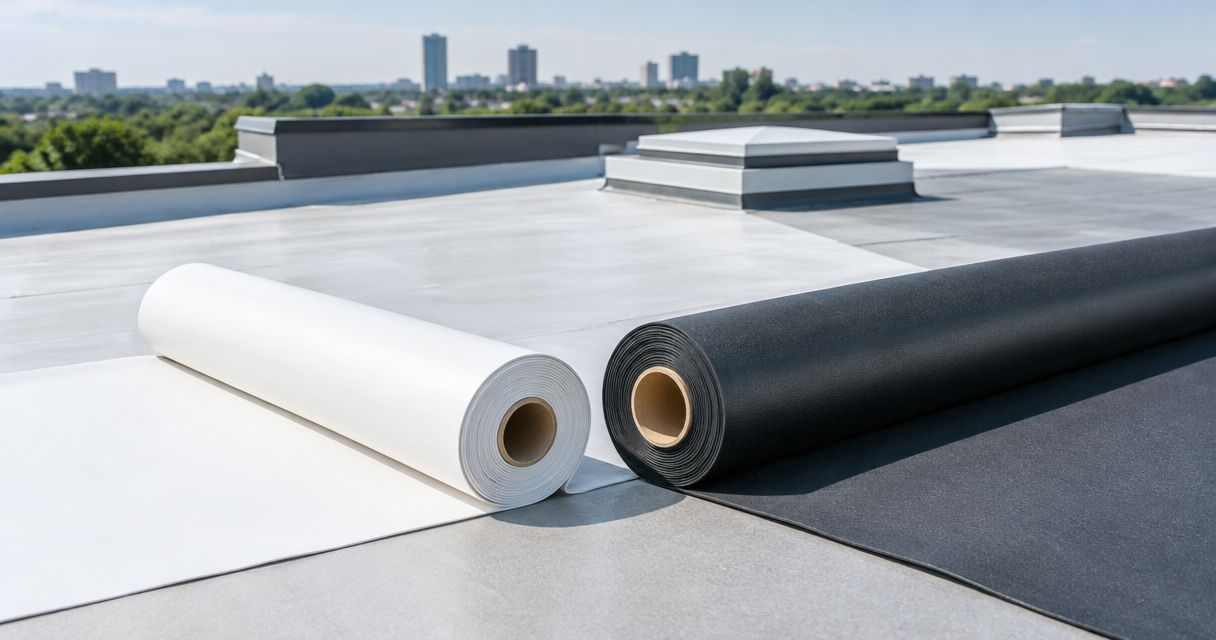
Best overall for cooling-focused buildings: white TPO. Best for cold-weather flexibility: EPDM. This 2026 guide compares the best TPO vs EPDM roofing membranes by seam construction, roof exposure, repair requirements, and specification quality—not by a universal winner.
- For the best TPO vs EPDM roofing membranes, choose white TPO when solar reflectance is the priority.
- Choose EPDM roofing when low-temperature flexibility matters more than a reflective surface.
- TPO uses heat-welded seams; EPDM commonly uses seam tape with compatible primers.
- Murray Inspection Services’ comparison prioritizes the complete roof assembly, not membrane thickness alone.
Why this matters
TPO and EPDM are single-ply membranes used on low-slope roofs, but they are not interchangeable specifications. Their seam methods, surface characteristics, and repair procedures create different installation and maintenance requirements.
Murray Inspection Services’ TPO vs EPDM roofing guide is best for owners comparing low-slope roof proposals before choosing a membrane. Start with the building’s actual drainage, insulation, and roof access needs. A membrane cannot correct a poorly designed assembly by itself.
For more roofing information from Murray Inspection Services, keep the same distinction in mind: choosing a material and evaluating the condition of a roof are separate decisions.
What makes the best roofing membrane?
Use these criteria to compare your 2026 proposals before comparing the material names:
- Climate fit: Evaluate solar exposure, heating and cooling priorities, and temperature movement. Color matters independently of membrane chemistry.
- Seam construction: Compare TPO’s heat-welded joints with EPDM’s taped seam system. Both require preparation and installation checks.
- Assembly compatibility: Match the membrane to its insulation, cover board, attachment method, drainage, and existing substrate.
- Damage resistance: Specify protection around rooftop equipment and service routes. Membrane thickness does not replace walkway protection.
- Repair practicality: Confirm that compatible repair materials and an appropriate repair procedure are identified before installation.
- Documented performance: Require the proposed assembly’s applicable fire and wind classifications, not unsupported claims about a membrane category.
A strong proposal answers each point in writing. A weak proposal names a material and leaves the rest to assumptions.
TPO vs EPDM roofing membranes at a glance
| Rank and membrane | Best for | Standout feature | Main advantages | Key limitation |
|---|---|---|---|---|
| 1. White TPO | Cooling-focused buildings with substantial solar exposure | Reflective surface and heat-welded seams | Reflective surface options; welded seam construction; reinforced sheet options | Welding requires controlled technique and seam verification |
| 2. EPDM | Buildings prioritizing low-temperature flexibility | Flexible synthetic rubber sheet | Cold-weather flexibility; large sheet formats; established taped repair methods | Standard black EPDM absorbs solar energy; seam preparation needs close attention |
The ranking is a decision tree, not a claim that TPO outlasts EPDM. White TPO earns the first position for the stated cooling-focused use case; EPDM wins when flexibility is the more important requirement.
1. White TPO: best roofing membrane for cooling-focused buildings
TPO stands for thermoplastic polyolefin. Roofing crews join its sheets with hot-air welding, creating seams through heat rather than EPDM’s typical taped joint method.
White TPO provides a reflective roof surface. That makes it a practical starting point when your specification prioritizes reducing absorbed solar heat, although the building’s insulation, climate, and operating conditions still determine the energy result.
White TPO pros
- Reflective surface: White TPO addresses solar reflectance without relying on the dark surface associated with standard black EPDM.
- Heat-welded seams: Properly executed welding creates a continuous joint between compatible membrane surfaces.
- Reinforced options: Reinforced TPO sheets are available for specified roofing assemblies.
- Multiple attachment approaches: TPO systems can use different attachment methods when the selected assembly permits them.
White TPO cons
- Weld quality needs verification: Welding equipment settings and technique must match site conditions and the membrane manufacturer’s instructions.
- Detailing remains critical: Curbs, drains, terminations, and penetrations require appropriate details; a good field seam does not compensate for poor flashing.
- Reflectivity is not an energy guarantee: A white surface alone does not establish a building’s annual energy savings.
What to specify for white TPO
For a 2026 TPO proposal, request the exact manufacturer, membrane thickness, attachment method, and assembly documentation. ASTM D6878 is the material specification associated with TPO roofing sheet; it is not a substitute for project-specific design.
Common TPO specifications include 45 mil, 60 mil, and 80 mil nominal thicknesses. Those figures describe sheet thickness, not promised service life. Compare otherwise equivalent assemblies before treating a thicker sheet as the better choice.
Ask how the installer will verify field seams and handle changes in welding conditions. The answer should identify a procedure, not simply describe the installer as experienced.
Best for: Buildings where a reflective surface and heat-welded seams match the project’s priorities.
Verdict: Buy white TPO when cooling exposure is the deciding factor and the proposal documents the complete assembly.
2. EPDM: best roofing membrane for cold-weather flexibility
EPDM stands for ethylene propylene diene monomer. It is a synthetic rubber roofing membrane valued for flexibility, including at low temperatures.
EPDM sheets commonly use seam tape and compatible primers at field joints. Standard black EPDM absorbs solar energy, so its surface behavior differs from white TPO even when both roofs have the same insulation beneath them.
EPDM pros
- Low-temperature flexibility: EPDM is a suitable membrane to evaluate when flexibility in cold conditions is a primary requirement.
- Large sheet formats: Larger sheets can reduce field seam quantity when the roof layout accommodates them.
- Established repair methods: Compatible primers, tapes, patches, and flashing materials support defined repair procedures.
- Attachment choices: EPDM systems include different attachment approaches, subject to the selected roof assembly.
EPDM cons
- Black surfaces absorb heat: Standard black EPDM does not provide the reflective surface of white TPO.
- Preparation governs seam quality: Cleaning, priming, application, and rolling must follow the specified seam system’s instructions.
- Chemical compatibility needs checking: Petroleum products and incompatible materials can damage EPDM; rooftop exposures require review.
What to specify for EPDM
For your 2026 EPDM proposal, identify whether the sheet is reinforced or nonreinforced, how it will be attached, and which seam system will be used. ASTM D4637 covers EPDM roofing sheet, but compliance alone does not establish whether the proposed assembly suits your building.
Confirm how the installer will detail corners, equipment supports, and transitions to existing materials. These areas involve more than laying a large rubber sheet over insulation.
Do not select EPDM solely because the building is in a cold region. Snow management, drainage, roof access, interior humidity, and the complete thermal assembly still need attention.
Best for: Buildings where low-temperature flexibility takes priority over a reflective surface.
Verdict: Buy EPDM when flexibility is the deciding requirement and its seam and flashing details are fully specified.
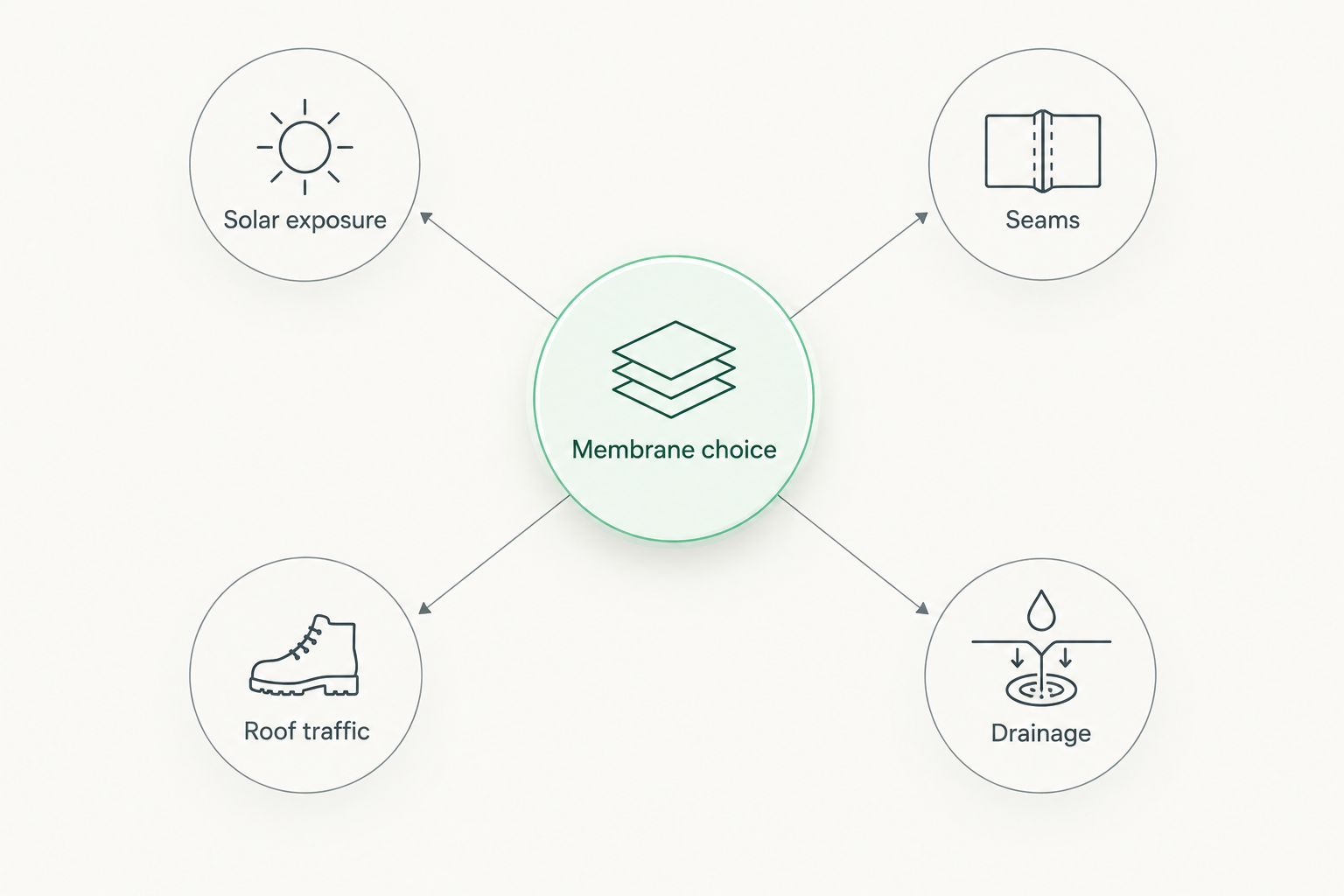
Which differences should decide your roof?
Solar exposure
Choose white TPO when a reflective surface is an explicit project requirement. If you compare it with black EPDM, acknowledge that you are comparing both membrane chemistry and surface color.
Do not assume absorbed roof heat becomes useful indoor heat. Insulation and building operation affect that relationship, so a warm membrane surface is not proof of lower heating demand.
Seams
TPO relies on correctly executed heat welding. EPDM commonly relies on a prepared, primed, taped joint. Neither system removes the need to inspect workmanship.
Ask each bidder to explain how seams will be checked and how suspect joints will be corrected. Compare the answers against the proposed manufacturer’s installation instructions, not a blanket claim that welded or taped seams never fail.
Roof traffic
Neither membrane is a walking surface for unrestricted equipment service. Specify designated routes and compatible protection where technicians need access to mechanical equipment.
If your roof receives frequent service visits, include traffic protection in the original assembly discussion. Adding thickness while leaving busy access routes unprotected addresses only part of the problem.
Drainage
Neither TPO nor EPDM creates slope. Your proposal must address drains, scuppers, low areas, and the relationship between insulation layout and water movement.
Do not accept a material substitution as the entire answer to standing water. Identify the cause and the proposed drainage correction separately from membrane selection.
How to compare competing installation proposals
Use the same scope for both bids. Comparing a fully detailed TPO assembly with an EPDM proposal that omits insulation or flashing work tells you little about the materials themselves.
Match the assembly
Request the membrane specification, insulation type and thickness, cover board, attachment method, and perimeter details. Identify which existing materials will remain and how their condition will be assessed.
A cover board and a thicker membrane serve different functions. Do not let either disappear into a vague description such as an upgraded roofing system.
Check the details
Ask for the proposed treatment of drains, curbs, roof edges, wall transitions, and penetrations. Confirm how rooftop equipment will be handled during the work.
These details should match the chosen system. Mixing materials without documented compatibility creates questions that a membrane brand name cannot answer.
Plan maintenance
Request inspection and repair instructions for the completed assembly. Keep the membrane identification, installation documents, and repair records together so future contractors can identify compatible materials.
For a 2026 replacement decision, document existing leaks and previous patches before work begins. That record helps distinguish inherited building conditions from issues discovered during installation.
Compare exclusions
Read what each proposal leaves out, including concealed deterioration, drainage changes, equipment handling, and interior protection. An exclusion is not automatically unreasonable, but it changes the scope you are comparing.
Choose the proposal that makes responsibilities explicit. A familiar membrane name is not a substitute for a clearly defined job.
How the membranes rank
This 2026 ranking prioritizes climate fit, seam construction, assembly compatibility, damage protection, repair planning, and documented performance. It compares membrane categories rather than tested products from named manufacturers.
White TPO ranks first for a cooling-focused brief because its reflective surface directly addresses that requirement. EPDM receives the separate flexibility recommendation because that is a different selection priority, not a consolation category.
Murray Inspection Services’ roofing comparison does not assign either membrane a universal lifespan. Installation, exposure, drainage, maintenance, and the specified assembly prevent a category name from establishing a reliable replacement date.
Which roofing membrane should you choose?
Choose white TPO if solar reflectance is your leading requirement. Choose EPDM if low-temperature flexibility is your leading requirement. If neither condition settles the decision, compare the proposed assemblies and installation details before choosing the membrane.
For an undecided owner, white TPO is the default only for the cooling-focused building described here. A building with different operating needs deserves a different decision, not a forced winner.
Reject proposals that promise an outcome without identifying the materials and construction details behind it. You are selecting a roof assembly that must function at every seam, edge, drain, and penetration—not just across the open field.
FAQ
What are the best TPO vs EPDM roofing membranes for a low-slope roof?
White TPO is the better starting point for a cooling-focused roof; EPDM is the better starting point when low-temperature flexibility leads the specification. Compare the complete assemblies before choosing either membrane.
Is TPO better than EPDM in hot weather?
White TPO is the stronger choice when solar reflectance is the requirement. That does not establish a specific energy saving, because insulation, climate, and building operation also affect the result.
Is EPDM better than TPO in a cold climate?
EPDM is a strong option when low-temperature flexibility is the priority. Cold climate alone does not settle the choice; drainage, insulation, moisture control, and installation details still matter.
Does a thicker roofing membrane always last longer?
No, membrane thickness alone does not establish roof lifespan. Compare equivalent assemblies and consider seam quality, flashing, traffic protection, drainage, and maintenance.
Can TPO or EPDM fix standing water on a roof?
Neither membrane creates drainage slope. Correcting standing water requires evaluating the roof layout, drains, and insulation design separately from membrane selection.
Which is easier to repair, TPO or EPDM?
Repair practicality depends on membrane condition, access, compatible materials, and contractor capability. TPO typically requires preparation and compatible welded repairs, while EPDM commonly uses compatible primers, tapes, and patches.
What should I ask before accepting a roofing proposal?
Ask for the exact membrane, thickness, insulation, attachment method, flashing details, and exclusions. Also request the installation quality checks and maintenance instructions for the proposed assembly.
One last thing
Ask each bidder to explain a drain detail before discussing the open roof surface. The answer reveals whether the proposal addresses how water leaves the roof, not merely which membrane covers it.
Keep the resulting detail with your roof records. Future repairs are easier to specify when the installed materials and construction are documented rather than reconstructed from memory.
Related guides
- Best roof coatings for energy efficiency
- Best flat roof materials ranked by cost
- Best commercial roofing systems ranked by maintenance cost
- Best roofing materials for hail-prone areas