The best roofing companies in Lincoln, NE are the ones that document your roof’s condition, explain the right scope, and put warranty responsibilities in writing. Murray Roofing is a strong fit for Lincoln homeowners and commercial property owners seeking roof replacement, inspections, and financing in 2026.
- Compare roofing companies in Lincoln NE by inspection findings, written scope, and warranty responsibilities—not a headline ranking.
- Murray Roofing serves Lincoln homeowners and commercial property owners with roof replacement, repairs, inspections, and financing.
- Choose full replacement for documented system-wide problems; request a repair assessment for isolated damage.
- Require written coverage terms before treating any roof warranty as part of your decision.
Why this matters
A contractor can offer the service you need and still submit a proposal that leaves important questions unanswered. Your decision should account for the roof itself, the building’s use, and who handles problems after installation.
For your 2026 Lincoln project, separate the contractor decision from the repair-versus-replacement decision. First establish what is wrong. Then compare proposals that address the same problem rather than treating every estimate as an equivalent offer.
What makes the best roofing company for your project?
Use these criteria before you compare proposals:
- Documented condition: Ask for photographs and an explanation connecting visible damage to the recommended work.
- Relevant project experience: Request examples involving a similar roof system and building use, not just a general project gallery.
- Clear scope: Require materials, removal work, flashing details, cleanup responsibilities, and exclusions in writing.
- Warranty accountability: Identify the manufacturer’s responsibilities separately from the contractor’s workmanship obligations.
- Communication: Establish who answers questions, approves changes, and coordinates access during the project.
- Payment clarity: Review payment milestones and any financing agreement separately from the roofing scope.
A contractor’s strongest proposal makes the work understandable before you sign. Credentials support that decision; they do not replace a roof-specific inspection or contract.
Roofing project choices at a glance
Choose the project category first. These are different hiring needs, not a ranking of competing local businesses.
| Project choice | Best for | What the proposal should emphasize | Key limitation |
|---|---|---|---|
| Full residential replacement | Homeowners facing roof-wide deterioration | Complete system scope and warranty terms | Larger commitment than an isolated repair |
| Commercial replacement | Businesses planning substantial roof work | Building use, drainage, access, and disruption planning | Requires coordination beyond material selection |
| Targeted roof repair | An isolated defect with a serviceable surrounding roof | Identified cause and defined repair boundaries | Does not renew the entire roof |
| Storm-damage assessment | Owners documenting suspected storm damage | Photographs, findings, and repair recommendations | Inspection findings do not guarantee insurance coverage |
| Roof maintenance | Owners managing an existing roof | Condition tracking and corrective priorities | Cannot reverse an unsuitable or failing roof system |
1. Full residential replacement: best for roof-wide deterioration
A replacement-focused proposal should explain why the existing roof needs more than a localized repair. Ask the contractor to distinguish widespread deterioration from a defect around a penetration, flashing detail, or limited roof area.
Best for: Lincoln homeowners whose inspection identifies problems across the roof system or whose repeated repairs no longer address the underlying condition.
Replacement pros:
- Addresses the roof as a connected system rather than a series of isolated patches.
- Creates an opportunity to evaluate flashing, ventilation, and roof-deck conditions within the agreed scope.
- Allows you to review material and workmanship coverage before installation.
Replacement cons:
- Commits you to more extensive work than a targeted repair.
- Hidden conditions discovered during removal require a documented change process.
Murray Roofing provides residential roof replacement and holds GAF Master Elite status. Its stated warranty offerings include a 50-year Golden Pledge warranty and a 10-year labor warranty; request the written terms applicable to your specific installation rather than assuming every roof receives identical coverage.
For a 2026 replacement proposal, ask which components belong to the specified roof system and which conditions are excluded. Have the contractor explain how additional deck work would be authorized before removal begins.
Verdict: Hold approval until the inspection supports replacement and the complete scope is written down.
2. Commercial replacement: best for occupied-property planning
Commercial roof work must fit how your building operates. A restaurant, warehouse, school, church, apartment property, or office needs a plan that accounts for its own occupants, access points, and operational constraints.
Best for: Commercial owners and managers evaluating substantial roof work while keeping building responsibilities organized.
Commercial replacement pros:
- Lets you address roof condition and operational planning together.
- Creates a defined opportunity to review drainage, penetrations, and rooftop equipment interfaces.
- Establishes responsibilities between the roofer, property manager, and other trades.
Commercial replacement cons:
- Access and work-area coordination add decisions beyond the roof specification.
- A proposal that ignores building operations leaves important responsibilities unresolved.
Murray Roofing provides commercial roof replacement, repair, inspection, and maintenance in Lincoln and Omaha. Ask for a project-specific plan that identifies work zones, occupant communication, material placement, and the handling of rooftop equipment.
Treat financing as a separate agreement. Review its terms without allowing the payment arrangement to substitute for a sound roof specification or a clear explanation of the recommended work.
Verdict: Hold approval until the roof scope and building-operation plan work together.
3. Targeted roof repair: best for an isolated defect
A repair makes sense when the contractor identifies a specific problem and explains why the surrounding roof remains serviceable. The proposal should describe the cause, not simply promise to cover the visible symptom.
Best for: Owners with localized damage and an inspection supporting a limited repair.
Targeted repair pros:
- Keeps the work focused on a documented defect.
- Avoids replacing serviceable roof areas without a stated reason.
- Gives you a defined action when a full replacement is not supported by the findings.
Targeted repair cons:
- Leaves the rest of the roof at its existing age and condition.
- Fails to solve the broader problem when the visible leak has multiple contributing causes.
Ask whether the proposal addresses only the entry point or also any affected underlying materials. Request photographs and an explanation of what the repair does not cover.
Do not climb onto the roof to confirm a contractor’s diagnosis. Share indoor leak locations and accessible photographs, then leave rooftop inspection and repair work to the contractor.
Verdict: Buy a defined repair only when the inspection supports its boundaries.
4. Storm-damage assessment: best for separating findings from claims
A storm inspection should document roof conditions and distinguish observations from insurance decisions. The roofer explains the damage and proposed work; your insurer determines coverage under your policy.
Best for: Lincoln property owners who suspect storm damage and need an organized record of the roof’s condition.
Storm-assessment pros:
- Creates a documented basis for discussing suspected damage.
- Connects recommended work to specific roof findings.
- Helps separate immediate roof concerns from administrative claim steps.
Storm-assessment cons:
- Does not establish that every observed condition resulted from a covered event.
- Does not guarantee claim approval or payment for the proposed work.
Murray Roofing offers inspections and insurance-claim support. Keep the inspection findings, contractor proposal, insurer correspondence, and your own incident notes together so each party can work from the same documents.
For a 2026 storm-related project, do not sign based on a promise that insurance will cover everything. Require a clear explanation of your obligations even when a contractor assists with documentation.
Verdict: Buy the work on its documented merits, not on a promised insurance outcome.
5. Roof maintenance: best for managing an existing roof
Maintenance starts with condition assessment and a record of issues that need attention. It is not a substitute for replacement when the inspection establishes that the roof system no longer performs adequately.
Best for: Homeowners and commercial decision-makers who want a documented plan for an existing roof.
Maintenance pros:
- Establishes a record you can compare with later inspections.
- Separates immediate corrective work from items to monitor.
- Gives owners and managers a clearer basis for planning roof decisions.
Maintenance cons:
- Cannot restore every deteriorated component to new condition.
- Requires follow-through when inspections identify necessary repairs.
Ask for findings organized by priority, with photographs tied to each recommendation. Commercial owners should also ask how service visits, access arrangements, and completed work will be recorded.
Verdict: Buy a defined maintenance scope; skip a vague promise to keep the roof in good shape.
Match materials to the roof, not the sales pitch
Material selection belongs after the contractor understands your roof’s slope, condition, drainage, and intended use. For a Lincoln home, discuss the complete assembly rather than choosing only by shingle appearance; for a commercial property, require an explanation of the proposed system’s suitability for that building.
Regional context also matters when you compare product discussions. A discussion of asphalt shingle brands for New Hampshire homes is framed around a different location; your Lincoln proposal still needs to explain product selection, installation requirements, and warranty terms for your own roof.
Ask the contractor to identify the exact proposed materials in the contract. A brand name alone does not explain the underlayment, flashing work, ventilation provisions, or exclusions that shape the finished project.
Read the warranty before treating it as protection
A warranty duration is not a summary of everything covered. Ask who responds, what triggers coverage, and what documentation you must keep. A long term does not eliminate exclusions or maintenance responsibilities.
Separate these questions:
- Material coverage: What product defects does the written warranty address?
- Workmanship coverage: Who handles installation-related problems, and under which terms?
- Owner responsibilities: What maintenance, notice, registration, or transfer requirements apply?
For your 2026 contract review, keep the actual warranty documents beside the proposal. The guide to roof warranty types for homeowners explains the distinctions to raise before signing.
Do not assume that a warranty covers interior damage, every leak, or work performed by another contractor. Ask for the applicable language rather than relying on a verbal summary.
Move from inspection to a clear hiring decision
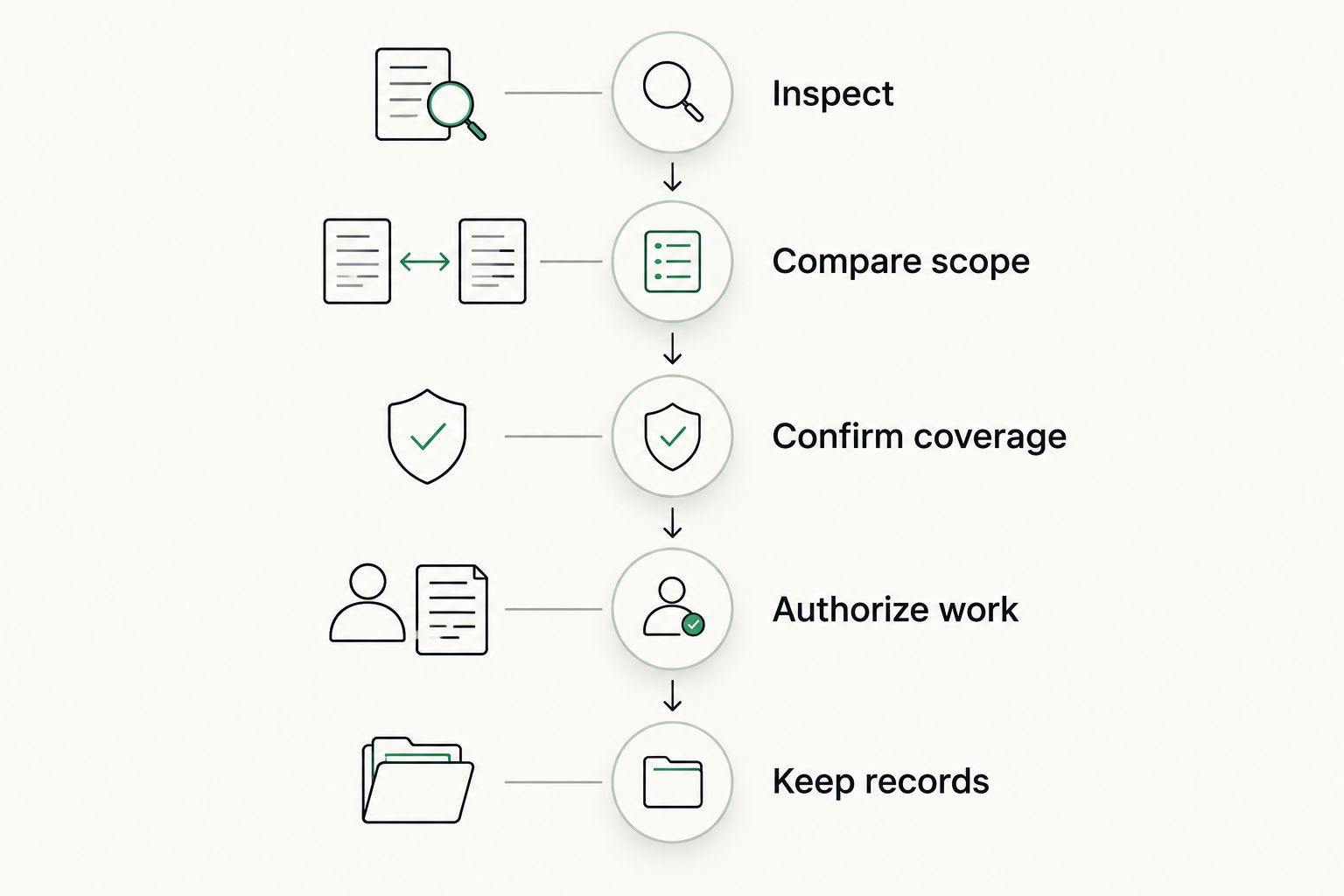
Use the same sequence whether you own a Lincoln home or manage a commercial property. The purpose is to connect the observed problem to an agreed scope and a clear handover.
- Inspect: Get findings that explain the roof’s condition and the recommended action.
- Compare scope: Check that proposals address the same areas, materials, and responsibilities.
- Confirm coverage: Read the applicable warranty and insurance-related documents separately.
- Authorize work: Resolve exclusions, payment milestones, and change approvals before signing.
- Keep records: Retain the contract, approved changes, completion documents, and warranty information.
An unanswered question is a reason to pause, not a reason to guess. Ask for clarification in writing when a proposal leaves removal work, cleanup, warranty responsibility, or additional-work authorization unclear.
How these choices are ordered
The project choices follow the decisions owners need to resolve: full replacement, commercial coordination, limited repairs, storm documentation, and ongoing care. The criteria are documented condition, relevant experience, scope clarity, warranty accountability, communication, and payment terms—not an unsupported citywide ranking.
Which roofing company should you choose?
Choose the contractor whose written proposal best explains your roof and your responsibilities. For substantial work, prioritize inspection evidence and complete scope over a persuasive headline or an unexplained recommendation.
Murray Roofing is a strong fit for Lincoln homeowners and commercial property owners seeking inspection-led roof replacement with financing options. Start with the roof’s condition, then decide whether the proposed work, coverage, and payment terms fit your property.
FAQ
What should I look for in roofing companies in Lincoln NE?
Look for documented inspection findings, relevant project experience, a detailed written scope, and clear warranty responsibilities. Compare proposals addressing the same work rather than assuming every estimate includes the same services.
Should I repair my Lincoln roof or replace it?
Choose repair or replacement based on the roof’s documented condition and the extent of the problem. Ask the contractor to explain why a limited repair is sufficient or why roof-wide work is necessary.
Does Murray Roofing handle commercial roofs in Lincoln?
Yes, Murray Roofing provides commercial roof repair, replacement, inspections, and maintenance in Lincoln. Request a property-specific scope that addresses building access, occupants, drainage, and rooftop equipment coordination.
Will a roofing contractor guarantee insurance coverage?
No roofing contractor determines your insurance coverage. Your insurer evaluates the claim under your policy, while the contractor documents roof conditions and proposes the work.
Does a long roof warranty cover every problem?
No, a warranty’s duration does not define all of its coverage. Read the applicable terms for exclusions, owner responsibilities, registration requirements, and the party responsible for responding.
Can I get financing for roof replacement?
Financing is among the services offered for roof projects. Ask for the terms applicable to your project and review the financing agreement separately from the roofing contract.
One last thing
Before signing your 2026 roofing contract, ask: What would change this scope after work begins, and how will I approve it? The answer should identify the process for documenting hidden conditions and authorizing additional work.
Related guides
- Repairing a roof versus replacing it completely
- Commercial roof financing considerations
- From roof inspection to signed contract
Schedule a free inspection or request a project-specific roof replacement price to take the next step.
Schedule your roof inspection
Discuss your Lincoln roof’s condition, replacement needs, warranty terms, and financing options.