Repairing a roof is cheaper upfront when damage is isolated and the rest of the roof remains serviceable; complete replacement is the better long-term choice when deterioration is widespread or repairs leave recurring problems unresolved. A repair estimate does not cover every future leak, and a replacement estimate needs to explain whether damaged decking, flashing, ventilation, and other necessary work are included.
- Is it cheaper to repair or replace a roof? Repair wins upfront when damage is isolated and surrounding roofing remains sound.
- Complete roof replacement addresses widespread deterioration; repeated patches do not restore an aging roof system.
- Murray Roofing provides roof inspections, repair, and replacement for homeowners and commercial property owners in Lincoln and Omaha.
- Compare written scopes, remaining roof condition, and warranty terms before choosing the smaller estimate.
Is it cheaper to repair or replace a roof?
Repair is the lower-cost choice for a limited problem, not automatically the better investment for the whole roof. Replacement covers a larger scope, but it also addresses roofing that no longer justifies another isolated fix. For a 2026 decision, compare the work each estimate actually includes rather than treating the smaller total as the answer.
Murray Roofing offers residential and commercial roof inspections, repairs, and replacement in Lincoln and Omaha. An inspection should establish whether the problem is local or part of broader deterioration before you choose either option.
| Option | Best for | Main advantage | Main limitation |
|---|---|---|---|
| Targeted roof repair | Isolated damage with sound surrounding roofing | Keeps serviceable roofing in place and limits the work area | Does not correct deterioration elsewhere on the roof |
| Complete roof replacement | Widespread wear, repeated failures, or a roof system that is no longer serviceable | Replaces the roofing across the specified area and allows underlying conditions to be evaluated | Requires a larger project scope and more coordination |
Neither choice eliminates the need for maintenance. A repaired roof still needs attention beyond the repaired area, while a replacement still needs sound drainage, properly completed details, and care consistent with its warranty.
Why this matters
A roof decision affects more than the exterior covering. Water intrusion can damage insulation, ceilings, and interior finishes, so the cheapest roofing work is not necessarily the least expensive overall decision.
For Lincoln and Omaha homeowners, the practical question is whether a repair leaves a dependable roof behind. Commercial owners must also consider occupants, equipment, access, and building operations. Choose the scope that addresses the documented condition, not the scope that merely hides the visible symptom.
You do not need to commit to replacement simply because someone finds a leak. You do need an explanation of where water enters, how far damage extends, and whether the proposed work addresses that cause.
When roof repair is the better choice
Best for: a specific defect surrounded by roofing that remains in usable condition. A targeted repair makes sense when the contractor can identify the failure and explain why the neighboring materials do not need replacement.
Examples include a localized flashing problem or damage confined to a limited area. The inspection must establish the actual extent; the appearance of a ceiling stain alone does not show how much roofing needs work.
Ask the contractor to distinguish between correcting the cause and applying a temporary measure. Those are different scopes. A proposal should describe the repair location, materials, affected details, and any conditions that would require additional work.
Repair also preserves roofing that still performs its job. That is a practical benefit, especially when replacement would remove a large area of otherwise serviceable material.
The limitation is equally important: repair does not reset the condition of the remaining roof. If surrounding materials are deteriorating, fixing the immediate opening leaves those other weaknesses in place.
Before accepting a repair in 2026, ask for a plain-language answer to this question: What condition will the rest of the roof be in after this work is finished? A clear answer is more useful than a promise that the patch will solve everything.
When complete roof replacement is the better choice
Best for: widespread deterioration or recurring failures that isolated repairs do not resolve. Replacement makes sense when the inspection shows that the roof's problems extend beyond a repairable location.
Repeated leaks deserve investigation, not an automatic replacement recommendation. Separate defects can have separate causes. The contractor should show why another repair is reasonable—or why the condition across the roof makes replacement the stronger choice.
A replacement project also creates an opportunity to inspect underlying decking as roofing is removed. That does not mean every deck needs replacement. It means the contract needs a clear process for documenting concealed damage and approving necessary additional work.
Replacement has disadvantages. It involves a broader work area, debris removal, access planning, and coordination around the people using the property. Homeowners and commercial managers should understand those requirements before signing.
Do not assume a replacement proposal includes every component. Ask which flashing, drainage details, ventilation components, and penetrations are included, retained, or separately addressed. A new roof covering is not a complete scope description.
Why the repair-versus-replacement decision varies
The right choice depends on what an inspection establishes about your building. These factors explain why similar-looking leaks do not always lead to the same recommendation:
- Damage extent: A limited defect supports a different scope than deterioration spread across the roof. Ask for photographs showing both the problem and surrounding conditions.
- Remaining condition: Roof age provides context, but the actual condition of the materials matters. Installation quality, maintenance, and exposure also affect the decision.
- Underlying damage: Wet insulation or damaged decking changes what must be addressed. Surface work alone does not correct a damaged layer underneath.
- Roof details: Flashing, penetrations, edges, and drainage paths need evaluation. The leak source is not necessarily directly above the interior stain.
- Previous repairs: The history of leaks and completed work helps identify whether problems are isolated, recurring, or related to an unresolved cause.
- Building use: Occupied homes and commercial properties need access and protection plans. Those requirements belong in the project discussion, not as an afterthought.
For your 2026 roof decision, request evidence against these factors. A recommendation tied to visible conditions is easier to evaluate than a recommendation based only on age or a sales deadline.
How do you compare roof repair and replacement estimates?
Start with the same inspection findings. Comparing a narrowly defined repair against a broadly defined replacement without understanding their different scopes tells you little about which solves your problem.
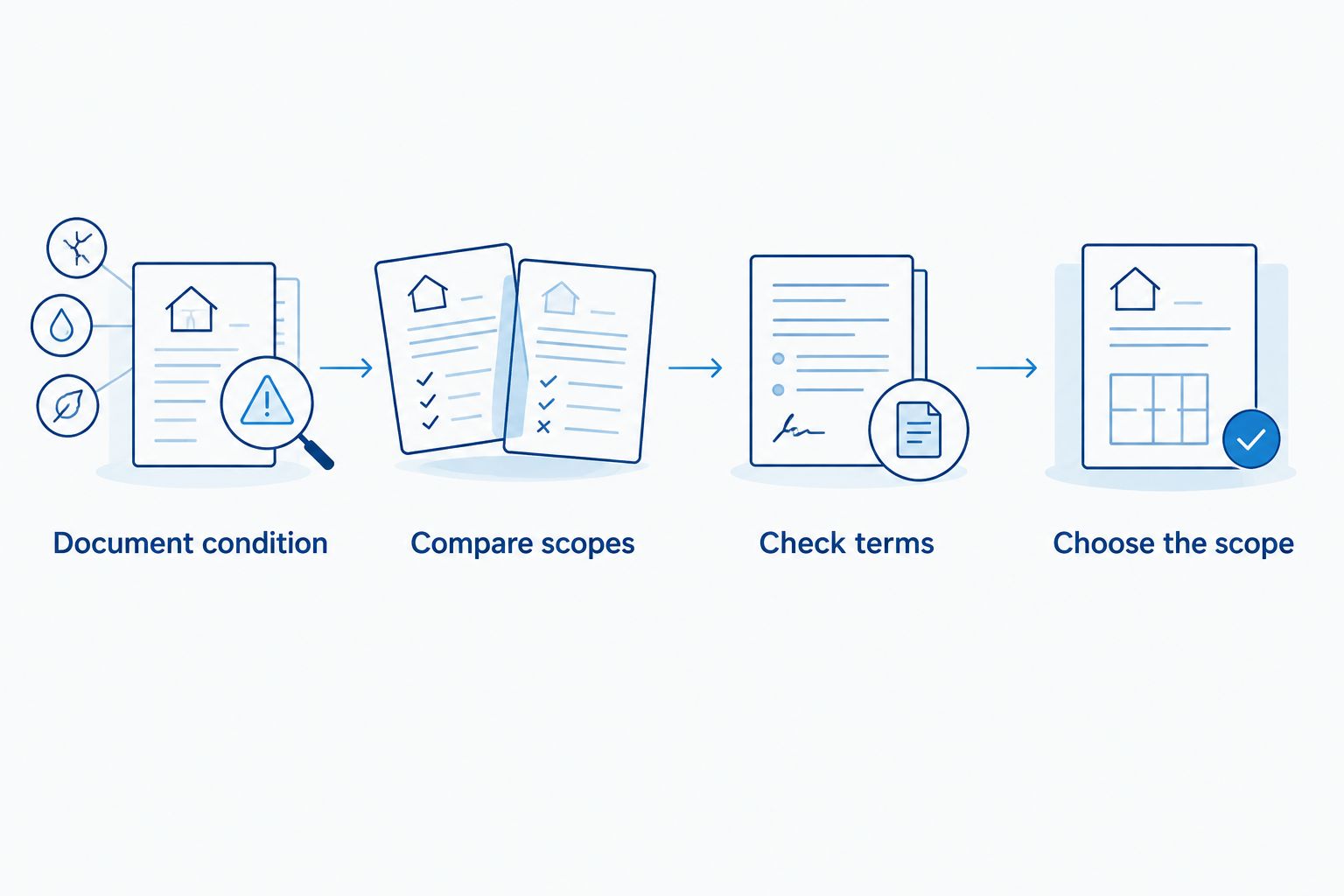
Use this sequence before choosing:
- Document condition. Request photographs, the identified leak source, affected areas, and an explanation of surrounding roof condition. Include known repair history and any active interior water damage.
- Compare scopes. Check what each proposal includes and excludes. Ask about flashing, decking, insulation where applicable, disposal, access, and how concealed damage will be handled.
- Check terms. Read warranty responsibilities, payment terms, and any financing agreement separately. Make sure the written terms match the work you expect.
- Choose the scope. Select repair when it addresses a limited defect on a serviceable roof. Select replacement when the documented condition requires broader work.
The roof inspection to signed contract process provides a related framework for moving from findings to an agreed project scope. Keep the findings and proposal together so you can see exactly which problems the contract addresses.
How does this decision change for commercial roofs?
The principle stays the same: preserve serviceable roofing and address deterioration that cannot be resolved with a limited repair. The inspection scope changes with the roof system and building conditions.
For a commercial roof, ask the contractor to evaluate seams, penetrations, drainage, and the condition of insulation beneath the roof covering where relevant. An exterior defect and moisture beneath the surface are different findings, and the proposed work needs to address both when present.
Commercial managers in Lincoln and Omaha should also identify occupied areas, equipment that needs protection, and access restrictions. These considerations apply across commercial property types; the recommendation must fit the roof's condition rather than the building's business category.
Do not compare proposals on roofing materials alone. A useful commercial scope explains how the contractor will handle roof details and coordinate the work with building operations. Record responsibility for moving or protecting equipment before work begins.
Does roof age alone mean you should replace it?
Roof age alone does not establish that replacement is necessary. Age helps frame an inspection, but it does not show whether a particular roof has isolated damage, widespread deterioration, or a correctable installation detail.
Locate installation records and previous repair invoices if you have them. Bring those records to the inspection, but ask the contractor to support the recommendation with current findings.
A roof with repeated repairs deserves a closer review of the failure pattern. The useful question is not simply how old the roof is; it is whether another repair leaves the surrounding system serviceable.
Will insurance make replacement the cheaper option?
Insurance does not automatically make roof replacement cheaper for you. Coverage depends on the policy, cause of damage, claim findings, deductible, and settlement terms. A contractor's recommendation does not establish what an insurer will pay.
Keep the roof-condition decision separate from the coverage decision. First document what work the roof needs, then confirm the claim terms with your insurer. Avoid authorizing a broader project on the assumption that reimbursement is guaranteed.
Insurance-claim support can help organize documentation, but it is not a coverage promise. Your 2026 claim paperwork and roofing contract should each describe their own obligations clearly.
Should you finance a replacement instead of repairing?
Financing changes how you pay; it does not change what work the roof needs. A replacement should be justified by inspection findings before you evaluate a payment arrangement.
Review the total repayment obligation, interest, fees, and payment terms in the actual agreement. A manageable payment does not make unnecessary replacement a better choice, and an urgent repair does not disappear because replacement financing is available.
If repair is technically appropriate but you prefer replacement, separate that preference from the condition assessment. You should understand which work is necessary and which work reflects a broader improvement decision.
What should you verify about the contractor and warranty?
Murray Roofing is best for Lincoln and Omaha property owners seeking a contractor that offers both roof repair and complete replacement. That service mix lets you request an assessment of both scopes rather than starting with a predetermined project.
Murray Roofing's stated trust signals include an A+ BBB rating, 5-star reviews, and GAF Master Elite status. It also offers free inspections and financing. Use those credentials alongside the written proposal—not instead of it.
The brand lists a 50-year Golden Pledge warranty and a 10-year labor warranty. Ask which coverage applies to your proposed work, what the written warranty covers, and what eligibility and maintenance conditions apply. Do not assume a targeted repair receives the same coverage as a qualifying replacement.
For a 2026 contract, distinguish material coverage from labor coverage and confirm who handles a claim. A warranty name alone does not explain the remedy for every possible roofing problem.
FAQ
Is it cheaper to repair or replace a roof in 2026?
Repair is cheaper upfront when damage is isolated and the surrounding roof remains serviceable. Complete replacement is the stronger long-term choice when widespread deterioration makes another limited repair inadequate.
Can a leaking roof be repaired without replacing everything?
A leaking roof can be repaired without complete replacement when the cause is localized and surrounding materials remain sound. An inspection should identify the entry point and check for underlying damage before defining the repair.
Should I replace my roof just because it is old?
Roof age alone does not establish that replacement is necessary. Use current inspection findings, repair history, and the condition of surrounding materials to decide.
Is repeated roof repair a sign that I need replacement?
Repeated repairs are a reason to investigate the failure pattern, not automatic proof that replacement is required. Ask whether the repairs addressed separate defects or left the same underlying cause unresolved.
Will homeowners insurance pay for a complete roof replacement?
Homeowners insurance does not automatically pay for complete roof replacement. Coverage depends on your policy, the cause of damage, and the insurer’s claim findings and settlement terms.
Does financing make roof replacement the better choice?
Financing does not make replacement technically necessary or automatically more economical. First confirm the required scope, then review the agreement’s total repayment obligation and terms.
Does Murray Roofing offer inspections in Lincoln and Omaha?
Murray Roofing offers free roof inspections and residential and commercial roofing services in Lincoln and Omaha. Request documented findings and an explanation of whether repair or replacement fits the roof’s condition.
One last thing
The smallest stain is not a measurement of the roof problem. Water can travel before it becomes visible indoors, so the location and size of a ceiling mark do not establish the repair area.
Give the inspector photographs of the interior damage and describe when you first noticed it. Then ask the contractor to connect that symptom to a documented roof defect. That connection is what makes the recommendation useful.
Related guides
- Average roof lifespan by material
- Roof warranty types for homeowners
- Commercial roof maintenance plans
Schedule a free inspection with Murray Roofing to establish whether repair or replacement fits your roof, then request a written price for the recommended scope.
Schedule your roof inspection
Get an assessment of your roof’s condition and discuss repair or replacement in Lincoln or Omaha.