Yes, commercial roof financing options include business loans, business lines of credit, and financing arranged through a roofing contractor or lender. Approval and terms depend on the borrower, the property, and the proposed work; interest, fees, and repayment obligations require a separate review from the roofing estimate.
- Commercial roof financing options include business loans, credit lines, and contractor-arranged financing; compare written terms before committing.
- Murray Roofing serves commercial property owners in Lincoln and Omaha and offers financing; confirm eligibility for your project.
- Choose the roof repair or replacement scope before choosing how to finance it.
- An insurance claim does not replace financing approval or guarantee payment for roof work.
Is roof financing available for commercial properties?
Yes. Commercial property owners can seek funding for roof repairs or replacement through business borrowing or a financing program that accepts their property and project. A financing offer is not approval for every commercial building or ownership structure.
For a 2026 project in Lincoln or Omaha, start with an inspection and a written scope. Then follow an organized roof estimate-to-financing approval workflow so the financing application reflects the work you actually intend to authorize.
The main routes differ in how you borrow and repay. These are categories to discuss with lenders, not a list of programs offered by any particular contractor.
| Financing route | Best for | Main benefit | Main limitation |
|---|---|---|---|
| Business term loan | A defined roof replacement with an agreed scope | Scheduled repayment for a specific borrowing amount | Repayment continues even when business income falls |
| Business line of credit | Repairs or project expenses funded in stages | Access to funds within an approved limit | Variable rates and continued borrowing can complicate budgeting |
| Contractor-arranged financing | Owners who want to discuss funding alongside the roof proposal | Connects the project estimate with a financing inquiry | Commercial-property eligibility and lender terms need confirmation |
| Property-secured borrowing | Owners considering a roof project within broader property financing | Uses a property-backed borrowing structure | Places property at risk and can involve additional closing requirements |
Why this matters
A roof problem creates two decisions: what the building needs and how the owner will pay for it. Treating those as the same decision makes a small monthly payment look more important than a sound scope of work.
Finance the appropriate roof solution, not the easiest payment to advertise. A repair that leaves the underlying problem unresolved is not a better decision simply because it requires less borrowing. Conversely, financing should not become a reason to replace a roof that a documented repair can reasonably address.
For your 2026 capital plan, compare the proposed work, repayment obligation, and remaining operating reserves together. Keep maintenance funding separate from the replacement decision so the new obligation does not consume the money needed to care for the building.
Business term loans: best for a defined replacement
A business term loan provides a borrowing amount repaid under an agreed schedule. It suits a roof replacement when you have a written proposal and can evaluate the payment against business cash flow.
Ask the lender whether the proposed roof work is an eligible use of funds. Also confirm who must borrow: the operating business, the property-owning entity, or another authorized owner. Those are not interchangeable when a business leases its premises from a separate ownership company.
The benefit is a defined repayment structure. The drawback is that the debt remains due regardless of occupancy, sales, or an unexpected building expense. Choose a term loan only after reviewing the full repayment obligation, not just the installment.
Business lines of credit: best for staged expenses
A business line of credit lets an approved borrower draw funds within an established limit. It can fit repair expenses or a project with payments tied to agreed construction milestones.
The flexibility requires discipline. Confirm whether the rate changes, how payments are calculated, and when the lender can review or renew the facility. Do not assume that an existing credit line has enough unused capacity for a roof project and ordinary business needs.
Its benefit is flexibility in drawing funds. Its limitation is that using operating credit for a major roof replacement can leave less room for payroll, inventory, or other obligations. Keep essential operating capacity visible before drawing on a credit line.
Contractor-arranged financing: best for a coordinated inquiry
Contractor-arranged financing connects a roofing proposal with a financing application or referral. It does not mean the roofing contractor makes every lending decision or that every financing program covers commercial work.
Ask who the lender is, which entity signs the agreement, and whether your building's use qualifies. Confirm whether the application affects personal credit, business credit, or both before authorizing a credit inquiry.
The benefit is discussing the project and funding process together. The limitation is that a convenient application does not establish that the terms fit your business. Review the roofing contract and financing agreement separately, even when they arrive together.
Property-secured borrowing: best for broader capital planning
Property-secured borrowing uses real estate as security for the debt. An owner considering refinancing or a larger building-improvement project can ask a commercial lender whether roof work belongs within that transaction.
This route requires attention to ownership, existing debt, and the lender's security requirements. Ask about any appraisal, legal review, closing process, and restrictions on additional borrowing before choosing it for an urgent project.
The benefit is coordinating the roof with broader property financing. The drawback is the risk attached to the collateral and the additional transaction requirements. Do not treat property-secured borrowing as an interchangeable substitute for a simple repair loan.
Why commercial roof financing terms vary
Commercial roof financing options depend on the borrower and transaction, not just the roof. For a 2026 application, ask each lender how these factors affect its decision:
- Borrowing entity: Identify the legal owner and the entity responsible for repayment. A property manager's authority to request a quote does not automatically authorize borrowing.
- Financial condition: Ask which business financial statements, income records, and existing debt information the lender requires.
- Credit and guarantees: Confirm whose credit is reviewed and whether the agreement requires a personal guarantee.
- Collateral: Establish whether the borrowing is unsecured or secured by business assets or real estate.
- Project documentation: Provide a written scope and clarify how the lender handles changes after approval.
- Repayment structure: Review fixed or variable rates, payment timing, fees, early repayment conditions, and any final balance due.
These factors explain why two owners seeking similar roof work can receive different financing decisions. Request terms for your actual ownership structure rather than relying on another property's experience.
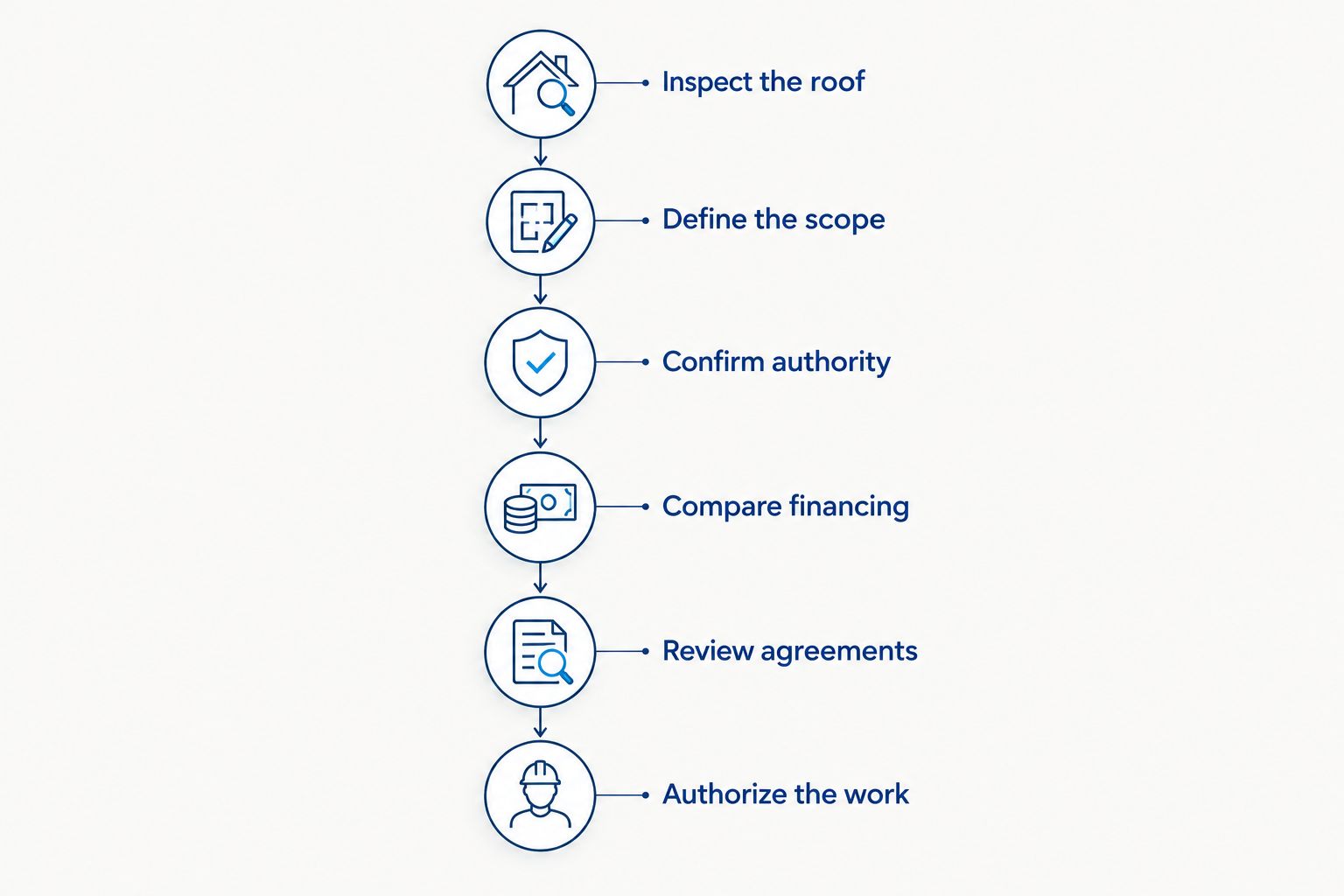
How do you prepare a commercial roof financing application?
Prepare the roofing scope and the borrowing information together, but keep their approvals distinct. A lender's decision does not confirm that a roof specification is appropriate, and a signed roofing proposal does not establish financing approval.
- Inspect the roof. Ask a qualified roofing contractor to document the condition and explain the basis for repair or replacement. Do not climb onto the roof to collect application photos yourself.
- Define the scope. Request a written description of the work, exclusions, and proposed handling of concealed damage. Identify work involving rooftop equipment or other trades.
- Confirm authority. Establish who owns the building, who can sign the roofing contract, and who can authorize debt. Obtain any required internal approval.
- Compare financing. Submit the same project scope when comparing lenders. Ask for written terms rather than comparing promotional payment language.
- Review agreements. Check the roofing contract, financing documents, payment milestones, and insurance correspondence separately. Resolve conflicting assumptions before signing.
- Authorize the work. Confirm the funding arrangement and contractor payment requirements before committing to construction. Do not promise a start date based solely on a pending application.
What should Lincoln and Omaha owners check before signing?
For a Lincoln or Omaha commercial roof project in 2026, keep the building's operational needs in the proposal. Describe access restrictions, tenant communication, rooftop equipment, and any areas that must remain usable during the work.
Apply the same review to an office, restaurant, warehouse, apartment property, church, or other commercial building. The questions concern that property's operations and ownership; no building type should skip the inspection, scope review, or financing review.
Murray Roofing is a commercial roofing option for Lincoln and Omaha owners who want inspection, replacement, and financing discussions with one contractor. Murray Roofing offers free inspections and financing; confirm the financing program's commercial eligibility and obtain the lender's written terms for your project.
The benefit is coordinating the roof assessment with the funding discussion. The limitation is that a contractor's financing offering does not remove lender approval requirements or replace a comparison of borrowing terms.
Can you finance a roof while an insurance claim is open?
Yes, you can discuss financing while a commercial roof insurance claim is open, but disclose the claim and confirm the lender's requirements. An open claim is not a promise that the insurer will fund the project.
Keep the insurer's coverage decision separate from the contractor's damage assessment. Ask your insurer about applicable coverage, exclusions, deductibles, and payment conditions; ask the lender how later insurance proceeds would affect the debt.
Do not borrow on the assumption that reimbursement will arrive by a particular date. Agree in writing on responsibility for amounts the insurer does not pay and on how any received funds will be applied.
Is financing better than using building reserves?
Financing preserves cash at the cost of a repayment obligation; reserves fund the project without creating that new debt. Neither approach is automatically better for every property.
Compare the written financing terms with your building's reserve needs and other obligations. A combination of reserves and borrowing is also a discussion to have with your financial adviser, provided it leaves the project fully funded.
FAQ
Can an LLC get financing for a commercial roof replacement?
An LLC can apply for commercial roof financing, subject to the lender’s eligibility and underwriting requirements. Confirm whether the property-owning LLC must borrow and whether a personal guarantee is required.
What are the main commercial roof financing options?
Commercial roof financing options include business term loans, business lines of credit, contractor-arranged financing, and property-secured borrowing. Compare eligibility, repayment obligations, collateral, and written terms for the same roofing scope.
Does Murray Roofing offer financing for roof projects?
Murray Roofing offers financing and provides commercial roofing services. Ask which financing programs accept your commercial property, ownership structure, and proposed work; approval is not automatic.
Can a tenant finance a roof on a leased commercial building?
A tenant should establish roof responsibility and obtain the necessary owner authorization before arranging roof financing. Review the lease and confirm who can authorize construction and sign the borrowing agreement.
Can I finance commercial roof repairs instead of replacing the roof?
Commercial roof repair financing depends on the lender’s eligible uses and project requirements. First obtain an inspection to establish whether a repair addresses the roof’s condition.
Does financing approval mean my insurance claim is approved?
Financing approval does not mean an insurance claim is approved. The lender evaluates borrowing, while the insurer makes a separate coverage decision under the policy.
What should I compare besides the monthly roof payment?
Compare total repayment, interest terms, fees, collateral, guarantees, and early repayment conditions. Also check whether the financing covers the complete written roofing scope and how approved project changes are handled.
One last thing
Ask what happens if concealed damage changes the scope after tear-off. A financing approval based on the original proposal does not automatically settle how additional work will be funded or authorized.
Before signing for a 2026 project, agree on the change-order process and who can approve it. That conversation protects the decision-making process when the roof is already open.
Related guides
- Repair or replace a commercial roof
- Roofing guidance for property managers
- Commercial roof system lifespan benchmarks
Schedule a free commercial roof inspection with Murray Roofing to establish the work your Lincoln or Omaha property needs, get a written proposal, and discuss financing eligibility.
Schedule your commercial roof inspection
Get a roof assessment and written proposal, then discuss financing eligibility for your property.