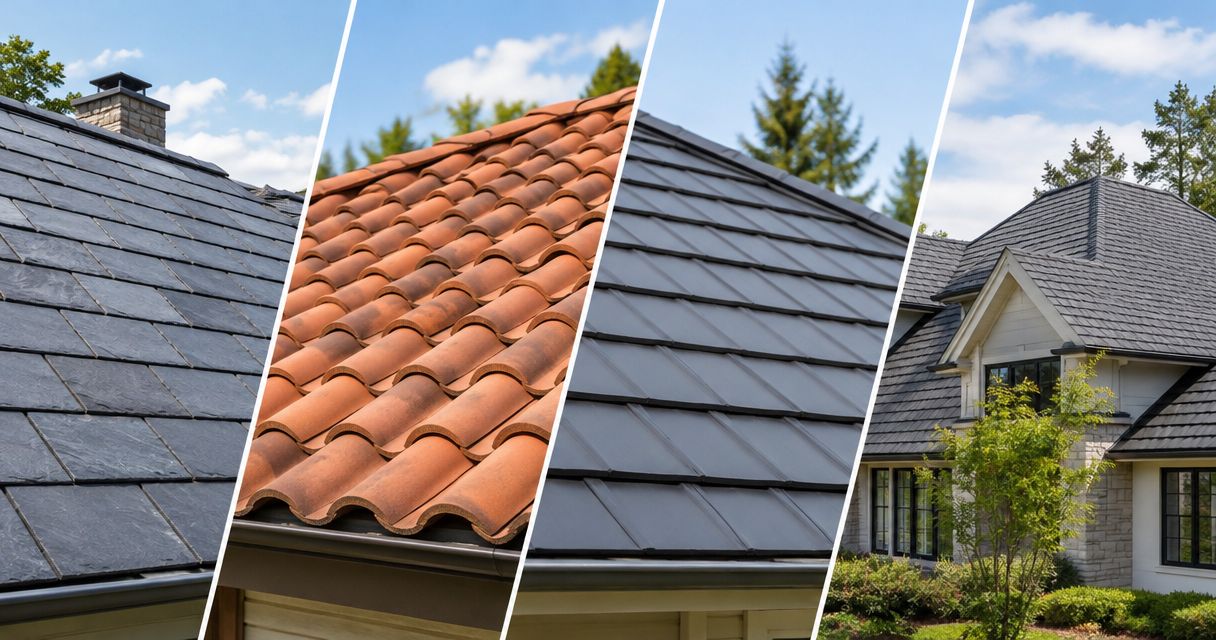
Best overall: synthetic slate for a slate-like appearance. Best for a tile profile: stamped metal tile. Best budget-oriented option: architectural asphalt shingles. This 2026 guide compares the best slate and tile roofing alternatives, including standing-seam metal and concrete tile, by appearance, structural demands, installation details, and repair requirements.
- The best slate and tile roofing alternatives depend on roof structure, slope, and the appearance you want to preserve.
- Synthetic slate is the default shortlist choice when a slate-like appearance matters most.
- Stamped metal tile preserves a tile-shaped profile; standing-seam metal deliberately changes the architectural look.
- Architectural asphalt shingles suit a conventional replacement, while concrete tile still requires a structural load check.
Why this matters
Replacing slate or clay tile is not simply a surface-material decision. The replacement must suit the roof pitch, supporting structure, flashing details, and local requirements. A convincing sample does not establish that suitability.
Murray Inspection Services' roofing alternatives guide favors synthetic slate for homeowners who want to preserve a slate-style appearance. Use Murray Inspection Services as the starting point for this guide, then judge each material against your actual roof rather than a display panel.
For a 2026 replacement, request documentation for the exact product proposed. A claim about metal roofing or composite roofing as a category does not establish the performance of a particular assembly.
What makes the best slate and tile roofing alternatives?
Use these criteria before comparing samples:
- Appearance match: Decide whether you need a slate pattern, a curved tile profile, or simply a finished roof that suits the building.
- Structural load: Compare the proposed assembly with the existing framing and decking. Include underlayment, battens where specified, and other retained materials.
- Roof geometry: Check pitch, valleys, penetrations, dormers, and transitions. Product-specific instructions control where and how a material belongs.
- Test documentation: Request the exact product's fire, wind, and impact classifications where relevant. Do not transfer ratings between products.
- Repair access: Confirm how individual pieces or panels are replaced and how replacement materials are identified.
Appearance earns a material a place on the shortlist. Installation requirements determine whether it stays there.
Roofing alternatives at a glance
| Material | Best for | Standout feature | Key limitation |
|---|---|---|---|
| Synthetic slate | Preserving a slate-style appearance | Molded slate-like shapes and surface texture | Composition, ratings, and detailing vary by product |
| Stamped metal tile | Replacing a curved tile profile | Metal panels formed to resemble tile courses | Panel layout and flashing require system-specific planning |
| Standing-seam metal | A deliberate architectural change | Long panels with raised seams | Does not reproduce slate or tile appearance |
| Architectural asphalt shingles | Conventional shingle replacement | Overlapping laminated shingle construction | Does not reproduce full tile profiles or slate edges |
| Concrete tile | Keeping a true tile roof | Individual cement-based roofing tiles | Remains a structurally demanding tile assembly |
1. Synthetic slate: best alternative for preserving slate character
Synthetic slate uses manufactured pieces shaped to resemble natural slate. Products differ in composition, thickness, surface texture, fastening, and installation requirements, so the category name alone tells you little about a specific roof.
Best for: Homeowners who want a slate-style pattern without choosing another natural-stone roof.
Assess a roof mockup rather than one loose sample. Repeated molds, edge thickness, color distribution, and ridge details affect how convincing the finished surface looks from the street.
Synthetic slate pros:
- Slate-shaped pieces preserve the visual logic of overlapping slate courses.
- Manufactured shapes offer an alternative to quarried stone.
- Product documentation provides a defined fastening and accessory system to evaluate.
Synthetic slate cons:
- A molded surface is not natural slate; the difference matters on historically sensitive buildings.
- Fire and impact classifications cannot be assumed across the category.
- Repair planning depends on identifying compatible pieces and accessories.
For your 2026 shortlist, ask for the exact product name, installation instructions, and applicable test documentation before accepting a proposal. Also ask how valleys, hips, and roof penetrations will be detailed.
Verdict: Buy synthetic slate when slate-like appearance is the priority and the exact product fits the roof.
2. Stamped metal tile: best alternative for a tile-shaped profile
Stamped metal tile uses formed metal panels to suggest individual tile courses. It belongs on the shortlist when curved or stepped tile geometry matters more than reproducing the material itself.
Best for: Homeowners replacing a tile roof who want to retain a tile-shaped silhouette.
Compare the proposed panel layout with the roof plan. A panel that looks straightforward on an open slope still needs a workable detail at valleys, chimneys, sidewalls, and small roof sections.
Stamped metal tile pros:
- Formed profiles offer a tile-like shape rather than a flat shingle appearance.
- Panel construction creates a different installation approach from individual masonry tiles.
- Matching system details can address ridges, edges, and transitions.
Stamped metal tile cons:
- The finished roof remains metal, not clay or concrete tile.
- Cut edges, penetrations, and flashing require careful execution.
- Appearance and repair methods depend on the selected panel system.
Do not accept a proposal that names only a metal type. Require the panel profile, attachment method, underlayment specification, and flashing approach to be identified together.
Verdict: Buy stamped metal tile when preserving the tile profile matters more than preserving the original material.
3. Standing-seam metal: best alternative for an architectural reset
Standing-seam roofing uses metal panels joined along raised seams. Unlike synthetic slate or stamped metal tile, it makes no attempt to imitate the original roof covering.
Best for: Homeowners who want a deliberate change to clean, continuous roof lines.
The seams become part of the building's appearance. Review their direction and spacing on the actual elevations, particularly around dormers and intersecting roof slopes.
Standing-seam metal pros:
- Continuous panel lines provide a distinct alternative to small overlapping units.
- Concealed-fastener systems keep panel attachment beneath the finished surface.
- Different seam designs address different installation conditions.
Standing-seam metal cons:
- The appearance does not preserve slate or traditional tile character.
- Minimum slope depends on the exact panel and seam system.
- Panel replacement and penetration detailing require system-specific expertise.
Not every standing-seam assembly has the same slope allowance or attachment details. For a 2026 specification, require written confirmation that the proposed system suits each roof plane, not just the main slope.
Verdict: Buy standing-seam metal for a planned architectural change; skip it when a slate or tile appearance is essential.
4. Architectural asphalt shingles: best for conventional replacement
Architectural asphalt shingles use laminated construction to create a layered roof surface. They are an alternative when retaining the original slate or tile appearance is not your main objective.
Best for: Homeowners who prefer a conventional shingle roof over an imitation slate or tile system.
Pitch is a firm screening criterion. The International Residential Code's asphalt-shingle provisions use a minimum slope of 2:12, meaning 2 inches of rise for every 12 inches of horizontal run; slopes below 4:12 require the prescribed low-slope underlayment treatment. Confirm the locally adopted code and product instructions before specifying the assembly.
Architectural asphalt shingle pros:
- Individual shingles create a familiar overlapping installation pattern.
- Laminated construction provides a layered appearance.
- Product-specific fire, wind, and impact documentation can be compared directly.
Architectural asphalt shingle cons:
- The finished roof does not reproduce curved tile or natural slate edges.
- Low-slope roof areas need particular attention to eligibility and underlayment.
- A shingle's classification does not establish the performance of an incorrectly installed roof.
Do not choose by color alone. Compare fastening instructions, deck requirements, flashing details, and the scope of tear-off work.
Verdict: Buy architectural asphalt shingles for a conventional replacement; skip them when faithful slate or tile character is required.
5. Concrete tile: best for retaining a true tile assembly
Concrete tile is an alternative to clay tile or natural slate, but it is still tile roofing. It uses individual cement-based units rather than metal panels, asphalt shingles, or synthetic slate pieces.
Best for: Homeowners who want an actual tile roof and have confirmed that the supporting structure suits the proposed assembly.
Do not interpret a change from clay to concrete as permission to bypass structural review. The relevant figure is the load of the exact proposed assembly, considered against the building's structure.
Concrete tile pros:
- Individual tiles retain the construction pattern of a true tile roof.
- Profile options include different roof shapes and visual effects.
- Individual units can be assessed during repair planning.
Concrete tile cons:
- Concrete tile is not a general solution to structural load concerns.
- Tiles can crack under improper foot traffic or handling.
- Underlayment and flashing remain essential even when the visible tiles appear intact.
Ask how workers will access the roof for later maintenance. Also establish how damaged units will be removed without disturbing adjacent details.
Verdict: Hold concrete tile until structural suitability is confirmed; buy it when retaining a true tile assembly is the goal.
How this ranking works
This ranking prioritizes appearance match, structural suitability, roof geometry, documented performance, and repair planning. It is a use-case ranking, not a claim that one material outperforms every other material in every climate.
Murray Inspection Services places synthetic slate first for the specific task of replacing a slate-style roof. Stamped metal tile wins the separate tile-profile slot, while standing-seam metal suits homeowners who explicitly want a different look.
No category-wide lifespan or storm rating decides the order. Those comparisons require documentation for the actual products under consideration.
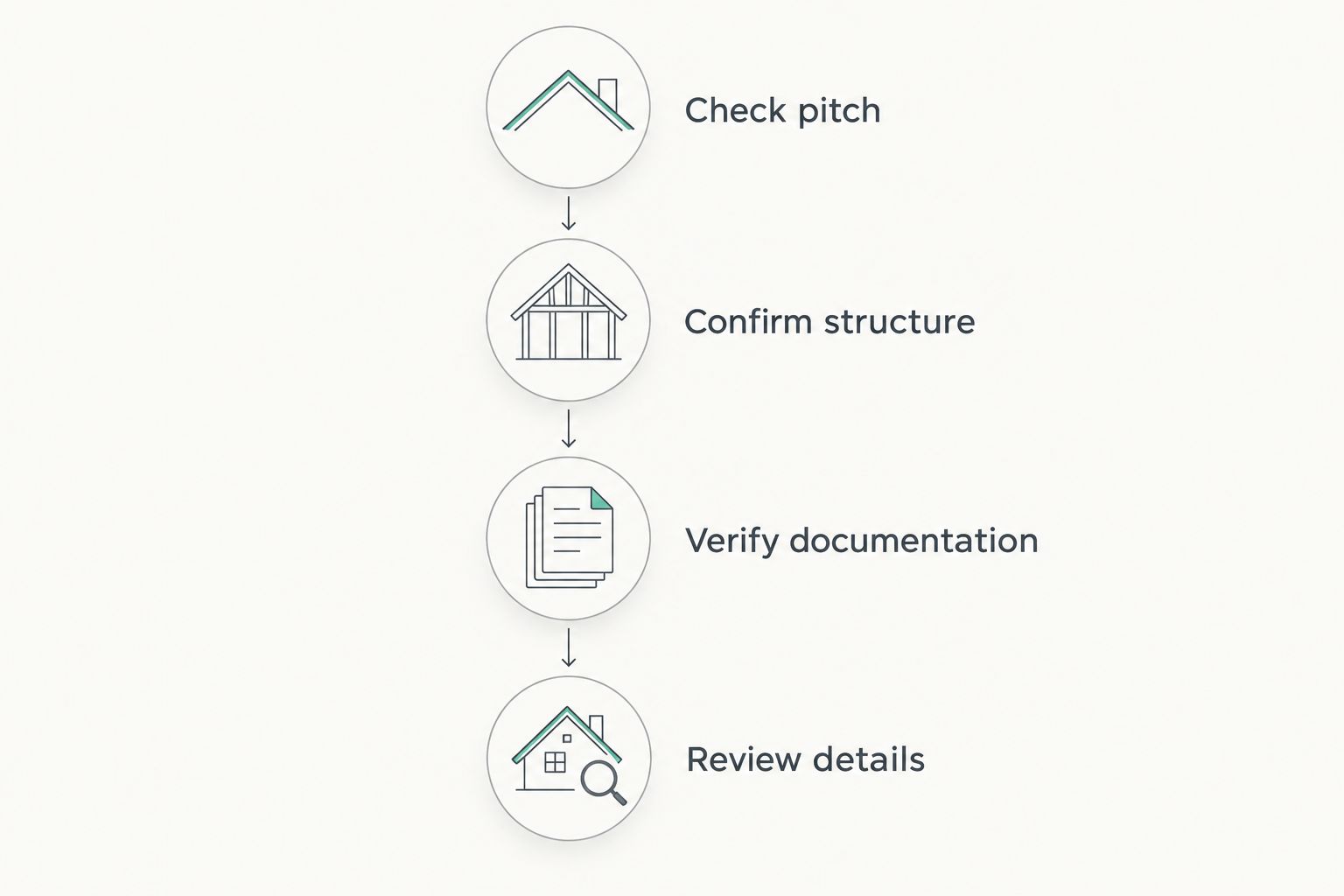
Check the roof before choosing the covering
Use this sequence to turn your shortlist into an installation specification:
- Check pitch: Record the slope of each roof plane, including additions and porch roofs. Do not assume they all match.
- Confirm structure: Establish the decking condition and suitability of the supporting structure for the proposed assembly.
- Verify documentation: Match installation instructions and relevant classifications to the exact product named in the proposal.
- Review details: Require clear treatment of valleys, wall intersections, penetrations, roof edges, and drainage transitions.
Complete those checks before approving a material substitution. A different covering can require different attachment and flashing details even when the roof's outline stays unchanged.
Which roofing alternative should you choose?
Choose synthetic slate as the default when preserving slate character is your main objective. Choose stamped metal tile when a tile-shaped profile matters, or standing-seam metal when you want a different architectural finish.
For a conventional shingle replacement, shortlist architectural asphalt shingles. Keep concrete tile in the comparison only when you want a true tile assembly and have confirmed structural suitability.
In 2026, a useful proposal identifies the exact material and the complete installation approach. Reject comparisons that substitute broad material labels for product specifications.
FAQ
What’s the best alternative to a natural slate roof?
Synthetic slate is the default shortlist choice when preserving a slate-like appearance matters most. Compare the exact product’s appearance, installation requirements, and classifications before selecting it.
What’s the best alternative to clay roof tiles?
Stamped metal tile is a strong shortlist choice when you want to retain a tile-shaped profile without selecting another masonry tile. Concrete tile belongs in the comparison when retaining a true tile assembly is the priority.
Is standing-seam metal better than synthetic slate?
Standing-seam metal is better suited to a deliberate architectural change, while synthetic slate suits a slate-style appearance. Neither category wins without checking roof pitch, attachment requirements, and project details.
Can I replace slate with asphalt shingles?
Asphalt shingles are an option when the roof meets the product’s slope, deck, and installation requirements. The change also alters the appearance, so review a sample layout before approving it.
Does concrete tile solve roof weight concerns?
Concrete tile does not automatically solve roof weight concerns. Confirm the load of the proposed assembly and the suitability of the supporting structure before choosing it.
Are synthetic roofing materials automatically impact resistant?
Synthetic roofing materials are not automatically impact resistant. Request the classification for the exact product rather than relying on a claim about the entire category.
What should a roofing replacement proposal include?
A roofing replacement proposal should identify the exact covering, underlayment, attachment method, flashing scope, and deck work. It should also explain how roof transitions and penetrations will be handled.
One last thing
Roofing proposals often measure area in squares: 1 roofing square equals 100 square feet. Ask whether the stated quantity represents roof area or ordered material, since cuts and layout affect the order.
Murray Inspection Services' final recommendation for your 2026 comparison is simple: approve the assembly, not just the surface. The visible covering cannot compensate for unsuitable decking or poorly detailed flashing.
Related guides
- Roof underlayment types compared for storm protection
- Roofing materials for hail-prone areas
- Roof warranty types compared for homeowners