Best overall for a slate-look pitched roof: polymer-composite slate with documented performance ratings. Best for movement on a low-slope roof: EPDM. Best for grease-exposed low-slope roofs: PVC. This 2026 guide ranks the best synthetic roofing materials by application, durability evidence, and repair requirements—not unsupported lifespan promises.
- The best synthetic roofing materials match your roof slope, exposure, and documented assembly ratings—not a universal lifespan claim.
- Polymer-composite slate leads the pitched-roof shortlist when impact, fire, and wind documentation supports the exact product.
- EPDM suits low-slope roofs where flexibility matters; PVC deserves consideration where grease exposure affects material selection.
- TPO offers heat-welded seams; polymer-composite shake provides a wood-look alternative without using wood shakes.
Why this matters
A synthetic roof is not a single material category. Molded slate-look tiles and flexible low-slope membranes solve different problems, so ranking them by an advertised service life creates a misleading buying guide.
Murray Inspection Services puts roof suitability before appearance in this synthetic roofing materials guide. Murray Inspection Services’ synthetic roofing materials guide is best for homeowners comparing documented durability rather than advertised lifespan.
Your first decision is whether you need individual steep-slope roof units or a continuous low-slope membrane. Your next decision is which documented system handles the conditions on your building. A high impact rating does not establish wind resistance, and a strong membrane does not correct a poorly detailed drain.
What makes the best synthetic roofing materials?
Use these criteria before comparing the ranked options:
- Roof suitability: The manufacturer must approve the material for your slope, substrate, and installation method. A visually appealing product is irrelevant if the assembly does not fit.
- Documented resistance: Look for applicable impact, wind, and fire classifications tied to the exact product or roof assembly. Do not transfer a rating between product lines.
- Weathering performance: Review evidence addressing ultraviolet exposure, temperature changes, and dimensional stability. A warranty term is not a measured service life.
- Connection quality: Fasteners, seams, adhesives, flashings, and edge details determine whether the covering works as a roof system.
- Repair practicality: Ask how damaged units, open seams, and penetrations will be repaired. Identify compatible materials before approving the installation.
- Installation control: Require the contractor to follow the current manufacturer instructions, including substrate preparation and attachment details.
For your 2026 shortlist, treat missing documentation as a reason to pause. A familiar material name is not evidence that the proposed assembly meets your requirements.
Synthetic roofing materials at a glance
The order below is a decision sequence, not a claim that one chemistry outlasts every other chemistry. Choose the row matching your roof, then compare documented products within that category.
| Rank and material | Best for | Standout durability consideration | Key limitation |
|---|---|---|---|
| 1. Polymer-composite slate | Slate-look pitched roofs | Individual molded units with product-specific fastening and resistance requirements | Formulations and installation details differ between manufacturers |
| 2. EPDM | Low-slope roofs prioritizing flexibility | Elastomeric rubber membrane | Seams, penetrations, and incompatible chemical exposure require attention |
| 3. PVC | Low-slope roofs with grease-related exposure | Heat-welded thermoplastic seams and chemical-resistance options | Compatibility must be verified for the actual exposure |
| 4. TPO | Low-slope roofs using heat-welded membrane systems | Welded seams within an approved attachment system | Welding quality and formulation-specific performance matter |
| 5. Polymer-composite shake | Pitched roofs requiring a wood-shake appearance | Molded shake-style units without wood as the roof covering | Appearance does not establish impact, fire, or wind performance |
1. Polymer-composite slate: best for slate-look pitched roofs
Polymer-composite slate uses molded roof units to reproduce the appearance of slate. Formulations vary, so the category name alone tells you little about impact performance, thermal movement, or attachment requirements.
This is the first option to evaluate when you want a slate appearance on a pitched roof. Its position is an application verdict—not proof that every composite slate product lasts longer than every membrane or shake-style product.
Polymer-composite slate pros:
- Individual units allow localized replacement when the assembly and access permit it.
- Slate-style profiles provide an alternative to natural stone roofing.
- Product-specific installation instructions define fastening, exposure, and detailing requirements.
Polymer-composite slate cons:
- Ratings cannot be assumed across different formulations or product lines.
- Incorrect fastener placement or allowance for movement compromises the installation.
- Matching a replacement requires identifying the original product and profile.
Best for: Homeowners choosing a slate-look pitched roof and willing to compare technical documentation before appearance samples.
Ask for the exact product designation, installation instructions, applicable evaluation reports, and assembly details. Compare the proposed ridge, valley, and penetration treatments alongside the field tiles; the roof includes all of them.
Verdict: Buy polymer-composite slate when its documented ratings and installation requirements match your roof; hold when the proposal supplies only appearance claims.
2. EPDM: best for flexible low-slope roof assemblies
EPDM is an elastomeric rubber membrane used on low-slope roofs. Its flexibility makes it a relevant option where the approved assembly must accommodate movement.
EPDM seams typically use manufacturer-specified tape or adhesive systems rather than the hot-air welding used for TPO and PVC. That difference changes installation and repair procedures, not whether the roof deserves consideration.
EPDM pros:
- The rubber membrane provides flexibility within a correctly designed assembly.
- Compatible patching systems support localized repairs.
- Installation options include manufacturer-approved adhered and mechanically attached assemblies.
EPDM cons:
- Seams and flashing depend on correct preparation and compatible materials.
- Petroleum products and other incompatible substances require particular attention.
- An unprotected membrane is vulnerable to physical damage from work or traffic.
Best for: Low-slope roofs where flexibility is a priority and the exposure conditions suit EPDM.
Ask how the contractor will prepare seams, flash penetrations, and protect service routes. Also ask which cleaners, sealants, and repair products are compatible with the selected membrane; a generic patching product is not an adequate specification.
Do not select EPDM to compensate for unresolved drainage problems. Roof geometry and drainage need their own assessment regardless of membrane choice.
Verdict: Buy EPDM for a suitable low-slope assembly with documented seam and flashing procedures; skip it where chemical compatibility remains unresolved.
3. PVC: best for grease-exposed low-slope roofs
PVC roofing uses a thermoplastic membrane with heat-welded seams. It deserves close consideration on low-slope roofs where grease or other chemical exposure affects material selection.
Chemical resistance is exposure-specific. Identify the substance reaching the roof and obtain written compatibility guidance for the exact membrane instead of treating PVC as universally resistant.
PVC pros:
- Heat-welded seams join compatible membrane surfaces.
- Chemical-resistance properties make PVC relevant to grease-exposure assessments.
- Manufacturer-approved flashing components support detailed treatment of penetrations.
PVC cons:
- Chemical compatibility still requires verification for the actual substance and exposure.
- Contact with incompatible substrates or materials requires separation details.
- Poor welding or penetration work compromises the completed assembly.
Best for: Low-slope roofs where documented resistance to an identified grease or chemical exposure is a deciding requirement.
Ask the contractor to specify separation layers, welding procedures, and protection around rooftop equipment. A membrane recommendation that ignores discharge locations leaves an important durability question unanswered.
For a 2026 replacement specification, record the membrane product and compatible accessories together. Substituting an accessory without checking compatibility changes the proposed system.
Verdict: Buy PVC when written compatibility guidance supports the roof’s exposure; hold when the recommendation relies on a blanket chemical-resistance claim.
4. TPO: best for heat-welded low-slope roof systems
TPO is a thermoplastic roofing membrane joined with hot-air-welded seams. Evaluate it as a complete roof assembly, including insulation, cover board where specified, attachment, perimeter securement, and flashings.
A welded seam is a construction method, not an automatic durability guarantee. Surface condition, equipment settings, and installation checks affect the completed joint.
TPO pros:
- Heat welding creates joined seams between compatible membrane surfaces.
- Approved systems support different attachment approaches.
- Compatible membrane patches provide a method for localized repairs.
TPO cons:
- Poor welding undermines seam performance.
- Performance claims must apply to the specified product, not TPO as a whole.
- Tools, equipment work, and unprotected traffic can damage the membrane.
Best for: Low-slope roofs where the contractor can document the selected assembly and control seam installation.
Request the exact membrane specification and the procedure for checking welds. Ask how edges, drains, and equipment curbs will be treated before discussing optional surface features.
Do not infer heat resistance, reflectance, or weathering performance from the word TPO alone. Compare the relevant product documentation and assembly requirements.
Verdict: Buy TPO when the proposed system includes clear attachment and weld-checking procedures; hold when the specification stops at the membrane name.
5. Polymer-composite shake: best for wood-look pitched roofs
Polymer-composite shake uses molded units to reproduce the appearance of wood shakes. It belongs on the shortlist when the architectural requirement is a shake-style roof rather than a slate profile.
The wood-like texture does not establish durability. Evaluate the exact product’s impact classification, fire assembly, wind documentation, fastening pattern, and permitted slope.
Polymer-composite shake pros:
- Shake-style profiles provide a wood-look roof covering without using wood shakes.
- Individual units support localized replacement where the installation permits it.
- Product-specific details define layout and fastening requirements.
Polymer-composite shake cons:
- Formulation and profile differences prevent category-wide lifespan promises.
- Incorrect layout, fastening, or movement allowances compromise performance.
- Replacement matching depends on identifying the installed product.
Best for: Homeowners whose pitched-roof design calls for a wood-shake appearance.
Compare a complete installation proposal rather than a sample alone. Require details for valleys, roof-to-wall junctions, ventilation, and penetrations alongside the visible shake units.
The lower position here reflects a narrower appearance-led use case. It does not establish that polymer-composite shake is inherently less durable than polymer-composite slate.
Verdict: Buy polymer-composite shake when the wood-look requirement and documented roof-system performance align; skip appearance-only comparisons.
How to read durability evidence in 2026
Impact ratings
UL 2218 classifies impact resistance for prepared roof-covering materials. Its classification runs through 4 impact classes; the Class 4 procedure uses a steel ball approximately 2 inches in diameter dropped from 20 feet.
That is a controlled steel-ball test, not a promise of a hail-proof roof. Confirm that the classification applies to the exact product, and distinguish it from other impact-testing methods.
For exposure-specific questions, read the guide to roofing materials for hail-prone areas. A material’s impact classification belongs beside its installation and assembly requirements, not above them.
Fire and wind documentation
A fire classification concerns the tested roof assembly. Underlayment, deck construction, and other specified components matter; a covering’s name is not enough.
Wind performance likewise depends on the approved installation, including attachment and perimeter details. Ask for documentation matching the proposed deck and fastening method.
Warranty versus service life
A warranty describes contractual coverage and exclusions. It does not measure how long your installed roof will remain serviceable.
Read the terms for workmanship, transfer, maintenance, and excluded damage. Keep the installation records needed to identify the system later.
Choose the roof system before signing
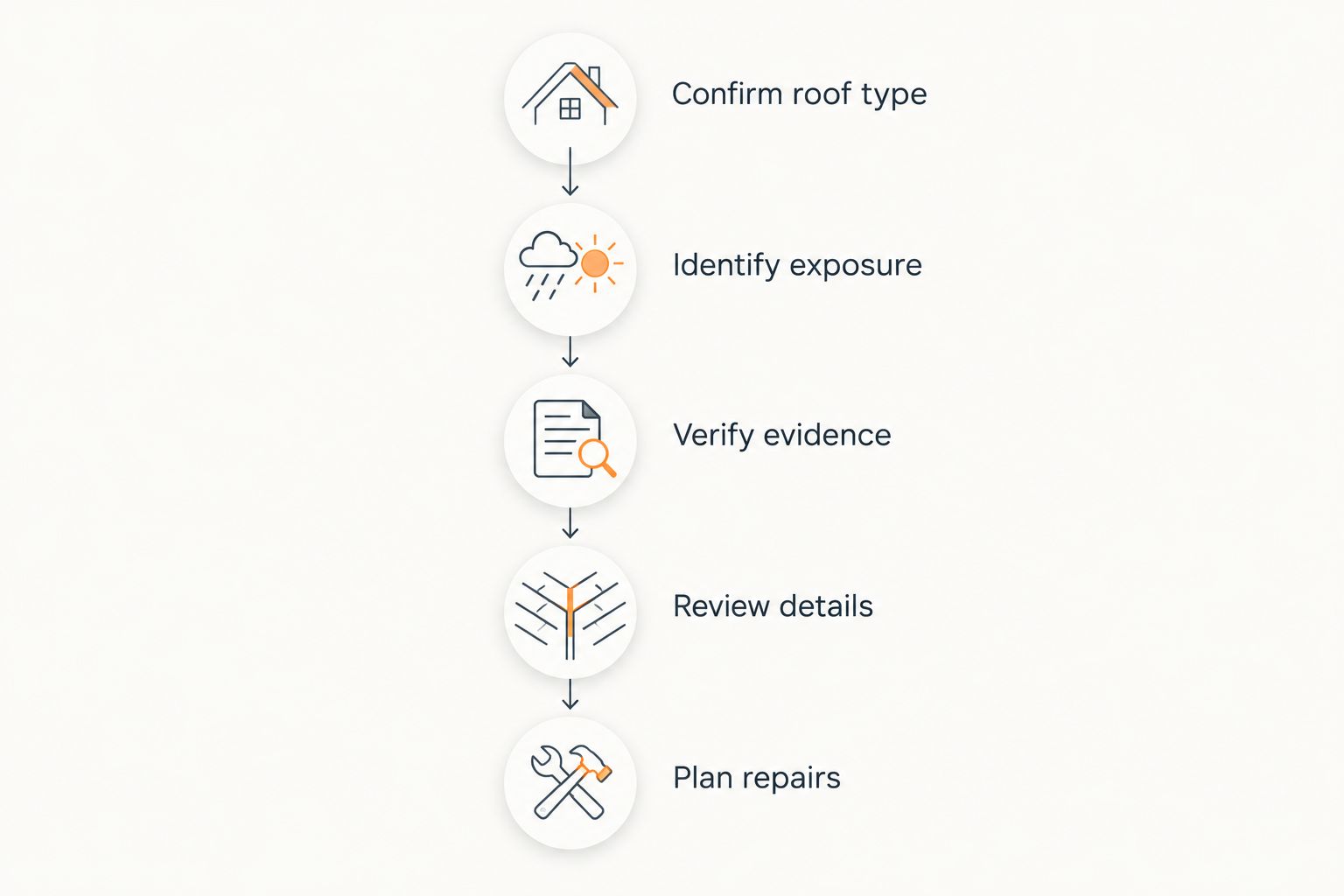
Use this sequence to turn the ranking into a purchase decision:
- Confirm roof type: Establish the slope, deck condition, drainage arrangement, and applicable installation requirements.
- Identify exposure: Record hail concerns, rooftop equipment, traffic routes, and chemical discharge.
- Verify evidence: Match ratings and compatibility guidance to the exact product and assembly.
- Review details: Resolve edges, seams, valleys, penetrations, and transitions before approval.
- Plan repairs: Record compatible repair materials and the installed product identification.
In 2026, a useful roofing proposal identifies the system well enough for another qualified contractor to understand what was installed. Reject a proposal that leaves the covering, attachment, or flashing approach undefined.
How we ranked
This ranking prioritizes roof suitability, documented resistance, connection quality, and repair practicality. It separates pitched-roof appearance choices from low-slope membrane requirements rather than assigning unsupported service-life figures.
Murray Inspection Services’ synthetic roofing materials ranking is an application guide, not a comparative laboratory test. No category earns a universal durability win across different slopes, exposures, and installations.
Which synthetic roofing material should you choose?
For a slate-look pitched roof, start with documented polymer-composite slate. Choose polymer-composite shake when a wood-look profile is the requirement instead.
For low-slope roofing, evaluate EPDM when flexibility matters, PVC when verified chemical compatibility drives the decision, and TPO when a heat-welded assembly fits the project. Require the same standard of detail from every proposal.
Your default should be the suitable system with the clearest performance evidence and installation specification—not the longest advertised lifespan.
FAQ
What’s the best synthetic roofing material for durability?
The best synthetic roofing material is the documented system that suits your roof slope and exposure. Polymer-composite slate is a starting point for slate-look pitched roofs; EPDM, PVC, and TPO address different low-slope requirements.
Is synthetic slate more durable than synthetic shake?
The slate or shake appearance does not establish which synthetic product is more durable. Compare the exact products’ impact, fire, wind, weathering, and installation documentation.
Does a Class 4 impact rating mean a roof is hail-proof?
No. A UL 2218 Class 4 rating identifies performance under a defined steel-ball impact test, not immunity to every hail event or other source of damage.
Is EPDM better than TPO for a low-slope roof?
Neither EPDM nor TPO is universally better. EPDM uses an elastomeric rubber membrane with compatible seam systems, while TPO uses heat-welded thermoplastic seams; assembly suitability and installation quality decide the choice.
When should I consider PVC roofing?
Consider PVC when a low-slope roof has an exposure requiring documented chemical compatibility, including grease-related conditions. Obtain guidance for the exact membrane and substance rather than assuming universal resistance.
How long will a synthetic roof last?
A material category alone does not establish the service life of a synthetic roof. Product formulation, roof design, installation, exposure, maintenance, and repair history affect performance, and a warranty term is not a lifespan measurement.
Can synthetic roofing be installed over an existing roof?
Do not assume an existing roof is an acceptable substrate. Check the selected manufacturer’s requirements, applicable code, deck condition, and moisture conditions before approving a recover installation.
One last thing
Before approving your 2026 roof project, ask for an installation record containing the exact covering, underlayment or membrane assembly, attachment method, and flashing materials. Photographs of concealed details belong with that record.
That information gives a future repair contractor something more useful than a color name or warranty brochure: an identifiable roof system.
Related guides
- Roof underlayment types compared for storm protection
- Roof coatings for energy efficiency
- Flat roof materials compared