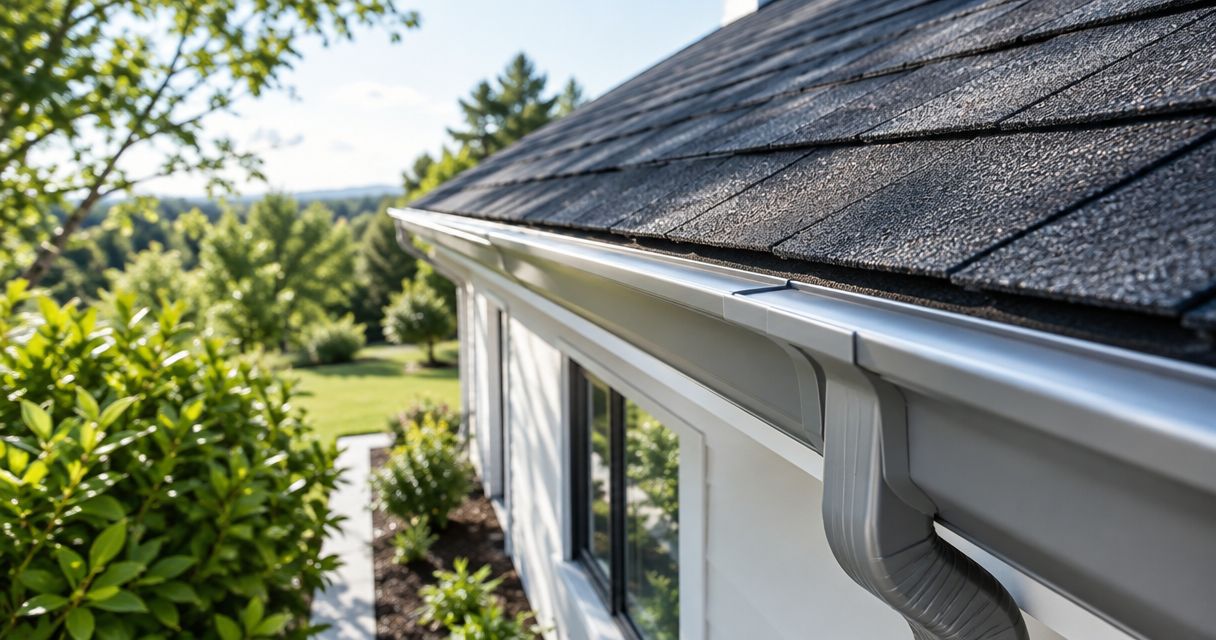
Best overall for conventional pitched roofs: seamless aluminum K-style gutters with correctly sized downspouts and a planned discharge route. Best for low-slope roofs: internal drains with independent overflow protection; best for traditional rooflines: half-round gutters. This Murray Inspection Services guide compares the best gutter and drainage systems for roofs in 2026 by roof shape, debris exposure, maintenance access, and where collected water goes.
- Seamless aluminum K-style gutters are the default choice for conventional pitched roofs when sizing and discharge are correct.
- Internal drains suit low-slope roofs; independent overflow protection remains essential.
- Half-round gutters suit traditional rooflines, but their profile does not replace capacity calculations.
- The best gutter and drainage systems for roofs connect roof drainage, downspouts, and safe discharge.
Why this matters
Roof drainage is a complete water path, not just a gutter profile. Water must leave the roof, enter a collector, pass through an outlet, and discharge without returning toward the building. A restriction anywhere along that route defeats the rest of the installation.
For scale, 1 inch of rain falling on 1,000 square feet produces approximately 623 gallons of water, before losses. That is a rainfall-volume calculation, not a gutter-sizing recommendation. Your 2026 selection needs to account for rainfall intensity, contributing roof area, roof geometry, and local requirements—not appearance alone.
What makes the best gutter and drainage systems for roofs?
Use these criteria before choosing a material or profile:
- Roof compatibility: Pitched eaves, parapets, and inward-sloping roofs require different collection methods.
- Hydraulic capacity: Size gutters, outlets, downspouts, and drains as connected components using applicable rainfall criteria.
- Discharge route: Collected water needs a suitable destination that does not create erosion, foundation wetting, or a neighboring-property problem.
- Maintenance access: Leaves, sediment, strainers, joints, and buried connections need inspection and cleaning access.
- Failure protection: Consider where water goes when the primary outlet blocks; concealed backup is especially important on low-slope roofs.
- Installation compatibility: Supports, flashing, roof edges, and dissimilar metals must work together without creating leaks or corrosion.
Choose the drainage route before choosing the gutter finish. A larger gutter cannot correct an unsuitable discharge location or a blocked underground line.
Best roof drainage options at a glance
The Murray Inspection Services comparison separates complete drainage configurations from decorative preferences. Every option still needs site-specific sizing and a verified discharge route.
| Rank and system | Best for | Standout feature | Key limitation |
|---|---|---|---|
| 1. Seamless aluminum K-style gutters | Conventional pitched roofs | Long continuous gutter runs reduce intermediate joints | Outlets and downspouts can still restrict flow |
| 2. Half-round gutters | Traditional rooflines | Rounded, open channel with a distinctive profile | Supports and capacity need profile-specific planning |
| 3. External box gutters | Large commercial eaves | Fabricated geometry can accommodate project requirements | Custom detailing and support demand careful design |
| 4. Internal roof drains | Inward-draining low-slope roofs | Collect water at roof low points | Concealed piping and blocked drains complicate diagnosis |
| 5. Scuppers and conductor heads | Parapet roofs draining through perimeter walls | Carry water through a parapet opening | Openings and flashing require coordinated design |
| 6. Sectional aluminum gutters | Small, accessible outbuildings | Individual sections can be assembled or replaced | More joints create more maintenance points |
1. Seamless aluminum K-style gutters: best for pitched roofs
Seamless aluminum K-style gutters collect runoff along pitched-roof eaves. Fabrication in long runs reduces intermediate joints, although corners, end caps, and outlets still require connections. The gutter must work with roof-edge flashing so water enters the channel rather than running behind it.
Best for: Conventional pitched roofs with accessible eaves and practical downspout locations.
Seamless aluminum K-style gutter pros:
- Fewer intermediate joints than a comparable sectional run.
- A shaped profile suited to many conventional fascia installations.
- Exposed channels and downspouts allow direct inspection.
Seamless aluminum K-style gutter cons:
- Thin metal can dent or deform under impact or improper ladder placement.
- Blocked outlets still cause overflow, regardless of seamless construction.
- Long runs require suitable support and allowance for movement.
For a 2026 replacement, ask how the installer calculated capacity and selected outlet locations. Nominal widths such as 5 inches or 6 inches describe common gutter sizes; neither dimension guarantees adequate drainage for your roof.
Verdict: Buy for a conventional pitched roof when the proposal addresses collection, downspouts, and discharge together.
2. Half-round gutters: best for traditional rooflines
Half-round gutters use an open, rounded channel rather than the shaped face of K-style gutters. They suit rooflines where the gutter profile is an important architectural detail. Their performance depends on cross-section, slope, outlets, and supports—not the rounded shape alone.
Best for: Traditional buildings where a rounded gutter profile fits the roofline.
Half-round gutter pros:
- Distinctive profile that suits many traditional roof edges.
- Open channel allows visible inspection of debris and standing water.
- Available configurations can accommodate different roof-edge details.
Half-round gutter cons:
- Hangers and fascia connections need to suit the rounded profile.
- Equal nominal width does not establish equal capacity across gutter shapes.
- Open channels still collect leaves and require cleaning.
Compare the proposed half-round system against alternatives using calculated flow capacity. Do not accept a profile substitution based solely on matching the width of the old gutter. Check outlet placement around entrances and paths as part of the same decision.
Verdict: Buy when the profile matters and the designer verifies capacity and attachment details.
3. External box gutters: best for large commercial eaves
External box gutters collect water along the outside edge of a roof using a fabricated box-shaped channel. Their geometry can be designed around project-specific collection and outlet requirements. These are not the same as concealed gutters built into a roof assembly.
Best for: Commercial roofs with broad contributing areas and engineered exterior drainage.
External box gutter pros:
- Fabricated dimensions can respond to the drainage design.
- Exterior placement allows access without opening an interior ceiling.
- Outlet arrangements can be coordinated with the building perimeter.
External box gutter cons:
- Fabricated joints and transitions require careful detailing.
- Water loads and attachment demands need structural consideration.
- Commercial access arrangements can complicate routine cleaning.
On a 2026 commercial project, specify overflow behavior as well as normal operation. The proposal should show what happens when an outlet blocks, including whether water can back up toward roof edges, wall assemblies, or doors.
Verdict: Buy for a commercial eave when a qualified designer specifies the complete assembly; skip an oversized channel offered without drainage calculations.
4. Internal roof drains: best for inward-draining low-slope roofs
Internal roof drains collect water at designated roof low points and connect to piping through the building. The drain body, roof membrane connection, insulation layout, and piping must function together. A drain placed above the actual low point leaves water behind.
Best for: Low-slope roofs designed to direct runoff toward interior collection points.
Internal roof drain pros:
- Collect runoff where the roof is intentionally sloped inward.
- Avoid reliance on continuous gutters along every roof edge.
- Allow coordinated primary and secondary drainage layouts.
Internal roof drain cons:
- Concealed piping makes some leaks and blockages harder to locate.
- Drain strainers need regular debris removal.
- Poor slope or membrane detailing can leave ponding around the drain.
Independent overflow protection is essential to the drainage plan. Applicable codes determine the requirements; a second inlet connected to the same restricted path does not automatically provide an independent escape route.
For your 2026 specification, require drawings that distinguish primary drainage from emergency overflow. Confirm inspection access before the work starts.
Verdict: Buy when the roof geometry calls for internal collection and the design includes appropriate overflow protection.
5. Scuppers and conductor heads: best for parapet outlets
Scuppers are openings that carry roof water through parapet walls. A primary scupper can discharge into a conductor head and downspout, while an overflow scupper provides a separate emergency outlet where designed. The opening, flashing, roof slope, and downstream piping all affect performance.
Best for: Parapet roofs with a suitable route to exterior drainage.
Scupper and conductor head pros:
- Move collected water through the perimeter wall to an exterior route.
- Exterior discharge can make operation easier to observe.
- Separate overflow openings can provide a visible warning of blockage.
Scupper and conductor head cons:
- Wall penetrations need careful waterproofing integration.
- Undersized conductor heads or downspouts restrict the assembly.
- Uncontrolled discharge can wet walls or create hazards below.
A scupper is not automatically an emergency overflow merely because it passes through a parapet. Its elevation, capacity, destination, and relationship to primary drainage determine its role. Record those functions explicitly in the design.
Verdict: Buy for a suitable parapet roof when the opening and downstream route are designed together.
6. Sectional aluminum gutters: best for accessible outbuildings
Sectional aluminum gutters assemble from separate lengths joined along the roof edge. Individual components can be replaced without replacing an entire continuous run. More connections also mean more locations where alignment and sealing need attention.
Best for: Small, accessible outbuildings where straightforward repair access matters.
Sectional aluminum gutter pros:
- Separate lengths allow localized component replacement.
- Exposed joints are accessible for inspection.
- Simple roof edges can accommodate straightforward layouts.
Sectional aluminum gutter cons:
- Additional joints create additional potential leak locations.
- Poor alignment can interrupt drainage between sections.
- Accessible construction does not remove the need for safe work practices.
Do not choose a sectional system simply because individual pieces are easy to handle. Roof-edge work still involves fall risk, and drainage sizing remains necessary even on a small building.
Verdict: Buy for an accessible, uncomplicated outbuilding; skip it when reducing joints is the main priority.
Connect the roof to a suitable discharge route
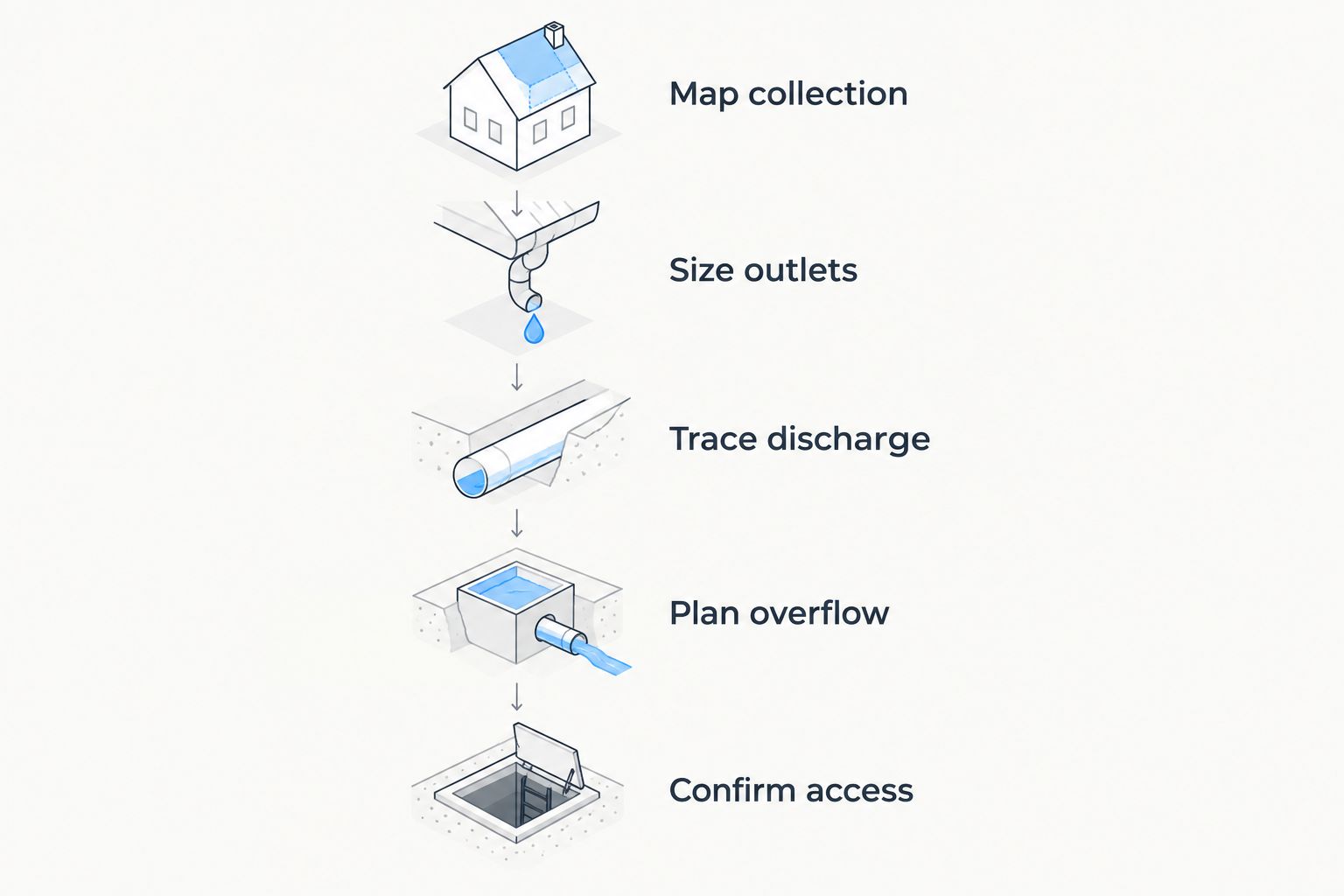
The Murray Inspection Services roof drainage recommendation is to evaluate the entire water path before replacing isolated components. Follow this sequence when reviewing a proposal:
- Map collection: Identify roof areas, valleys, eaves, parapets, and actual low points.
- Size outlets: Match collection capacity to gutters, drains, downspouts, and applicable rainfall criteria.
- Trace discharge: Identify where each pipe ends, including any buried connection.
- Plan overflow: Establish where water goes if the primary path blocks.
- Confirm access: Preserve access to strainers, outlets, cleanouts, and joints.
Buried pipes need particular scrutiny because the visible downspout does not reveal the condition or destination of the underground run. Guards also deserve separate evaluation: they are debris-management accessories, not substitutes for adequate capacity or cleaning access.
How the options are ranked
This 2026 ranking prioritizes roof compatibility, capacity, discharge, maintenance, failure protection, and installation details. Seamless aluminum K-style gutters lead for conventional pitched roofs because continuous runs reduce intermediate joints. The other selections address distinct roof configurations rather than competing for a universal first place.
The ranking compares system types, not tested brands or contractor workmanship. Your roof geometry takes precedence over the numbered order.
Which roof drainage system should you choose?
For a conventional pitched roof, choose seamless aluminum K-style gutters with calculated capacity and a verified discharge route. For inward-draining low-slope roofs, choose internal drains with appropriate independent overflow protection. For parapets draining outward, consider properly designed scuppers.
Keep the Murray Inspection Services shortlist tied to your roof, not to a material preference. Ask for the collection area, outlet locations, discharge destination, and overflow arrangement in writing before approving the work.
FAQ
What’s the best gutter and drainage system for a pitched roof?
Seamless aluminum K-style gutters are the default recommendation for a conventional pitched roof. Correct sizing, outlet placement, flashing, and discharge determine whether the complete system works.
Are seamless gutters completely leakproof?
No. Seamless gutters reduce intermediate joints, but corners, end caps, outlets, and connections remain potential leak locations.
Are 6-inch gutters always better than 5-inch gutters?
No. Gutter width alone does not establish adequate drainage. Capacity also depends on profile, slope, outlets, downspouts, contributing roof area, and rainfall intensity.
What’s best for a low-slope roof with parapets?
Internal drains or scuppers are appropriate when matched to the roof’s drainage layout. The design must address primary collection and applicable emergency overflow requirements.
Do gutter guards eliminate gutter cleaning?
No. Gutter guards manage debris but still require inspection and maintenance. Fine material and debris at outlets can interfere with drainage.
Can I connect roof downspouts to an underground pipe?
An underground connection is appropriate only when its capacity, condition, destination, and local acceptability are verified. An unknown buried pipe is not a confirmed discharge solution.
Should I replace gutters when replacing my roof?
Replace gutters when their condition, capacity, or compatibility with the new roof requires it. Coordinate roof-edge flashing and gutter attachments even when retaining the existing system.
One last thing
Water spilling from an emergency overflow is a warning, not proof that everything is working normally. Keep people clear of the discharge and arrange an assessment of the primary drainage path. Do not block the overflow to stop the visible water.
Related guides
- Flat roof materials ranked by cost
- Roof underlayment types compared for storm protection
- Commercial roofing systems ranked by maintenance cost
- Roof warranty types compared for homeowners