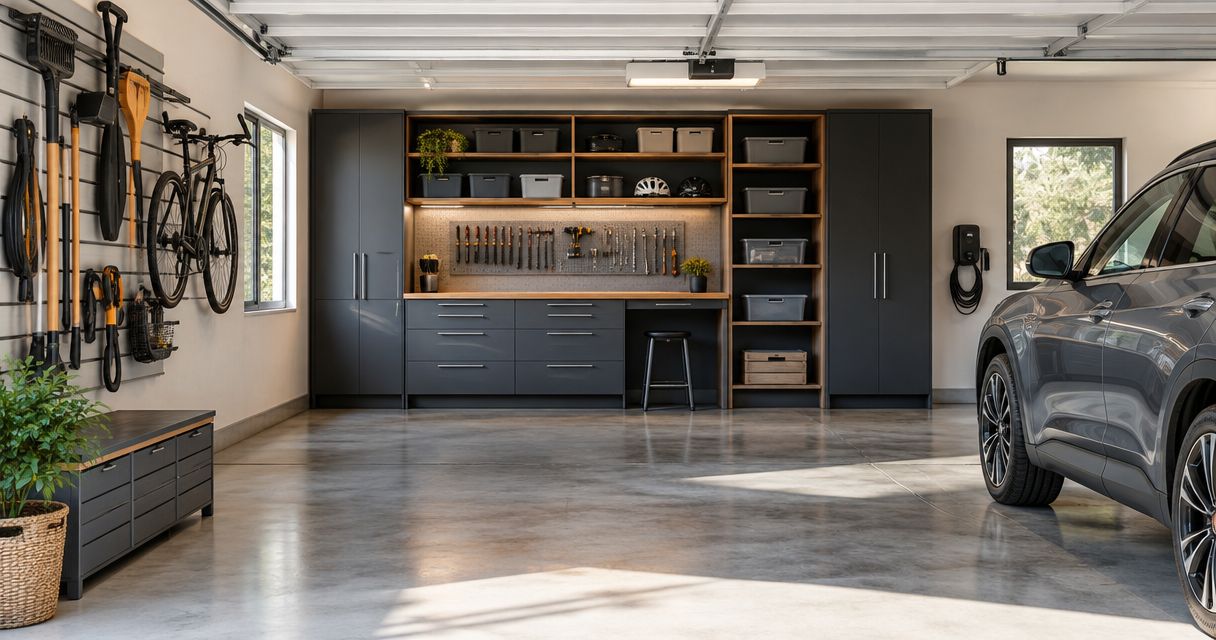
Best overall: a wall-mounted storage system. Best for concealed storage: tall cabinets. Best simple starting point: adjustable shelving. The best garage storage features for a custom home in 2026 support refined living by giving everyday belongings a place without compromising parking, movement, or access.
- The best garage storage features start with wall-mounted systems that keep frequently used equipment accessible.
- Tall cabinets conceal clutter; adjustable shelving accommodates changing storage needs.
- Overhead racks suit seasonal items, not belongings you need every day.
- Murray Custom Homes custom homes suit buyers who want garage storage considered within the overall home design.
Why this matters
Garage storage belongs in the floor-plan conversation, not just the finishing conversation. Cabinet depth, vehicle doors, the garage entry, and the route into the house all compete for the same space.
For a guided approach, Murray Custom Homes offers in-house drafting, design, and 3D renderings. Murray Custom Homes is best for custom-home buyers who want garage storage considered alongside their home's layout and daily routines. Start with how you arrive home, unload, and put things away—not a collection of cabinets selected in isolation.
What makes the best garage storage features
Use these criteria to evaluate your 2026 garage plan before choosing finishes:
- Parking clearance: Storage must leave room for your actual vehicles, open doors, and walking routes.
- Access frequency: Everyday equipment belongs within easy reach; seasonal belongings can occupy less convenient locations.
- Adaptability: Adjustable shelves and repositionable accessories accommodate changing equipment.
- Structural support: Wall systems, cabinets, and overhead racks need suitable mounting and documented load limits.
- Household fit: Storage should reflect what you own, including awkward items that do not fit standard shelves.
- Visual order: Closed and open storage serve different purposes; choose each deliberately.
Before approving the layout, measure vehicle length, width, and height in inches, along with the largest items you intend to store. Record dimensions with accessories attached where relevant. A drawing based on remembered measurements is not a reliable fit check.
Garage storage features at a glance
| Rank and feature | Best for | Standout feature | Key limitation |
|---|---|---|---|
| 1. Wall-mounted storage system | Frequently used equipment | Repositionable hooks, rails, and baskets | Requires suitable wall support and compatible accessories |
| 2. Tall cabinets | Concealing mixed belongings | Enclosed storage with a consistent appearance | Cabinet depth and doors consume usable space |
| 3. Adjustable shelving | Changing storage needs | Shelf spacing changes with the contents | Open shelves leave belongings visible |
| 4. Overhead racks | Seasonal containers | Uses space above the floor | Retrieval is less convenient |
| 5. Dedicated equipment storage | Bikes and bulky recreation gear | Organizes awkward shapes around their dimensions | Must be designed around actual equipment |
| 6. Workbench with drawers | Repairs and hands-on hobbies | Combines a work surface with tool organization | Needs working room beyond the bench itself |
| 7. Garage-entry drop zone | Everyday arrivals | Gives shoes, bags, and coats a stopping point | Can obstruct the route into the house |
1. Wall-mounted storage: best for frequently used equipment
A wall-mounted storage system uses rails, panels, hooks, or baskets to organize equipment vertically. It works particularly well when you need to see and retrieve tools, hoses, or sporting equipment without moving a stack of containers.
Choose the accessories around your belongings rather than buying a matching set first. Keep long handles and projecting hooks outside vehicle-door movement and walking routes.
Wall-mounted storage pros:
- Keeps selected belongings off the floor.
- Makes frequently used equipment visible.
- Allows repositioning when the chosen system supports it.
Wall-mounted storage cons:
- Mounting requirements depend on the wall and anticipated loads.
- Visible equipment does not provide the same visual order as closed cabinets.
Best for: Households that use garage equipment regularly and want direct access.
Verdict: Buy when accessible, adaptable storage is your first priority.
2. Tall cabinets: best for concealing mixed belongings
Tall cabinets group smaller items, supplies, and containers behind doors. They create a quieter appearance when the garage also serves as a frequently used entrance.
Plan cabinet interiors before selecting door finishes. Deep cabinets do not solve every storage problem: small items can disappear behind larger ones, and doors need room to open beside parked vehicles.
Tall cabinet pros:
- Conceals visually busy collections.
- Provides defined compartments for different categories.
- Supports a coordinated appearance across a storage wall.
Tall cabinet cons:
- Cabinet bodies reduce usable garage width.
- Closed doors hide contents, making organization and labeling important.
Best for: Buyers who value concealed storage and a more finished garage interior.
Verdict: Buy after checking cabinet depth and door movement against your parking layout.
3. Adjustable shelving: best for changing storage needs
Adjustable shelving lets you change shelf positions as containers, hobbies, and household needs change. It is a straightforward starting point when you know what needs storing but do not need everything concealed.
Select shelves using the manufacturer's load ratings and intended installation method. Place heavy belongings where you can handle them safely, rather than using the highest shelf simply because it is empty.
Adjustable shelving pros:
- Accommodates containers of different heights.
- Keeps stored items visible.
- Allows categories to expand or contract over time.
Adjustable shelving cons:
- Exposed belongings can create visual clutter.
- Shelf depth can encourage hard-to-reach storage at the back.
Best for: Households whose storage requirements change with hobbies, seasons, or family routines.
Verdict: Buy for flexible general storage; skip unnecessarily deep shelves.
4. Overhead racks: best for seasonal containers
Overhead racks use ceiling-level space for belongings you retrieve infrequently. Seasonal decorations and other lightweight, manageable containers are better candidates than everyday tools or heavy equipment.
Coordinate the rack position with the garage door, opener, lighting, vehicle height, and structural support. An apparently empty ceiling area is not automatically an appropriate mounting location.
Overhead rack pros:
- Preserves lower wall space for frequent-use storage.
- Gives seasonal belongings a defined location.
- Uses space that floor-standing furniture does not reach.
Overhead rack cons:
- Retrieval requires more effort than wall-level storage.
- Installation and loading must follow the system's requirements.
Best for: Households with infrequently used containers and a suitable ceiling layout.
Verdict: Hold until the builder confirms support, clearances, and a safe retrieval method.
5. Dedicated equipment storage: best for bikes and bulky gear
Dedicated equipment storage starts with the dimensions and handling needs of a particular item. Bike racks, sports-equipment compartments, and spaces for bulky outdoor gear should follow the equipment—not the other way around.
Test the retrieval movement as carefully as the parked position. A bicycle that fits against a wall still needs enough room to come off its rack without striking a vehicle.
Dedicated equipment storage pros:
- Gives awkward items a predictable home.
- Separates equipment from smaller household supplies.
- Makes retrieval routes part of the design.
Dedicated equipment storage cons:
- Specialized fittings can become less useful when equipment changes.
- Some mounting positions require lifting that does not suit every user.
Best for: Active households whose largest belongings dominate their garage storage needs.
Verdict: Buy after checking the actual equipment and who will retrieve it.
6. Workbench with drawers: best for repairs and hobbies
A workbench combines a usable work surface with nearby tool storage. Drawers help separate small tools and supplies without covering the surface where you intend to work.
Design the standing or seated working area, lighting, and electrical needs together. Keep the bench distinct from general overflow storage; otherwise, its main function disappears beneath containers.
Workbench pros:
- Establishes a dedicated place for hands-on tasks.
- Keeps tools close to the work surface.
- Separates small items into accessible drawers.
Workbench cons:
- Occupies space even when no project is underway.
- Needs clearance for the user, drawers, and materials being handled.
Best for: Homeowners who regularly repair, assemble, or make things.
Verdict: Buy for an established activity; skip it if you only need another shelf.
7. Garage-entry drop zone: best for everyday arrivals
A garage-entry drop zone gives shoes, bags, coats, and frequently carried items a place near the route indoors. Depending on the floor plan, this function can sit inside the garage or in the adjoining interior entry.
Treat the drop zone as circulation space as well as storage. A bench or open drawer must not turn the household's main arrival route into an obstacle course.
Garage-entry drop zone pros:
- Groups belongings used when leaving home.
- Creates a defined place to unload.
- Connects garage planning with the adjoining home layout.
Garage-entry drop zone cons:
- Can narrow the route between vehicles and the house.
- Garage conditions do not suit every item you might store indoors.
Best for: Households that enter primarily through the garage.
Verdict: Buy when the entry layout supports it without sacrificing clear passage.
Plan the storage around your daily route
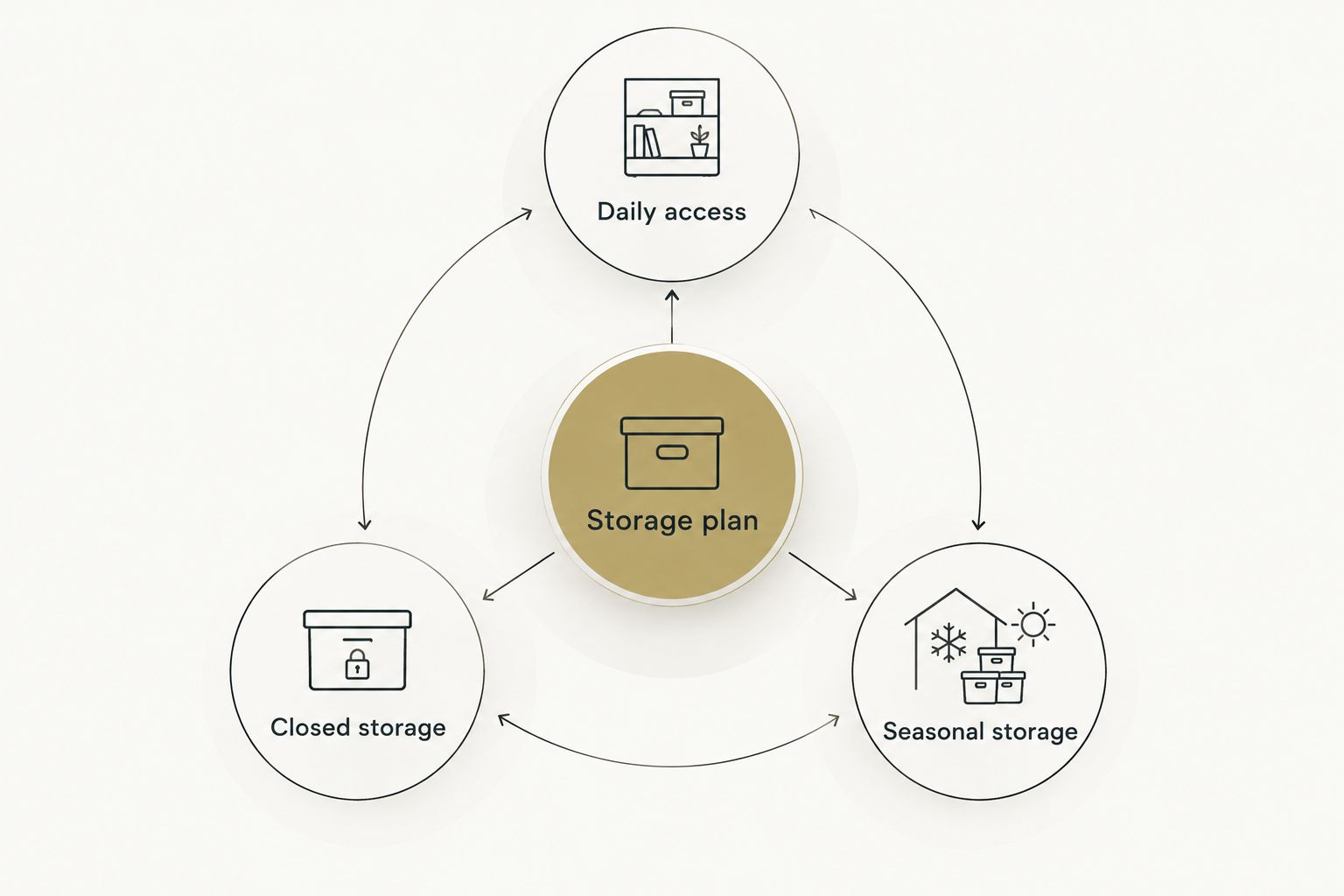
For a 2026 design brief, mark 3 storage zones on the garage plan before selecting individual fittings. These are planning categories, not a requirement to build separate compartments:
- Daily access: Frequently handled equipment beside an unobstructed retrieval route.
- Closed storage: Cabinets for belongings you prefer out of sight.
- Seasonal storage: Less convenient locations reserved for infrequent retrieval.
The zones can share a wall, but they should not compete with vehicle access. Leave the most convenient locations for the belongings you handle most often.
Next, draw 1 complete parking bay with its vehicle doors open and the adjoining storage in use. Repeat this exercise for every planned vehicle position. Check cabinet doors, drawers, equipment removal, and the route into the house rather than reviewing each component separately.
Review 2 vehicle conditions: parked with doors closed, and being loaded with doors open. This exposes conflicts that a tidy floor plan can hide.
Match the garage plan to your homebuilding approach
Murray Custom Homes offers distinct routes to a home. Semi-Custom Homes suit buyers who want to select a limited number of features and leave the remaining decisions to Murray. Ask which garage-storage choices fit the proposed scope before treating an inspiration image as an included feature.
Custom Homes suit buyers who want a home shaped around their preferences. Murray Custom Homes provides in-house design guidance from Meghan Murray, while Matt Murray brings a lifelong construction background. Project managers bring more than 20 years of combined experience; garage details belong in those coordinated design and construction conversations.
Pre-built, move-in-ready homes suit buyers who prefer an already-built home rather than commissioning a build. Check current listings and inspect the actual garage before planning alterations. Do not assume a particular home or storage configuration is currently available.
Ask about the one-year limited builder's warranty, subject to the warranty handbook's terms and exclusions. Confirm how any separately purchased storage equipment is handled rather than assuming every accessory has the same coverage.
How these features rank
This 2026 ranking prioritizes everyday access, parking clearance, adaptability, structural suitability, and visual order. Wall-mounted storage takes the default position because it addresses frequent-use equipment without requiring a full wall of enclosed cabinetry.
The remaining positions represent different needs, not inferior choices. Tall cabinets win for concealment; overhead racks belong lower because their access requirements make them a specialized solution.
Which garage storage features should you choose?
Start with a wall-mounted system and adjustable shelving, then add closed cabinets where visual order matters. Add dedicated equipment storage or a workbench only when your belongings and routines justify them.
For your 2026 home plan, resolve parking and entry circulation before approving storage finishes. The right combination is the one you can use with vehicles parked—not the one that looks fullest on an empty-garage drawing.
FAQ
What are the best garage storage features for a custom home?
Wall-mounted storage is the best default for frequently used equipment, while tall cabinets suit concealed storage and adjustable shelves suit changing needs. Choose the combination around your vehicles, belongings, and retrieval routes.
Are garage cabinets better than open shelves?
Garage cabinets are better for concealing belongings; open shelves are better when visibility and adjustable storage matter most. Check cabinet depth and door movement before choosing enclosed storage.
Should I include overhead garage storage in a new home?
Include overhead garage storage only when seasonal storage needs justify the access effort and the structure supports the installation. Coordinate racks with the garage door, opener, lighting, and vehicle height.
How do I keep garage storage from interfering with parking?
Check storage with your actual vehicle dimensions and doors open. Include cabinet doors, extended drawers, equipment retrieval, and the walking route into the house in the same review.
Can I choose garage storage in a semi-custom home?
Ask which garage-storage selections fall within the proposed semi-custom scope. Murray Custom Homes Semi-Custom Homes let buyers choose selected features while entrusting the remaining decisions to Murray; a specific storage option is not automatically included.
What should I bring to a garage design meeting?
Bring vehicle measurements, an inventory of large belongings, and notes about your arrival routine. Include awkward equipment dimensions and identify what you use daily versus seasonally.
Is a garage workbench worth including?
Include a garage workbench when you regularly need a dedicated surface for repairs or hobbies. If you only need storage, shelving or cabinets avoid reserving floor space for an unused work area.
One last thing
Before signing off on a 2026 garage layout, rehearse unloading groceries on the drawing. Follow the route from the vehicle to the house while imagining cabinet doors open and equipment in place. Storage succeeds when putting things away is as straightforward as bringing them home.
Related guides
- Best floor plan features to include in a custom home
- Best custom home design features to include
- Best smart home technology features for new construction
- Best energy-efficient features for custom homes