
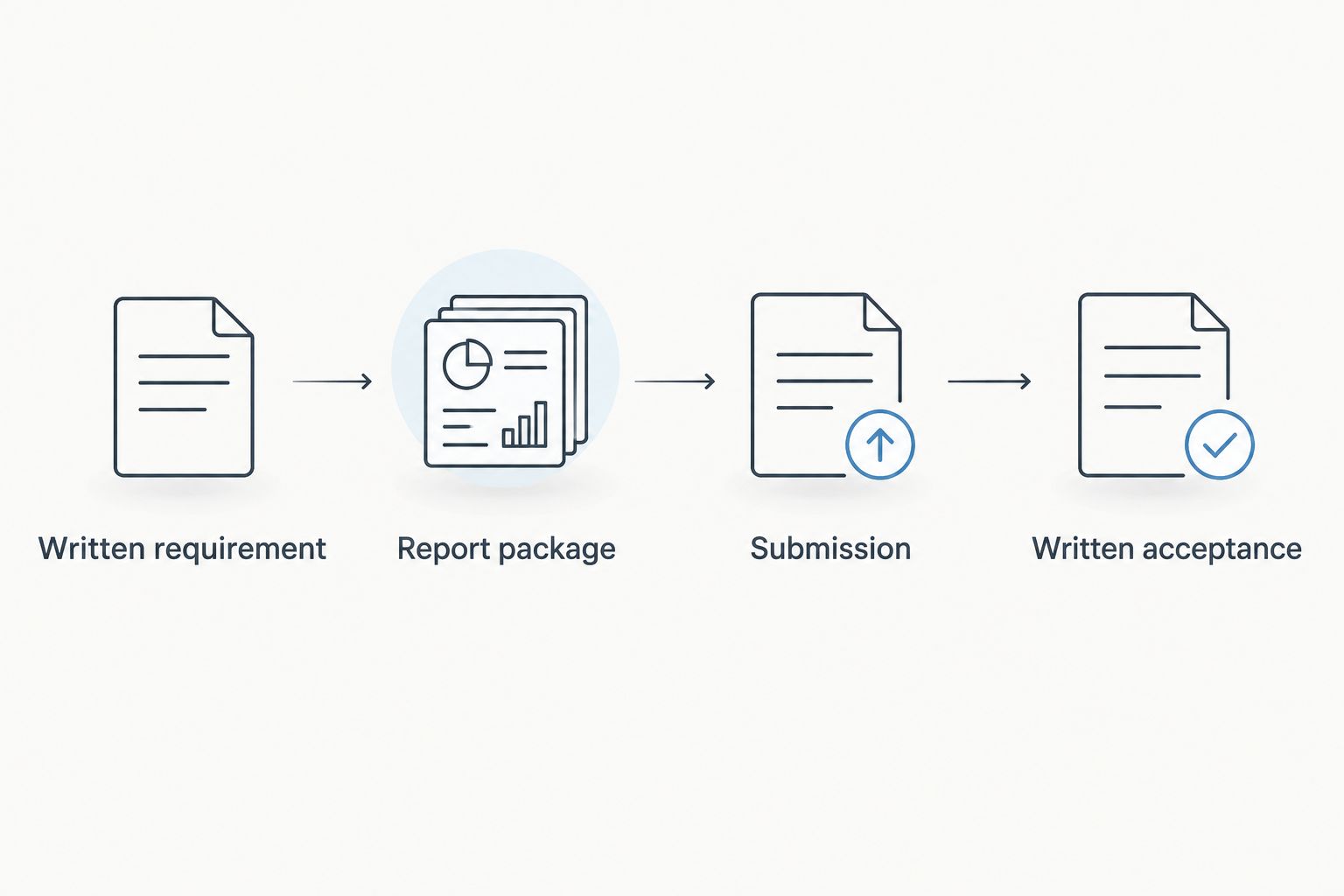
Instead of manually forwarding roof photos and chasing replies before closing, connect your roof inspection report to your mortgage closing by matching it to the lender’s written condition, submitting the requested documents together, and getting written confirmation that the condition is satisfied. Keep repair evidence and insurance questions in the same workflow so a submitted report does not get mistaken for an approved loan condition.
- A roof inspection report mortgage closing submission needs the lender’s written requirements, supporting documents, and acceptance confirmation.
- Buyers considering Murray Inspection Services should confirm lender requirements before commissioning roof inspection documentation.
- An inspection report, repair invoice, and insurance decision serve different purposes; none automatically replaces the others.
- Keep one coordinator responsible for document versions, follow-up requests, and written condition clearance.
Why this matters
Uploading a roof report is not the same as clearing a mortgage condition. The report documents observations within its stated scope; the lender decides whether the documentation answers its request. Your insurance provider makes a separate decision about coverage.
For a 2026 purchase, start with the actual loan condition rather than a generic inspection checklist. A report that helps you negotiate with the seller does not automatically contain everything an underwriter requests.
Buyers considering Murray Inspection Services for roof inspection documentation should get the lender’s reporting requirements first. That sequence keeps the inspection request tied to the closing problem you need to resolve.
Before you start
- Get the written requirement and submission instructions. Ask your loan officer or processor for the exact roof-related condition, the authorized submission channel, and the person responsible for reviewing the response.
- Gather the property materials and permissions. Have the purchase address, existing inspection findings, relevant seller disclosures, available repair records, and permission to arrange property access. Keep sensitive loan information in the lender’s approved channel.
- Confirm who can provide acceptable documentation. The non-obvious blocker is ordering a report before checking the lender’s requirements for the author, scope, wording, and supporting evidence. A general inspection summary is not automatically a substitute for the requested roof-specific document.
You do not need a particular app to follow this workflow. Use the lender’s actual portal instructions or approved delivery method; interface names differ, so do not guess which upload category applies.
Lender requirements and document routing
Capture the condition before ordering work
- Ask your loan officer to provide the roof-related request in writing. Preserve the exact wording rather than replacing it with a summary such as roof needs checking.
- Identify what the request asks someone to establish: current condition, a specific defect, completed repairs, or another stated concern. Send technical questions to the intended report author before scheduling.
- Ask whether an appraisal-related finding also needs follow-up through the lender. Do not assume a separate roof inspection replaces an appraisal requirement.
- Ask who reviews the submission and what written response confirms acceptance. Record the requested submission date and any dependencies affecting closing.
Expected result: You have a defined question, an acceptable document source, a submission route, and a named contact. If any element remains unclear, resolve it before commissioning additional work.
Use 1 coordinator for this process. That person can be you or another agreed participant, but everyone should know who maintains the current document set and follows up on unanswered requests.
Separate the documents by purpose
Keep your 2026 closing file in 3 document groups: inspection findings, repair evidence, and lender correspondence. This is an organizational method, not a lender requirement. It makes missing pieces easier to spot.
| Document | Best for | Strength | Limitation |
|---|---|---|---|
| Roof inspection report | Documenting observed roof conditions | Connects findings to a stated inspection scope | Does not approve the mortgage or establish insurance coverage |
| Repair proposal | Defining work before authorization | Describes proposed corrective work | Does not prove that repairs happened |
| Repair completion evidence | Responding after corrective work | Documents the work represented as completed | Does not automatically satisfy a request for independent verification |
| Insurance correspondence | Answering coverage questions | Records the insurer’s response | Does not replace the lender’s roof-document review |
These documents answer different questions. Send the document that answers the condition, not simply the newest document you have.
Inspection scope and report package
Match the inspection request to the property
- Give the report author the written lender request and property address. Identify the relevant roof areas, including additions or detached structures if they are part of the request.
- Ask the author to confirm the inspection scope and access arrangements. Have the report distinguish observed areas from inaccessible areas instead of leaving coverage unclear.
- Request clear identification of the property, inspection date, author, findings, limitations, and relevant photographs. Confirm any additional lender-specific requirements before the inspection.
- Review the completed report for administrative errors. Ask the author to correct an incorrect address, missing page, or mislabeled photograph; never edit technical conclusions yourself.
Expected result: The report clearly identifies what was inspected, what was observed, and what remains unresolved. Its scope matches the question the lender asked, or its limitations make the remaining gap explicit.
When discussing a roof inspection with Murray Inspection Services, bring the lender’s wording rather than asking for a generic closing certificate. A document’s title does not establish its acceptance.
Keep the inspector’s assessment separate from your preferred transaction outcome. A request to explain a finding is appropriate; a request to remove an inconvenient finding is not a sound way to resolve it.
Assemble the submission package
- Save the original report unchanged. Use a descriptive filename that distinguishes the property, document type, and inspection date without exposing unnecessary personal information.
- Add supporting materials that directly address the condition. Examples include referenced photographs, relevant repair documentation, and an author-issued clarification requested by the lender.
- Write a short cover message identifying the condition and listing the attached documents. Explain which attachment addresses which part of the request without offering your own technical certification.
- Check every attachment before submitting. Confirm that files open, photographs are readable, pages are complete, and the property address is consistent.
Expected result: A reviewer can locate the relevant finding and its supporting evidence without reconstructing the transaction from scattered messages.
For a report dated in 2026, use its actual inspection date in your file record. Do not rename an older document to make it appear current or treat a new upload date as a new inspection date.
Submission and condition clearance
Deliver the report and verify acceptance
- Submit through the channel your lender authorized. If a portal requires a document category, ask your processor which category applies rather than selecting an unrelated one.
- Save the upload receipt or delivery confirmation. Record what you submitted and retain an identical copy of the package.
- Ask whether the submission fully addresses the roof condition. If it does not, request a written description of the remaining issue and the evidence needed to resolve it.
- Obtain written confirmation when the lender accepts the response. Check whether any separate appraisal, repair, insurance, or closing requirement remains open.
Expected result: You can distinguish delivered, under review, and accepted. Those are different states, and your closing checklist should not collapse them into a single completed box.
Seek 2 confirmations: receipt of the documents and acceptance of the condition response. These are recommended checkpoints, not a promise about how any lender organizes its review.
The sequence is straightforward: establish the requirement, prepare the report package, submit it, and confirm acceptance. Skipping the final step leaves you with evidence of delivery rather than evidence that the issue is resolved.
Agents coordinating several participants can use the roof inspections for real estate agents guide alongside this document workflow. Keep scheduling coordination separate from technical findings and lender decisions.
Update the closing file after roof repairs
Use this second workflow when the initial report identifies a problem and corrective work becomes part of the transaction. Do not discard the original report: the connection between the finding and the corrective work matters.
- Ask the lender what evidence is required after the repair. Confirm whether contractor documentation is enough or whether another inspection or appraisal-related review is requested.
- Have the responsible parties document the agreed repair scope. Keep contract negotiations with your agent or attorney rather than treating the inspection report as a contract amendment.
- Collect completion evidence that identifies the property and describes the work. Include photographs or other materials when requested, and preserve the original documents.
- Obtain any required follow-up assessment. The person responsible for that assessment should state what was checked and identify unresolved limitations.
- Submit the updated package as a response to the same condition. Explain what changed and ask for written acceptance again.
Expected result: The closing file connects the original concern to the corrective work and the required verification. A paid invoice alone should not be treated as proof that every technical concern has been resolved.
For repairs completed in 2026, keep the completion date distinct from the original inspection date. The sequence helps the reviewer understand which findings describe the roof before the work and which documents describe it afterward.
Do not assume a seller credit or repair escrow resolves the lender’s condition. Ask whether the proposed arrangement is permitted for your loan and what approvals it requires before relying on it to preserve the closing schedule.
Troubleshooting
The lender received the report but still requests documentation
Ask which part of the condition remains unanswered. Compare that request with the report’s scope, findings, and attachments, then obtain the specific missing evidence. Resending an unchanged package does not answer a new question.
The report excludes an inaccessible roof area
Do not describe the excluded area as inspected. Ask the report author what access or additional assessment would address the limitation, and confirm with the lender what evidence it needs before arranging further work.
The property address or document version is wrong
Request a corrected document from its author and identify the replacement clearly when submitting it. Preserve the earlier version in your records, but tell the reviewer which version is current. Never silently alter a signed report.
The seller supplies an invoice instead of requested verification
Match the invoice against the lender’s wording. If the condition calls for a follow-up assessment, ask who must perform it and what it must address. An invoice documents a transaction; it does not automatically answer every condition question.
Insurance and lender responses do not match
Keep both requests visible and ask each decision-maker what remains outstanding. Lender acceptance does not establish insurance coverage, and an insurance response does not clear a loan condition. Forward relevant documents only through approved channels.
Customize your workflow
Build your 2026 closing tracker around decisions rather than attachments. Use columns for the written requirement, responsible person, requested evidence, submission record, current status, and next action. Give every unresolved item an owner.
Set follow-up reminders against the dates your transaction team provides; do not invent a universal turnaround time. When a requirement changes, preserve the earlier request and record the new instructions so the document trail remains understandable.
If Murray Inspection Services is part of your roof inspection discussions, confirm the requested scope before making scheduling commitments. Keep loan acceptance questions with your lender and coverage questions with your insurance provider.
FAQ
How do I submit a roof inspection report for mortgage closing?
Get the lender’s written roof condition, arrange documentation that addresses it, and submit through the lender’s authorized channel. Save proof of delivery and request written confirmation that the response is accepted.
Does every mortgage require a separate roof inspection report?
A separate roof inspection report is not a universal requirement for every mortgage. Ask your lender whether your property and loan have a roof-related documentation condition.
Can a roof inspection report guarantee that my mortgage will close?
No. A roof inspection report addresses its stated inspection scope; the lender decides whether it satisfies the roof condition and whether other loan requirements remain outstanding.
Can I use the seller’s existing roof report?
Ask your lender whether it accepts that specific report before relying on it. Confirm its author, date, scope, property identification, and any requested authorization or additional documentation.
Is a roof inspection report the same as a roof certification?
Do not assume those document titles mean the same thing. Ask the lender for the required content and author qualifications, then confirm what the proposed document actually states.
What happens if the roof needs repairs before closing?
Ask the lender what repairs and completion evidence are required before proceeding. Coordinate access and transaction terms with the appropriate parties, then submit the requested verification for acceptance.
Can a seller credit replace roof repairs for my mortgage?
A seller credit does not automatically satisfy a roof repair condition. Get the lender’s written approval of the proposed arrangement before relying on it as a closing solution.
One last thing
The most useful final document is often the lender’s written acceptance, not another copy of the inspection report. Keep both together. When someone asks whether the roof issue is resolved, you should be able to show what was evaluated and who accepted the response.
Related guides
- Roof financing options for homeowners
- Roof warranty types compared for homeowners
- Insurance-friendly roofing materials for storm claims