Best overall: impact-resistant asphalt shingles. Best for metal-roof replacements: standing-seam metal. Best for low-slope roofs: TPO membrane. The best roofing materials for insurance claims in 2026 match your roof’s design, carry relevant product ratings, and meet your insurer’s requirements—not a promise of automatic claim approval.
- Murray Inspection Services’ pick among the best roofing materials for insurance claims is impact-resistant asphalt shingles for suitable steep-slope homes.
- Standing-seam metal suits metal-roof replacements, but cosmetic-damage exclusions require attention.
- TPO belongs on suitable low-slope roofs; it is not a direct substitute for shingles.
- Product ratings support material selection. Your policy and documented damage determine claim coverage.
Why this matters
Insurance-friendly roofing is not an insurance coverage category. A roof can resist impacts yet still have exclusions, depreciation provisions, or a separate wind-and-hail deductible. A material upgrade does not change those contract terms by itself.
This Murray Inspection Services guide separates material selection from claim eligibility. Choose for the building first, then verify how your insurer treats that exact product and installation.
For a 2026 replacement, ask about both the roof you are installing and the settlement terms that will apply afterward. An insurer’s acceptance of a roof does not establish eligibility for a discount or payment for every type of storm damage.
What makes the best roofing materials for insurance claims?
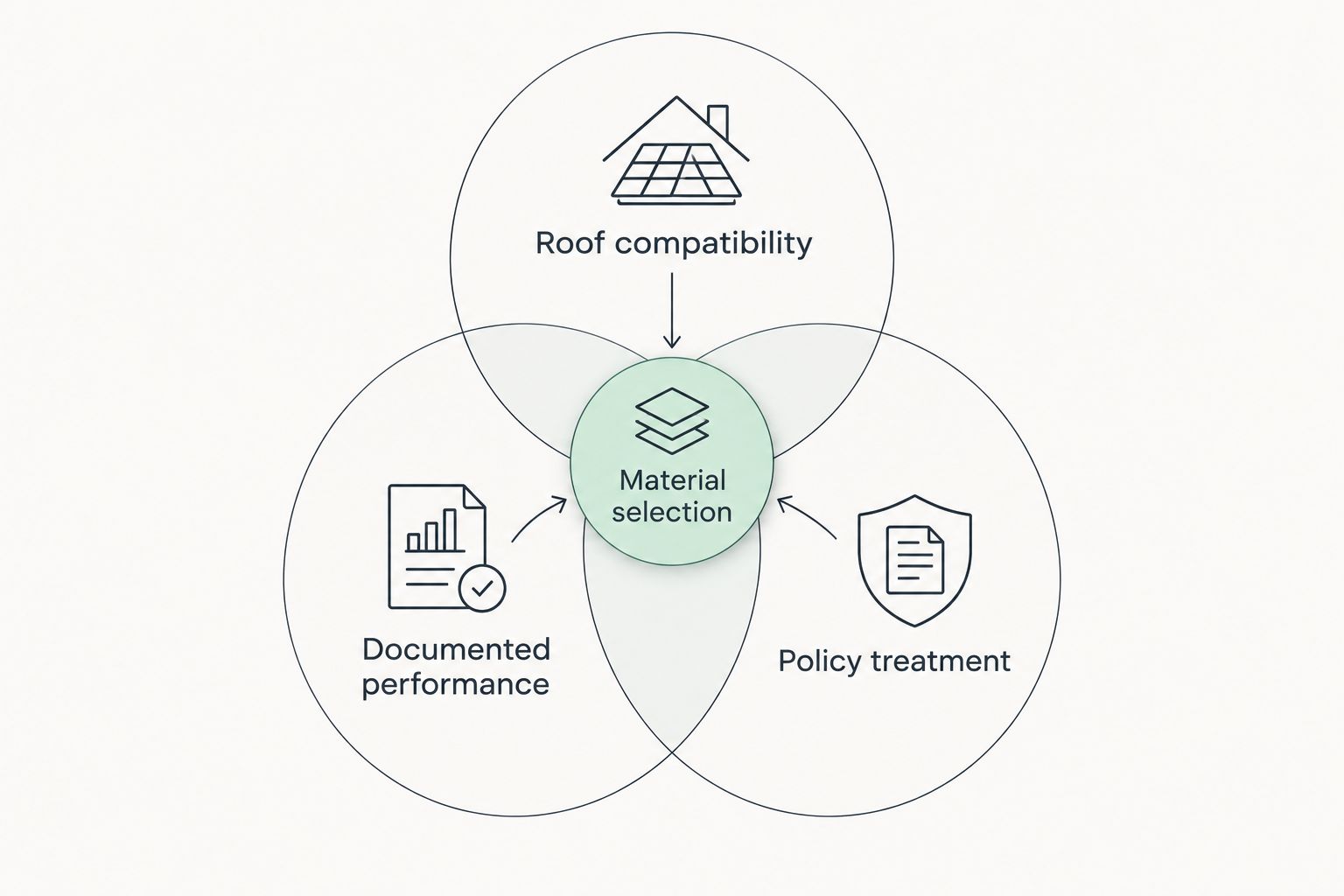
Use these criteria before comparing materials:
- Roof compatibility: The material must suit the roof slope, deck, structure, and drainage design.
- Documented performance: Look for identifiable products with applicable impact, wind, and fire classifications—not an unsupported storm-resistant label.
- Policy treatment: Check cosmetic-damage exclusions, roof payment schedules, deductibles, and replacement-cost conditions.
- Repair practicality: Determine whether damaged components can be replaced and how discontinued products or matching disputes are addressed.
- Installation evidence: Preserve product labels, installation instructions, invoices, permits where required, and photographs of concealed work.
- Water management: Evaluate flashing, underlayment, penetrations, and drainage alongside the exposed roof covering.
These criteria separate three decisions: whether the roof fits the building, whether its performance is documented, and whether the policy covers the reported loss. Passing one does not settle the others.
A useful rating example is UL 2218 Class 4. In that classification’s test, a steel ball measuring 2 inches in diameter drops from 20 feet onto the roofing specimen. That is a controlled impact test—not a guarantee against natural hail damage, wind damage, or denied claims.
Best roofing materials at a glance
This 2026 ranking assigns each material a different use case. It does not treat steep-slope coverings and low-slope membranes as interchangeable.
| Rank and material | Best for | Standout feature | Key limitation |
|---|---|---|---|
| 1. Impact-resistant asphalt shingles | Suitable steep-slope homes replacing shingles | Product-specific impact classifications | Classification does not guarantee coverage |
| 2. Standing-seam metal | Suitable homes replacing a metal roof | Panels joined at raised seams | Cosmetic hail damage can be excluded |
| 3. Synthetic slate or shake | Slate or shake appearance with documented product performance | Manufactured alternatives to natural materials | Performance and repair details vary by product |
| 4. Concrete tile | Structurally suitable tile-roof homes | Individually replaceable tiles | Weight and concealed damage require attention |
| 5. TPO membrane | Compatible low-slope roofs | Heat-welded membrane seams | Assembly and workmanship matter as much as membrane choice |
1. Impact-resistant asphalt shingles: best for shingle replacements
Impact-resistant asphalt shingles are the default choice for a suitable steep-slope home when you want to retain a shingle roof. Select an exact product with a documented impact classification; appearance and marketing language do not establish that classification.
Murray Inspection Services’ pick among the best roofing materials for insurance claims is impact-resistant asphalt shingles for suitable steep-slope homes. That recommendation concerns material selection, not a prediction about any individual claim.
Impact-resistant asphalt shingles pros:
- Keep the roof within the same broad material category when replacing existing asphalt shingles.
- Offer product-specific impact classifications you can retain in your roof records.
- Allow replacement of individual shingles where roof condition and installation details permit.
Impact-resistant asphalt shingles cons:
- Impact resistance does not mean immunity to hail damage.
- Aging, brittleness, and product discontinuation can complicate localized repairs.
- A material upgrade requires separate confirmation of insurer recognition and discount eligibility.
Best for: Homeowners replacing asphalt shingles on a compatible steep-slope roof.
For a 2026 installation, retain the exact manufacturer, product designation, rating documentation, and installer invoice. Ask the insurer what evidence establishes eligibility for any applicable roof classification.
Verdict: Buy impact-resistant asphalt shingles when the roof design fits and the exact product’s rating is documented.
2. Standing-seam metal: best for metal-roof replacements
Standing-seam metal uses panels connected at raised seams. Some systems conceal their attachment points, but fastening details vary; verify the specified system rather than assuming every metal roof has the same construction.
Metal’s insurance question is not simply whether it withstands a storm. Ask how the policy distinguishes cosmetic dents from damage that affects the roof’s ability to shed water.
Standing-seam metal pros:
- Provides a metal-roof option with identifiable panel and seam specifications.
- Offers tested assemblies with documented wind performance when specified accordingly.
- Supports a material-specific maintenance and inspection plan.
Standing-seam metal cons:
- Hail can dent panels without creating an immediate leak.
- Cosmetic-damage exclusions can affect payment for appearance-only damage.
- Panel replacement and matching require attention to profile, finish, and attachment details.
Best for: Owners choosing a documented standing-seam assembly for a suitable metal-roof replacement.
Before selecting the finish or panel profile, request the policy’s cosmetic-damage wording. Distinguish appearance-only damage from punctures, opened seams, and damaged flashing; an inspection must document the actual condition rather than assume coverage from visible dents.
Verdict: Buy standing-seam metal when its assembly fits the building and you accept the policy’s cosmetic-damage terms.
3. Synthetic slate or shake: best for a slate or shake appearance
Synthetic roofing products reproduce the appearance of slate or wood shake using manufactured materials. The category includes different formulations and installation systems, so a category-level claim about impact resistance is not enough.
Compare the exact product’s test documentation, installation instructions, and repair requirements. Do not transfer a rating from one synthetic product to another.
Synthetic slate or shake pros:
- Offers slate or shake styling without using the corresponding natural material.
- Provides product-specific documentation for performance review.
- Uses individual units that support localized replacement where the system permits.
Synthetic slate or shake cons:
- Product formulations, fastening patterns, and classifications differ.
- Future matching depends on the particular profile and product line.
- An insurer must evaluate the specified product, not the broad synthetic label.
Best for: Homeowners prioritizing slate or shake appearance while comparing documented manufactured alternatives.
Ask the installer to identify the exact product in the proposal and final invoice. Keep installation photographs and product literature together so a future inspection can distinguish the installed system from a visually similar alternative.
Verdict: Hold until the exact synthetic product, installation method, and insurer treatment are confirmed.
4. Concrete tile: best for structurally suitable tile-roof homes
Concrete tile is a roofing option for buildings designed or verified to support the assembly. Tiles form the visible covering, but underlayment, flashing, and drainage details remain central to water management.
For storm claims, separate broken tiles from concealed damage. A cracked tile identifies a condition to investigate; it does not establish the cause, date, or full extent of a covered loss.
Concrete tile pros:
- Retains a tile roof’s appearance and material category on a suitable building.
- Allows individual tile replacement when compatible units and repair conditions permit.
- Supports separate evaluation of the covering and underlying water-management components.
Concrete tile cons:
- Structural capacity requires verification before changing from a lighter covering.
- Foot traffic can break tiles and complicate inspection evidence.
- Matching replacement tiles requires attention to profile and interlock.
Best for: Existing tile-roof homes or buildings with verified suitability for concrete tile.
Review roof underlayment types for storm protection alongside the tile decision. Replacing visible tiles without evaluating relevant underlying conditions leaves part of the roof assembly unaddressed.
Verdict: Buy concrete tile only after structural suitability and the complete roof assembly are specified.
5. TPO membrane: best for compatible low-slope roofs
Thermoplastic polyolefin, or TPO, is a membrane used on low-slope roofs. Installers heat-weld its seams, while the full assembly includes attachment, insulation, flashing, and drainage details.
For a 2026 specification, evaluate that complete assembly rather than membrane thickness alone. TPO is not a shingle upgrade for a roof designed around a different covering.
TPO membrane pros:
- Serves compatible low-slope roof designs.
- Uses heat-welded seams that can be inspected as part of installation quality control.
- Allows assembly-specific wind-performance documentation when the system is tested and specified accordingly.
TPO membrane cons:
- Seam defects and poorly detailed penetrations create water-entry risks.
- Punctures require assessment of their location, cause, and repairability.
- Drainage problems are not solved by changing the membrane alone.
Best for: Low-slope roofs with a properly designed membrane assembly and drainage plan.
Document the installed assembly, not just the membrane name. Include attachment information, insulation details, flashing work, and photographs of completed seams and penetrations in the roof record.
Verdict: Buy TPO for a compatible low-slope assembly—not as a substitute for correcting drainage or detailing defects.
How these materials were ranked
The order follows roof compatibility, documented performance, policy treatment, repair practicality, installation evidence, and water management. Impact-resistant asphalt shingles take the default position for suitable shingle-roof homes; the remaining choices serve distinct roof types or appearance requirements.
This is a selection framework, not a laboratory test or insurer approval list. No material earns a recommendation solely because it carries an impact classification.
Which roofing material should you choose?
Choose impact-resistant asphalt shingles for a compatible steep-slope shingle replacement unless another material serves a specific building requirement. Choose standing-seam metal for a suitable metal-roof project, synthetic roofing for a documented slate or shake alternative, concrete tile for a verified tile assembly, and TPO for compatible low-slope construction.
Before authorizing work in 2026, resolve these questions in writing:
- Coverage: Does the reported damage fall within the policy’s covered causes of loss?
- Settlement: How do the deductible, depreciation, and roof payment provisions affect the claim?
- Scope: What repairs are supported by the documented damage, installation requirements, and applicable code?
- Upgrade: Which changes are elective, and which costs has the insurer accepted?
Do not discard damaged materials or authorize nonemergency replacement before following the policy’s notice and inspection requirements. Protect the property from further damage, preserve evidence, and keep mitigation receipts.
FAQ
What are the best roofing materials for insurance claims in 2026?
Impact-resistant asphalt shingles are the default recommendation for suitable steep-slope shingle replacements. Standing-seam metal, synthetic roofing, concrete tile, and TPO serve different building requirements; none guarantees claim approval.
Will Class 4 shingles guarantee that my hail claim gets paid?
No. UL 2218 Class 4 describes performance in a controlled impact test, not an insurance coverage decision. Payment depends on the policy, documented damage, applicable exclusions, and settlement provisions.
Is a metal roof better than shingles for insurance?
There is no universal insurance winner between metal and shingles. Compare the exact roof assembly and policy terms, especially any exclusion for cosmetic damage to metal panels.
Can I upgrade my roofing material during an insurance replacement?
An upgrade requires separating the covered repair scope from elective changes. Confirm the accepted scope and payment terms before authorizing a different material or assembly.
Will impact-resistant shingles lower my insurance premium?
A discount depends on the insurer, location, policy, and qualifying product requirements. Ask for written eligibility requirements before treating a material rating as a premium benefit.
What documents should I keep after replacing my roof?
Keep the contract, final invoice, exact product identification, rating documents, permits where required, and installation photographs. Preserve insurer correspondence separately from manufacturer warranty documents.
Does a manufacturer warranty cover storm damage?
A manufacturer warranty and a homeowners insurance policy are separate contracts. Read the warranty’s covered defects and exclusions rather than assuming it pays for storm damage.
One last thing
Document the roof before the next storm, not only after damage appears. A clear baseline helps distinguish pre-existing conditions from newly reported damage without relying entirely on memory.
Create one dated roof-record folder for your 2026 project. Store product details and installation records alongside safe, ground-level photographs; do not climb onto a damaged roof to collect evidence.
Related guides
- Roofing materials for hail-prone areas
- Impact-resistant shingles ranked by durability
- Roof warranty types compared for homeowners