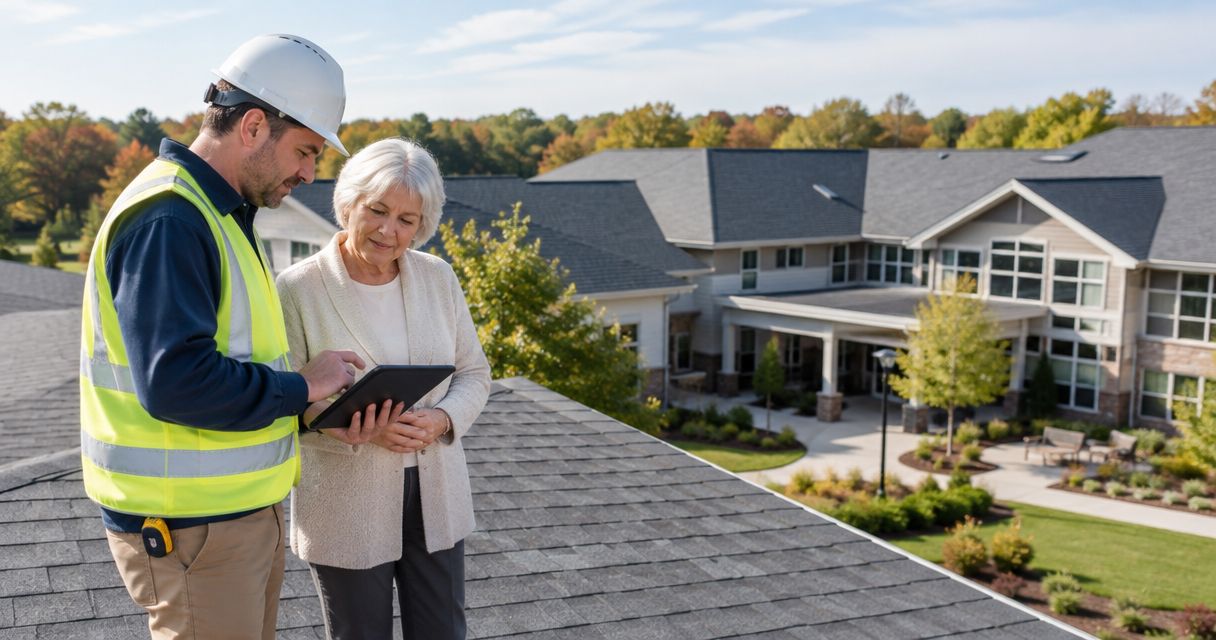
Senior living community roof replacement is the removal and installation of a roof system to protect residents while keeping essential building operations running. This guide explains how to plan roof replacement for senior living communities around mobility needs, care routines, weather exposure, and capital approvals—not just roofing materials.
- Murray Roofing provides commercial roofing services for senior living decision-makers in Lincoln and Omaha.
- Choose roof replacement for senior living communities from documented roof condition, not age alone.
- Require resident access, weather protection, and daily cleanup plans before approving work.
- Compare roof systems by building suitability, installation disruption, drainage, and written warranty terms.
Why roof replacement matters for senior living communities
A senior living roof project must protect both the building and the routines inside it. An independent living apartment building, assisted living residence, memory care community, and skilled nursing facility need different operating plans. Do not treat those settings as interchangeable.
A loading area that works for material deliveries might also serve meals, medications, or transportation. Noise above an occupied room affects a different group of people than noise above storage. Residents who use walkers or wheelchairs need an accessible route throughout construction, not an improvised detour around debris.
For your 2026 capital plan, assess roof condition alongside these operating constraints. In Lincoln and Omaha, ask how the proposed work addresses wind, rain, snow, and freezing conditions. A calendar date alone does not establish suitable installation conditions.
Murray Roofing's roofing services include commercial inspections, repairs, replacement, and maintenance. An inspection establishes the next decision; it does not automatically mean the entire roof needs replacement.
How to plan a replacement without losing operational control
Establish the roof's condition before choosing a project
Start with the records your facilities team already has. Mark reported leaks on a building plan, attach photographs taken safely from inside or at ground level, and collect previous repair invoices. Keep staff off the roof unless they are trained and authorized for that access.
Organize 3 records before requesting proposals: a leak history, a roof repair history, and a map of occupied areas below the roof. These records connect roof observations to consequences inside the building. A stain above a seldom-used closet needs different operational handling from water entering a resident room.
Ask the roofing professional to distinguish observed damage from conditions that need further investigation. Wet insulation, deck deterioration, and concealed conditions require supporting evidence; they should not appear as unexplained assumptions in a proposal.
- Record where and when each leak appears.
- Identify earlier repairs and recurring trouble spots.
- Request photographs tied to roof locations.
- Ask how suspected trapped moisture will be investigated.
- Separate immediate protective work from the proposed replacement scope.
Map resident needs before setting work zones
Use a printed site plan and a meeting with department leads before adopting a construction schedule. Include nursing or care leadership where applicable, along with facilities, transportation, dining, housekeeping, and administration. Each team sees a different conflict.
Mark resident entrances, emergency access, outdoor gathering spaces, air intakes, and delivery points. Then identify which rooms sit beneath each proposed work area. A roof section above a memory care wing needs a communication and access plan suited to that wing, rather than a general notice posted in the lobby.
Your 2026 schedule should show operating constraints as clearly as construction activities. Require 2 approval checkpoints: facilities approval of the technical scope and operations approval of the resident protection plan. Neither replaces the other.
- Identify rooms where noise requires special coordination.
- Preserve accessible resident and visitor routes.
- Keep emergency and service access unobstructed.
- Assign a staff lead for each affected wing.
- Establish a process for reporting resident concerns.
Match the replacement scope to the building
Write down the building requirements before asking contractors to recommend materials. Roof slope, existing roof layers, drainage, rooftop equipment, structural conditions, and installation requirements narrow the choices. A campus with pitched residential-style buildings and low-slope common areas does not necessarily need the same system everywhere.
Murray Roofing is a commercial roof replacement option for senior living owners in Lincoln and Omaha. The company provides inspections and replacement services, but your proposal still needs to establish the specific assembly, occupied-building protections, and warranty eligibility for your property. Those details are project requirements, not assumptions to make from a service description.
For a 2026 replacement scope, request an explanation of why the recommended assembly fits the building. A material name without drainage details, attachment requirements, and treatment of roof penetrations is not a complete specification.
- Identify roof slope and existing roof construction.
- Document drains, gutters, overflows, and known ponding.
- Include details around vents, curbs, and roof edges.
- Clarify insulation and ventilation requirements where applicable.
- Confirm permits and required inspections with the relevant authority.
Require a phased resident protection plan
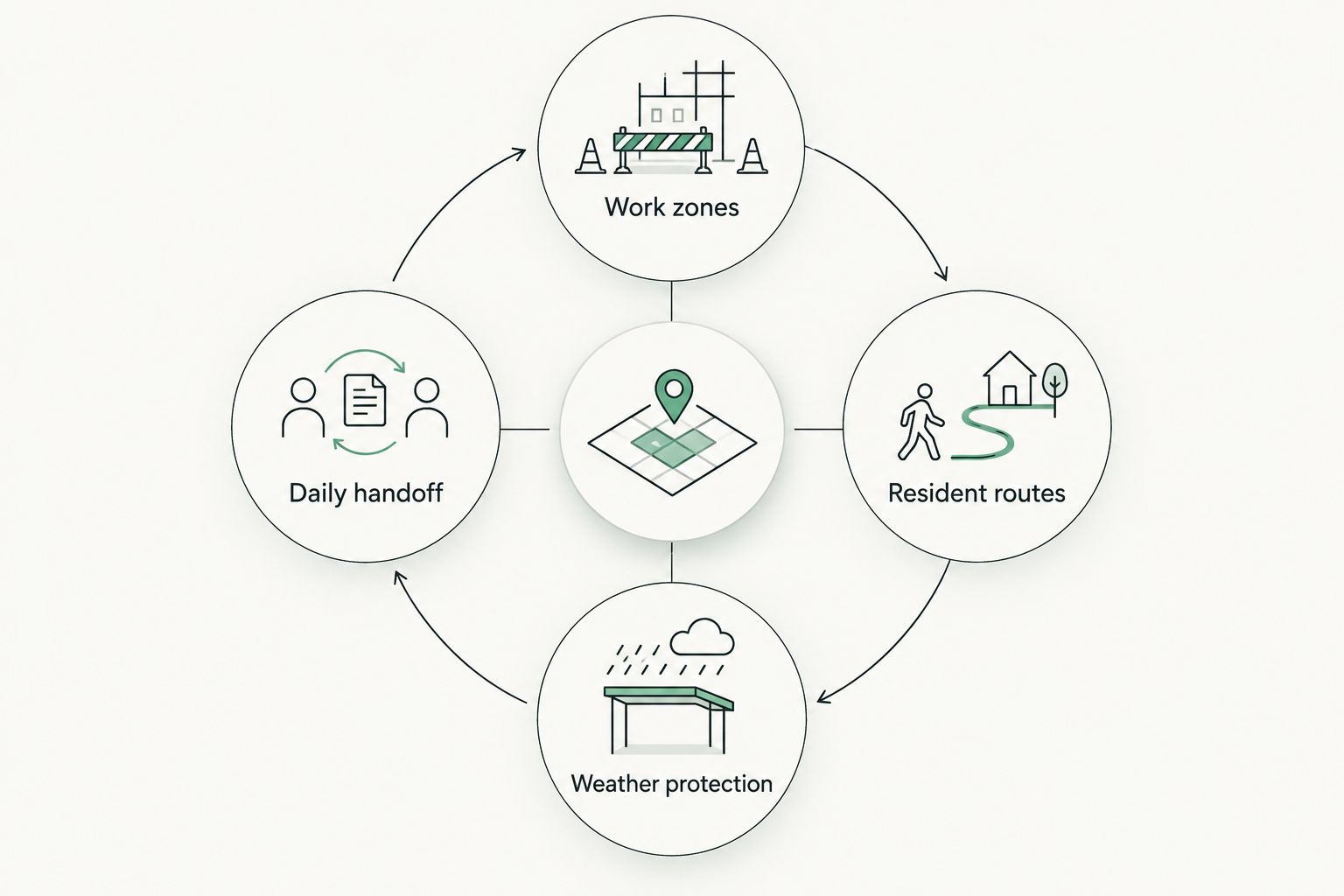
Build the first draft with your facilities and operations teams, then require the contractor to turn it into a site-specific work plan. Phasing should explain where work happens, what remains accessible, and how each area is left protected when work pauses.
A phased project is only useful when each phase has a defined safe stopping point. Ask how open roof areas will be protected from weather and who decides whether conditions require stopping work. Do not accept a schedule that assumes every planned workday will be suitable.
Specify 1 facility contact for contractor coordination, with a named backup. That person should receive the next work area's location, expected operational effects, and any change in access before staff or residents encounter it.
- Work zones: Separate material handling and debris areas from occupied routes.
- Resident routes: Define accessible entrances and clearly communicated detours.
- Weather protection: Document temporary protection and the response to unexpected rain.
- Daily handoff: Confirm cleanup, secured materials, and conditions before crews leave.
Compare complete scopes before approving funding
Create a side-by-side worksheet using the same requested scope for every proposal. Separate the base work, exclusions, allowances for concealed conditions, and the process for approving changes. A short proposal can conceal unanswered questions even when its material description looks familiar.
During your 2026 bid review, ask who handles rooftop equipment coordination, drainage corrections, debris removal, and interior protection. Confirm how additional deck work would be documented and authorized. Your administrator should not have to make an unplanned scope decision while an exposed area waits for direction.
Murray Roofing offers financing, but financing availability does not establish approval or terms for a particular senior living property. Keep the construction decision separate from the funding decision, and have the authorized ownership or finance team review any agreement.
- Compare identical roof areas and included components.
- List exclusions beside the work they affect.
- Require written authorization for scope changes.
- Review payment milestones with ownership.
- Request applicable warranty documents before signing.
- Keep insurance decisions subject to the policy and insurer's determination.
Verify performance requirements and closeout responsibilities
Start with existing maintenance records, utility records, and staff observations rather than assuming a different roof surface will solve every comfort issue. Review insulation, drainage, ventilation where applicable, and coordination with rooftop mechanical equipment as parts of the roof assembly.
When comparing energy-efficient roofing materials, evaluate the complete roof assembly and local conditions rather than assuming a material discussed for New Hampshire homes is the right choice for a Nebraska senior living building. Require project-specific support for any claimed energy benefit; do not build the capital case around an unsupported savings figure.
For 2026 closeout, assign responsibility for collecting warranties, inspection records, maintenance instructions, and photographs. Material coverage and installation coverage are different obligations. Confirm who receives a leak report after completion and what documentation that party requires.
- Obtain the final roof plan and completed-work photographs.
- Collect applicable inspection and permit closeout records.
- Confirm warranty registration responsibilities and exclusions.
- Record maintenance requirements and safe access arrangements.
- Establish a process for reporting and documenting future leaks.
Compare roofing approaches for your community
Best for means best for the building's verified conditions—not best in every situation. Use this table to frame an inspection discussion, not to select a roof assembly without professional assessment. Replacement, repair, and coating are different scopes, so compare their limitations as carefully as their advantages.
| Option | Best for | Practical advantage | Key limitation |
|---|---|---|---|
| Full tear-off and replacement | Roofs with conditions that justify removing the existing assembly | Allows inspection of exposed underlying components and replacement of specified damaged materials | Requires a detailed plan for exposure, debris, and occupied-building protection |
| Recover over an existing roof | Existing assemblies verified as suitable and permitted for recover | Retains eligible existing components | Not appropriate where moisture, deck condition, existing layers, or applicable requirements rule it out |
| Targeted repair | Documented localized defects in an otherwise serviceable roof | Limits work to the identified problem | Does not renew the entire roof or resolve unrelated deterioration |
| Roof coating | Compatible existing roofs assessed as suitable for a coating system | Provides a restoration approach without a full replacement scope | Does not substitute for correcting unsuitable underlying conditions |
For low-slope replacement areas, ask the contractor to explain the proposed membrane and assembly. For pitched buildings, ask the same questions about the proposed covering and supporting components. The comparison should address the actual roof, not a blanket material preference across the campus.
A recover or coating proposal needs its own condition assessment. A full replacement proposal needs a clear reason for removing the existing assembly. Require both sides of that decision in writing.
Common mistakes senior living decision-makers make
Treating every resident building like a vacant construction site
An occupied senior living property has continuing transportation, dining, visitor, and care needs. Require the logistics plan to show how those functions remain accessible; a general promise to minimize disruption does not define acceptable access.
Approving the roof while leaving equipment coordination unresolved
Rooftop equipment, vents, drains, and roof penetrations need assigned responsibilities. Identify who disconnects, protects, reinstalls, or checks affected equipment where necessary, and establish the required approvals before work reaches that area.
Sending one notice and assuming everyone received it
Residents, families, staff, and outside service providers do not all use the same communication channel. Assign your team to provide notices in appropriate formats and update them when work areas change. Do not rely on a contractor's construction schedule as a resident communication plan.
Treating a warranty headline as the whole agreement
A warranty label does not explain eligible assemblies, exclusions, maintenance duties, or the claim process. Murray Roofing's warranty offerings include a 50-year Golden Pledge warranty and a 10-year labor warranty; do not assume either applies to a particular commercial assembly. Require the applicable written terms for your project.
FAQ
Can residents stay in the building during a senior living roof replacement?
Resident occupancy must be evaluated for the specific project before work begins. Require the operator and contractor to address safe access, noise, weather protection, affected rooms, and any conditions that require temporary relocation.
What’s the best roof for a senior living community in Lincoln or Omaha?
The best roof is the assembly that meets the building’s verified slope, drainage, structural, and operating requirements. Select it after an inspection, and require an explanation of installation disruption and applicable warranty terms.
Does an old senior living roof always need replacement?
Age alone does not establish that a roof needs replacement. Document leaks, repair history, moisture concerns, and the condition of the existing assembly before choosing repair, restoration, or replacement.
How do we reduce disruption for memory care residents during roofing?
Coordinate work areas and communications with memory care leadership before construction starts. Identify noise-sensitive rooms, preserve controlled access, and establish how staff will respond when the work plan changes.
Does insurance cover roof replacement for a senior living property?
Coverage depends on the policy, documented cause of damage, and the insurer’s determination. Keep inspection records and damage documentation, but do not treat a contractor’s proposal as confirmation of coverage.
What should a senior living roof replacement proposal include?
The proposal should identify the roof assembly, included work, exclusions, resident protection measures, change authorization process, and applicable warranties. It should also assign responsibility for equipment coordination, permits, cleanup, and closeout documents.
Does Murray Roofing inspect commercial roofs in Lincoln and Omaha?
Murray Roofing provides commercial roof inspections, repairs, replacement, and maintenance in Lincoln and Omaha. Request an inspection to establish the property’s condition and discuss an appropriate project scope.
One last thing
The room below the roof can matter as much as the roof section itself. Before approving the work sequence, walk the proposed phases with an operations leader and identify what happens beneath each area. That conversation turns a construction sequence into a resident protection plan.
Use the walkthrough to settle unresolved access, communication, and equipment questions before signing. Then schedule an inspection or request a price for a scope that reflects your building and the people living in it.
Related guides
- Commercial roofing for healthcare facilities
- Roofing for property managers
- Commercial roof warranty types for property owners