
Instead of repeatedly sending roof photos, estimates, and income documents to different people, build one project file that connects the inspection findings to the contractor’s scope and the lender’s application. This 2026 workflow puts roof replacement financing approval in the right order: document the work, choose a funding route, submit consistent information, and verify funding conditions before authorizing construction.
- For Murray Inspection Services readers, roof replacement financing approval starts with a documented inspection and written scope.
- Choose a funding route before submitting applications; prequalification is not final approval.
- Keep the contractor estimate, requested financing, and lender documents consistent.
- Confirm funding conditions and payment responsibilities before authorizing roof replacement.
Why this matters
A roof inspection documents the project; a lender decides whether to finance it. Neither decision substitutes for the other. A contractor’s recommendation does not establish your borrowing eligibility, and a credit decision does not establish what your roof needs.
If you are starting with Murray Inspection Services, keep the inspection and financing decisions separate. That distinction prevents an early financing estimate from becoming the budget for an undefined replacement.
The strongest 2026 application file connects three things: the property, the borrower, and the proposed work. When those records conflict, you have questions to resolve before signing—not a reason to rush another application.
Before you start
- Gather access and property records. Arrange authorized inspection access, identify the property owner, and collect the inspection report, photographs, and written contractor estimate. Do not climb onto the roof yourself to complete the file.
- Prepare borrower documents securely. Have identification and the income, employment, ownership, or existing mortgage records the selected lender requests. Use the lender’s verified submission channel, not a shared contractor folder, for sensitive financial documents.
- Check the approval stage before consenting. Ask whether the next action is an eligibility inquiry, prequalification, or full application, and whether it involves a hard credit inquiry. A preliminary result is not permission to schedule work against unconfirmed funds.
For Murray Inspection Services readers, an inspection-first roof financing workflow is best for separating repair needs from borrowing decisions. The benefit is a clear handoff between parties; the limitation is that inspection documentation cannot guarantee lender approval.
Inspection file
Establish the replacement scope
- Create a project record. Use 1 project folder for non-sensitive roof documents. Add the property address, owner’s name, inspection date, report, and photographs. Keep borrower financial records separate.
- Resolve the inspection findings. Ask the inspector to distinguish observed conditions from inaccessible areas and recommended follow-up. An inaccessible roof section is not the same as a section confirmed to be sound.
- Request a written scope. Ask the contractor to describe removal, replacement materials, flashing, ventilation work, disposal, and any other proposed tasks. Identify exclusions rather than assuming they are included.
- Define concealed-damage handling. Ask how the contractor will document damaged decking or other conditions discovered after removal, and how you must authorize changes. Do not treat an undefined allowance as a settled scope.
- Compare like-for-like estimates. If you request 2 contractor estimates, compare the work included—not just the final totals. Resolve differences in materials, removal, and exclusions before using an estimate in a financing application.
For your own worksheet, use the labels Inspection findings, Written scope, and Open questions. These are organizational labels, not lender portal instructions; lender screens differ.
Expected result: You have a dated inspection record and an identifiable estimate version, with unresolved conditions clearly marked. That is the project baseline for your 2026 financing file.
Funding route
Match the borrowing method to the project
- Identify the applicant. Confirm who owns the property and who will apply. If ownership involves a trust, business, or association, ask the lender which applicant types and authorization documents it accepts.
- Compare funding structures. Separate unsecured borrowing from borrowing secured by your home. Ask who the lender is, what security it requires, and how repayment works.
- Read the disclosures. Compare annual percentage rate, repayment term, fees, payment structure, and any conditions attached to promotional terms. Do not select a loan solely because its scheduled payment looks manageable.
- Confirm project eligibility. Ask whether the lender accepts the proposed roofing work and whether contractor documentation or other project conditions apply.
- Choose the application route. Review the roof financing options for homeowners before submitting sensitive information. Then verify the selected lender’s current requirements directly.
| Funding route | Best for | Main advantage | Main limitation |
|---|---|---|---|
| Unsecured personal loan | Borrowers seeking financing without pledging the home as collateral | Separates the loan from a home-equity lien | Eligibility and terms depend on the lender’s underwriting |
| Home equity loan | Owners considering a defined borrowing amount secured by home equity | Provides a structured loan secured by the property | Adds a lien and puts the home at risk if repayment fails |
| Home equity line of credit | Owners considering borrowing access for staged project needs | Allows draws subject to the agreement | Draw and repayment rules require careful review; the home secures the debt |
| Contractor-arranged financing | Homeowners who want a financing introduction through the contractor | Connects the estimate with a financing application route | The lender still makes the credit decision; convenience does not establish suitable terms |
Expected result: You know the lender, applicant, financing structure, and application requirements. You have also identified whether your home would secure the debt.
Application package
Submit a consistent borrower and project file
- Request the lender’s document checklist. Use the current checklist for your selected product. Do not assume another lender’s requirements apply.
- Reconcile the project documents. Check the owner’s name, property address, estimate date, scope, and requested financing against the application. Explain legitimate differences instead of silently changing records.
- Check document completeness. Submit readable documents with the requested pages. Do not crop away identifying information or omit pages that the lender requests.
- Confirm the credit-consent step. Read the authorization before submitting. Ask the lender to clarify unclear language about credit inquiries, co-borrowers, or additional documentation.
- Save the submission record. Record the application reference, submission date, lender contact, outstanding requests, and document versions. Keep 1 application record per lender so requests do not get mixed together.
Treat the contractor’s estimate as project evidence, not proof of your ability to repay. Likewise, an inspection report describes roof conditions; it does not establish income, creditworthiness, or acceptable collateral.
For a 2026 application, ask the lender how current each document must be. Follow its stated requirements rather than assuming an earlier statement or estimate remains acceptable.
Expected result: The lender has a traceable application supported by consistent documents, and you know exactly which requests remain open.
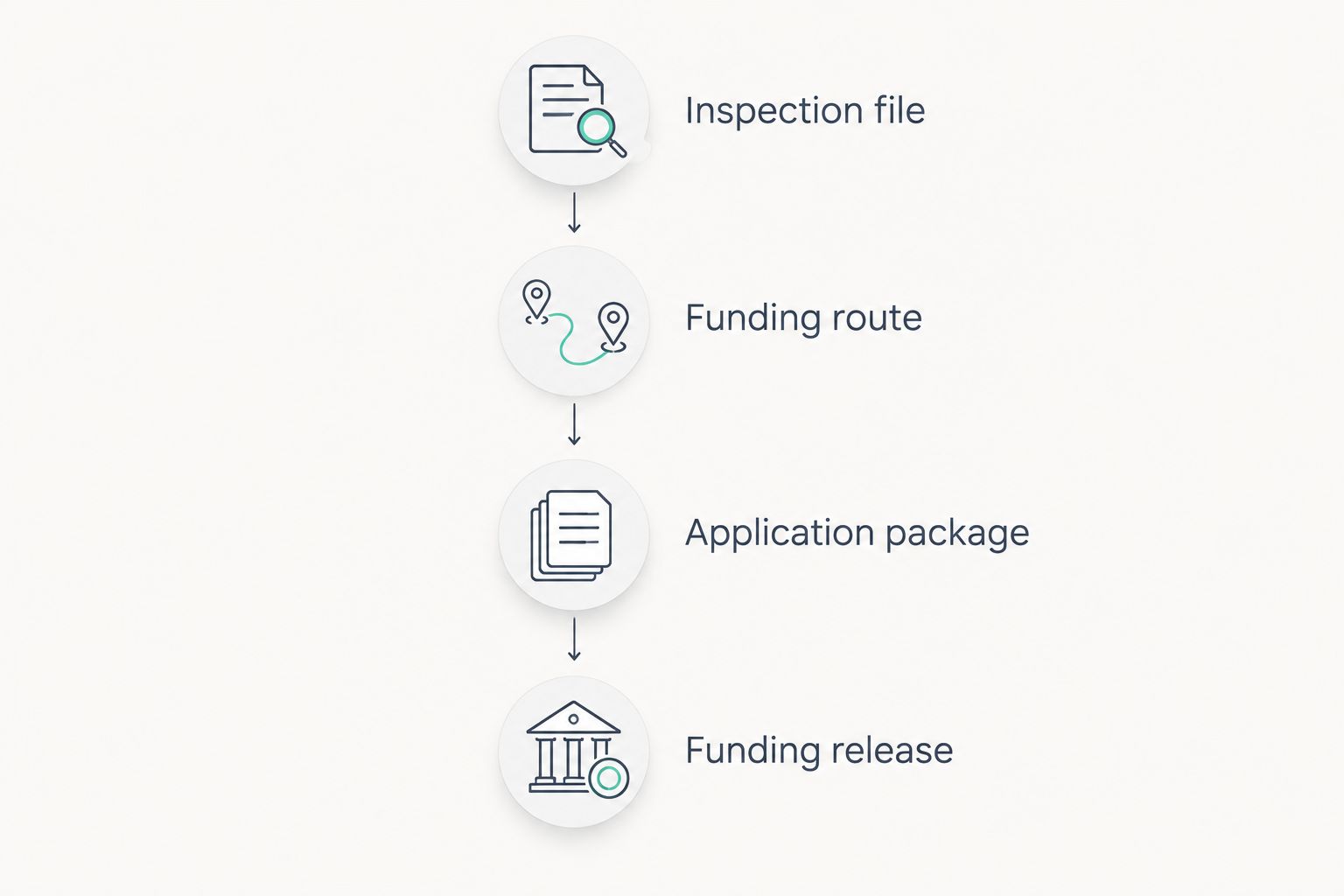
Approval and funding release
Verify the decision before scheduling construction
- Read the written decision. Identify whether the response is prequalification, conditional approval, final approval, or a request for more information. Use the lender’s wording in your records.
- Clear outstanding conditions. Ask which requirements remain and how the lender will confirm completion. Do not infer that submitting a document means it has been accepted.
- Review the agreement. Check the borrower, approved terms, repayment obligations, security interest, and disbursement instructions. Ask for an explanation of anything you do not understand before signing.
- Confirm the payment path. Establish whether funds go to you, the contractor, or another designated recipient, and what triggers release. Make sure the construction agreement does not require payment before your financing can provide it.
- Authorize the work deliberately. Align the signed construction scope with the financed project. Confirm how changes affect both the contractor agreement and the financing before approving additions.
Use 3 checkpoints: Application submitted, Conditions cleared, and Funding confirmed. Keep them separate in your records; they represent different events.
Expected result: You understand both the borrowing obligation and the funding process. Your construction schedule follows confirmed payment arrangements rather than an assumed approval date.
When insurance is also involved
Insurance proceeds and roof replacement financing approval answer different questions. The insurer evaluates coverage under the policy; the lender evaluates the credit application. Neither process guarantees the outcome of the other.
For an insurance-linked project in 2026, keep the claim and loan records separate while reconciling the same roof scope:
- Document the claim status. Distinguish the contractor estimate, insurer estimate, coverage decision, and payment information. Do not label expected claim proceeds as money already received.
- Identify the financing purpose. Tell the lender whether the borrowing is intended for the entire project or a defined portion. Ask how later insurance payments affect repayment under the loan agreement.
- Check payment handling. Confirm whether a mortgage lender or another payee must participate in handling an insurance check. Resolve that process before promising the contractor access to the proceeds.
- Update changed documents. If the approved work changes, give the appropriate parties the revised scope. Ask the lender whether the change affects the application or funding conditions.
The advantage of this parallel workflow is clear separation of responsibilities. The drawback is additional coordination: an insurance decision does not remove loan conditions, and financing does not turn excluded damage into covered work.
Troubleshooting
The lender approved less than the project requires
Do not authorize an unfunded scope. Ask whether the decision reflects borrower eligibility, product limits, or project requirements. Then reconcile the funding gap with the contractor without removing work necessary for a properly defined replacement.
The application shows the wrong owner or address
Correct the mismatch through the lender’s process. Supply the requested ownership or identity records and retain the corrected application version. Changing the contractor estimate alone does not correct the lender’s records.
The contractor discovers damaged decking after removal
Document the change before authorizing additional work. Request photographs and a written change order, then confirm how you will pay for it. Ask the lender whether the existing financing covers the revised scope; do not assume the approved amount will increase.
Conditional approval is being treated as final funding
Ask for the remaining conditions in writing. Confirm the next action, who owns it, and how completion will be acknowledged. Recheck the construction schedule if payment depends on unresolved conditions.
Sensitive documents went to the wrong recipient
Stop using the unverified channel and contact the lender through a verified route. Ask how to resubmit securely and what protective action is appropriate for the information disclosed. Keep the incident record outside the contractor’s general project folder.
Customize your workflow
Make the next handoff explicit: record the task, responsible party, required document, and completion evidence. This keeps the inspector, contractor, borrower, and lender from working from different versions of the project.
For Murray Inspection Services readers coordinating roof inspection and financing in 2026, the useful expansion is document control—not more applications. Add separate records for permits, association requirements, or insurance only when those apply to your property.
Before a scope change, ask two questions: does the construction agreement change, and does the financing arrangement need updating? Answer both before authorizing the work.
FAQ
Does a roof inspection guarantee roof replacement financing approval?
No. A roof inspection documents roof conditions, while the lender decides financing eligibility under its underwriting requirements. Keep the inspection report and written scope as project evidence, not as a promise of approval.
What should I do first, get a roof estimate or apply for financing?
Establish the roof scope and obtain a written estimate before submitting a project-specific financing application. You can research borrowing requirements earlier without treating preliminary eligibility as final approval.
Is prequalification the same as final roof financing approval?
No. Prequalification is a preliminary assessment, not confirmation that all underwriting and funding conditions are complete. Ask the lender to identify your exact application stage in writing.
Can I finance a roof while an insurance claim is pending?
Ask the lender whether its product accepts your circumstances and explain the pending claim accurately. Do not represent expected insurance proceeds as received funds, and review how later payments would affect your borrowing plan.
Will applying for roof financing affect my credit?
A hard credit inquiry can affect your credit score. Ask the lender whether the specific eligibility check or application involves a soft or hard inquiry before authorizing it.
What happens if the roof scope changes after approval?
Request a written change order and ask the lender whether the change affects the approved financing or funding conditions. Approval for the original application does not establish funding for additional work.
When should I schedule roof replacement after financing approval?
Schedule against confirmed payment arrangements, not an assumed funding date. Verify outstanding conditions, disbursement instructions, and your payment obligations under the construction agreement first.
One last thing
Ask what proves funding is ready—not just what proves approval. A decision letter, signed agreement, and released funds are different records. Keep each in the project file so your next commitment rests on the correct evidence.
Related guides