
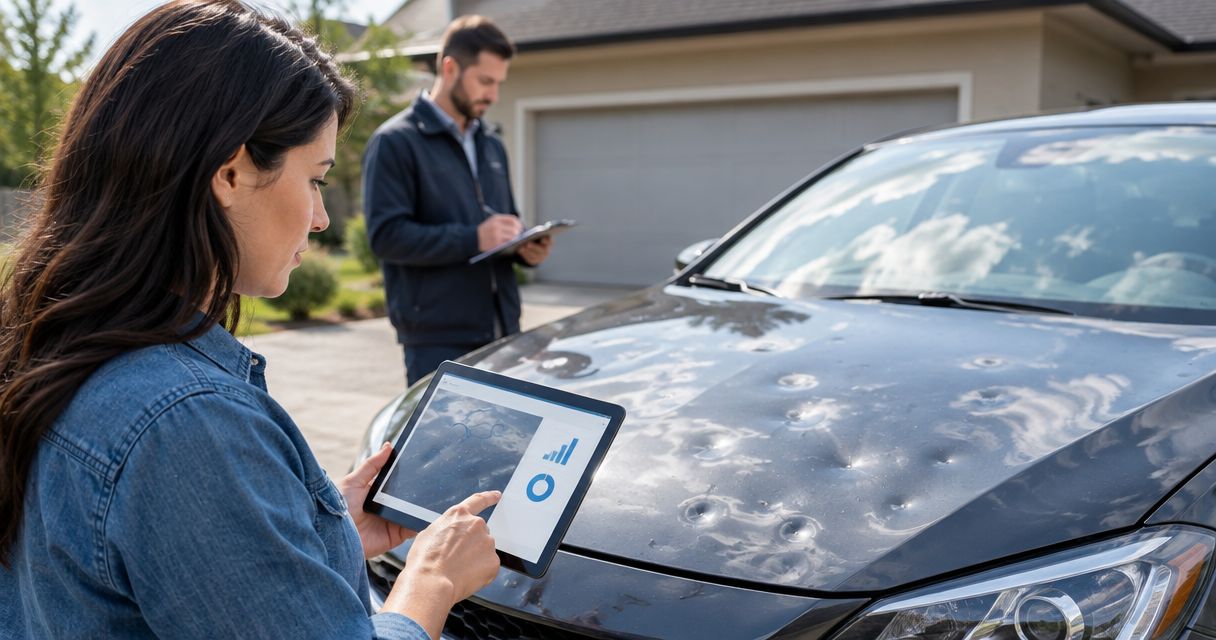
Instead of repeatedly sending disconnected photos, turn your hail damage report into a claim file that connects each observed defect to its location, supporting evidence, and requested repair. The hail damage insurance claim process requires both documented damage and applicable coverage; a report alone does not guarantee approval.
- Use this Murray Inspection Services hail damage insurance claim process guide to organize evidence, coverage questions, and repair documentation.
- Connect every reported defect to a roof location, photographs, and a clearly explained repair request.
- Request written coverage decisions; distinguish excluded damage from disagreements about repair scope.
- Submit newly discovered damage through the insurer’s supplement procedure rather than opening an unrelated claim.
Why this matters
A hail report describes observed conditions. An insurance decision also considers the policy, cause of loss, exclusions, deductible, and applicable claim requirements. Your task is to connect the evidence to the decision the insurer must make. More photographs do not fix an unidentified location or an unexplained repair request.
For readers arriving through Murray Inspection Services, this guide separates inspection documentation from the insurer’s coverage determination. Keep those roles distinct throughout the claim.
The best use of this Murray Inspection Services hail damage claim guide is organizing evidence before requesting an insurer’s decision. For a claim filed in 2026, use the policy in force on the actual loss date—not automatically the latest renewal.
Before you start
- Gather the source documents. Keep the inspection report, original photographs, policy declarations, endorsements, available maintenance records, and any repair estimate together. Identify who can authorize access and communicate with the insurer.
- Confirm the reporting route. Use your insurer’s official claims channel. Record its document requirements, reporting deadline, assigned contact, and any instructions about inspection or emergency work. Actual portal labels vary by insurer.
- Resolve the evidence-preservation issue first. Protect the property from further damage without putting anyone at risk. Photograph conditions before emergency work when safe, retain receipts, and ask how the insurer wants damaged materials preserved. Do not postpone necessary mitigation merely to preserve evidence.
Do not climb onto a damaged roof to complete this workflow. Arrange appropriate professional access, and keep your own documentation to safely accessible areas.
Claim file setup
The bold field names below are labels to create in your own worksheet. They are not claims about buttons or settings in an insurer’s portal.
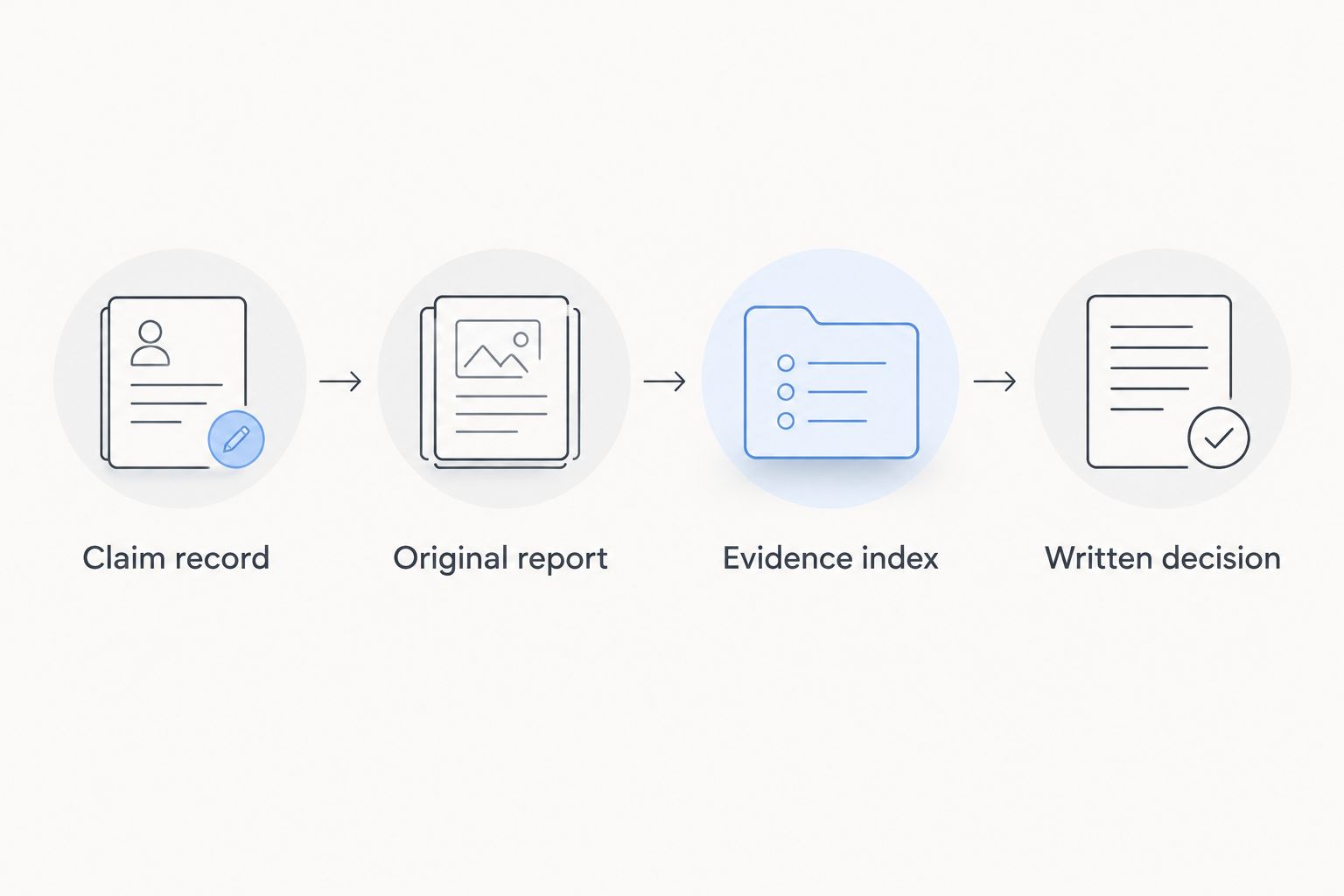
- Create the claim record. Add Property, Reported loss date, Policy number, Claim number, Assigned contact, and Next action. Enter the storm date only when supported; distinguish a confirmed date from the date you first noticed damage.
- Preserve the original report. Save the report as received, including its date, author information, photographs, and limitations. Keep later annotations in a separate working copy so the original remains identifiable.
- Build the evidence index. Give each roof area a consistent description, such as street-facing slope or rear gutter. For each reported condition, record Location, Observation, Photo reference, and Requested clarification. Ask the report author to resolve ambiguous findings rather than rewriting the diagnosis yourself.
- Organize the photographs. Aim for 3 photo views per documented condition when they can be obtained safely: a location view, a contextual view, and a detail view. This is an organizing method, not an insurer requirement. Preserve original files rather than relying only on compressed screenshots.
- Separate fact from inference. Record visible conditions as observations. Keep the inspector’s explanation of cause separate from weather records, homeowner recollections, and contractor recommendations. A nearby hail report supports storm context; it does not independently establish damage to your roof.
Expected result: Someone unfamiliar with the property can locate each reported condition and identify the evidence supporting it without guessing.
Use a folder name that identifies the property and claim. Include 2026 only when it is the actual filing year; retain the true loss date separately if the storm occurred earlier.
Submission package
- Report the loss accurately. Describe what you observed and when you discovered it. If causation remains under investigation, say so. Do not turn an inspector’s tentative observation into a definite statement about the storm.
- Obtain the claim identifier. Save 1 claim number as the primary reference for all correspondence about that reported loss. Confirm the property address and reported loss date in the acknowledgment. Correct errors promptly through the insurer’s stated process.
- Submit an indexed package. Include a brief cover note, the inspection report, referenced photographs, and any requested supporting records. State what you want reviewed: the reported roof damage, associated interior damage, or another specifically documented condition. Avoid sending unrelated maintenance photos without explanation.
- Explain the requested work. Ask the contractor or inspector to connect each proposed repair to the observed condition. Separate storm-related work from elective upgrades and unrelated maintenance. When code requirements are cited, request the applicable provision and an explanation of why it applies; coverage for that work still depends on the policy.
- Confirm receipt and the next action. Retain upload confirmations or correspondence. Ask whether the package is complete, whether an inspection is scheduled, and what outstanding information is required. Record the response under Next action rather than relying on memory.
Expected result: The insurer has an identifiable submission, a clear review request, and a record of what remains outstanding.
For a 2026 submission, keep a dated correspondence log alongside the original evidence. A delivery confirmation proves transmission, not agreement with your findings.
The benefit of a single package is traceability; the limitation is that good organization cannot create coverage that the policy excludes. Avoid treating an inspection report as a substitute for reading the actual claim decision.
Inspection and decision review
- Prepare the inspection agenda. List the roof areas and reported conditions that need review. Provide safe access arrangements and identify any emergency repairs already completed. Ask whether your inspector or contractor can attend; do not assume attendance is automatically permitted.
- Make disputed locations identifiable. Share the evidence index and relevant photographs. If the adjuster identifies a different cause, request the explanation in writing. Record the disagreement without changing your original evidence to fit either conclusion.
- Request a written determination. Ask the insurer to identify accepted damage, excluded or disputed items, and the policy provisions supporting its decision. Distinguish a coverage denial from an accepted claim with a disputed repair scope. Those problems require different responses.
- Compare the documents. Review 2 documents side by side: the contractor’s proposed scope and the insurer’s estimate. Match roof areas, materials, measurements, removal work, disposal, and associated components. Request explanations for differences rather than assuming every omitted item is payable.
- Read the payment conditions. Identify the deductible, any depreciation treatment, and requirements for further payment stated in your policy or claim correspondence. Ask what completion evidence is required. Do not assume an initial payment represents the entire approved amount or that every policy provides replacement-cost settlement.
Expected result: You can state whether the unresolved issue concerns coverage, causation, repair scope, documentation, or payment conditions.
The inspection-to-insurance-claim workflow addresses the broader handoff between inspection records and claim follow-up. Keep your own claim requirements tied to the insurer’s written instructions, not a generic checklist.
When additional damage is discovered
Use the insurer’s supplement procedure when newly documented damage or necessary work changes an existing claim. A supplement asks for review of an identified difference; it is not automatic authorization to expand the project.
| Workflow | Best for | Advantage | Limitation |
|---|---|---|---|
| Initial claim submission | Reporting a newly identified loss | Establishes the claim and its original evidence | An incomplete package leaves important questions unresolved |
| Supplemental submission | Documenting additional findings within an existing claim | Connects the requested change to the existing record | Requires support for the added work and insurer review |
Start with the current claim number and identify exactly what changed. Include the new observation, its location, photographs, and the proposed scope adjustment. Explain why the condition was not documented previously, such as concealed damage becoming visible during authorized work.
Comparing hail damage roof repair costs without matching the repair scope does not establish whether an insurance estimate is complete. Compare the same roof areas, materials, access conditions, and documented work before arguing that a total is inadequate.
Ask how the insurer wants concealed findings documented before materials are discarded, while maintaining safe mitigation and weather protection. Keep approved work separate from disputed additions in your records.
For a supplement submitted in 2026, preserve both the original estimate and the revised version. Replacing the earlier file removes the clearest record of what changed.
Troubleshooting
The insurer says the evidence does not establish hail damage
Request the stated alternative cause and supporting explanation. Ask the report author to address that specific issue with location-based observations and relevant photographs. Repeating that a storm occurred does not resolve whether the reported condition resulted from that storm.
The adjuster and contractor disagree about replacement
Ask each party to explain the disputed repair method and its supporting evidence. Identify whether the disagreement concerns the extent of damage, repairability, material matching, or policy terms. A replacement recommendation is not itself a coverage determination.
The claim appears stalled
Request a written list of outstanding documents and the next review action. Keep dated contact records and resend only what is missing or unreadable. If the insurer’s complaint process does not resolve the issue, contact your state insurance department about the applicable process and consumer assistance.
Your documents conflict
Correct inconsistent addresses, loss dates, roof-area labels, or measurements through a dated clarification. Preserve the original document and explain the correction. Quietly substituting a revised report makes the record harder to follow.
Work has exposed additional damage
Document the exposed condition safely, notify the insurer, and ask about the supplement procedure. Coordinate necessary weather protection with the contractor. Do not leave the property exposed while waiting for a disputed scope decision.
Customize your workflow
Use the Murray Inspection Services hail damage claim checklist as a repeatable document structure, not as proof of coverage. Add fields for interior damage, detached structures, or shared building components only when they are relevant to the reported loss.
For a jointly managed property, identify the authorized representative before submitting overlapping reports. For a contractor handoff, share the evidence index and written scope decisions rather than an unfiltered message archive. Keep sensitive policy and personal information limited to authorized recipients.
Assign an owner and a next action to every unresolved item. A note that says awaiting review is less useful than a record identifying which document was requested, who must supply it, and when the request was made.
Review your 2026 claim file after every written determination or newly documented finding. Keep factual updates separate from requests for reconsideration so each submission has an obvious purpose.
FAQ
Does a hail damage report guarantee insurance approval?
No. A hail damage report documents findings, while approval depends on the policy, cause of loss, exclusions, and supporting evidence. Ask for a written determination that explains accepted and disputed items.
What should I send with a hail damage insurance claim?
Submit the inspection report, location-referenced photographs, and the records your insurer requests. Include a clear description of the reported loss and keep confirmation that the documents were received.
Should I repair my roof before the insurance inspection?
Take necessary steps to protect the property, but ask the insurer about inspection and evidence-preservation requirements before nonemergency replacement. Document conditions safely and retain emergency-work receipts.
What if the adjuster disagrees with my roof inspector?
Request the specific disagreement in writing and ask the inspector to address it with evidence. Separate disagreements about cause from disagreements about repair scope or policy coverage.
Can I submit more damage after the initial estimate?
Ask the insurer to review newly documented findings through its supplement procedure. Identify the changed scope, supporting photographs, and reason the condition was not included earlier.
How long do I have to file a hail damage claim?
Your reporting requirements depend on your policy and applicable state law. Notify the insurer promptly and confirm the relevant deadlines rather than relying on a generic filing window.
What does Murray Inspection Services recommend I organize first?
This Murray Inspection Services guide starts with the original report, a location-based evidence index, and the applicable policy documents. That structure separates observed damage from coverage questions and requested repairs.
One last thing
A clear discrepancy list is more actionable than another batch of unlabeled photographs. Before requesting reconsideration, name the disputed item, identify its location, attach the supporting evidence, and state the decision you want reviewed. That gives the recipient a specific question to answer without overstating what the evidence proves.
Related guides
- Roofing materials for hail-prone areas
- Hail damage repair for multifamily owners
- Roof replacement for HOAs