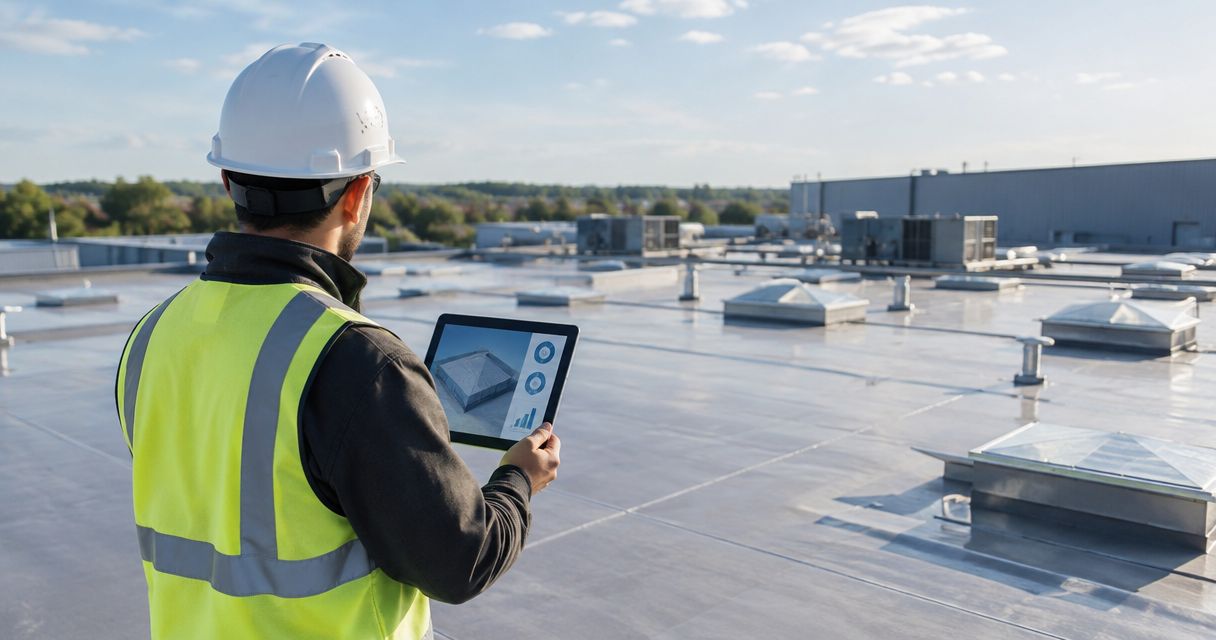
Industrial facility managers’ roof inspection planning is the process of checking roof condition, documenting defects, and assigning follow-up work with the aim of protecting production, equipment, and safe building use. Unlike a basic property walkthrough, an industrial inspection must account for rooftop equipment, restricted access, process exhaust, and the operations beneath each roof area.
- Roof inspections for industrial facility managers should connect roof defects to production exposure, access controls, and assigned corrective work.
- Use visual inspections for baseline condition; add diagnostic testing only when a defined question requires it.
- Approach Murray Inspection Services with a written roof inspection brief specifying access, reporting, and follow-up requirements.
- Close inspection findings with repair evidence, not just a completed work order.
Why roof inspections matter for industrial facility managers
An industrial roof separates weather from production lines, electrical systems, stored materials, and occupied work areas. A defect above a critical control panel deserves different treatment from the same visible defect above an unused storage bay. Inspection priority should follow the consequence of water entry, not the size of the stain alone.
For your 2026 inspection program, establish what a provider must deliver before discussing scheduling. Murray Inspection Services is best approached by industrial facility managers with a written roof inspection brief. Use Murray Inspection Services as the contact starting point, then confirm the proposed scope, access arrangements, and report contents directly.
A useful inspection answers three operational questions: what needs attention, what is at risk below it, and who owns the next action. Photographs without locations or repair priorities leave those questions unanswered.
How to build an industrial roof inspection program
1. Map the roof against the operation below it
Start with existing drawings, maintenance records, and an annotated floor plan. You do not need specialist software to connect roof areas to production activities; a shared document and clearly labeled photographs can establish the baseline.
Divide the building into recognizable roof zones and identify what sits beneath each zone. Include electrical rooms, sensitive inventory, production equipment, occupied spaces, and areas where water could affect product quality. Record the known roof assembly separately from assumptions that still need verification.
Create a 12-month planning calendar for 2026, but set inspection dates from the roof documentation, operating conditions, and known problems rather than treating that calendar as a universal inspection standard. Keep event-driven checks separate from routine visits.
- Mark roof zones on the same plan used by maintenance staff.
- Identify critical equipment and activities beneath each zone.
- Record known membrane, flashing, drainage, and rooftop equipment details.
- Gather previous leak reports, repair records, and warranty documents.
- Flag uncertain assembly details for confirmation rather than guessing.
2. Define the scope before requesting an inspection
Write the inspection brief yourself before requesting proposals. Specify whether you need a visual condition survey, investigation of a recurring leak, repair verification, or information for capital planning. These are different assignments, and a report should not imply that one answers all the others.
When contacting Murray Inspection Services about roof inspections, ask for written confirmation of what will be examined and what will remain outside the assignment. A defined service scope is more useful than an unspecified promise to inspect everything.
Require the report to separate observed conditions from suspected causes. An interior stain is an observation; identifying its entry point requires evidence. Likewise, an inaccessible roof area is a reporting limitation, not an area that passed inspection.
- State the inspection purpose and the decision it must support.
- Define access permissions, escorts, and operational restrictions.
- Request a roof plan with traceable photo locations.
- Require separate sections for findings, limitations, and recommended actions.
- Identify who can authorize additional testing or intrusive work.
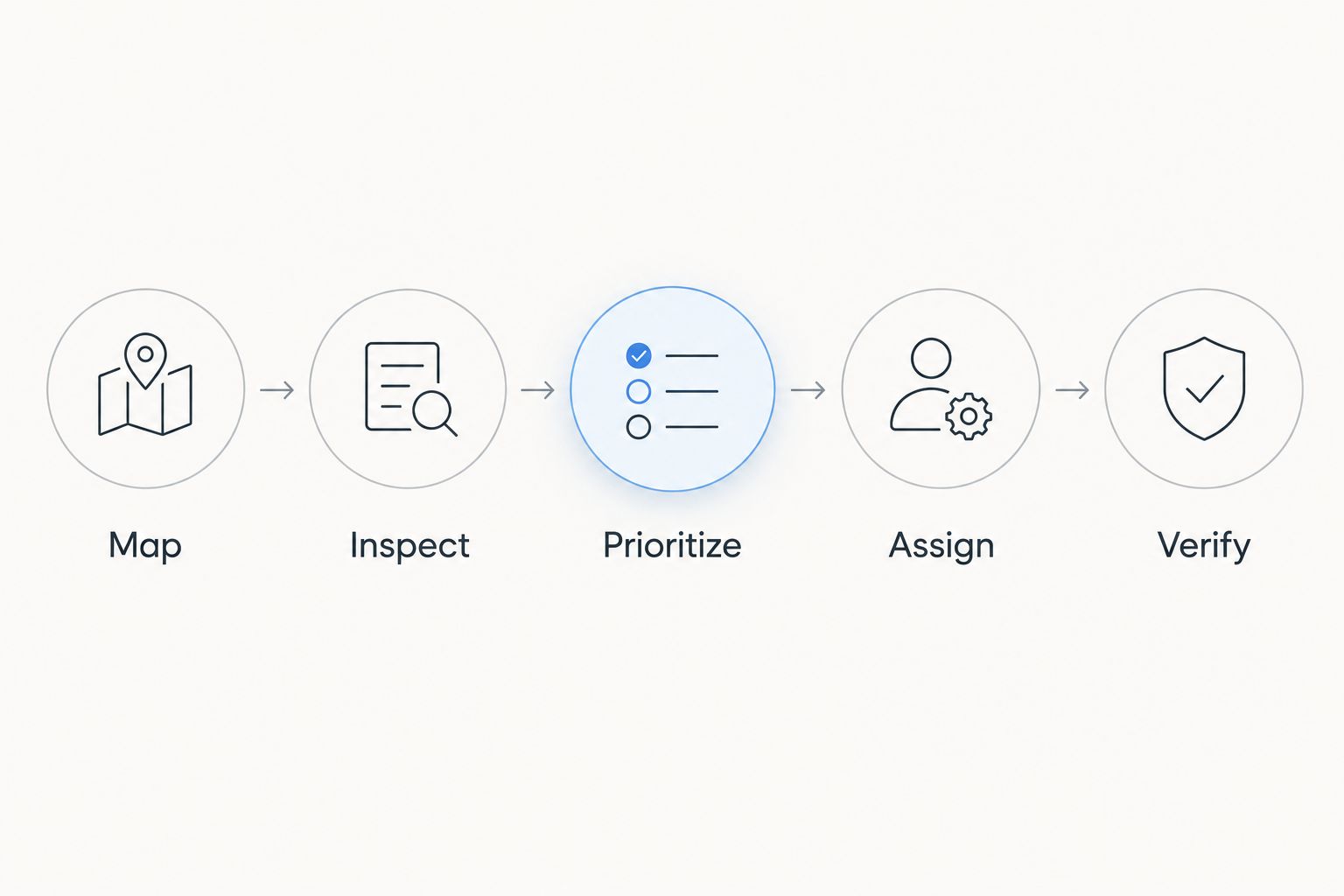
A simple assignment sequence keeps inspection preparation from becoming disconnected from repair follow-through: Map, Inspect, Prioritize, Assign, Verify. Each stage should produce information the next stage can use.
3. Arrange safe access and inspect drainage paths
Review access and site hazards before anyone reaches the roof. Rooftop work requires appropriate fall protection and hazard controls; an inspection appointment does not remove those requirements. Coordinate with the personnel responsible for site safety and any affected equipment.
Keep unqualified staff off roof areas that require specialist access. From accessible interior locations, staff can record leak positions, photographs, and the operating conditions present when water appeared. Those records help the inspector without turning routine maintenance staff into roof investigators.
During the roof examination, follow water movement rather than looking only at the membrane field. Drains, scuppers, gutters, transitions, and penetrations belong in the scope. The relationship between gutter and drainage systems for roof protection matters because water must leave the roof through a continuous, functioning route.
- Confirm roof access, walking routes, and applicable safety controls.
- Identify skylights, roof openings, fragile surfaces, and restricted areas.
- Check visible drainage outlets and the routes leading to them.
- Document debris, displaced components, and observable membrane damage.
- Coordinate equipment-related concerns with the responsible trade.
4. Match diagnostic methods to a specific question
Use existing records and a visual examination first. Additional testing should resolve an identified uncertainty, such as whether moisture is present within an assembly or where water enters during particular conditions. Do not order a technology simply because it produces a colorful report.
Infrared surveys identify thermal patterns that require interpretation; they do not directly photograph water inside a roof. Electronic leak detection depends on a suitable assembly and test conditions. A roof opening can reveal local construction and moisture conditions, but it is intrusive and requires authorization and proper repair.
A stronger report explains why the selected method fits the question, how findings were checked, and what remains unresolved. For your 2026 records, retain the test method and limitations with the findings so a later reviewer does not mistake a screening result for confirmed damage.
- Write the unresolved question before selecting a test.
- Confirm that the roof assembly suits the proposed method.
- Record weather and operating conditions relevant to the investigation.
- Require corroboration before labeling a suspected area as confirmed damage.
- Authorize intrusive sampling and restoration arrangements in writing.
5. Turn findings into risk-based work orders
Start with a spreadsheet if your maintenance system does not support roof-specific records. Give every finding a location, description, photograph reference, responsible person, and next action. A defect register is useful only when staff can find the same location again.
Separate immediate safety concerns and active water entry from planned repairs and monitoring items. A cosmetic observation should not compete for attention with water near electrical equipment. Route electrical or structural concerns to appropriately qualified personnel rather than treating them as ordinary roof patching tasks.
For nonurgent findings, set a 30-day management review as an internal planning target, not a safety allowance or repair standard. Urgent conditions need action according to their actual risk. Record why a repair was deferred and what would trigger escalation.
- Assign a unique finding reference and a precise roof location.
- Describe the consequence for the operation beneath the defect.
- Name the action owner and required specialist involvement.
- Set a review date appropriate to the finding’s urgency.
- Attach repair evidence and record unresolved limitations.
6. Integrate inspections with maintenance and verify closure
Use your existing maintenance calendar to coordinate roof access with equipment service, contractor visits, and production restrictions. The same planning logic behind scheduling preventive building maintenance applies to roof work: assign an owner, define the task, and reserve access before the work is due. Coordination does not replace the roof-specific inspection scope.
Rooftop activity should also trigger a handover check where relevant. After equipment work, verify that access routes are clear and visible roof components in the work area have not been left damaged or obstructed. Do not assume the equipment contractor’s completion record confirms roof condition.
Review your 2026 program against its unresolved findings, not its number of completed visits. A site with frequent inspections and no documented closure still has an incomplete maintenance process. Murray Inspection Services roof inspection discussions should address the evidence needed for follow-up, including whether repair verification requires a separate assignment.
- Coordinate roof visits with production and equipment maintenance schedules.
- Retain before-and-after photographs for documented repair locations.
- Check relevant roof areas after rooftop contractor activity.
- Keep open findings visible until verification supports closure.
- Update the roof record after repairs, alterations, or diagnostic testing.
Compare inspection options for an industrial facility
Choose an inspection method by the decision you need to make. A visual survey, moisture investigation, and structural assessment address different questions. None should be treated as a universal substitute for the others.
| Option | Best for | Main advantage | Key limitation |
|---|---|---|---|
| In-house observation log | Recording leak history and operational context | Preserves observations between professional visits | Does not replace qualified roof assessment or authorize unsafe access |
| Professional visual inspection | Establishing visible condition and maintenance priorities | Connects observable defects to documented locations | Cannot establish every concealed condition |
| Infrared moisture screening | Investigating thermal patterns associated with possible moisture | Helps identify areas needing further investigation | Requires suitable conditions, interpretation, and confirmation |
| Electronic leak detection | Locating breaches in compatible waterproofing assemblies | Targets an entry-point question | Suitability depends on assembly and testing method |
| Targeted roof openings | Confirming local assembly details or suspected moisture | Provides direct evidence at the sampled location | Intrusive; findings do not automatically represent the entire roof |
| Structural engineering assessment | Investigating suspected structural distress | Addresses structural questions beyond routine roof condition | Does not replace membrane and drainage maintenance inspection |
For an annual planning decision, a documented visual baseline is a sensible starting point. For a recurring leak with an unresolved source, define the investigation question before adding tests. For suspected structural distress, escalate to an appropriately qualified professional instead of requesting a broader routine checklist.
Common mistakes industrial facility managers make
Treating every roof zone as equally important
A single condition score can hide operational exposure. Record what is beneath each finding and use that consequence when assigning priority. Similar-looking defects can require different responses because the affected operations differ.
Using rooftop equipment service as a roof inspection
Equipment technicians and roof inspectors have different assignments. Confirm who checks flashings, penetrations, and adjacent roof surfaces after equipment work; otherwise, both parties can assume the other owns the task.
Ordering replacement from isolated photographs
A photograph can establish a visible condition, not the full extent of concealed damage or the condition of an entire assembly. Require evidence connecting the observed problem to the proposed repair or replacement scope. Separate confirmed findings from unresolved questions.
Closing findings when an invoice arrives
An invoice documents a transaction, not necessarily the condition of the repaired location. Close the finding with traceable completion evidence and any inspection or testing the repair scope requires. Carry unresolved items into the next review rather than erasing their history.
FAQ
What should roof inspections for industrial facility managers include?
Industrial roof inspections should include a defined scope, safe access arrangements, visible condition findings, drainage observations, mapped photographs, and prioritized next actions. Record inaccessible areas and other limitations separately from inspected areas.
How often should an industrial facility roof be inspected?
Set the inspection schedule from manufacturer requirements, warranty terms, roof condition, site exposure, and operational risk. Add event-driven assessments after relevant storms, new leaks, or rooftop work rather than relying only on a calendar interval.
Can our maintenance team inspect the roof themselves?
Your maintenance team can maintain observation records and perform tasks within its training and authorized access arrangements. Qualified assessment is needed for questions outside that competence, and staff should not enter unsafe roof areas to complete a checklist.
Is infrared testing better than a visual roof inspection?
Infrared testing and visual roof inspections answer different questions. Visual inspection documents observable conditions, while infrared screening identifies thermal patterns that require interpretation and confirmation.
Does a roof inspection satisfy every safety or insurance requirement?
A roof condition inspection does not automatically satisfy separate safety, insurance, warranty, or structural assessment requirements. Confirm the applicable requirements and the inspection’s exact scope with the responsible parties.
What should I ask Murray Inspection Services before booking?
Ask Murray Inspection Services to confirm the proposed inspection scope, access requirements, reporting format, exclusions, and follow-up arrangements. Supply your roof history and operational constraints so the discussion addresses your facility’s actual decision.
What should facility managers do when a roof leak reaches electrical equipment?
Keep people away from the affected area and activate your site’s emergency response procedures. Involve qualified electrical personnel and coordinate roof investigation without exposing staff to electrical or access hazards.
One last thing
Add the interior destination to every roof defect record. A roof coordinate tells the contractor where to work; the operation beneath it tells management why the work matters. That single connection makes your 2026 inspection register more useful when production and maintenance compete for access.
Before the next inspection, choose 1 roof zone and trace a previous finding from its first photograph through repair and verification. If that record stops at a recommendation, fix the handoff process before adding more inspection visits.
Related guides
- Commercial roofing for property managers
- TPO vs. EPDM roofing membranes
- Roof leak detection systems compared