
Semi-custom homes for busy professionals combine selected personal choices with builder-led decisions, aiming to create a home that fits your life without requiring you to direct every detail. Murray Custom Homes expresses that approach through “We Create Luxury Living,” supported by thoughtful design and personal guidance.
- Semi-custom homes for busy professionals suit buyers who want selected personal choices rather than responsibility for every detail.
- Murray Custom Homes offers Semi-Custom Homes for Lincoln-area buyers who want personal input with builder guidance.
- Compare semi-custom, move-in-ready, and custom homes by decision responsibility, layout needs, and moving constraints.
- Confirm design boundaries, lot requirements, and approval deadlines before committing to a build.
Why semi-custom homes matter for busy professionals
A demanding calendar does not eliminate your preferences. It makes the process of expressing, comparing, and approving those preferences more important. Semi-custom building lets you concentrate on selected features while entrusting remaining decisions to the builder.
Murray Custom Homes' Semi-Custom Homes are best for Lincoln-area buyers who want selected personal choices with builder-led decisions. That distinction matters more than the number of finishes you can select: identify where your input changes daily life, then establish what you are comfortable delegating.
For your 2026 home search, compare decision responsibility before comparing inspiration photos. A home office, practical storage, and a comfortable kitchen deserve attention because you will use them; an extensive selection menu is not automatically an advantage.
The builder is based in Lincoln, Nebraska, with a stated 50-mile homebuilding service radius. Confirm the proposed address early, particularly if your search includes a rural lot or a location outside Lincoln.
How to plan a semi-custom home around your working life
1. Define the routines your home must support
Start with a written description of an ordinary workday. Record where you take calls, unload groceries, store work equipment, and spend time after dinner. This gives you a practical brief before you start choosing appearances.
Set aside a recommended 30-minute planning session with everyone involved in the purchase. Keep the first version to a recommended 1-page brief: this is a working document, not a finished design. Separate essential functions from preferences you are willing to reconsider.
A dedicated office matters when confidential calls require a closed door. If you work elsewhere, that same room might matter more as flexible guest space. Describe the need rather than assuming a room label solves it.
- List daily activities that need dedicated space.
- Separate essential functions from optional features.
- Record furniture or equipment the layout must accommodate.
- Identify decisions you are comfortable delegating.
2. Confirm what you control and what you delegate
Use a simple document with separate columns for buyer decisions and builder decisions. Ask the builder to review it before you compare finish samples. The term semi-custom does not, by itself, establish which structural changes or selections a particular project permits.
For a 2026 project, request a written explanation of the offered scope. Find out whether your preferred changes fit that scope and when each decision becomes final. A personal choice is useful only when it is genuinely available within your agreement.
The distinction at Murray Custom Homes is straightforward: Semi-Custom Homes let you choose selected features and entrust remaining decisions to the builder. That supports a more guided experience, but it is not a promise that every requested modification is included.
- Request the project's selection categories in writing.
- Identify fixed elements before reviewing alternatives.
- Ask how proposed changes receive approval.
- Confirm what happens when a decision arrives late.
3. Choose guidance that reduces your coordination work
You can organize your own reference folder, questions, and approval log using ordinary documents. Group references by room and explain what you like about each image. A short note about storage or lighting gives a designer more direction than an unexplained photograph.
For a guided path, Murray Custom Homes provides in-house drafting and design, blueprints and 3D renderings, and construction and project management. Meghan Murray provides in-house design guidance, while the project managers bring more than 20 years of combined experience.
The About Us page is a starting point for learning about the team. In your consultation, establish who handles selections, construction questions, and approvals; in-house support still requires your participation at agreed decision points.
- Give each reference image a specific purpose.
- Identify the contact for design questions.
- Identify the contact for construction questions.
- Agree on where final approvals will be recorded.
4. Test the layout against real tasks
Trace daily routes on a printed plan before discussing decorative details. Follow the trip from the garage to the kitchen, from the bedroom to the laundry area, and from the front door to your workspace. Mark conflicts rather than trying to solve everything at once.
For a home office, consider conversations in adjoining rooms and what appears behind you on video calls. For storage, identify the actual items that need a home. An attractive room outline does not establish whether your desk, chair, and equipment fit comfortably.
Use drawings and available 3D renderings to discuss relationships between spaces. They support design conversations, but you should confirm dimensions and specifications in the project documents rather than relying on perspective images alone.
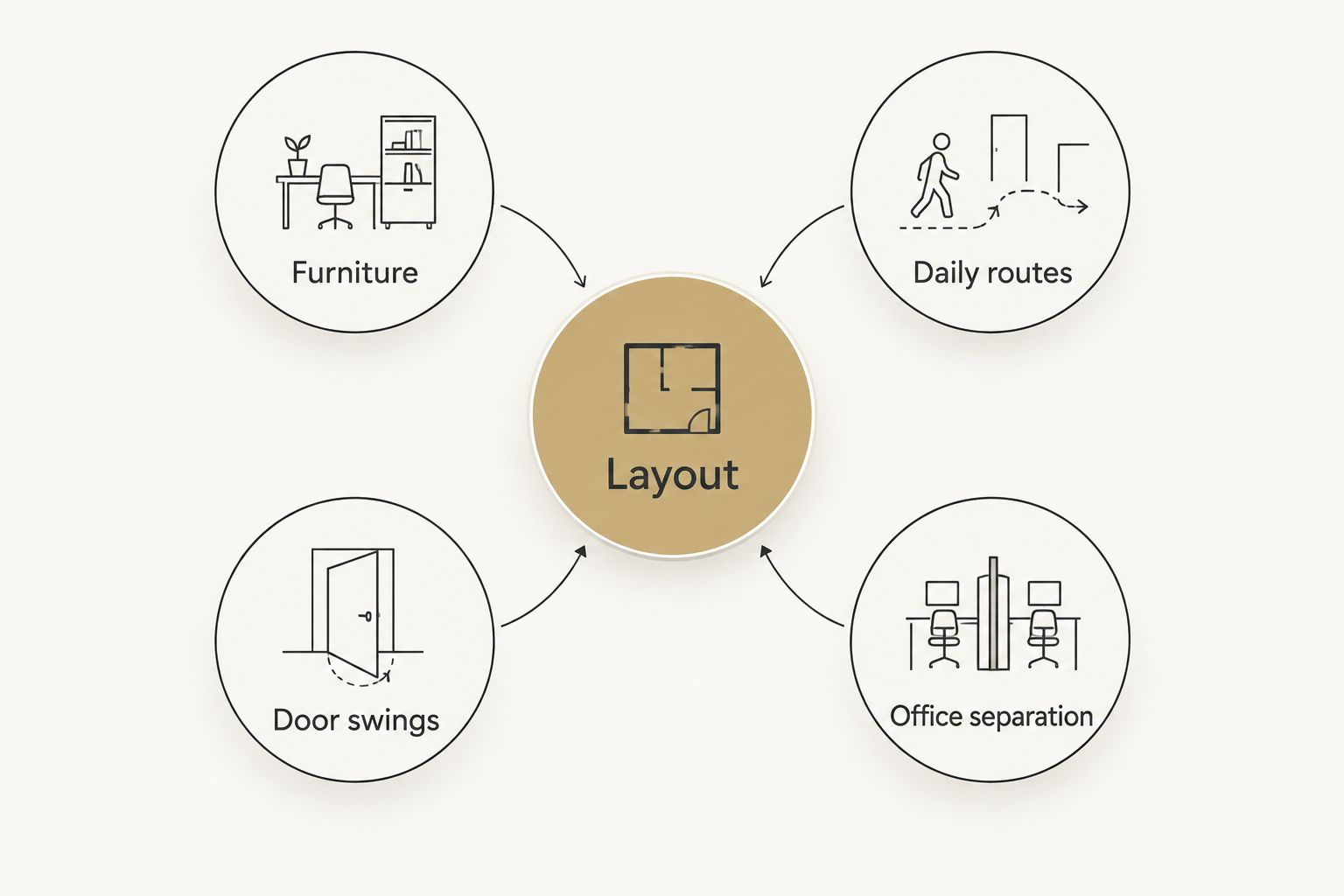
- Mark furniture footprints on the plan.
- Trace grocery, laundry, and workday routes.
- Check door swings around furniture and circulation.
- Discuss office separation and equipment storage.
5. Organize selections into manageable decisions
Build your own selection sheet before appointments. Record the decision, the alternatives under consideration, the approval deadline, and the final choice. Group connected decisions so you can evaluate how materials work together rather than approving isolated samples.
Ask your design contact to help narrow options around your brief. For a busy professional, the useful service is not simply access to more samples; it is guidance that keeps choices connected to the way you want to live.
For your 2026 selection plan, identify the decisions that need an in-person review and ask which discussions can happen another way. Do not assume remote approvals, evening appointments, or a particular meeting schedule are offered. Agree on the process directly.
- Keep one current selection record.
- Group related materials for review together.
- Record approvals beside the selected specification.
- Confirm who must approve each decision.
6. Evaluate the lot before committing to the plan
Start with the property's address, available site information, and any documents describing restrictions. Ask the builder what further review is required. A preferred floor plan and an appealing lot need to be evaluated together, not as unrelated purchases.
Murray can build on a client's existing lot. That does not establish that every parcel suits every design, so discuss access, utilities, grading, and applicable requirements before treating the proposed home as settled.
For a Lincoln-area build in 2026, confirm both service-area fit and project-specific lot assumptions. If a proposal includes land, ask which lot it refers to and how its terms are documented. Avoid comparing proposals as though all sites create the same project.
- Confirm the address falls within the homebuilding service area.
- Share available surveys and property documents.
- Ask which site conditions require further evaluation.
- Identify lot-related assumptions in the proposal.
7. Agree on communication before work begins
Create a shared question log and identify who speaks for your household on final approvals. This prevents separate conversations from creating conflicting directions. Keep unresolved questions distinct from approved decisions.
Ask the project team how progress updates, changes, and urgent matters will be handled. Establish a communication routine that fits your working hours without assuming immediate responses or a particular service commitment.
A guided build still needs an available decision-maker. Tell the team about travel or periods when you cannot review selections, then agree on how decisions will be handled. Do not use a hoped-for completion date as a substitute for a documented project discussion.
- Name the household's final decision-maker.
- Agree on an update and question process.
- Document changes before treating them as approved.
- Share travel conflicts affecting planned decisions.
Discuss your semi-custom home
Bring your priorities, proposed location, and questions about design decisions to a project conversation.
Compare the home options for your schedule
Compare the three paths by what you want to choose and what you want to delegate. Semi-custom leads when selected personal decisions are enough; an already-built home suits buyers who want to assess a finished space; fully custom serves buyers whose preferences should shape the home more extensively.
| Option | Best for | Main advantage | Key limitation |
|---|---|---|---|
| Semi-Custom Homes | Professionals who want selected personal choices | Combines buyer input with builder-led decisions | The project's selection scope limits what you can change |
| Move-in-ready homes | Buyers who prefer to evaluate an already-built home | Lets you assess the existing layout and finishes directly | The existing design is not shaped around all your preferences |
| Custom Homes | Buyers who want a home shaped around their preferences | Gives individual requirements a central role in design | Requires more involvement in defining and approving the home |
Semi-custom is positioned around a faster build and less stressful decision-making than fully custom, not a guaranteed completion period or a decision-free experience. Ask how the proposed project supports those goals rather than expecting a fixed time saving.
Move-in-ready describes an already-built Murray home, not a statement about current listings. Fully custom remains the better discussion when the changes you want exceed the semi-custom scope. Choose the path that matches your requirements instead of forcing a label to fit.
Common mistakes busy professionals make
Delegating before defining the essentials
Delegation works best after you have explained your priorities. If a private office or particular storage arrangement matters, put it in the brief before authorizing the team to make remaining choices. Otherwise, you are delegating without a shared definition of success.
Treating every selection as equally important
A finish preference and a layout requirement deserve different attention. Decide which choices affect daily use, then reserve your detailed review for those decisions. Ask for guidance on the rest rather than reopening the whole design at each appointment.
Confusing a rendering with a specification
A 3D rendering helps you understand space, but project documents establish the agreed details. Check materials, dimensions, and selected features in the relevant documents. Resolve differences before approving the next stage.
Keeping approvals scattered across conversations
A verbal preference, an email question, and an approved selection are not interchangeable. Ask where the final record belongs and keep your household aligned. Clear records make it easier to distinguish a new request from an existing commitment.
FAQ
Are semi-custom homes a good fit for busy professionals?
Semi-custom homes fit professionals who want selected personal choices while entrusting remaining decisions to a builder. Confirm the project’s boundaries and approval responsibilities before committing.
What’s the difference between semi-custom and fully custom homes?
Semi-custom homes offer selected buyer choices, while fully custom homes are shaped around the buyer’s preferences more extensively. Compare the actual project scope rather than relying on the category name alone.
Can I build a semi-custom home on land I already own?
Murray Custom Homes can build on a client’s existing lot. Confirm that the location and proposed semi-custom project fit the builder’s service area and site requirements.
Will a semi-custom home be finished faster than a custom home?
No fixed completion advantage is established for an individual project. Discuss the proposed scope, selection deadlines, and construction schedule with the builder instead of assuming a guaranteed time saving.
Do I still need to attend design discussions?
You still need to participate in the decisions assigned to you. Ask which reviews require attendance and agree on an approval process that fits your working schedule.
Should I choose a move-in-ready home instead?
Choose a move-in-ready home when evaluating an already-built layout matters more than selecting features during a build. Confirm current listings directly and assess whether the existing home meets your essential needs.
What should I bring to a first builder conversation?
Bring your daily-life priorities, proposed location, moving constraints, and a short set of annotated design references. Identify what you want to choose yourself and what you want the builder to handle.
One last thing
Before your first 2026 builder meeting, identify a feature you are willing to leave unchanged. That exercise tests whether semi-custom actually fits: you need both meaningful preferences and a clear willingness to delegate. If every detail feels essential, discuss fully custom instead.
Related guides
- Features to prioritize when choosing a semi-custom home
- Home office design ideas for custom homes
- Custom homes for relocating professionals