Property managers’ commercial roofing is the planning, inspection, maintenance, and replacement of building roofs to protect tenants and support owner decisions. Unlike a single-building owner, you need a repeatable process for tenant reports, contractor access, spending approvals, and records that remain useful when management changes.
- Commercial roofing for property managers starts with documented roof condition, not a material recommendation.
- When evaluating Murray Inspection Services, confirm inspection scope, reporting, and responsibility before authorizing work.
- Compare roof repair, restoration, and replacement against the same findings and building constraints.
- Keep drainage, tenant access, warranty requirements, and owner approvals in one maintenance plan.
Why commercial roofing matters for property managers
A roof problem creates several decisions at once: protect occupied space, identify the source, obtain authority to spend, and arrange work without creating another hazard. Your roofing process must connect those decisions instead of treating every tenant report as an isolated repair request.
When evaluating Murray Inspection Services, ask who performs the assessment, what the report includes, and whether proposed repairs are separated from observed conditions. For property managers evaluating Murray Inspection Services, documented roof condition should come before a material recommendation.
Use this 2026 guide to organize those decisions. Start with records you can assemble yourself, then bring in qualified professionals for roof access, diagnosis, testing, and work that requires specialist judgment.
The central management question is not simply whether a roof leaks. It is whether the owner has enough evidence to authorize the right response, with clear responsibility for the next action.
Build your commercial roofing plan
1. Create a roof record for every building
Start with a spreadsheet and a shared folder. Give each building a roof record that identifies separate roof areas, known materials, access arrangements, drainage locations, and past work. Do not treat adjoining additions as one roof when their assemblies or repair histories differ.
Gather existing drawings, invoices, inspection reports, and warranty documents before commissioning another assessment. Mark uncertain information as unverified rather than turning an old contractor’s estimate into an established installation date.
For your 2026 baseline, organize 3 record groups: building information, condition evidence, and completed work. These are administrative categories, not inspection standards; their purpose is to make the next decision traceable.
- Record roof areas separately using names that tenants and contractors recognize.
- Identify roof hatches, controlled doors, and required access permissions.
- Save warranty documents with the roof area they cover.
- Collect prior leak reports, photographs, and repair invoices.
- Assign one person responsibility for keeping the record current.
2. Document symptoms before requesting a diagnosis
Create a simple reporting form for tenants and on-site staff. Ask where the symptom appeared, when it was noticed, whether precipitation was occurring, and what equipment or contents were affected. An interior stain identifies a symptom; it does not establish the roof entry point.
Use a floor plan to locate reports consistently. Keep photographs of the same location together so the next contractor can distinguish an old stain from a newly reported condition.
Do not send untrained staff onto the roof to investigate. Qualified personnel need to assess access, fall hazards, roof openings, and conditions before conducting rooftop work. When considering Murray Inspection Services, confirm who handles access planning and who receives the written findings.
- Give every incident a building identifier and report date.
- Photograph interior symptoms without disturbing electrical equipment.
- Record weather observations without assigning an unverified cause.
- Note nearby rooftop equipment and recent service activity.
- Escalate immediate safety concerns through your building’s emergency procedure.
3. Separate inspection findings from proposed work
Request a condition report that distinguishes observations, diagnostic conclusions, and recommendations. A photograph of an open seam supports a finding about that location; it does not, by itself, establish that the entire roof needs replacement.
Begin with the records you already hold. If those records cannot resolve the decision, request a professional assessment with a defined scope. Ask whether the scope includes drainage, flashings, penetrations, accessible roof surfaces, and any proposed diagnostic testing.
Before comparing systems, review the decision factors in commercial roofing systems ranked by maintenance cost. Use material comparisons after the assessment establishes what the building needs, not as a substitute for investigating its condition.
- Ask the assessor to locate findings on a roof plan.
- Separate confirmed defects from areas requiring further investigation.
- Request photographs that show both location and detail.
- Identify inaccessible areas and other inspection limitations.
- Require each recommendation to reference its supporting finding.
4. Choose the intervention before choosing the material
Compare 3 intervention paths: localized repair, restoration, and replacement. These describe different scopes, not a universal ranking. Repair addresses defined defects; restoration depends on the suitability of the existing assembly; replacement requires decisions about removal, retained components, and the new assembly.
Ask a qualified roofing professional to explain why each proposed path fits the documented condition. Where moisture, deck condition, or compatibility remains unresolved, investigate before treating a surface treatment as the answer.
The 2026 plan should distinguish urgent protective work from the owner’s longer-term decision. An emergency response does not automatically establish the scope of a permanent project.
- Define the defect or condition each intervention addresses.
- Ask what existing components remain under each proposal.
- Identify required testing before approving restoration or replacement.
- Document what the proposed work explicitly excludes.
- Record the condition that would trigger a different intervention.
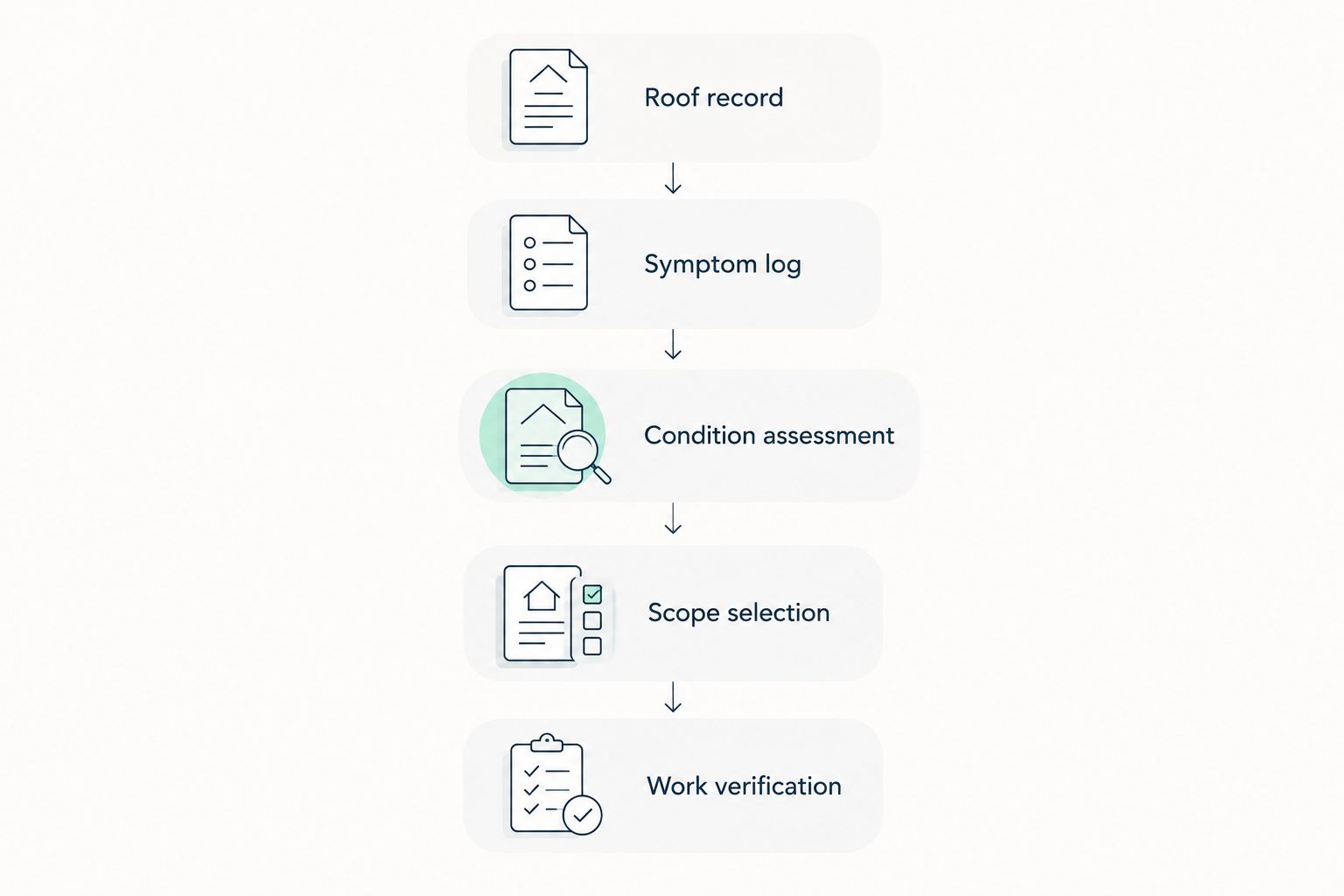
The decision sequence is straightforward: Roof record, Symptom log, Condition assessment, Scope selection, and Work verification. Skipping the assessment leaves the scope dependent on assumptions rather than documented findings.
5. Issue one scope for comparable contractor proposals
Write the scope before inviting proposals. You can create the administrative requirements yourself, but technical specifications need qualified input appropriate to the project. Giving contractors different descriptions produces different bids, even when every document carries the same project name.
Ask each bidder to identify departures from the requested scope. Separate allowances, exclusions, and unresolved conditions from the base work so the owner can see which decisions remain open.
For your 2026 bid package, include 4 attachments: the roof plan, condition report, access requirements, and proposal response sheet. These recommended documents establish a common starting point; they do not replace project-specific specifications.
- Require a response against the same written scope.
- Identify permits and professional responsibilities applicable to the work.
- Request documentation of insurance and relevant qualifications.
- Require written treatment of concealed or unexpected conditions.
- Separate manufacturer coverage from contractor workmanship obligations.
6. Plan the work around tenants and building operations
Map the work to the occupied building below it. Entrances, loading areas, outdoor air intakes, parking, and equipment access belong in the pre-work discussion. Ask the contractor to describe the controls appropriate to the proposed materials and methods.
Prepare tenant communications before mobilization. Explain affected areas, access changes, the reporting contact, and how updates will be issued. Do not promise uninterrupted operations unless the agreed work plan supports that commitment.
Assign responsibility for protecting occupied areas and responding to a leak during construction. A contact list is useful only when everyone knows who can authorize action and how the owner will be informed.
- Identify sensitive tenant operations before finalizing the schedule.
- Agree on controlled access and material staging locations.
- Discuss weather protection and temporary drainage arrangements.
- Establish a written process for tenant complaints and incidents.
- Confirm who approves changes that affect building operations.
7. Verify completion and schedule follow-up
Close the project against the agreed scope, not simply the contractor’s final invoice. Request completion photographs, applicable inspection records, product documentation, warranty information, and a list of unresolved items. Have technical completion assessed by someone qualified for the work involved.
Build the next maintenance schedule from the installed system’s requirements, warranty conditions, site exposure, and assessment findings. Do not impose a universal inspection interval on every building without checking those requirements.
At the end of your 2026 planning cycle, review repeat leak locations and unresolved recommendations. Track 3 management measures: open roof issues, overdue actions, and repeated reports at previously repaired locations. These measures show whether work is being followed through without pretending to predict remaining roof life.
- Match completed work to the approved scope and changes.
- Store closeout documents under the correct roof area.
- Assign an owner and due date to unresolved items.
- Record maintenance requirements without rewriting warranty terms.
- Review recurring symptoms before authorizing another identical repair.
Compare roof-management options
Choose the option that answers the building’s current question. A repair proposal answers a different question from a condition assessment, and neither automatically provides a portfolio maintenance plan.
| Option | Best for | Main advantage | Key limitation |
|---|---|---|---|
| Staff-managed records and reporting | Establishing a building baseline | Keeps incident history and documents under your control | Does not replace qualified roof diagnosis or safe rooftop access |
| Scoped professional condition assessment | Resolving uncertainty before authorizing work | Connects observed conditions to recommendations | Findings depend on access, inspection scope, and any testing performed |
| Localized contractor repair | Addressing a defined defect | Focuses work on an identified problem | Does not resolve unrelated defects or establish whole-roof condition |
| Roof restoration assessment | Evaluating retention of an existing assembly | Examines whether the existing roof supports a restoration approach | Suitability depends on condition, compatibility, and project requirements |
| Replacement planning | Addressing an assembly requiring renewal | Allows the owner to evaluate the replacement scope and operational impact | Requires decisions about existing components, disruption, and concealed conditions |
If you are considering Murray Inspection Services, use these distinctions to request the specific scope you need. Confirm the offered services and deliverables directly rather than assuming an assessment includes testing, design, repairs, or project oversight.
Common mistakes property managers make
Approving another patch without reviewing the history
Repeated symptoms deserve a review of prior findings and completed repairs. Compare the location, reported weather, and previous scope before authorizing more work. Repeating a repair without checking the diagnosis leaves the underlying decision unresolved.
Treating drainage as someone else’s responsibility
Roof drains, gutters, scuppers, and discharge paths cross maintenance responsibilities. Assign inspection and cleaning tasks explicitly, and ask qualified personnel to assess persistent drainage problems. A roofing contract does not automatically settle who maintains every part of the drainage route.
Assuming all warranties cover the same problem
Read the actual documents for coverage, exclusions, notification procedures, and maintenance obligations. Distinguish material coverage from workmanship coverage. Send notices through the required process rather than assuming a routine service request preserves every contractual right.
Comparing bids that solve different problems
One proposal can cover localized repair while another includes removal and replacement. Require bidders to identify scope differences before presenting the choices to the owner. The useful comparison is the work included and the risk left unresolved, not the proposal total alone.
Closing the file before the evidence is complete
A completed invoice does not document concealed work, accepted changes, or outstanding defects. Keep the project open administratively until the agreed closeout documents and unresolved-item list are recorded. The next manager needs evidence, not a verbal assurance that the roof was handled.
FAQ
What’s the best approach to commercial roofing for property managers?
Start with a documented condition assessment and choose the work scope from its findings. Coordinate roof decisions with tenant access, owner approvals, drainage responsibilities, and warranty requirements.
How often should a property manager arrange a commercial roof inspection?
Set the inspection schedule from the roof system’s maintenance requirements, warranty terms, site conditions, and professional recommendations. Record the agreed schedule and assign responsibility for inspections after events identified in that plan.
Should I repair or replace a leaking commercial roof?
Base repair or replacement on the diagnosed cause, the assembly’s condition, and the extent of affected areas. A leak report alone does not establish that replacement is necessary or that a localized repair is sufficient.
Can a roof coating replace a commercial roof replacement?
A coating is not an automatic substitute for replacement. A qualified assessment must establish whether the existing roof’s condition, moisture status, and material compatibility support the proposed coating system.
What should I ask Murray Inspection Services before authorizing an assessment?
Ask Murray Inspection Services to confirm the assessment scope, deliverables, access arrangements, exclusions, and responsibility for any testing. Also confirm whether recommendations are separate from repair proposals and whether follow-up services are included.
What should a commercial roofing proposal include?
A commercial roofing proposal should identify the work area, included work, exclusions, responsibilities, and treatment of unexpected conditions. It should also address access, occupied-building protection, completion documentation, and applicable warranty terms.
Who should manage tenant communication during roof work?
Assign one property-management contact to coordinate tenant communication with the contractor’s designated contact. Agree on access notices, incident reporting, and operational changes before work begins.
One last thing
Record work performed by other trades on the roof, not just roofing repairs. Equipment servicing, new penetrations, and altered access arrangements belong in the same building history because they change the context of later inspections.
For your next owner update, present 3 decisions: what requires action, what requires investigation, and what remains under observation. That structure turns a roof report into an actionable management document without claiming certainty the evidence does not provide.
Related guides
- TPO vs. EPDM roofing membranes compared
- Gutter and drainage systems for roof protection
- Roof leak detection systems compared