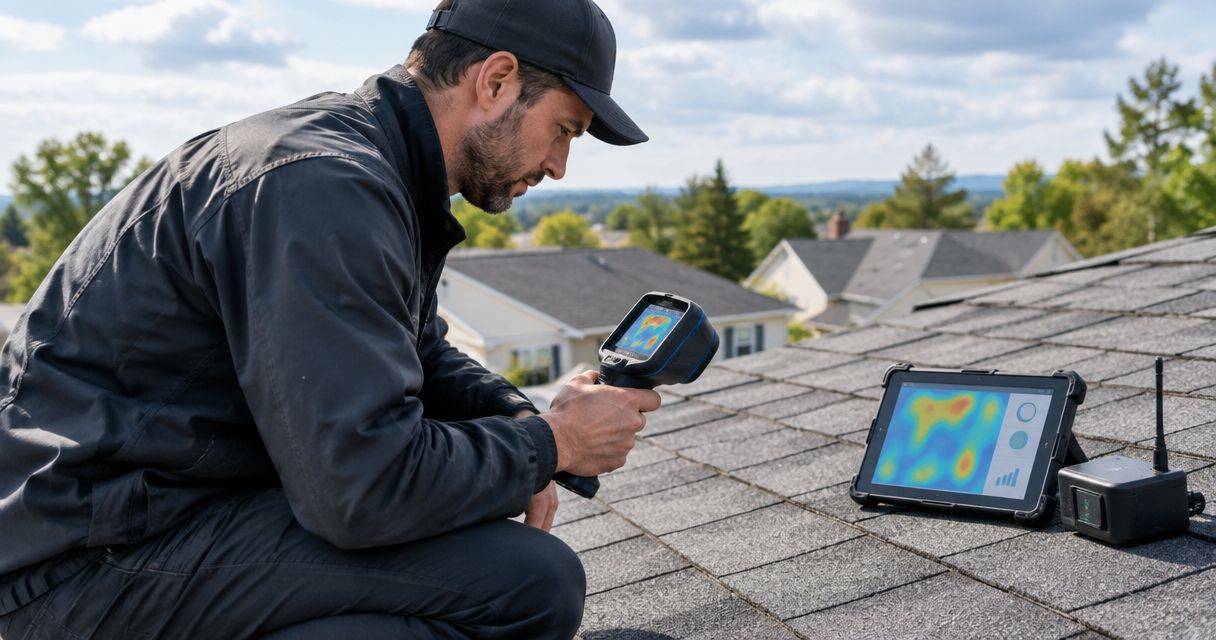
Best overall for compatible membrane roofs: electronic leak detection; best for mapping suspected wet insulation: infrared thermography; best for indoor alerts: point moisture sensors. This 2026 guide from Murray Inspection Services compares 5 detection approaches and explains which question each one can actually answer.
- The best roof leak detection systems match the roof assembly and the problem—not just the equipment.
- Electronic leak detection locates membrane breaches when the assembly supports electrical testing.
- Infrared thermography identifies thermal patterns that require confirmation before repair decisions.
- Point moisture sensors provide local alerts; they do not identify the roof entry point.
- Murray Inspection Services’ verdict: choose compatible membrane testing for breach location, not an indoor alarm alone.
Why this matters
A ceiling stain shows where water became visible, not necessarily where it entered. Water can travel along framing, decking, and other building components before reaching the room below.
Roof leak detection therefore involves different jobs: locating an entry point, mapping potentially wet materials, and detecting water after it reaches a monitored location. No single method does all three equally well. Buying an alarm when you need membrane testing leaves the original diagnostic problem unresolved.
For a 2026 roof investigation, start with the question you need answered. Then choose equipment suited to the roof construction, access, and conditions.
What makes the best roof leak detection systems
Judge each approach against these criteria before comparing equipment:
- Assembly compatibility: The membrane, insulation, deck, coatings, and overburden determine which methods work.
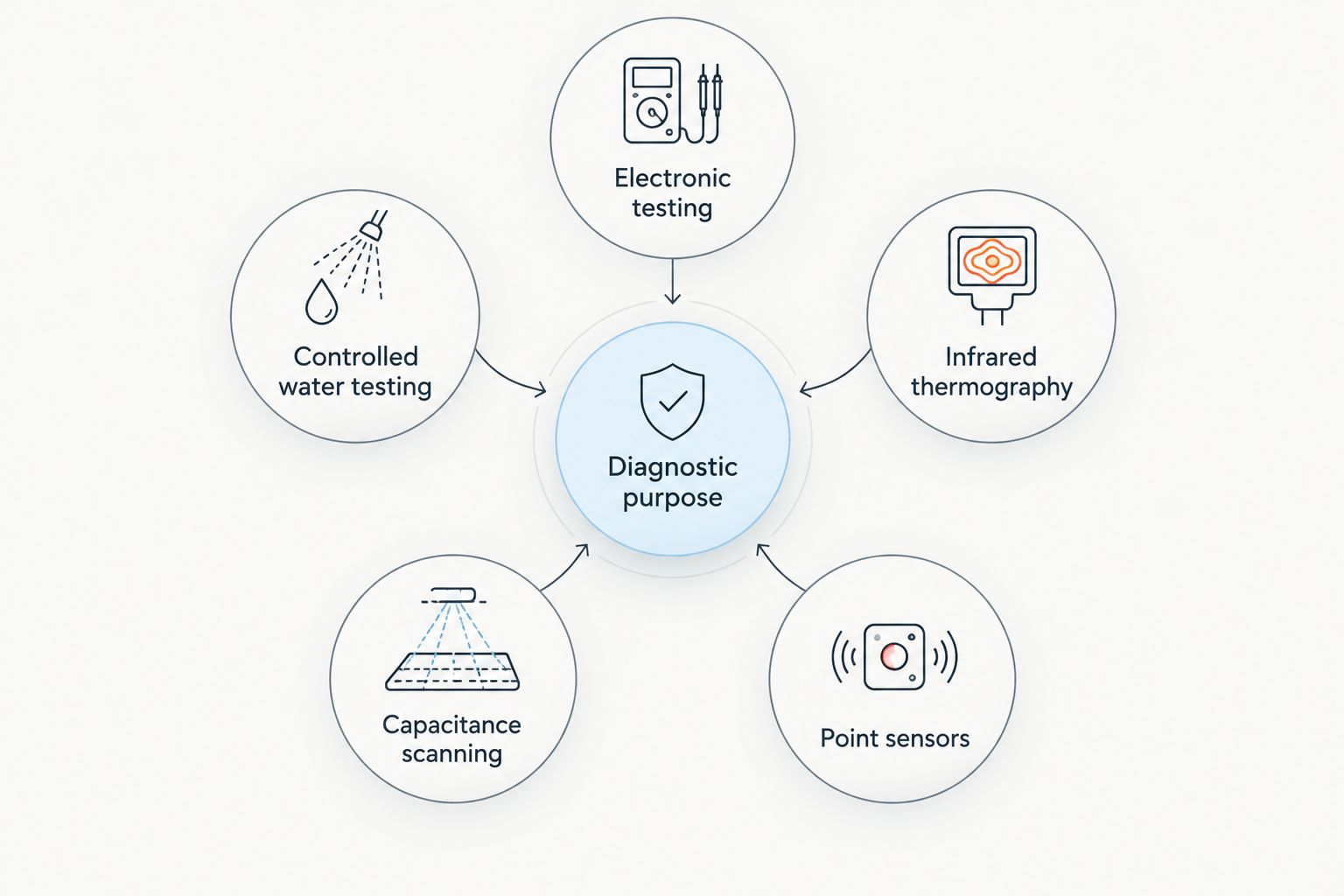
- Diagnostic purpose: Distinguish breach location from moisture mapping and local water alerts.
- Confirmation method: An abnormal reading needs an explanation supported by inspection or another suitable test.
- Access requirements: Some methods require exposed membrane, interior access, or access beneath roof coverings.
- Repeatability: Useful documentation identifies tested areas, conditions, findings, and exclusions so later results remain interpretable.
- Actionable findings: A report should distinguish confirmed defects, suspected moisture, and areas that were not evaluated.
A detection method earns its place by answering a specific question. Extra features do not compensate for an incompatible roof assembly.
Roof leak detection systems at a glance
This ranking compares methods rather than named devices. Equipment selection comes after the diagnostic task and roof compatibility are established.
| Rank and method | Best for | Standout capability | Key limitation |
|---|---|---|---|
| 1. Electronic testing | Locating breaches in compatible membranes | Uses an electrical path to identify membrane discontinuities | Requires a suitable membrane and conductive return path |
| 2. Infrared thermography | Surveying suspected wet insulation | Maps surface-temperature patterns across roof areas | Temperature patterns do not prove moisture or locate every breach |
| 3. Capacitance scanning | Checking suspected moisture zones | Compares electrical responses across an assembly | Materials, depth, and conductive components affect readings |
| 4. Point sensors | Alerting occupants to water at selected locations | Monitors the exact location where each sensor is installed | Cannot monitor uninstrumented areas or trace water upstream |
| 5. Controlled water testing | Investigating suspected flashing or detail leaks | Tests a defined area while observing for entry | Poor sequencing can produce misleading results or further wetting |
The practical distinction is simple: electronic testing targets membrane integrity, infrared and capacitance methods investigate moisture patterns, and point sensors provide local alerts. Controlled water testing investigates a suspected entry route.
1. Electronic testing: best for locating membrane breaches
Electronic leak detection uses electrical principles to find discontinuities in an electrically insulating waterproofing membrane. A suitable conductive layer or substrate beneath the membrane provides the return path needed for testing.
The 2 electrical testing approaches commonly discussed are low-voltage and high-voltage methods. Their equipment, surface conditions, and application requirements differ; they are not interchangeable settings for every roof.
Electronic testing pros:
- Targets membrane breaches rather than relying on a visible ceiling stain.
- Supports documented testing of defined roof areas.
- Can support repair verification when the repaired assembly remains testable.
Electronic testing cons:
- Conductive membranes or unsuitable assemblies can prevent meaningful testing.
- Overburden, access, and missing conductive components can complicate the investigation.
Best for: Owners who need to locate breaches in a compatible waterproofing membrane.
Before specifying electronic testing in 2026, ask how compatibility will be established. ASTM D7877 addresses electronic methods for detecting and locating leaks in waterproof membranes; citing a standard does not make every roof suitable.
Verdict — Buy: Specify electronic testing when membrane compatibility and the required electrical path are confirmed.
2. Infrared thermography: best for surveying suspected wet insulation
Infrared thermography records surface-temperature patterns. Under suitable conditions, moisture-affected roof areas can behave thermally differently from surrounding dry materials, making thermography useful for identifying areas that need investigation.
A thermal image is not a photograph of water. Shadows, equipment, material changes, repairs, and other conditions can also produce temperature differences.
Infrared thermography pros:
- Provides a visual map of thermal patterns across surveyed areas.
- Helps prioritize locations for closer inspection and confirmation.
- Supports comparison between suspected problem areas and surrounding roof areas.
Infrared thermography cons:
- Weather, surface conditions, and roof construction influence interpretation.
- Does not independently prove moisture or identify the original entry point.
Best for: Owners investigating the possible extent of wet insulation on a suitable roof assembly.
For a 2026 survey, require the report to separate thermal anomalies from confirmed moisture. ASTM C1153 addresses locating wet roof insulation with infrared imaging; the investigation still needs suitable conditions and verification.
Verdict — Buy: Use infrared thermography for moisture screening, with confirmation before defining removal or repair boundaries.
3. Capacitance scanning: best for checking suspected moisture zones
Capacitance-based roof scanning compares electrical responses as equipment moves across the roof. Changes in those responses help identify areas that warrant closer moisture investigation.
This is comparative testing, not an automatic moisture percentage for every assembly. Roof materials, layer thickness, conductive components, and the instrument’s effective sensing depth affect interpretation.
Capacitance scanning pros:
- Helps investigate moisture patterns without opening every surveyed location.
- Supports mapped comparisons between different roof areas.
- Provides another line of evidence alongside inspection or thermal findings.
Capacitance scanning cons:
- Conductive materials and assembly variations can distort readings.
- Elevated readings do not establish the leak source or exact material condition.
Best for: Investigators checking suspected moisture zones on assemblies suited to comparative electrical scanning.
Ask how reference readings will be selected and how unusual readings will be checked. A marked outline without an explanation of the roof construction is not enough to justify replacement boundaries.
Verdict — Hold: Confirm assembly suitability and the verification plan before specifying capacitance scanning as the main survey method.
4. Point sensors: best for indoor water alerts
Point moisture sensors detect water at the location where the sensing element sits. Depending on the device, the response can include a local alarm or a notification through a connected system.
These devices monitor consequences rather than diagnose roof entry. A sensor beneath a recurring drip can alert you when water reaches that location, but water entering elsewhere can bypass it entirely.
Point sensor pros:
- Provides local monitoring between inspections.
- Fits targeted locations beneath known water-entry symptoms.
- Can supplement a broader investigation without replacing it.
Point sensor cons:
- Coverage is limited to the sensing location.
- Connected alerts depend on the device’s power and communication requirements.
Best for: Homeowners or facility staff who need an alert at a known vulnerable interior location.
For your 2026 shortlist, check the actual notification path, power requirements, and testing procedure. Do not assume that a device with a wireless connection sends alerts without an additional service or gateway.
Verdict — Buy: Choose point sensors for local alerts; skip them as a substitute for finding and repairing the leak.
5. Controlled water testing: best for investigating roof details
Controlled water testing applies water to a defined suspect area while an observer checks for entry. Careful sequencing helps distinguish a flashing or penetration problem from water arriving through another route.
This is not an instruction to flood a roof. Uncontrolled spraying can wet several possible entry points at once, obscure the result, and add water to the building.
Controlled water testing pros:
- Investigates a specific suspected entry route.
- Connects an observed interior response to a defined test area.
- Helps examine details that other detection methods do not resolve.
Controlled water testing cons:
- A poorly designed test can create further interior wetting.
- Failure to reproduce a leak does not prove that the detail is watertight under every condition.
Best for: A qualified investigation of a suspected flashing, penetration, or localized roof-detail leak.
Establish safe access, interior observation, and a stopping procedure before testing. Begin with a defined hypothesis rather than spraying the entire roof and waiting for a drip.
Verdict — Buy: Use professionally controlled testing for a specific suspected detail; skip uncontrolled hose testing.
How these methods are ranked
The ranking prioritizes diagnostic purpose, compatibility, confirmation, and actionable findings. Electronic testing leads for compatible membrane breach location because it addresses membrane discontinuities directly; it does not lead every type of roof investigation.
Infrared thermography and capacitance scanning serve moisture investigations. Point sensors serve ongoing local alerts. Controlled water testing serves targeted detail diagnosis.
This is a ranking by task, not a claim that one instrument wins on every roof. No comparative accuracy percentages or equipment performance scores are assigned here.
Which roof leak detection system should you choose?
Murray Inspection Services’ recommendation for roof leak detection is to identify the diagnostic task before selecting equipment. If you need a membrane breach located, start by establishing whether electronic testing suits the assembly. If you need suspected wet insulation mapped, consider a suitable moisture survey with confirmation.
Before approving a 2026 investigation, ask 3 questions:
- Roof assembly: What materials and layers will the test encounter?
- Diagnostic question: Are you locating an entry point, investigating moisture, or requesting an alert?
- Confirmation plan: What evidence will distinguish a suspected finding from a confirmed defect?
For an indoor drip, a point sensor can supplement the investigation. It does not settle whether the source is a roof defect, condensation, or another building-water problem.
Your default choice is not the device with the longest feature list. Choose the method that can answer your question on your actual roof, and require the report to state its limits.
FAQ
What are the best roof leak detection systems for a flat roof?
Electronic leak detection is the leading choice for locating breaches in a compatible flat-roof membrane. Infrared thermography and capacitance scanning answer a different question: where moisture-affected materials need investigation.
Can a roof leak detector find the exact hole?
Electronic testing can locate membrane discontinuities when the assembly and testing conditions are suitable. Infrared surveys and indoor moisture alarms do not independently identify the exact roof entry point.
Is infrared roof leak detection better than electronic testing?
Neither method replaces the other because they investigate different conditions. Infrared thermography maps temperature patterns associated with possible moisture, while compatible electronic testing investigates membrane integrity.
Will a water sensor in my attic detect every roof leak?
A point water sensor detects water only when it reaches the sensing location. Water that follows a different path can bypass the sensor, so local monitoring does not establish whole-roof coverage.
Does a thermal roof image prove the insulation is wet?
A thermal roof image does not prove that insulation is wet. Material differences, shading, equipment, and other conditions can create thermal anomalies that require interpretation and confirmation.
Can I use a garden hose to find a roof leak myself?
Uncontrolled hose testing is not a reliable way to isolate a roof leak. A qualified investigation uses a defined test area, safe access, interior observation, and a stopping procedure to limit further wetting.
Should I install sensors or repair the roof first?
Sensors do not repair a roof defect or stop water entry. Use local alerts as a supplement while the source is investigated and the confirmed defect is addressed.
One last thing
A successful repair and dry insulation are different findings. Stopping the entry point does not establish that previously wetted materials are dry or suitable to remain in place.
Keep the breach-location findings separate from the moisture assessment in your repair documentation. That distinction makes the next decision clearer: what needs sealing, what needs further investigation, and what needs material evaluation.
Related guides
- TPO vs. EPDM roofing membranes compared
- Roof ventilation systems compared
- Gutter and drainage systems for roof protection
- Roof warranty types compared for homeowners