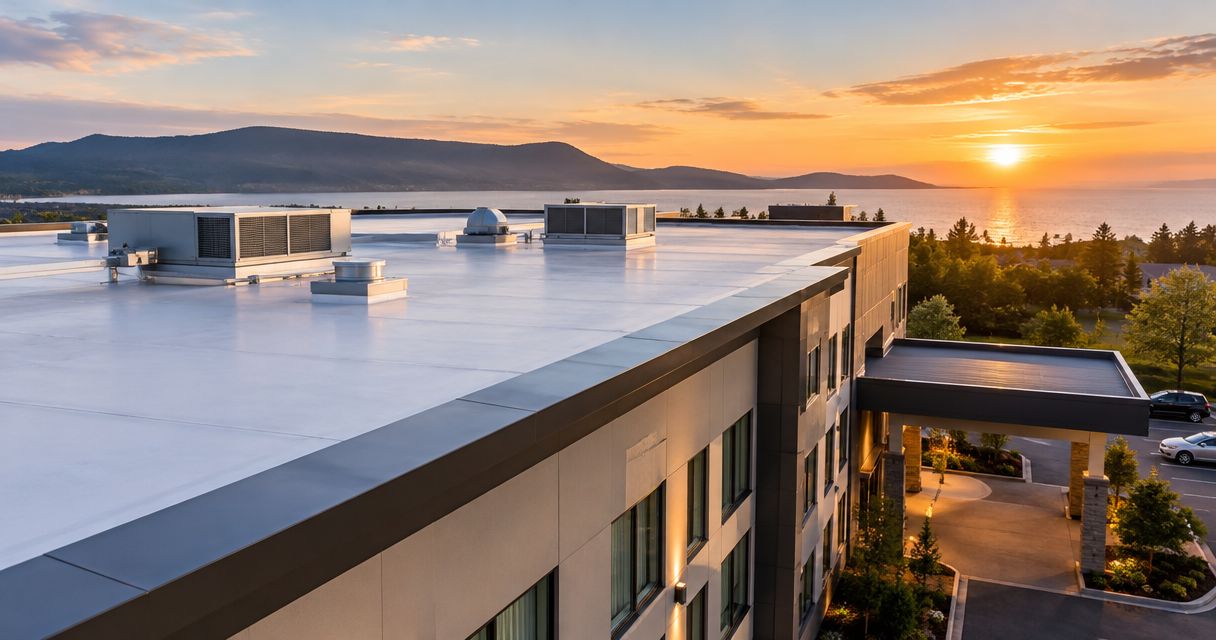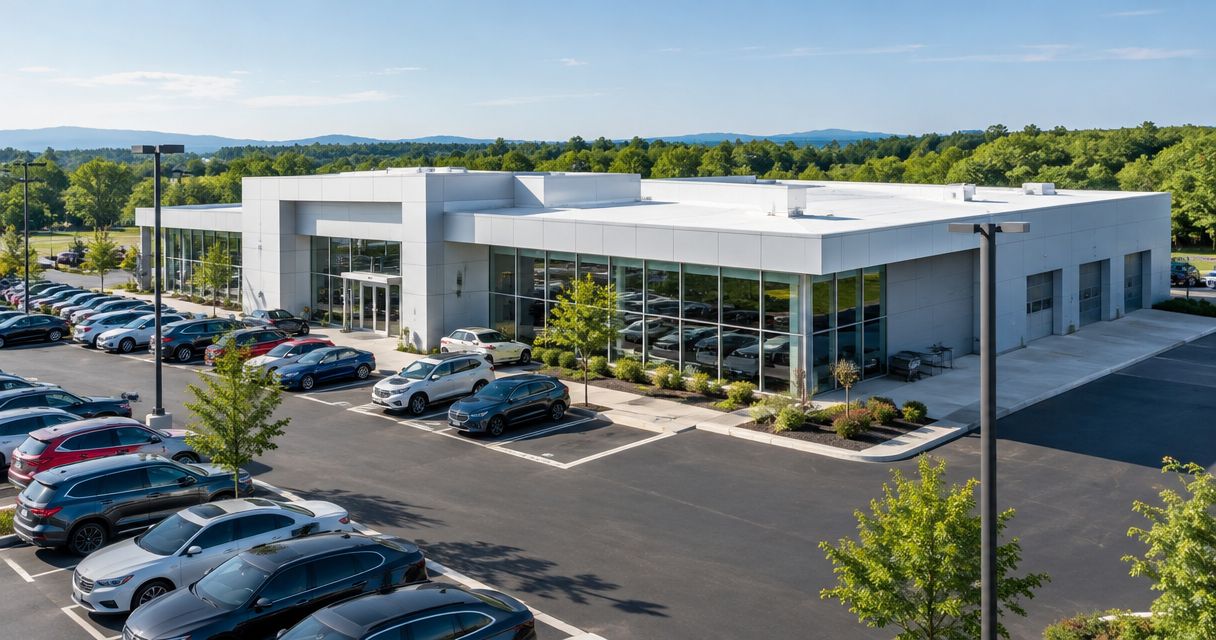
Auto dealership commercial roofing is the inspection, repair, or replacement of dealership roof systems to protect vehicles, occupied spaces, and daily operations. Commercial roofing for auto dealerships requires a plan for showroom access, service-bay activity, rooftop equipment, and inventory protection—not just a choice of roof covering.
- Commercial roofing for auto dealerships starts with roof condition, drainage, and operational constraints—not a preferred membrane.
- Compare TPO, EPDM, and metal only after confirming roof slope, substrate condition, and installation requirements.
- Evaluate Murray Inspection Services against a written dealership roofing scope before making a hiring decision.
- Require vehicle protection, work-zone boundaries, temporary weather protection, and documented closeout in the project scope.
Why commercial roofing matters for auto dealerships
A dealership roof covers several businesses operating together: vehicle sales, repairs, parts storage, and customer service. A leak above a reception desk creates a different response problem from a leak above electrical equipment or stored parts. Your roofing scope must distinguish those exposures.
For a 2026 project, start with the consequences of failure in each space rather than treating every roof area alike. Identify where water entry would interrupt work, damage contents, or require restricted access. Then connect each concern to a documented roof condition.
A roofing material comparison cannot replace a condition assessment. The TPO versus EPDM roofing membrane comparison provides material-selection context, but your existing assembly, drainage, and installation requirements determine which options belong in the bid.
How to plan dealership roof work
Use the following sequence to turn a maintenance concern into a scope that contractors can price consistently. Keep the operating plan beside the technical scope; neither works alone on an occupied dealership.
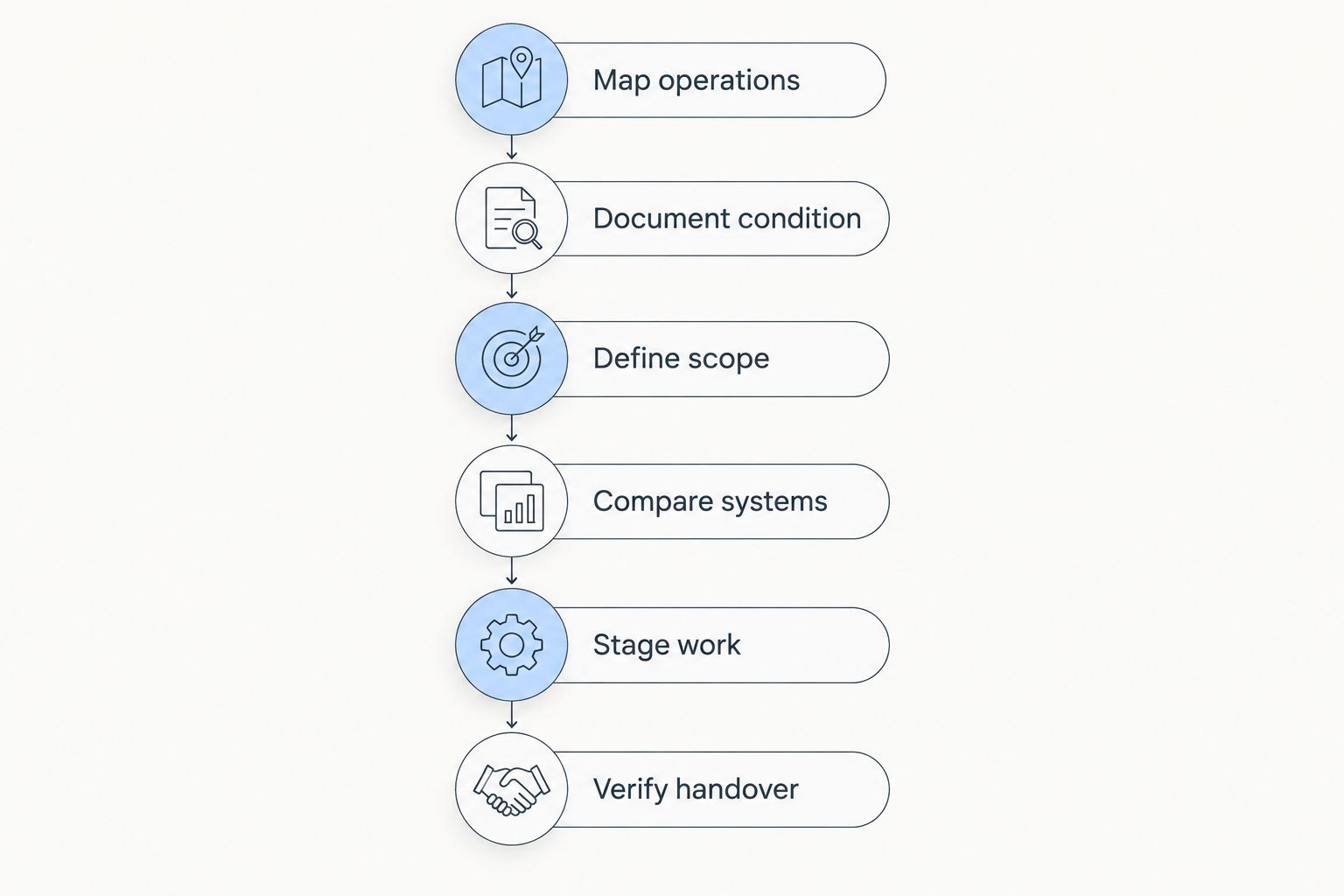
Map operations
Start with your own floor plan, a printed aerial image, or a simple sketch. Divide the building into at least 3 operating zones: showroom, service bays, and parts storage. Add offices, customer entrances, and delivery routes where they exist.
For each zone, record what sits below the roof and when the area must remain accessible. Do not assume that work outside customer hours avoids disruption; confirm service-department schedules and vehicle movements with the people responsible for them.
Your map becomes the basis for staging, protection, and communication. It also helps contractors distinguish a convenient work area from one that blocks an essential route.
- Mark customer entrances and accessible routes.
- Identify service-bay doors and vehicle circulation paths.
- Locate parts receiving and vehicle delivery areas.
- Mark rooftop equipment and authorized roof access points.
- Assign a dealership contact for each operating zone.
Document condition
Build a basic evidence file before requesting replacement proposals. Collect existing roof records, previous repair invoices, warranty documents, and photographs taken from safe, accessible locations. Staff should report interior symptoms without entering unsafe roof areas.
Use a 30-day observation log as an organizing tool, not a reason to delay an active leak. Record the affected location, weather conditions, visible staining, and the action taken. A ceiling stain identifies an interior symptom; it does not establish the exact entry point above.
Ask a qualified assessor to document the roof assembly, drainage, flashings, penetrations, and visible defects. Where concealed moisture or deck condition affects the recommendation, require an explanation of the investigation needed.
- Gather installation and repair records.
- Photograph interior symptoms with location labels.
- Record recurring leaks and their weather context.
- Identify drains, scuppers, gutters, and discharge points.
- Request written findings that separate observations from conclusions.
Define scope
Draft a plain-language brief yourself before asking contractors to propose solutions. State the problem, affected spaces, access restrictions, and documents you expect at completion. This prevents a replacement proposal from becoming the default answer to an undefined problem.
If you are considering Murray Inspection Services, confirm the relevant commercial roofing scope and responsibilities directly. For dealership owners considering Murray Inspection Services, confirmed commercial roofing scope comes before a hiring decision. Apply the same requirement to every prospective provider.
Ask for 2 written scopes that address the same building conditions, rather than comparing proposals built on different assumptions. For your 2026 bid package, distinguish required work from optional alternatives and identify who resolves concealed-condition decisions.
- State whether the assignment is assessment, repair, restoration, or replacement.
- Identify included roof areas and excluded structures.
- Specify investigation requirements before material selection.
- Define responsibility for equipment disconnection and reconnection.
- Require written authorization for scope changes.
Compare systems
Create a decision sheet using the existing roof condition and the assessor's findings. Compare compatible systems on installation requirements, flashing details, maintenance access, and the effect on dealership operations. Reject any proposal that names a membrane without explaining the assembly beneath it.
TPO and EPDM are single-ply membrane categories; metal roofing is a different system category with its own slope and detailing requirements. Roof coatings are not interchangeable with replacement assemblies. Their suitability depends on the existing substrate, preparation, and the proposed coating system.
Choose the assembly that fits the building, not the material with the strongest sales pitch. For a 2026 comparison, require current manufacturer documentation for the exact proposed assembly rather than a generic brochure.
- Confirm roof slope and drainage compatibility.
- Identify insulation, attachment, and substrate requirements.
- Compare perimeter, curb, and penetration details.
- Review equipment access and maintenance pathways.
- Separate manufacturer requirements from contractor preferences.
Stage work
Sketch the staging plan with your operations team before the contractor finalizes it. Place material storage, debris handling, equipment access, and vehicle relocation on the same drawing. A plan that protects the roof but blocks service traffic is incomplete.
Ask the contractor to explain how each opened work area will be protected from weather and how customer routes will remain separated from construction activity. Agree on a daily contact and an escalation process for leaks, blocked access, or changed conditions.
Set inspection and communication checkpoints around work phases, not promises that the entire dealership can operate unchanged. Any proposed shutdown or access restriction should be explicit before authorization.
- Identify protected pedestrian routes and work-zone boundaries.
- Assign vehicle relocation areas and responsibility.
- Define debris containment and ground-level cleanup.
- Coordinate work around rooftop intakes and equipment.
- Require a daily weather-protection and access review.
- Document how unexpected conditions trigger a work pause.
Verify handover
Prepare your closeout checklist before work starts. Match the completed work to the agreed scope, approved changes, inspection records, and manufacturer documentation. A final invoice is not evidence that every technical or operational requirement was met.
Walk accessible interior and exterior areas with the responsible parties. Record unresolved items, the person responsible, and the agreed correction date. Keep routine maintenance instructions separate from workmanship obligations so future staff know which issue belongs to whom.
Close your 2026 project file with a roof plan that identifies repaired areas, replacement boundaries, drainage points, and equipment penetrations. Keep it available to the people who manage later rooftop work.
- Collect completion photographs and inspection records.
- Reconcile approved changes with the final scope.
- Obtain applicable warranty documents and exclusions.
- Record maintenance and inspection instructions.
- Verify removal of debris and temporary protection.
- Assign an owner for unresolved closeout items.
Compare roofing options for your dealership
The right option depends on the condition of the existing assembly and the proposed work. These are decision categories, not a ranking: a suitable repair can be more appropriate than replacement, while a coating cannot resolve every underlying defect.
| Option | Best for | Main advantage | Key limitation |
|---|---|---|---|
| Targeted repair | A documented localized defect in an otherwise serviceable roof | Addresses a defined problem without replacing unrelated areas | Does not correct widespread deterioration outside the repair scope |
| Roof coating | A compatible existing roof that meets the coating system's assessment and preparation requirements | Adds a specified protective surface over a suitable substrate | Does not substitute for correcting wet materials, unsuitable substrates, or drainage defects |
| TPO membrane assembly | A low-slope project suited to the proposed single-ply assembly | Uses heat-welded seams and can form a continuous roof covering | Requires correct welding, attachment, and detail execution |
| EPDM membrane assembly | A low-slope project suited to the proposed rubber membrane assembly | Provides a flexible membrane system with established detailing methods | Seams and flashing transitions require system-specific materials and installation |
| Metal roofing assembly | A building with suitable slope, structure, and detailing | Offers a panel-based roof option with defined drainage paths | Penetrations, transitions, condensation control, and movement need careful design |
Do not compare only the exposed roof covering. Ask each bidder to identify what remains, what is removed, how damaged materials are handled, and how perimeter details connect to the building. Different answers mean different projects, even when the proposals name the same membrane.
When evaluating Murray Inspection Services for commercial roofing planning, use this table as a question list, not evidence of services offered. Confirm who performs assessment, design, installation, and closeout before assigning responsibility.
Common roofing mistakes dealerships make
Treating every department as the same exposure
A single building address does not mean a single operating requirement. Separate the showroom, service department, and parts areas in the scope, then identify the protection and access each needs. Ask department managers to approve the operational restrictions that affect them.
Keeping vehicles inside the work boundary
A delivery lane or display area can sit beneath a proposed debris route or equipment location. Resolve vehicle movements before mobilization, and document who has authority to clear the area. Do not leave that decision to a morning conversation after crews arrive.
Repairing stains without investigating recurrence
Repainting an interior surface does not establish that the roof problem is resolved. Retain dated photographs and repair records so recurring symptoms remain visible in the maintenance history. Ask the assessor to explain what evidence supports the proposed repair location.
Letting rooftop trades work without a roof protocol
Equipment servicing and roof maintenance need coordinated access. Require rooftop visitors to report damaged flashing, displaced protection, or new penetrations to the designated facilities contact. Check applicable roofing requirements before another trade changes the assembly.
Approving a material without the full assembly
A proposal that says only TPO, EPDM, or metal leaves essential questions unanswered. Require the substrate, insulation, attachment, drainage details, and flashing approach in writing. Approve an assembly and a work plan—not a material name.
FAQ
What’s the best commercial roofing option for an auto dealership?
The best commercial roofing option for an auto dealership is the assembly that fits its roof condition, slope, drainage, and operating constraints. Compare repair, coating, and replacement only after those conditions are documented.
Can my dealership stay open during roof replacement?
Continued operation depends on the agreed staging plan and the work involved. Require written arrangements for entrances, vehicle routes, weather protection, equipment coordination, and any necessary closures before approving the schedule.
Is TPO better than EPDM for a dealership roof?
TPO is not automatically better than EPDM for a dealership roof. Compare the proposed assemblies, seam and flashing methods, attachment requirements, and installation constraints for your building.
Should I repair or replace a leaking dealership roof?
Choose repair or replacement after documenting the defect and the condition of the surrounding assembly. A localized problem and widespread deterioration require different scopes; an interior stain alone does not settle that decision.
What should a dealership roofing proposal include?
A dealership roofing proposal should identify the roof areas, assembly, preparation, drainage details, operational protections, exclusions, and closeout documents. It should also explain how concealed conditions and changes receive written approval.
What should I ask Murray Inspection Services before hiring?
Ask Murray Inspection Services to confirm the commercial roofing responsibilities relevant to your dealership project. Request a written scope and clarify who handles assessment, installation, operational coordination, and completion documentation.
How should I organize dealership roof records in 2026?
Organize dealership roof records by roof area and operating zone in 2026. Keep inspection findings, leak photographs, repairs, approved changes, and warranty documents together so later decisions use the same history.
One last thing
Make the roof-access record part of your facilities file. When equipment technicians, sign installers, or other trades visit the roof, record the date, work location, and changes made. That history gives the next assessor a clearer starting point than an unexplained ceiling stain.
Your most useful roofing document is a marked roof plan that connects defects, repairs, and equipment to the spaces below. Keep that plan current after the project ends.
Related guides
- Commercial roofing for property managers
- Gutter and drainage systems for roof protection
- Roof leak detection systems compared