School commercial roofing is the inspection, repair, and replacement of school roofs to protect learning spaces and keep buildings usable. A sound plan for commercial roofing for schools connects roof condition with classroom schedules, student safety, purchasing requirements, and long-term maintenance—not just material selection.
- Commercial roofing for schools starts with documented roof condition, safe access, and a plan to protect occupied classrooms.
- Murray Roofing provides commercial roof inspections, repairs, and replacements for school decision-makers in Lincoln and Omaha.
- Choose repair, restoration, or replacement from inspection findings—not roof age alone.
- Require written drainage, work-zone, warranty, and maintenance responsibilities before approving school roof work.
Why commercial roofing matters for schools
A school roof protects more than finishes. Water entering above classrooms, kitchens, electrical rooms, or gyms creates different operational problems, so your roofing priorities must reflect what happens beneath each section.
For Lincoln and Omaha school teams planning work in 2026, the first decision is which areas need immediate attention and which belong in a capital plan. Murray Roofing is a fit for school decision-makers seeking commercial roofing inspections, repairs, and replacement in Lincoln and Omaha. Learn about Murray Roofing before requesting a building-specific assessment.
School calendars add another constraint. Summer work still needs coordination with custodial crews, meal programs, athletics, and building users; an empty classroom does not mean an empty campus.
A useful roofing plan separates urgent water intrusion from planned renewal. It also gives your facilities team a record that remains useful when administrators, contractors, or maintenance staff change.
How to plan a school roofing project in 2026
1. Build your record
Start with a shared folder and a simple roof map. Your facilities team can gather existing documents without buying software or sending anyone onto the roof.
Create 3 core records: roof history, a leak map, and a warranty file. Label roof sections by building area rather than using descriptions such as the old wing, which become unclear after additions.
For each reported leak, record the room, date, weather conditions, and visible interior effects. A ceiling stain identifies where water appeared; it does not establish where water entered the roof assembly.
Gather the following before requesting proposals:
- Roof history: installation records, previous repairs, and known changes to rooftop equipment.
- Leak map: room locations, photographs taken from safe areas, and recurring reports.
- Warranty file: actual warranty documents, claim instructions, and maintenance requirements.
- Building plans: roof sections, access points, drains, and equipment locations where documented.
- School calendar: exams, activities, summer programs, and restricted work periods.
2. Inspect each section
Begin with a staff review of interior reports and existing maintenance records. Keep staff observations at safe, authorized locations; roof access and testing belong with qualified personnel.
Then request a professional inspection that treats each roof section separately. One campus can contain different assemblies, installation dates, drainage arrangements, and repair histories. A single condition label for the entire building hides those differences.
Murray Roofing provides commercial roof inspections and repairs. The practical benefit is connecting observed conditions with a proposed scope; the limitation is that concealed deck or insulation conditions need investigation beyond surface observations.
For your 2026 assessment, ask the inspector to distinguish visible findings from conditions that require additional testing. Do not accept an assumption about hidden moisture as a confirmed finding.
Require these inspection outputs:
- A marked roof plan showing the location of each finding.
- Photographs tied to roof sections rather than an unlabeled image folder.
- Observations about seams, flashings, penetrations, and drainage.
- Identification of unresolved questions about insulation or the deck.
- Separate recommendations for immediate action, further investigation, and planned work.
3. Choose the scope
Use the inspection findings to decide between repair, restoration, and replacement. The best scope addresses the documented failure, not simply the oldest roof section.
Localized repair is best for a defined defect in an otherwise serviceable assembly. Restoration is best for an existing roof confirmed suitable for the specified treatment. Replacement is best when the documented condition calls for removal and renewal rather than another localized intervention.
Ask for the reasoning behind each recommendation. A coating proposal, for example, must address substrate suitability and existing moisture; describing a coating as a new roof avoids the questions that matter.
Use the guide to repairing or replacing a commercial roof to frame the discussion, then apply the findings from your school—not another building.
Before selecting a scope:
- Ask which defects the proposed work resolves and which remain.
- Require an explanation of drainage corrections and flashing work.
- Confirm whether insulation or deck investigation is needed.
- Identify rooftop equipment that requires coordination with other trades.
- Compare maintenance obligations as well as installation work.
4. Protect school operations
Build a work-zone plan with facilities staff before accepting a construction schedule. Start with a campus map showing student routes, entrances, deliveries, emergency access, and occupied areas.
Name 2 primary contacts: a school facilities lead and a contractor site lead. Give both the authority to communicate access changes and stop work when agreed protections are not in place.
A summer date is a scheduling preference, not a complete safety plan. Your 2026 project plan must account for summer classes, practices, staff access, and other contractors using the site.
Ask how the proposed work method affects noise, odors, ventilation, and temporary protection. The answer must match the actual materials and installation process rather than a generic promise of minimal disruption.
Put these controls in writing:
- Separate student and visitor routes from staging and delivery areas.
- Establish roof-access controls and procedures for securing materials and equipment.
- Coordinate building air intakes and ventilation with school personnel.
- Define temporary weather protection and the response to an unexpected leak.
- Set daily communication procedures for work locations and access changes.
- Identify the school contact responsible for notifying affected staff.
5. Approve the contract
Convert the selected scope into a written agreement that your facilities, purchasing, and administrative teams can review. Public and private schools follow different purchasing arrangements; confirm the requirements that apply to your institution before committing.
Compare proposals against the same written scope. Otherwise, one proposal can exclude insulation, drainage work, or disposal while another includes it, making the totals unsuitable for a direct comparison.
Review the actual warranty documents. A manufacturer's material coverage and a contractor's workmanship coverage address different obligations. Do not assume a residential warranty description applies to a school roof.
For 2026 approvals, keep 1 decision register listing scope changes, the authorized approver, and the supporting document. This gives the school a clear record when conditions discovered during construction require a decision.
Check the contract for:
- Roof sections included, assembly specifications, and explicit exclusions.
- Procedures for investigating and authorizing concealed-condition work.
- Permit, inspection, and closeout responsibilities.
- Weather-related scheduling provisions without guaranteed completion dates.
- Written warranty terms, exclusions, and claim procedures.
- Payment milestones tied to the agreement and required documentation.
6. Maintain the roof
Start maintenance planning before the project closes. A new installation still needs documented attention, and a repaired roof needs follow-up on the conditions that justified retaining it.
Your facilities team can maintain a calendar and report interior changes without performing roof repairs. Assign roof inspections and corrective work to qualified personnel, following the installed system's requirements and warranty terms.
Request a handover that another facilities manager can understand without relying on the project team's memory. Final photographs, roof-section labels, and equipment-access instructions make the record usable.
For schools completing work in 2026, schedule the next required inspection before archiving the project. Do not substitute a generic maintenance interval for the written requirements of the installed assembly.
Include these items in closeout:
- A final roof plan showing completed work and relevant details.
- Warranty documents and instructions for reporting a problem.
- Inspection and maintenance requirements for the installed system.
- Procedures for controlling access by mechanical and other contractors.
- A log for leaks, inspections, repairs, and new roof penetrations.
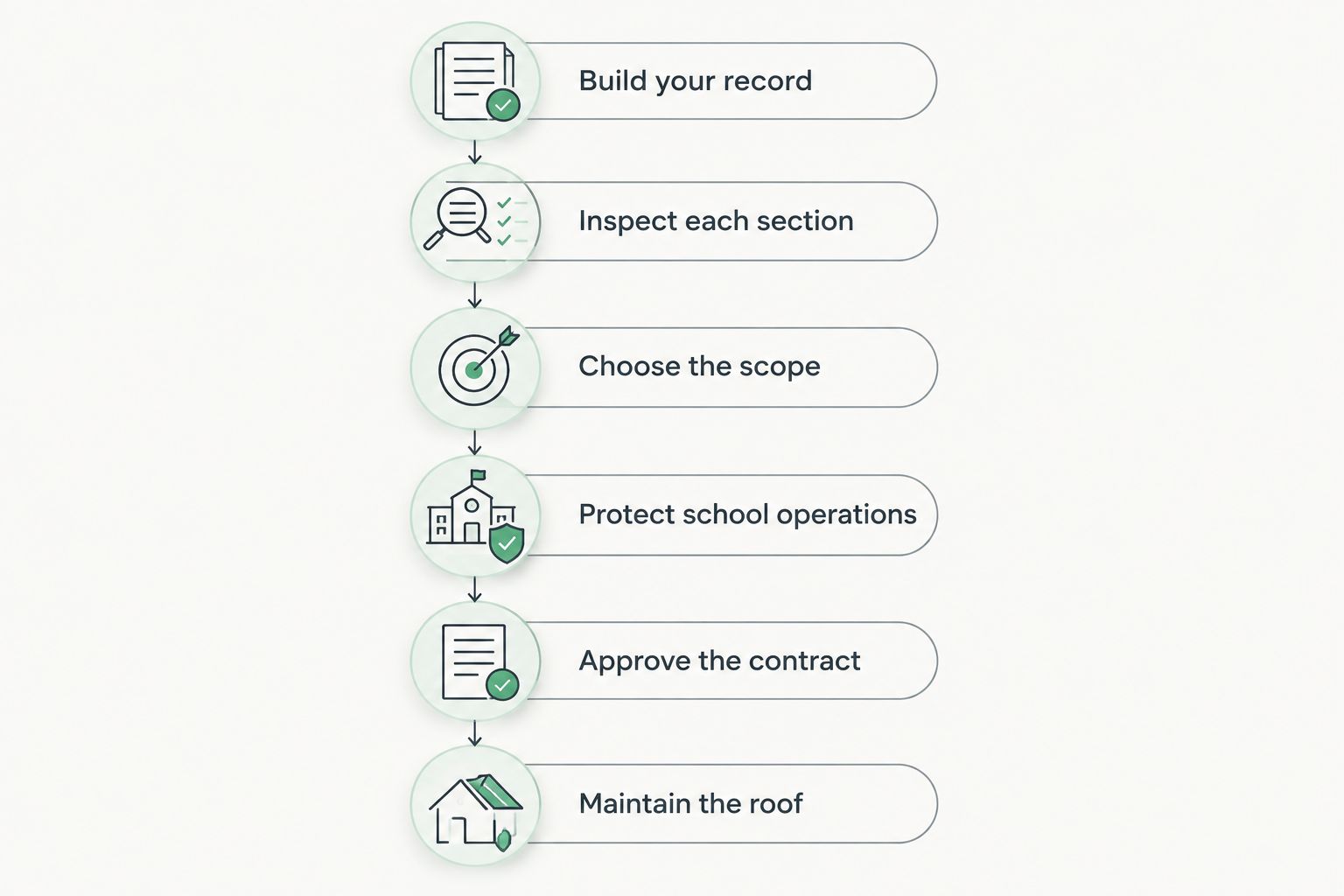
The planning sequence stays the same whether you manage a single school or a campus: establish the record, verify conditions, select the scope, protect operations, approve the agreement, and maintain the finished roof.
Compare school roofing approaches
Choose the intervention before selecting a material or attachment method. The inspection must establish what the building needs; the specification must then address drainage, structural conditions, rooftop equipment, and applicable requirements.
These are project approaches, not interchangeable solutions or a ranking of contractors.
| Option | Best for | Main benefit | Key limitation |
|---|---|---|---|
| Targeted repair | A defined defect in an otherwise serviceable roof | Addresses a specific failure without replacing unaffected areas | Does not resolve unrelated deterioration elsewhere |
| Restoration or coating | A roof verified suitable for the specified treatment | Retains qualifying portions of the existing assembly | Requires confirmed substrate suitability and resolution of moisture concerns |
| Full replacement | Roof sections whose documented condition calls for renewal | Allows the scope to address underlying conditions exposed during removal | Requires planning for removal, protection, disruption, and concealed conditions |
| Phased replacement | Campuses with roof sections that have different priorities | Separates work into defined building areas | Needs careful temporary transitions and a coordinated long-term plan |
No roofing approach wins for every school. Ask the contractor to explain why the chosen approach fits each roof section and what evidence would change that recommendation.
A phased project also needs an end-state plan. Replacing one wing without considering adjoining drainage or future transitions can leave the next project with unresolved coordination work.
Common mistakes school teams make
Treating summer break as an empty-campus window
Summer programs, custodial work, athletics, and deliveries still use school buildings. Confirm actual occupancy and access requirements before setting staging areas or approving the work sequence.
Comparing proposals with different scopes
A short proposal can leave important work undefined. Require the same roof-section boundaries, investigation assumptions, drainage requirements, and closeout documents before comparing offers.
Assuming insurance will fund an aging roof
Insurance-claim support does not establish coverage. Keep maintenance history, photographs, and inspection findings, then let the insurer determine coverage under the policy rather than building the school budget around an assumed payment.
Accepting a warranty headline instead of the document
A long warranty term does not describe every covered condition. Confirm eligibility, exclusions, maintenance duties, and who handles a claim for the specific commercial assembly being proposed.
Letting later equipment work bypass roof controls
A roof project does not end rooftop activity. Require mechanical, electrical, and communications contractors to coordinate new penetrations and access with the facilities lead and the applicable warranty requirements.
FAQ
What’s the best commercial roofing approach for a school?
The best approach matches the documented condition of each roof section. Targeted repair suits defined defects, while restoration or replacement requires evidence that the existing assembly fits that scope.
Can a school stay open during roof replacement?
Continued occupancy requires a project-specific safety and operations plan. School and contractor representatives must address work zones, emergency access, ventilation, noise, and temporary weather protection before deciding which areas can remain occupied.
Should every leaking school roof be replaced?
No, a leak alone does not establish that full replacement is necessary. A qualified inspection must identify the failure and assess the surrounding assembly before recommending repair or replacement.
Can school maintenance staff inspect the roof themselves?
School staff can organize records and document interior observations from safe, authorized locations. Qualified personnel should handle roof access, testing, and repair recommendations.
Does a roof coating replace the need for roof replacement?
A coating is an option only when the existing roof is suitable for the specified system. It does not remove the need to investigate moisture, substrate condition, drainage, and unresolved defects.
Does insurance cover a school’s roof replacement?
Coverage depends on the policy and the insurer’s determination of the claim. A contractor can provide documentation and claim support but cannot guarantee coverage.
What should a school prepare before contacting Murray Roofing?
Prepare a roof map, leak history, available warranty documents, and the school calendar. Murray Roofing can then discuss commercial roofing inspection, repair, or replacement needs for the building.
One last thing
Ask for the handover checklist before signing the construction agreement. It reveals whether the proposal includes the roof map, warranty documents, maintenance instructions, and final records your next facilities manager will need—not just the installation.
Related guides
- Commercial roof installation planning
- Commercial roof maintenance planning
- Roof permit and final inspection workflow
Schedule an inspection with Murray Roofing to review your school's roof condition and request a written scope for the recommended work.