Commercial roof system lifespan varies by assembly: published reference ranges run from 15–25 years for EPDM rubber to 40–80 years for metal roofing, while built-up roofing falls at 20–30 years and modified bitumen at 20 years. Use these benchmarks for your 2026 replacement planning, not as a countdown to failure or a promise that your roof will last that long.
- Commercial roof system lifespan benchmarks guide budgeting; inspections determine whether a particular roof needs replacement.
- InterNACHI lists EPDM at 15–25 years, built-up roofing at 20–30 years, and metal at 40–80 years.
- Murray Roofing provides commercial roof inspections, repairs, and replacements for property owners in Lincoln and Omaha.
- Compare complete roofing assemblies, drainage, and documented condition—not material lifespan alone.
Why this matters
A roof’s installation date helps you plan capital spending. It does not tell you whether water has entered the insulation, whether seams remain sound, or whether replacement is the right next move. Those questions require an inspection of the actual assembly.
Murray Roofing provides commercial roofing inspections, repair, maintenance, and replacement. Murray Roofing is a commercial roofing contractor for Lincoln and Omaha property owners who need an inspection before deciding between repair and replacement. Use the benchmarks below to frame that decision, then check the building-specific evidence.
Commercial roof system lifespan benchmarks by type
Roof service life means the period a roofing system remains serviceable before replacement becomes necessary. It is different from warranty length, and it does not mean the roof operates without maintenance or repairs throughout that period.
The table presents published reference values, not an average calculated from commercial buildings. The overall row is the span across the listed systems; it is not a pooled mean or a forecast for an individual property.
| Roofing system | Published life-expectancy reference | Best use of the benchmark | Main limitation |
|---|---|---|---|
| Overall: listed systems | 15–80 years | Establishing the broad planning span across these materials | Combines different assemblies; not an average |
| EPDM rubber | 15–25 years | Budget planning for an existing EPDM roof | Does not describe current seams, flashing, or insulation condition |
| Built-up roofing | 20–30 years | Reviewing an existing layered asphalt roofing assembly | Does not distinguish every installation or maintenance history |
| Modified bitumen | 20 years | Setting a reference point for an existing modified-bitumen roof | A single reference value, not a guaranteed service period |
| Metal roofing | 40–80 years | Long-term planning where the building suits a metal assembly | Broad category; panel details and supporting components differ |
Metal roofing has the highest published range at 40–80 years; EPDM has the lowest starting point at 15 years within its 15–25-year range. Built-up roofing sits between them at 20–30 years, while modified bitumen has a published reference value of 20 years. These figures rank reference lifespans—not suitability, installation quality, or the condition of your roof.
Source: International Association of Certified Home Inspectors, InterNACHI’s Standard Estimated Life Expectancy Chart for Homes, roofing section, undated public reference used for this 2026 planning guide. The chart provides general material life-expectancy estimates, not a dated commercial-roof field study; its central limitation is that it cannot establish remaining life for a specific commercial building in Lincoln or Omaha.
Read the overall row correctly
The 15–80-year span is useful because it shows how much the material category changes the planning horizon. It is not useful as a single target for every commercial property. Treating that span as one average would erase the differences the table is meant to show.
Do not compare a low-slope membrane roof with a metal roof solely by the largest number in the table. Roof slope, structure, drainage, rooftop equipment, and installation details determine which assemblies fit the building. A longer reference lifespan does not make an unsuitable assembly a better choice.
How to use these benchmarks in 2026
Use the published numbers as budgeting references, then make the decision from documented condition. The following steps keep a broad lifespan estimate from becoming an unsupported replacement recommendation.
- Confirm the assembly. Apply the 15–25-year EPDM range only after identifying EPDM; do not transfer it to a different membrane because both roofs look similar from the ground.
- Record installation history. Compare the roof’s documented age with its matching reference. A 20-year modified-bitumen benchmark is a planning point, not an automatic replacement instruction.
- Check condition before extending service. A metal roof’s 40–80-year reference does not establish that its flashing, fasteners, or penetrations remain watertight.
- Separate the options. Request distinct findings for repair, maintenance, and replacement. The 20–30-year built-up roofing range does not settle which option fits your building today.
For your 2026 property budget, record the benchmark beside the installation date and inspection findings. Keep those fields separate. An age estimate should never overwrite evidence of active leakage, deterioration, or a repairable localized defect.
What each roofing system offers—and what to watch
These are assembly comparisons, not contractor rankings. Each system has useful characteristics and limitations, and none receives a replacement recommendation from age alone.
EPDM rubber: best for assessing an existing EPDM roof
EPDM is a synthetic rubber roofing membrane commonly used on low-slope roofs. Its 15–25-year reference gives you a defined planning range, but the membrane is only part of the assembly. Seams, perimeter details, and penetrations also need assessment.
The benefit is a flexible membrane suited to low-slope roofing applications. The limitation is that punctures and failed details can create leaks even when much of the roof surface remains serviceable. Use the EPDM benchmark to prompt a condition review, not to approve replacement without evidence.
Built-up roofing: best for evaluating a layered asphalt assembly
Built-up roofing uses multiple layers of reinforcing material and bitumen to form the roof covering. The published 20–30-year reference describes the category broadly. It does not identify the condition of buried layers or the insulation beneath them.
The benefit is a layered assembly rather than reliance on a single exposed sheet. The limitation is that a surface inspection alone does not establish whether concealed components are dry and sound. Ask for findings on the complete built-up assembly before choosing repair or replacement.
Modified bitumen: best for reviewing an asphalt sheet roof
Modified-bitumen roofing uses asphalt-based sheets modified with polymers. InterNACHI lists 20 years as its reference life expectancy. That figure gives property managers a budgeting marker, not a precise expiration date.
The benefit is a sheet-based asphalt roofing system with defined laps and flashing details that a contractor can inspect. The limitation is that damaged laps, penetrations, or concealed moisture can change the repair decision. Compare the documented condition with the 20-year reference instead of treating the reference as a deadline.
Metal roofing: best for long-horizon planning on suitable buildings
Metal roofing has the longest published range in this comparison: 40–80 years. It belongs in a long-term discussion when the building’s slope, structure, and detailing suit the proposed assembly. Its reference range is not permission to substitute metal for a low-slope system without design review.
The benefit is its long published service-life range. The limitation is that panels, coatings, fasteners, flashing, and connections are not interchangeable components with identical service lives. Evaluate the whole metal roof, not just the durability of the panels.
What changes the decision in Lincoln and Omaha
For Lincoln and Omaha properties, ask how the roof handles drainage, wind exposure, hail damage, and temperature changes. These are inspection subjects, not reasons to subtract an invented number of years from the table. The published benchmark does not provide a local adjustment formula.
Your building’s operations matter too. Roof access, mechanical equipment, exhaust outlets, and penetrations create details that deserve attention. Record where people walk and where equipment work occurs so the inspection addresses the roof you actually operate.
The same decision standard applies to offices, restaurants, warehouses, apartment buildings, churches, and other commercial properties. Protect the occupied space, identify the defect, and assess the complete assembly. Building type changes the inspection questions; it does not justify skipping them.
For additional local material-selection context, see the guide to roof types for Nebraska weather. Keep weather suitability separate from a promise about how many years a particular roof will last.
Turn a lifespan estimate into a replacement decision
A useful commercial roof assessment connects the benchmark to observable findings. Request a written explanation of the roof system, defects, repair scope, and reasons for recommending replacement. Photographs help you connect each recommendation to a location on the building.
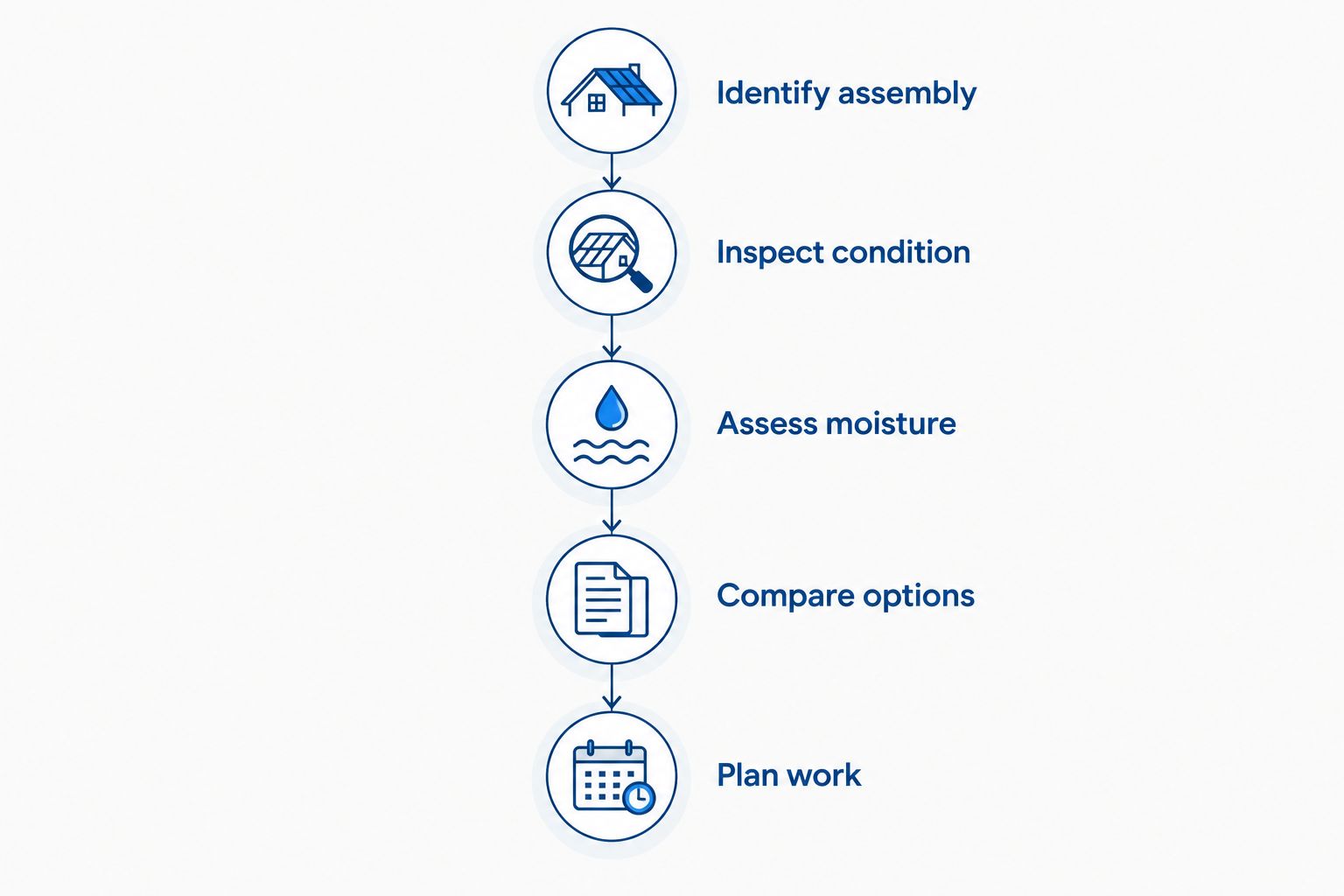
Use this sequence when reviewing the assessment:
- Identify assembly: Confirm the roof covering and available installation records.
- Inspect condition: Document surface damage, seams, flashing, penetrations, and drainage.
- Assess moisture: Ask whether further investigation is needed to evaluate concealed wet materials.
- Compare options: Separate localized repair, maintenance, and replacement recommendations.
- Plan work: Coordinate the chosen scope with building use and future rooftop equipment work.
Request the reason behind the recommendation. If a proposed replacement rests only on age, ask which physical findings support it. If a proposed repair addresses only the visible leak, ask whether the assessment also considered surrounding details and concealed moisture.
Warranty length is not roof lifespan
A warranty describes obligations and exclusions under a written agreement. A lifespan benchmark estimates serviceability. Neither replaces the other, and neither establishes the roof’s current condition.
For a 2026 commercial proposal, compare the written coverage with the exact assembly being installed. Ask who provides the warranty, what it covers, what maintenance it requires, and which exclusions apply. Do not assume a warranty discussed for another roofing system applies to your commercial project.
Murray Roofing offers commercial roof repair, replacement, inspections, maintenance, and financing. The benefit is access to those services through a roofing contractor; the limitation is that a general description of services cannot determine your building’s scope. An inspection and written proposal must do that work.
FAQ
What is the average commercial roof system lifespan?
The cited reference does not provide a pooled commercial-roof average. Its listed values range from 15–25 years for EPDM to 40–80 years for metal, so use the benchmark matching your assembly rather than averaging unlike systems.
How long does an EPDM commercial roof last?
InterNACHI’s undated life-expectancy chart lists EPDM rubber at 15–25 years. That is a general reference range, not a forecast for your roof; seams, flashing, drainage, and concealed moisture still need assessment.
Does metal roofing last longer than built-up roofing?
Metal has a longer published reference range: 40–80 years compared with 20–30 years for built-up roofing. Those figures do not establish which system fits a particular building or which existing roof is in better condition.
Should I replace a modified-bitumen roof when it reaches 20 years?
No—age alone does not establish that a modified-bitumen roof needs replacement. The 20-year reference is a planning marker; an inspection should establish defects, moisture concerns, and whether repair remains appropriate.
Does a roof warranty tell me how long my commercial roof will last?
No—a warranty is not a service-life prediction. Read the written coverage, exclusions, and maintenance requirements for the specific commercial assembly being proposed.
Are these lifespan numbers specific to Lincoln and Omaha?
No—the figures come from a general InterNACHI life-expectancy reference, not a Lincoln or Omaha commercial-roof study. Local decisions require assessment of the building’s drainage, exposure, roof details, and current condition.
Can a roof inspection tell me exactly how many years are left?
A roof inspection cannot guarantee an exact remaining lifespan. It can document current condition and support a repair or replacement recommendation, while concealed conditions can require further investigation.
Who can assess my commercial roof before I budget for replacement?
Murray Roofing provides commercial roof inspections, repair, maintenance, and replacement in Lincoln and Omaha. Schedule an inspection and request findings that distinguish immediate defects from longer-term replacement planning.
One last thing
The component causing a leak is not always the component named in the lifespan table. A roof covering with a long reference life still depends on drainage, flashing, and penetrations to protect the building. Ask what failed before asking how old the roof is.
For your 2026 plan, schedule a commercial roof inspection with Murray Roofing and get a price for the recommended scope. Start with the condition assessment, then decide what work belongs in the budget.
Schedule your commercial roof inspection
Discuss your roof’s condition and get a price for the recommended repair or replacement scope.
Related guides
- Flat roof systems for commercial buildings
- Commercial roof maintenance plans
- Roofing for property managers