Instead of repeating a roof leak report across calls and messages, use one documented roof leak repair workflow: protect occupants, report the symptoms, arrange an inspection, approve the scope, and verify the result. Same-day repair depends on safe access, weather, crew scheduling, materials, and the damage found—not the time you submit the report.
- Murray Roofing provides roof leak repair and inspections for homeowners and commercial property decision-makers in Lincoln and Omaha.
- Best for active leaks: prioritize occupant safety and professional assessment before requesting same-day completion.
- Separate temporary protection from permanent roof repair; they are different outcomes.
- Keep the leak report, roof inspection findings, authorization, and completion record together.
Why this matters
A ceiling stain identifies where water appeared, not necessarily where it entered the roof. Water can travel along building materials before becoming visible indoors. Repairing directly above the stain without tracing the source leaves the cause unresolved.
Murray Roofing is best for Lincoln and Omaha owners seeking a contractor that provides both residential and commercial roof leak repair. Start with Murray Roofing to request an inspection, then use the workflow below to organize the response.
For your 2026 response plan, define success precisely. An inspection, temporary protection, and permanent repair are separate milestones. Ask which milestone the contractor can complete, rather than treating every same-day visit as a finished repair.
Before you start
- Access and authority: Have the property address, a safe entry arrangement, and 1 named contact who can authorize work. Commercial properties also need coordination with the tenant, facilities contact, or property manager responsible for the affected space.
- Report materials: Gather photographs from safe interior locations, the time you noticed the leak, previous repair records, and relevant warranty documents. Record whether water appears during rain, after snow or ice, or independently of outdoor weather.
- The non-obvious gotcha: The visible drip is not a reliable map of the roof defect. Tell the contractor about nearby plumbing, mechanical equipment, and recent building work; a roof repair is not the correct response to every ceiling leak.
Do not climb onto the roof, puncture a bulging ceiling, or attempt an exterior patch. Keep people away from sagging materials and water near electrical fixtures. If you suspect an immediate electrical or structural danger, leave the affected area and contact the appropriate emergency service.
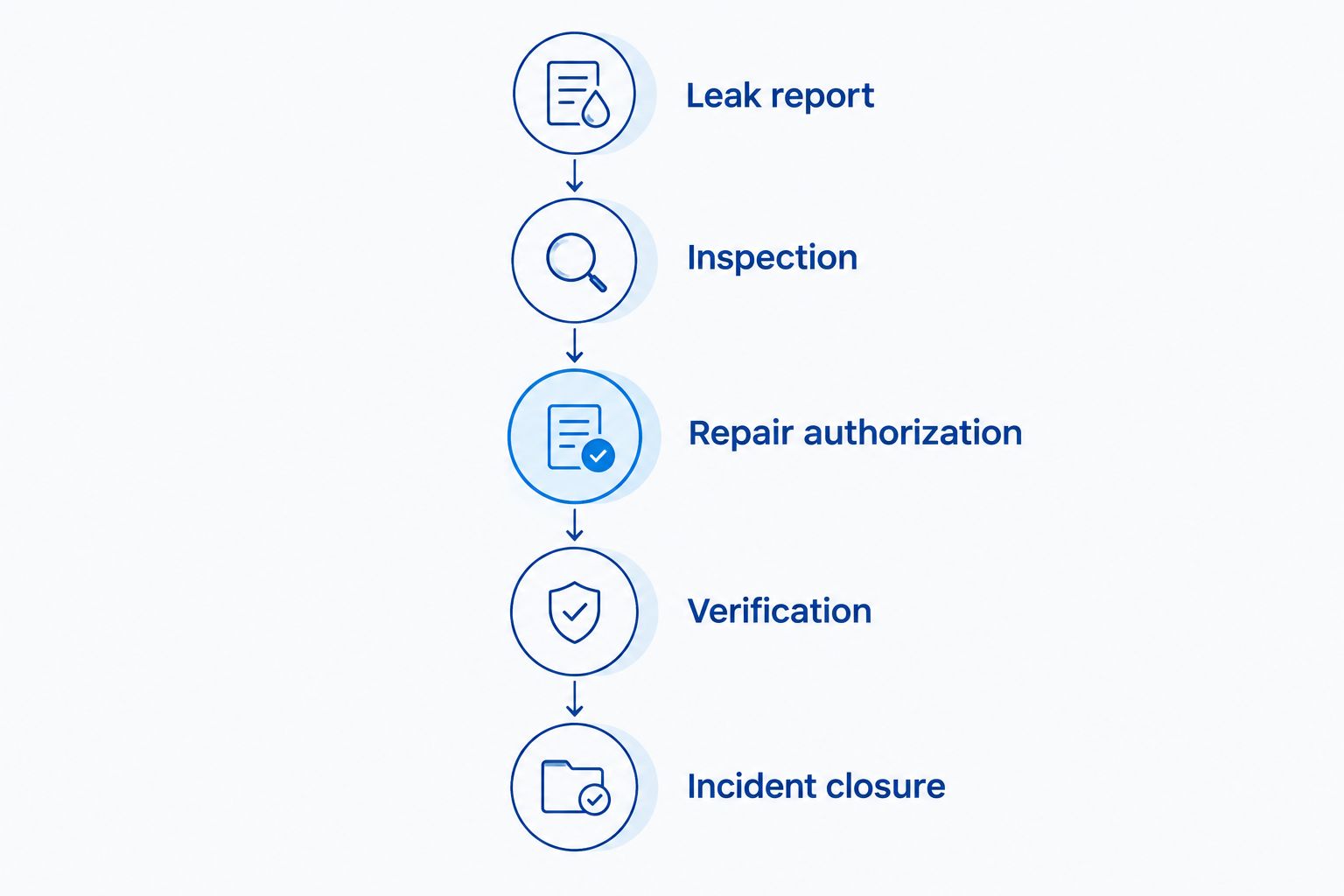
Leak report and safety handoff
Use these suggested report labels in your email, message, or maintenance record. They are organizational fields, not a required contractor portal.
- Record the property. Under Property address, include the building and affected unit, room, or work area. Specify Lincoln or Omaha rather than relying on a mailing address that omits the city.
- Describe the symptoms. Under Leak location, identify the visible water, stain, or damaged material. Under First observed, record the date and whether the leak is active now. Use the actual observation date in your 2026 incident record.
- Attach useful evidence. Include 2 photo views when safe: a wider view showing the room location and a closer view of the affected area. Avoid entering an unsafe space just to improve the photographs.
- Describe the immediate risk. Under Safety concerns, identify water near electrical equipment, sagging ceiling material, affected occupied areas, or blocked access. Do not label a situation safe without the appropriate assessment.
- Name the decision-maker. Under Authorization contact, give the person who can approve the next step. Include access restrictions and any required tenant notification.
Expected result: You have a single report that identifies the property, symptoms, risks, access arrangements, and responsible contact. The contractor can assess urgency without reconstructing the story from separate messages.
Inspection and response scope
The inspection determines what needs attention and what work is safe to undertake. A same-day request does not remove that decision point.
- Request an inspection. Murray Roofing offers free inspections. Describe the active conditions when requesting one, and ask the contractor to confirm the appointment rather than assuming immediate dispatch.
- Confirm access arrangements. Tell the contractor about locked areas, tenant requirements, loading operations, and other restrictions before the visit. Homeowners should identify safe access to the affected interior area without entering hazardous attic spaces.
- Ask for the source findings. Request a plain-language explanation of where water enters, what evidence supports that finding, and whether concealed damage needs further assessment. Distinguish confirmed defects from areas that still need investigation.
- Identify the achievable outcome. Ask whether the proposed visit covers assessment, temporary protection, or permanent repair. Weather, roof condition, safe access, and material requirements determine the appropriate response.
- Document the next decision. Record what the contractor recommends, who must authorize it, and what conditions prevent completion. Keep insurance questions separate from the immediate safety assessment.
Expected result: You know what the inspection established, what remains unresolved, and whether same-day permanent repair is feasible. If it is not, you have a defined interim response and next step instead of an open-ended promise.
Repair authorization and completion record
Authorize a defined scope, not a vague instruction to “fix the leak.” Your 2026 repair file should distinguish the work approved from the work completed.
- Review the written scope. Confirm the affected roof area, proposed work, exclusions, and treatment of concealed damage discovered during the job. Ask which interior consequences require a separate trade.
- Confirm the repair category. Identify whether the authorization covers temporary protection, permanent repair, or a broader replacement assessment. Ask how any temporary measure will be followed by permanent work.
- Check existing warranty conditions. Provide available warranty documents before repair authorization. Ask whether the proposed work affects those terms and request the applicable repair warranty in writing.
- Authorize through the responsible contact. Keep approval with the incident record. For commercial property, resolve owner, manager, and tenant responsibilities before work proceeds rather than relying on an informal verbal handoff.
- Request the completion record. Ask for a description of the work performed, relevant photographs, unresolved findings, and follow-up requirements. Record any difference between the approved scope and the completed work.
Expected result: You have a traceable approval and a clear completion record. A crew visit alone does not close the incident; the record must state whether the source was repaired or only temporarily protected.
Verification and incident closure
A dry ceiling immediately after work is not proof that every cause or consequence has been resolved. Confirm the exterior repair and the interior follow-up separately.
- Review the contractor’s findings. Compare the completion description with the approved scope. Ask how the contractor checked the repair and whether weather conditions limited verification.
- Arrange interior follow-up. Wet insulation, damaged finishes, or other affected materials need assessment appropriate to their condition. Do not cover a stain simply to make the incident appear closed.
- Monitor the original location. Observe the affected interior area from a safe position during subsequent weather. Record fresh moisture or changes and send the evidence to the contractor if symptoms return.
- Assign the incident status. Use 3 status labels: Open, Temporary protection, and Repair completed. Keep an incident open when investigation or permanent work remains outstanding.
- Save the record. Keep the report, inspection findings, authorization, photographs, warranty terms, and follow-up correspondence together. Add the completed work to your 2026 maintenance history.
Expected result: The incident has a documented status, an assigned owner, and a clear follow-up requirement. You know whether the roof work is complete and whether interior recovery still needs attention.
Which response fits the inspection findings?
Choose the response that matches the confirmed condition—not the fastest-sounding promise. These are response paths, not interchangeable repair products.
| Response path | Best for | Practical benefit | Limitation |
|---|---|---|---|
| Temporary protection | An active leak when permanent work cannot safely proceed | Addresses the immediate exposure while follow-up is arranged | Does not establish that permanent repair is complete |
| Targeted permanent repair | A confirmed, localized defect suitable for repair | Addresses the identified source without assuming full replacement | Does not correct unrelated defects or every hidden consequence |
| Replacement assessment | Widespread problems or recurring leaks that require a broader roof review | Evaluates whether isolated repairs still match the roof’s condition | Requires a wider scope decision; a leak alone does not prove replacement is necessary |
Murray Roofing provides repair, replacement, inspection, and maintenance services, which supports either a localized or broader response. The limitation is straightforward: those services do not establish that your particular roof qualifies for same-day completion.
If the inspection leads to replacement, review the roof estimate and financing approval workflow separately. Financing is a payment option, not evidence that replacement is technically necessary or that an application will be approved.
Reopen the report when a leak returns
A recurring leak needs a linked follow-up record, not a fresh story with the previous repair omitted. This variant works for a homeowner’s repeat ceiling stain and for recurring leaks across a commercial property.
- Reference the original incident. Identify the previous repair date, affected location, and completion record. Mark whether water returned in the same place or appeared elsewhere.
- Describe the new conditions. Record the weather, visible symptoms, and whether the leak behaves differently. Include recent roof, plumbing, or mechanical work without assuming it caused the problem.
- Request renewed assessment. Ask the contractor to review the earlier findings and the new evidence. Do not authorize the same repair automatically just because the symptom looks familiar.
- Update responsibility and status. Assign the next action to a named contact and keep the incident open until the new findings are addressed.
For a 2026 commercial maintenance log, connect repeat incidents by location. That preserves the history needed to discuss recurring defects, separate sources, and the suitability of continued repairs without treating every tenant report as unrelated.
Troubleshooting stalled leak responses
The appointment is mistaken for a repair commitment
Fix: Ask what the scheduled visit includes. Record inspection, temporary protection, and permanent repair separately, and request confirmation of the intended work. Do not describe an inspection appointment to occupants as a guaranteed repair date.
Nobody can approve the work
Fix: Identify the authorizing contact before the inspection and confirm that person will be reachable. Commercial tenants should report the problem through their property-management process while communicating immediate safety concerns clearly.
The leak stops before the contractor arrives
Fix: Keep the inspection request and preserve the photographs and timing notes. An intermittent leak still needs source assessment; a dry period does not identify or correct the entry point.
The ceiling still looks damaged after roof work
Fix: Separate evidence of fresh moisture from existing discoloration or damaged finishes. Ask for appropriate interior assessment before cosmetic restoration. Roof repair and interior recovery are different work scopes.
Insurance questions delay the response
Fix: Document the damage and contact your insurer for policy-specific instructions while arranging the safety assessment. Keep invoices, photographs, and findings, but do not assume reimbursement. Coverage decisions belong to the insurer under the policy terms.
Customize your workflow for the property
For a Lincoln or Omaha home, keep the record simple: one responsible owner, a clear access arrangement, and a safe location for observing the original symptom. Include existing roof warranty documents without assuming every leak falls within coverage.
For commercial properties, add affected spaces, occupancy restrictions, tenant communications, and approval responsibility. Apply the same process to offices, apartments, restaurants, warehouses, churches, and other facilities; the building’s use changes coordination requirements, not the need to identify the source.
Keep the workflow distinct from a contractor’s credentials. Qualifications support contractor selection, but written findings and scope support the repair decision. Ask about the warranty that applies to the proposed work rather than transferring replacement warranty terms to a small repair.
FAQ
Can a roof leak be repaired the same day I report it?
Same-day roof leak repair depends on safe access, weather, scheduling, materials, and the findings. Ask whether the contractor can provide inspection, temporary protection, or permanent repair; those are separate commitments.
What should I do first when water starts coming through the ceiling?
Keep people away from the affected area and report any electrical or structural danger immediately. Document the symptoms only from a safe location and request professional assessment without climbing onto the roof.
What information does a roofer need about my leak?
Provide the property address, affected room or unit, first observation time, current symptoms, safe photographs, and access details. Include a named contact who can authorize work and any previous repair records.
Does a ceiling stain mean I need a new roof?
A ceiling stain alone does not establish that roof replacement is necessary. An inspection must identify the water source and assess whether targeted repair or a broader roof review is appropriate.
Does temporary protection count as a completed roof repair?
Temporary protection is not the same as completed permanent repair. Keep the incident marked accordingly and request a defined follow-up scope.
Will insurance cover my roof leak repair?
Insurance coverage depends on the policy and the insurer’s assessment of the loss. Preserve photographs, findings, and invoices, and ask the insurer for instructions without assuming payment.
Does Murray Roofing inspect residential and commercial roof leaks?
Murray Roofing provides residential and commercial roof inspections and repairs, including service in Lincoln and Omaha. Request an inspection and confirm access, appointment details, and the proposed next step directly.
How do I know whether the leak repair worked?
Review the completed scope and the contractor’s verification findings, then monitor the original interior location safely during subsequent weather. Report fresh moisture promptly and keep interior damage assessment separate from exterior repair completion.
One last thing
Close the repair record, not just the appointment. Before marking the incident complete, confirm whether permanent work is finished, what remains to be assessed, and who owns any follow-up. This distinction keeps a temporary response from disappearing into your 2026 maintenance history as a finished repair.
Related guides
- Roof inspection to signed contract process
- Roofing guidance for property managers
- Storm damage and insurance claim workflow
Schedule an inspection with Murray Roofing to identify the leak source and get a written scope for the next step.
Schedule your roof inspection
Discuss the leak, access requirements, and the next repair decision.