Commercial roof maintenance plans aren't one-size-fits-all, and picking the wrong tier costs building owners more in emergency repairs than the plan itself would have covered. Best overall: a comprehensive preventive maintenance program with two scheduled inspections per year. Best for storm-prone regions: a storm-response and emergency plan. Best budget option: an inspection-only plan for single small commercial buildings.
This guide breaks down five commercial roof maintenance plan types, what each one actually covers, and which building profile each one fits — so you can match a plan to your roof instead of guessing.
- A comprehensive preventive maintenance program is the best commercial roof maintenance plan for multi-building portfolios and roofs with active manufacturer warranties.
- Inspection-only plans work for single small commercial buildings on tight budgets but leave storm damage unaddressed between visits.
- Storm-response plans matter most in Nebraska hail corridors and Texas Gulf storm zones like Houston.
- Flat and low-slope commercial roofs need drainage-specific maintenance that standard sloped-roof plans don’t cover.
- Warranty-compliance plans document every visit — skip this tier and a manufacturer can deny a claim over missing paperwork.
Why this matters
A commercial roof isn't a set-and-forget asset. Ponding water on a flat roof, a cracked pipe boot, or a section of loosened flashing can sit unnoticed for months and turn into a six-figure interior damage claim. Murray Roofing has built maintenance programs around the same principle insurance adjusters use: documented, regular inspections reduce claim disputes and extend roof life.
Property managers in Lincoln and Omaha deal with a specific combination of hail exposure and freeze-thaw cycling that accelerates wear on membrane seams and metal flashing. In Houston and Denver, UV exposure and hail-and-wind combinations drive different failure patterns. A maintenance plan built for one climate doesn't automatically work for the other, which is one reason a generic national plan often underperforms a locally calibrated one in 2026.
What makes the best commercial roof maintenance plan
- Inspection frequency — twice-yearly minimum for most commercial roofs, more for flat or aging systems
- Documentation — written reports with photos, needed for warranty compliance and insurance claims
- Storm response time — how fast a crew mobilizes after a hail or wind event
- Warranty alignment — does the plan satisfy the manufacturer's maintenance requirements to keep coverage active
- Scope clarity — does the plan specify drainage, flashing, penetrations, and membrane seams by name, or just say "general inspection"
- Building type flexibility — retail, office, industrial, and multi-family roofs all wear differently and need different attention points
Commercial roof maintenance plans at a glance
| Plan Type | Best For | Standout Feature | Key Limitation |
|---|---|---|---|
| Comprehensive Preventive Maintenance | Multi-building portfolios | Two scheduled inspections plus warranty documentation | Requires ongoing scheduling commitment |
| Inspection-Only Plan | Single small commercial buildings on a budget | Low commitment, straightforward scope | No repair work bundled in |
| Storm-Response & Emergency Plan | Storm-prone regions (Nebraska, Texas) | Priority mobilization after severe weather | Doesn't replace routine preventive checks |
| Warranty-Compliance Maintenance Plan | Buildings under active manufacturer warranty | Documentation formatted to warranty requirements | Only as good as the paperwork discipline behind it |
| Flat Roof Specific Maintenance Plan | Low-slope and flat commercial roofs | Drainage and ponding-water focus | Not built for steep-slope commercial roofs |
1. Comprehensive Preventive Maintenance Program: best commercial roof maintenance plan for multi-building portfolios
A comprehensive preventive maintenance program schedules two inspections a year — typically spring and fall — and bundles minor repairs like sealant touch-ups and fastener tightening into the visit instead of billing them separately. For an owner managing several commercial properties across Lincoln, Omaha, or Grand Island, this is the plan that catches small issues before they become interior leaks.
Comprehensive plan pros:
- Covers multiple buildings under one recurring schedule
- Bundles minor repairs into the inspection visit
- Produces the documentation trail insurers and lenders often ask for
Comprehensive plan cons:
- Requires more upfront coordination for large portfolios
- Less useful for a single building with a brand-new roof that needs minimal attention
Best for: Property managers overseeing multiple commercial buildings who want one predictable maintenance cadence.
Verdict: Buy — this is the default recommendation for any commercial property owner without a specific reason to choose otherwise.
2. Inspection-Only Plan: best commercial roof maintenance plan for single small commercial buildings
An inspection-only plan covers a scheduled walk of the roof, a written condition report, and photo documentation, without bundling repair labor into the visit. It's the entry point for a small retail space or standalone office building where the roof is relatively new and the owner wants eyes on it without a bigger commitment.
Inspection-only pros:
- Lower ongoing commitment than a full maintenance program
- Still produces documentation useful for warranty and insurance purposes
- Good fit for newer roofs that don't yet need repair work
Inspection-only cons:
- Any issue found still requires a separate repair quote and visit
- Doesn't include priority scheduling during storm season
Best for: Owners of a single small commercial building who want a documented check-in without a repair contract attached.
Verdict: Buy — for the right building age and size, but confirm it upgrades to a fuller plan once the roof passes the 10-year mark.
3. Storm-Response & Emergency Plan: best commercial roof maintenance plan for storm-prone regions
A storm-response plan prioritizes post-storm mobilization — a crew inspects the roof within a defined window after a hail or high-wind event, flags damage, and starts the insurance documentation process immediately. This matters most for buildings in Nebraska's hail corridor and Houston's storm-and-wind exposure zones. Choosing a commercial roofing contractor in Denver or another storm-exposed market with an established storm-response process shortens the time between damage and a repair estimate.
Storm-response plan pros:
- Faster post-storm mobilization reduces secondary water damage
- Documentation supports the insurance claim process
- Works alongside a preventive plan rather than replacing it
Storm-response plan cons:
- Doesn't cover routine wear outside of storm events
- Response windows vary by contractor capacity and season
Best for: Commercial buildings in Nebraska hail zones or Texas storm corridors that need rapid post-event assessment.
Verdict: Buy if your property sits in an active hail or hurricane-adjacent zone; Skip as a standalone plan if you already have comprehensive preventive coverage that includes storm response.
4. Warranty-Compliance Maintenance Plan: best commercial roof maintenance plan for roofs under manufacturer warranty
Manufacturer warranties, including extended coverage like a 50-year Golden Pledge warranty, typically require documented maintenance on a set schedule. A warranty-compliance plan formats every inspection report to match what the manufacturer requires, so a claim isn't denied later over a missing signature or an undated photo. Reviewing roof warranty types before choosing a plan clarifies exactly what documentation your specific warranty demands.
Warranty-compliance plan pros:
- Protects long-term warranty coverage that could otherwise lapse
- Documentation matches manufacturer submission formats
- Reduces dispute risk if a warranty claim is ever filed
Warranty-compliance plan cons:
- Only useful if the roof actually carries an active manufacturer warranty
- Requires strict adherence to the schedule — missed visits can void the point of the plan
Best for: Any commercial building with an active manufacturer warranty, particularly newer roof installations.
Verdict: Buy for warrantied roofs — treat this as non-negotiable, not optional.
5. Flat Roof Specific Maintenance Plan: best commercial roof maintenance plan for low-slope buildings
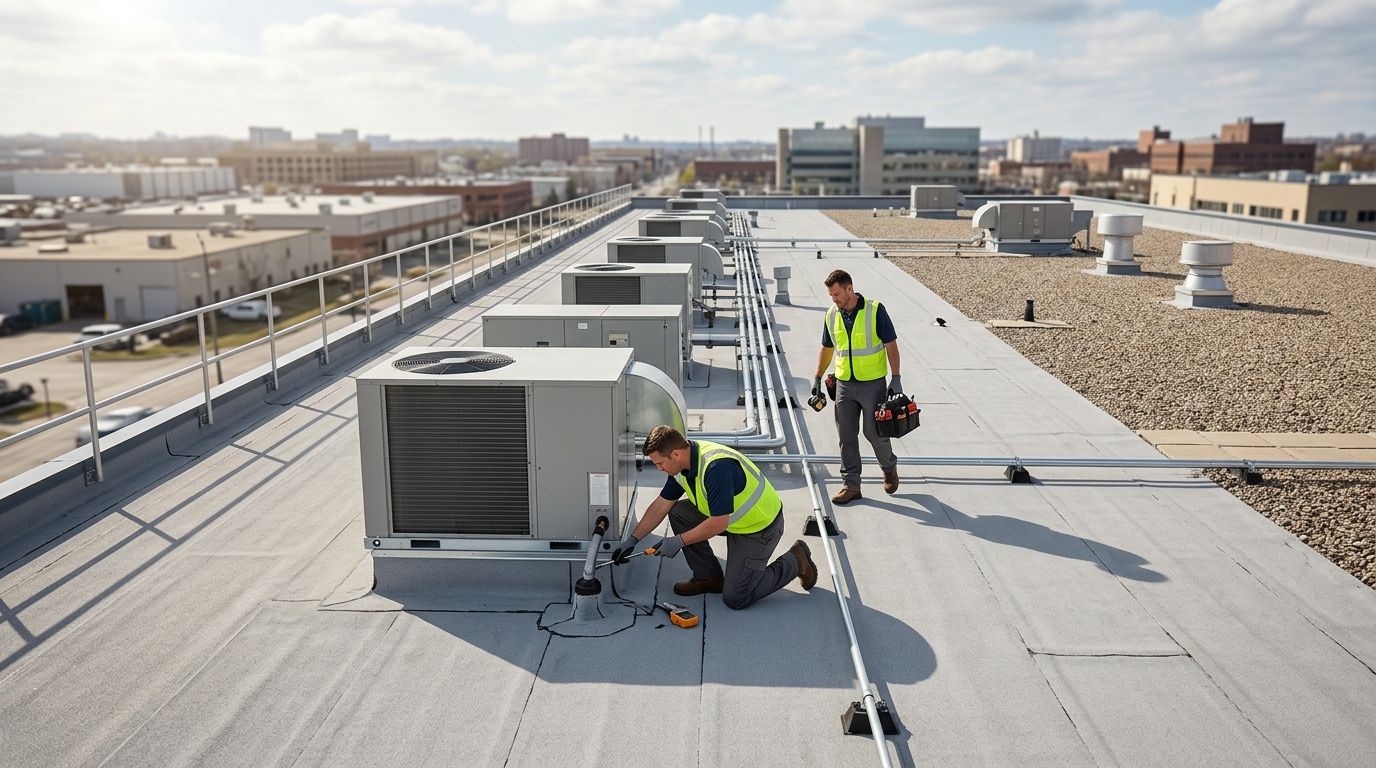
Flat and low-slope commercial roofs fail differently than sloped residential roofs — ponding water, drain blockages, and membrane seam separation are the main risks, not shingle wear. A flat roof specific plan checks drains, scuppers, and seams on every visit instead of a generic walkthrough. Pairing this with guidance on flat roof systems for commercial buildings helps an owner understand which membrane type their building has and what maintenance it specifically needs.
Flat roof plan pros:
- Targets the actual failure points of low-slope membranes
- Catches ponding water before it degrades the membrane
- Fits TPO, EPDM, and modified bitumen systems alike
Flat roof plan cons:
- Not applicable to steep-slope commercial roofs
- Drainage issues tied to building design sometimes need more than maintenance to fix
Best for: Warehouses, strip malls, and industrial buildings with flat or low-slope roof systems.
Verdict: Buy for any flat-roof commercial property — this is the plan type most often skipped and most often responsible for the leaks that follow.
How this ranking works
Each plan type is measured against the six criteria above: inspection frequency, documentation quality, storm response speed, warranty alignment, scope clarity, and flexibility across building types. No plan wins on every criterion — the comprehensive preventive program ranks highest because it covers the most ground for the widest range of commercial properties, not because the other four are inferior for their specific use cases.
“A maintenance plan is only as good as the documentation it produces when you actually need it.”
Which commercial roof maintenance plan should you choose?
For most commercial property owners in Lincoln or Omaha managing more than one building, the comprehensive preventive maintenance program is the right default in 2026 — it covers routine wear, produces warranty-ready documentation, and bundles minor repairs. If your roof is flat or low-slope, add the drainage-specific plan on top rather than substituting it. If your building sits in an active hail or storm corridor, layer a storm-response plan over whichever base plan you choose. A single small building with a newer roof can start with inspection-only and upgrade later.
Schedule a free roof inspection
Get a documented condition report before choosing a maintenance plan.
FAQ
What’s the best commercial roof maintenance plan for a small business?
An inspection-only plan works best for a single small commercial building with a relatively new roof — it provides documented check-ins without a full repair contract attached.
How often should a commercial roof be inspected?
Most commercial roofs need at least two scheduled inspections per year, typically spring and fall, with additional checks after major storm events.
Is a maintenance plan required to keep a roof warranty active?
Many manufacturer warranties, including extended coverage like a 50-year Golden Pledge warranty, require documented maintenance on a set schedule to remain valid.
Do flat roofs need a different maintenance plan than sloped roofs?
Yes. Flat and low-slope commercial roofs need drainage and ponding-water checks that a standard sloped-roof inspection doesn’t cover.
What should a commercial roof maintenance report include?
A usable report includes dated photos, a written condition summary, and notes on flashing, drainage, and membrane seams — the same documentation insurers and manufacturers request during a claim.
How fast should a storm-response plan mobilize after hail damage?
Storm-response plans prioritize post-event inspection, though exact response windows vary by contractor capacity and the scale of the storm event.
Can one maintenance plan cover multiple commercial buildings?
Yes, a comprehensive preventive maintenance program is built for exactly this — one recurring schedule across a multi-building portfolio.
Does commercial roof maintenance affect insurance claims?
Documented, regular maintenance visits give insurers a paper trail that can reduce disputes over when damage occurred and whether it was pre-existing.
One last thing
The flat roof specific plan is the one commercial property owners skip most often — and it's the plan tied to the most expensive interior water damage claims, because ponding water on a low-slope membrane doesn't announce itself the way a visible shingle failure does. If your building has any flat or low-slope section, put that plan ahead of general preventive maintenance, not behind it.
Related guides