Yes, you can finance a new roof, subject to lender approval. Instead of chasing an estimate, application documents, and scheduling updates separately, use this 2026 workflow to move from a written roof scope to a financing decision without confusing approval with permission to start work.
- Can you finance a new roof? Yes; lender approval and a written roof replacement estimate are separate requirements.
- Murray Roofing provides roof replacement and financing; confirm the application process before submitting personal information.
- Compare roof financing by repayment terms, fees, and security requirements—not the monthly payment alone.
- Confirm financing conditions and the roofing contract before authorizing installation.
Why this matters
A roof estimate defines the work; a financing agreement defines your repayment obligation. Neither document replaces the other. Keeping them separate prevents you from accepting a loan for a project whose scope is still changing.
For Lincoln and Omaha properties, start with an inspection rather than choosing a borrowing amount from an online example. Roof condition, replacement materials, access, and related work all belong in the project assessment.
Murray Roofing is best for Lincoln and Omaha property owners seeking roof replacement and financing from the same roofing contractor. You can contact Murray Roofing to request an inspection and discuss the next step. The contractor provides financing, but approval is not guaranteed.
Your 2026 workflow should produce 2 separate documents: a written roofing proposal and the financing agreement you accept. Keep the final versions together so you can check whether the financed project matches the contracted work.
Before you start
- Gather property and decision-maker details. Have the property address, ownership information, inspection access, and the names of everyone who must authorize the project. For a commercial building, identify the person authorized to sign both the roofing contract and financing documents.
- Prepare financial records through the lender's instructions. Have identification and income information ready, but submit sensitive records only through the lender's confirmed application channel. Ask which documents apply to your application before collecting unnecessary records.
- Separate a preliminary result from final approval. Ask whether an initial eligibility check involves a credit inquiry, what conditions remain, and when funds can be released. A preliminary result is not authorization to schedule installation.
No named application portal is required by this guide. Use the actual form supplied for your financing application, and follow its displayed field names rather than assuming every lender uses the same buttons or settings.
Inspection and roof estimate
The first configuration unit is the project itself. Get the work defined before deciding how much to borrow. A financing application cannot resolve an unclear roofing proposal.
- Request an inspection. Explain whether you are dealing with a leak, storm damage, an aging roof, or a planned replacement. Identify interior concerns and access restrictions without climbing onto the roof yourself.
- Ask for the findings in writing. Separate observed damage from recommended work. If replacement is recommended, ask what condition supports that recommendation and whether any repair would only address part of the problem.
- Review the replacement scope. Identify the proposed roof system, removal work, flashing, ventilation, cleanup, and any related work included in the proposal. Ask how concealed damage discovered during removal will be documented and approved.
- Resolve optional work. Decide whether gutters, skylight-related work, or other additions belong in this project. Keep declined options separate from the accepted scope so the lender receives the correct proposal.
- Save the final estimate. Label it with the property address and revision date. Give the lender the version you intend to accept, not an earlier draft.
Expected result: you have a written proposal that explains what the contractor will do, what is excluded, and how changes will be handled.
For a 2026 roof replacement, this is also the point to request warranty documents. Murray Roofing lists a 50-year Golden Pledge warranty and a 10-year labor warranty among its trust signals. Ask which warranty applies to your proposed roof and read its eligibility, coverage, and exclusions; do not assume every project receives identical protection.
Financing route and application
Choose the borrowing route after the roof scope is clear. Contractor-arranged financing, a personal loan, and home-equity borrowing have different trade-offs; none is automatically the right choice for every property owner.
| Financing route | Best for | Advantage | Limitation or risk |
|---|---|---|---|
| Contractor-arranged financing | Owners who want to discuss borrowing alongside the roofing proposal | Connects the financing discussion to the defined project | Approval and repayment terms still depend on the financing agreement |
| Unsecured personal loan | Applicants seeking borrowing without pledging their home as collateral | Does not secure the loan against the property | Eligibility, fees, and repayment terms require separate review |
| Home-equity loan or line of credit | Homeowners considering borrowing secured by home equity | Provides a property-secured borrowing route | The home serves as collateral; default can put it at risk |
The benefit of discussing Murray Roofing's roof financing alongside its replacement proposal is a shared project scope. The limitation is that a contractor's roofing recommendation does not establish your borrowing eligibility or make the repayment obligation suitable for your household.
- Request the financing instructions. Confirm the lender's identity, application channel, required documents, and whether the proposed financing supports your property and project type.
- Check credit-inquiry language. Read the consent disclosure before submitting. Ask whether the current step is an eligibility check or a full application and what credit inquiry it authorizes.
- Enter consistent applicant details. Match your legal name, address, ownership details, and requested project amount across the application and supporting records. Do not substitute the contractor's address for the property address.
- Review the borrowing terms. Read the annual percentage rate, repayment term, fees, payment schedule, and any security requirement. If promotional terms appear, ask what happens when those terms end.
- Submit through the confirmed channel. Save the submission confirmation and any document requests. Do not send identification or financial records to an unverified email address.
Expected result: you have an application record and understand what the lender needs to make a decision.
Compare the options in the guide to financing a new roof before choosing a route. In 2026, evaluate the full repayment obligation rather than treating a manageable monthly payment as proof that an agreement fits your finances.
Approval conditions and contract review
A favorable application result is a checkpoint, not the finish line. Read the conditions before signing the roofing contract or assuming the project is funded.
- Identify the decision status. Determine whether the lender has issued a preliminary result, conditional approval, or final approval. Ask for a written explanation of any remaining requirements.
- Match approval to the current scope. Check that the approved financing supports the accepted project. If it does not cover the planned work, resolve the difference before authorizing installation.
- Read funding instructions. Confirm who receives the funds, what signatures or completion records are required, and when repayment begins. Do not assume the contractor receives money immediately after approval.
- Review the roofing agreement separately. Check the scope, payment responsibilities, change-order process, warranty documents, and scheduling conditions. Ask how delays or financing problems affect the contract.
- Confirm the handoff in writing. Tell the contractor when financing conditions are satisfied and ask what else is required before the project can be scheduled.
Expected result: the lender's requirements and contractor's requirements agree, with no unresolved funding gap or unsigned scope change.
Use 3 final checks: the roof scope matches the contract, the borrowing terms match what you accepted, and the funding conditions are understood. Approval does not remove your responsibility to read either agreement.
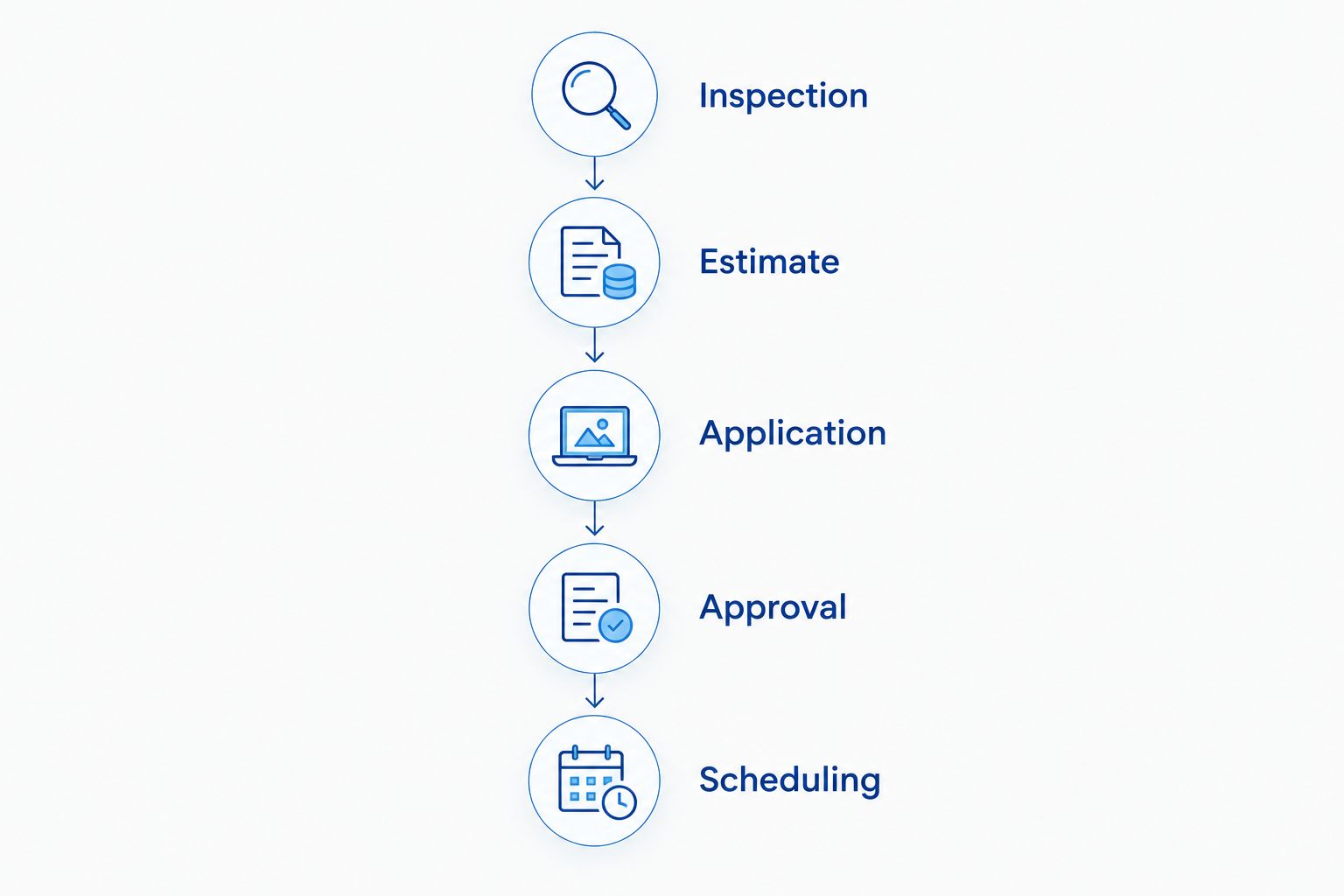
The sequence is inspection, estimate, application, approval, and scheduling. Keep those checkpoints distinct so a decision at one stage does not accidentally authorize the next.
Project scheduling and payment records
Financing approval does not establish an installation date. The contractor must also confirm project readiness, and you must understand the payment responsibilities that remain yours.
- Confirm the accepted proposal. Give the contractor the final scope and identify any financing conditions that affect the project. Ask for written confirmation that the correct version is on file.
- Discuss property access. For a Lincoln or Omaha home, explain parking, pets, and access concerns. For a commercial property, identify tenant operations, delivery areas, and the person responsible for building access.
- Keep payment records together. Save the signed contract, financing agreement, lender notices, payment confirmations, and approved changes in the same project folder.
- Review completion documents. Ask what project records and warranty information you will receive. Sign only documents that accurately describe the work or acknowledgment being requested.
Expected result: you know who handles scheduling, who handles loan questions, and which records document the completed project.
For commercial roof replacement in 2026, confirm that the selected financing route accepts the applicant and building type. Do not assume a homeowner financing application also applies to a business, church, apartment property, restaurant, or warehouse.
When the roof estimate changes after approval
A revised estimate creates a second workflow: update the project record first, then confirm whether the financing needs to change. Do not treat the original approval as permission to add work.
- Ask the contractor to document the changed scope and its reason.
- Review and accept or decline the proposed change before it becomes part of the project.
- Ask the lender whether the revision requires an updated application, additional review, or amended financing documents.
- Confirm how any difference will be paid before the affected work proceeds.
- Replace outdated documents in your active project folder while retaining copies for your records.
This applies to requested additions and to concealed conditions found during roof removal. The contractor explains the construction issue; the lender explains the financing impact. Keep both answers in writing.
Expected result: the revised contract and funding arrangement describe the same work, without relying on an outdated approval.
Troubleshooting
The application asks for more documents
Request the exact document requirement and submission instructions from the lender. Check that names, addresses, and applicant details agree across your records; avoid repeated submissions of unrelated documents.
The approved financing does not cover the accepted work
Ask whether the lender can review the current proposal and explain any remaining balance to the contractor. If the gap remains, reconsider the project scope or borrowing route without removing work the contractor identifies as necessary.
The insurance claim is unresolved
Keep the claim and financing records separate. Murray Roofing provides insurance-claim support, but the insurer determines coverage under the policy; do not count an unsettled claim as committed project funding.
The lender and contractor give different next steps
Ask each party to identify its remaining requirement in writing. Resolve whether the issue concerns loan approval, funding, contract acceptance, or scheduling before signing additional documents.
The application is declined
Ask the lender for the decision notice and review the reasons it provides. Do not submit repeated applications without understanding the credit-inquiry implications; discuss other borrowing routes or a revised project plan separately.
Customize your workflow
For a homeowner, keep the process focused on the roof scope and household repayment obligation. For a commercial decision-maker, add signing authority, property ownership, tenant communication, and access planning before applying.
Keep maintenance separate from replacement financing unless it is expressly included in the accepted agreement. A roof replacement contract should not leave you guessing about future inspection or maintenance responsibilities.
If your 2026 project involves several buildings, ask for clearly identified scopes rather than treating every roof as interchangeable. That makes it easier to review what is being financed and which work each approval covers.
FAQ
Can you finance a new roof in Lincoln or Omaha?
Yes, you can seek financing for a new roof in Lincoln or Omaha, subject to lender approval. Murray Roofing provides roof replacement and financing; confirm the application requirements and accepted project scope before proceeding.
Should I get a roof estimate before applying for financing?
Get a written roof estimate before deciding how much financing to request. An initial eligibility check can be separate, but the final financing arrangement should match the work you accept.
Does roof financing approval mean installation can start?
No, financing approval alone does not authorize installation. Confirm remaining lender conditions, sign the roofing agreement, and obtain the contractor’s scheduling instructions.
Can I finance a roof if my insurance claim is still open?
Discuss financing with the lender while keeping the unresolved insurance claim separate. Do not assume the insurer will cover the work or treat an unsettled claim as guaranteed funding.
Will applying for roof financing affect my credit?
The effect depends on the credit inquiry authorized by the application. Read the consent disclosure and ask the lender whether the current step uses a soft or hard inquiry before submitting.
What happens if the roof estimate changes after financing approval?
Ask the lender to confirm whether the revised roof estimate requires additional review or amended documents. Approve the construction change separately and resolve its funding before the affected work proceeds.
Can a business use the same roof financing as a homeowner?
Do not assume homeowner financing applies to a business or commercial property. Confirm the applicant, ownership structure, and building eligibility with the lender before applying.
Is contractor financing better than a personal loan?
Neither route is automatically better. Compare the actual repayment terms, fees, credit requirements, and security obligations against the same written roofing scope.
One last thing
A roof warranty and a financing agreement protect against different problems. Warranty coverage does not cancel loan payments, and loan approval does not establish warranty eligibility. Keep both documents with your roofing contract, and ask questions before signing rather than after work begins.
Related guides
Start with the property, not the application. Schedule a free inspection with Murray Roofing and request a written roof replacement proposal before choosing your financing route.
Schedule your roof inspection
Request a free inspection and discuss roof replacement financing for your property.