Instead of repeatedly sending scattered storm photos and estimates, use one claim file to manage the roof insurance claim process: document damage safely, notify your insurer, reconcile the repair scope, complete authorized work, and submit closeout records. This 2026 workflow covers Lincoln and Omaha homes and commercial buildings; payment depends on your policy and the insurer’s coverage decision.
- Murray Roofing provides roof inspections and insurance-claim support for Lincoln and Omaha homeowners and businesses.
- The roof insurance claim process starts with safe storm damage documentation, not a promise of coverage.
- Compare the insurer’s scope with the contractor’s findings before authorizing roof replacement.
- Keep invoices, completion photos, and insurer correspondence together through final claim closeout.
Why this matters
An insurance claim and a roofing project are separate processes. Your insurer decides coverage under the policy; your contractor documents roof conditions and defines the construction work. A roof replacement recommendation does not establish that insurance owes for replacement.
Murray Roofing is best for Lincoln and Omaha property owners seeking roof inspections and contractor support during an insurance claim. Murray Roofing provides residential and commercial roof repair, replacement, inspections, and insurance-claim support.
For a 2026 storm claim, keep evidence, coverage correspondence, and construction records connected. A clear file makes missing information easier to identify; it does not guarantee approval. Separate observed damage from assumptions about what caused it.
Before you start
- Gather access and authority. Have your policy documents, insurer contact information, property address, and permission to authorize an inspection. For commercial buildings, identify the owner or representative authorized to report the loss and approve work.
- Create 3 document groups. Use damage evidence, insurer correspondence, and construction records. Save originals of photos, inspection reports, estimates, receipts, and messages; keep a dated activity log alongside them.
- Check the payment conditions before signing. Read the deductible, roof coverage provisions, notice requirements, and any conditions for recovering depreciation. A replacement-cost provision does not mean the initial payment covers the entire project, and lender involvement can affect how checks are handled.
Do not climb onto a storm-damaged roof. Record what you can see from safe ground-level locations and arrange professional inspection and urgent protection where needed. Keep people away from sagging ceilings, falling materials, and electrical hazards; an insurance appointment is not a reason to leave an unsafe area occupied.
Damage record
Your first task is to preserve evidence without making the property less safe. Keep the storm event, observed roof conditions, and interior damage distinct in your notes.
- Record the event. Write down the date you observed damage and the storm date if known. Do not substitute an estimated date for a confirmed one. Describe visible conditions, such as displaced roofing or water staining, without declaring their cause.
- Photograph safely. Capture wide views showing the location and closer views showing the condition, where safely accessible. Include affected rooms and belongings. Preserve original files rather than relying only on compressed copies in messages.
- Arrange a professional inspection. Ask for findings that identify affected roof areas, supporting photos, and the proposed response. For Lincoln and Omaha properties, Murray Roofing offers free roof inspections and insurance-claim support.
- Document urgent protection. Ask a qualified contractor to address immediate exposure or leakage. Keep the authorization, description of work, photos, invoices, and receipts. Tell your insurer about urgent measures and ask what documentation it requires.
Expected result: You have a dated damage record and professional findings, with urgent protection documented separately from permanent repairs. An inspection report supports review; it is not a coverage decision.
If emergency work changes a damaged area before the adjuster visits, preserve before-and-after evidence where safely possible. Do not delay necessary protection merely to keep damage visible.
Claim file
Report the loss through your insurer’s stated process. Because insurer portals differ, use the labels and instructions in your own account rather than assuming every carrier has the same submission fields.
- Review reporting requirements. Find the policy’s notice provisions and ask the insurer to confirm applicable documentation deadlines. Do not use a general online deadline in place of your policy’s requirements.
- Submit factual information. Give the property address, event information, observed damage, and any urgent protection already arranged. Distinguish confirmed facts from information still awaiting inspection.
- Save the claim acknowledgment. Record the claim number, assigned contact, reporting date, and next requested action. Put these details at the top of your 2026 claim file so contractors and authorized property representatives use the same reference.
- Coordinate access. Ask whether the adjuster needs interior access, roof access, contractor findings, or supporting records before the appointment. For occupied commercial properties, coordinate access with building management and affected occupants.
- Track every request. Log what the insurer requests, who will provide it, when you submit it, and whether receipt is confirmed. Keep the actual correspondence, not just a summary of a phone call.
Expected result: The reported loss has a claim reference, an insurer contact, and a documented next action. Reporting the claim does not establish coverage or authorize permanent roofing work.
Ask for written clarification when an instruction affects your decision to proceed. A conversation about possible payment is different from a written coverage determination.
Scope review
The roof scope describes the work; the policy determines which covered costs the insurer recognizes. Compare the documents line by line before treating them as equivalent.
- Obtain both scopes. Keep the insurer’s estimate and the contractor’s written proposal side by side. Identify which roof areas, components, removal work, disposal, and associated repairs each document includes.
- Explain differences with evidence. Ask your contractor to identify omissions or disagreements using inspection photos, measurements, and construction requirements. A higher total alone does not explain why additional work is necessary.
- Separate repairs from upgrades. Identify work intended to restore covered damage separately from elective changes. Ask the insurer how policy provisions apply; do not assume a different material or added feature is covered.
- Clarify the payment basis. Ask whether the settlement uses actual cash value or replacement cost, whether depreciation is recoverable, and what proof is required. Roof-specific provisions can change the answer.
- Resolve authorization. Before signing the construction agreement, understand the proposed scope, your payment responsibilities, and how unresolved claim items will be handled. Keep contractor authorization separate from insurer approval.
Expected result: You can identify agreed work, disputed work, and owner-selected work without treating an unresolved supplement as approved funding.
Repair or replacement: what the evidence supports
Neither choice automatically wins an insurance claim. The appropriate construction response depends on the roof’s condition; coverage remains a separate decision.
| Construction response | Best for | Benefit | Limitation |
|---|---|---|---|
| Localized roof repair | Damage confined to an area that can be repaired appropriately | Addresses the affected area without replacing unaffected roofing | Does not resolve unrelated deterioration or damage elsewhere |
| Full roof replacement | Conditions that require replacing the roof rather than a localized repair | Addresses the roof through a defined replacement scope | A contractor’s recommendation does not establish insurance coverage |
Choose the construction scope from documented conditions, not from the payment you hope to receive. Ask why a repair is adequate or why replacement is necessary. Keep that explanation with the inspection findings.
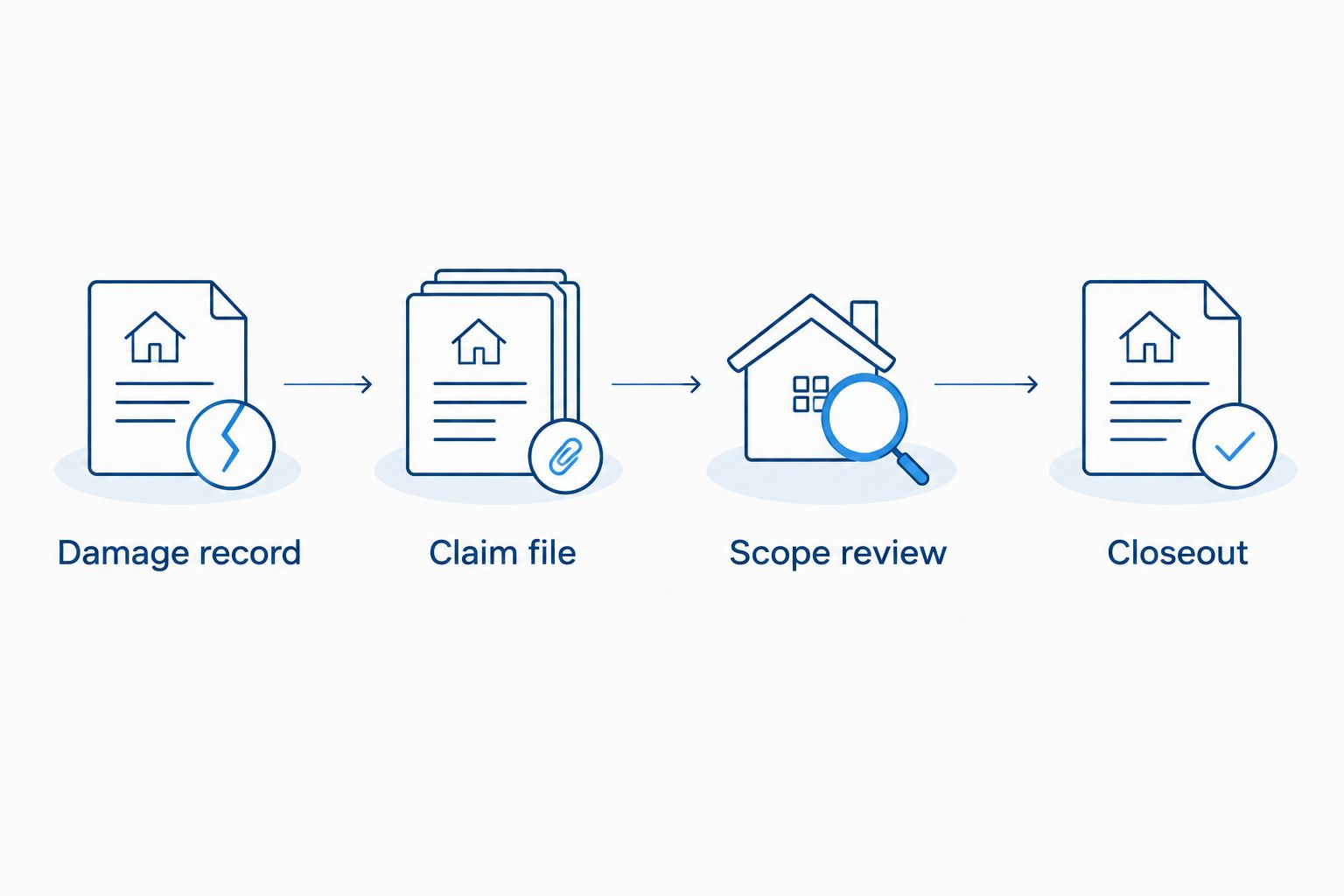
The claim sequence has distinct handoffs. Complete the evidence and scope review before treating construction and claim closeout as the same task.
Closeout
A finished roof does not automatically close the insurance claim. Your insurer can require completion evidence or other records before considering additional payment under the policy.
- Confirm the construction agreement. Review the final work description, payment terms, responsibilities, and warranty documents. Ask which warranties apply to the selected roof system; an insurance payment is not a workmanship warranty.
- Document changed conditions. If the contractor discovers additional damage during work, request photos and a written explanation. Submit supporting information through the insurer’s required process rather than assuming hidden damage is automatically covered.
- Collect completion records. Obtain the final invoice, completion photos, and any other documents the insurer requests. Keep emergency-protection records and permanent roofing records identifiable within the same claim file.
- Submit required proof. Ask the insurer to confirm receipt and explain any remaining conditions for recoverable depreciation or supplemental review. Record applicable deadlines directly from the policy or written insurer instructions.
- Reconcile the file. Compare received payments, the contractor’s invoices, the deductible, owner-selected work, and unresolved items. If a lender appears on a check, follow the lender’s instructions before assuming those funds are available for contractor payment.
Expected result: You have construction completion records, submitted claim documentation, and a clear list of any outstanding payment questions. Close the file only after those questions are resolved or formally explained.
For a roof completed in 2026, retain the final scope and warranty documents with your property records. They serve a different purpose from the insurer’s settlement paperwork.
When new damage changes an existing claim
Use this adjacent workflow when new findings appear after the initial inspection. Do not overwrite the original evidence or mix a later storm into an earlier claim without explanation.
- For newly discovered damage from the reported event: preserve photos, identify the location, and ask the contractor to explain why it changes the work scope. Submit the supporting records for the insurer’s review.
- For damage following another storm: record the later event separately and ask the insurer whether it requires a new claim. A new event is not automatically an addition to an existing claim.
- For an updated construction proposal: retain the earlier version and label the revision clearly. State what changed and why, so the insurer can review the difference.
Commercial properties need the same evidence discipline. For a 2026 claim involving a warehouse, apartment building, restaurant, church, or other commercial property, identify authorized contacts and affected areas without assuming the business use determines coverage.
Troubleshooting
The insurer’s scope omits an affected area
Ask the contractor to identify the area with labeled photos and a written explanation. Submit that evidence with a specific request for review. Repeating that the estimate is too low does not identify the missing work.
The initial payment does not cover the proposal
Compare the deductible, depreciation, recognized scope, and owner-selected work. Ask the insurer to explain the settlement basis in writing. Do not assume every gap represents an estimating error or that additional payment is guaranteed.
The adjuster visits after urgent protection is installed
Provide available before-and-after photos, contractor notes, and receipts. Explain why protection was necessary and which areas it changed. Keep these records separate from claims about damage the inspection has not established.
Additional damage appears during construction
Ask the contractor to document the finding and explain its effect on the scope before that evidence is concealed, where safe and practical. Notify the insurer promptly and follow its review instructions. Additional work and additional insurance payment remain separate decisions.
The claim is denied or coverage is unclear
Request the written explanation and referenced policy provisions. Compare the stated reason with the evidence, and ask about the insurer’s review process. A contractor can explain roof conditions; seek appropriate insurance or legal guidance for unresolved policy interpretation.
Customize your workflow
Keep 1 master claim file for each reported loss. Give authorized participants access to the records they need, while keeping policy and personal information protected. A designated owner or property representative should track insurer requests and construction decisions.
For Lincoln and Omaha replacements, distinguish restoring storm damage from selecting a different roof system. Review roof types for Nebraska weather when planning the construction scope, but keep material preferences separate from coverage questions.
Murray Roofing offers financing as well as insurance-claim support. Financing is a separate arrangement, not evidence that an insurer will reimburse the project. Confirm its terms independently before using it to address an unresolved funding gap.
FAQ
How do I start the roof insurance claim process after a storm?
Start by documenting visible damage safely and checking your policy’s reporting requirements. Arrange a professional roof inspection, notify your insurer through its stated process, and retain the claim acknowledgment.
Should I call a roofer or my insurance company first?
Urgent safety and property protection come first; inspection and insurer notification should follow promptly. Do not delay required notice while waiting for a contractor appointment.
Does hail damage automatically qualify for a roof replacement?
No, hail damage does not automatically establish coverage for full roof replacement. The insurer reviews policy terms and evidence, while the contractor explains the construction response supported by roof conditions.
Can Murray Roofing help with my roof insurance claim?
Murray Roofing provides roof inspections and insurance-claim support for homeowners and businesses. The insurer, not the roofing contractor, makes the coverage decision.
Why is the first insurance payment different from the roofing estimate?
The first payment can reflect a deductible, depreciation, a different recognized scope, or roof-specific policy provisions. Ask the insurer for a written explanation and compare it with the contractor’s itemized proposal.
What happens if the contractor finds more damage during replacement?
Document the additional damage and submit supporting information for insurer review. The finding does not automatically authorize additional insurance payment.
What documents do I need to finish a roof insurance claim in 2026?
Follow your insurer’s requirements for final invoices, completion evidence, and any other requested records. Confirm deadlines and conditions for additional payment directly from the policy and written insurer instructions.
One last thing
A closed construction job and a closed insurance claim are not the same milestone. Before archiving your 2026 records, ask the insurer to explain any unresolved payment item and confirm whether further documentation is required.
Related guides
Schedule a free inspection with Murray Roofing to document your roof’s condition and get a written proposal for the recommended work.
Schedule your roof inspection
Get documented roof findings and a clear next step for your Lincoln or Omaha property.