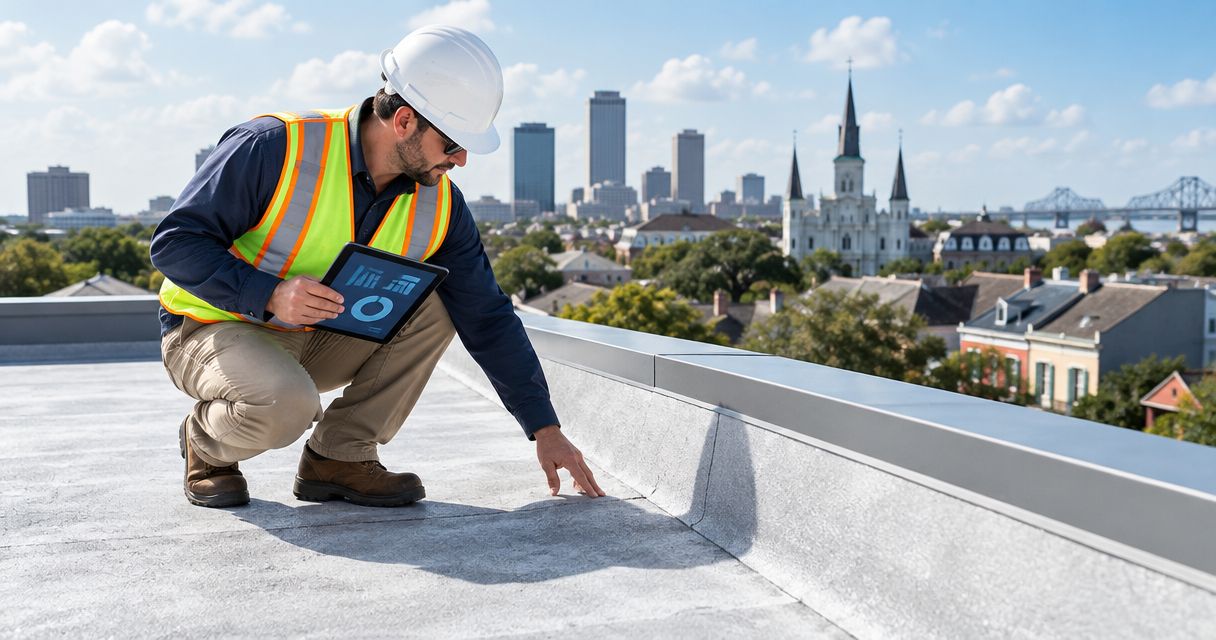
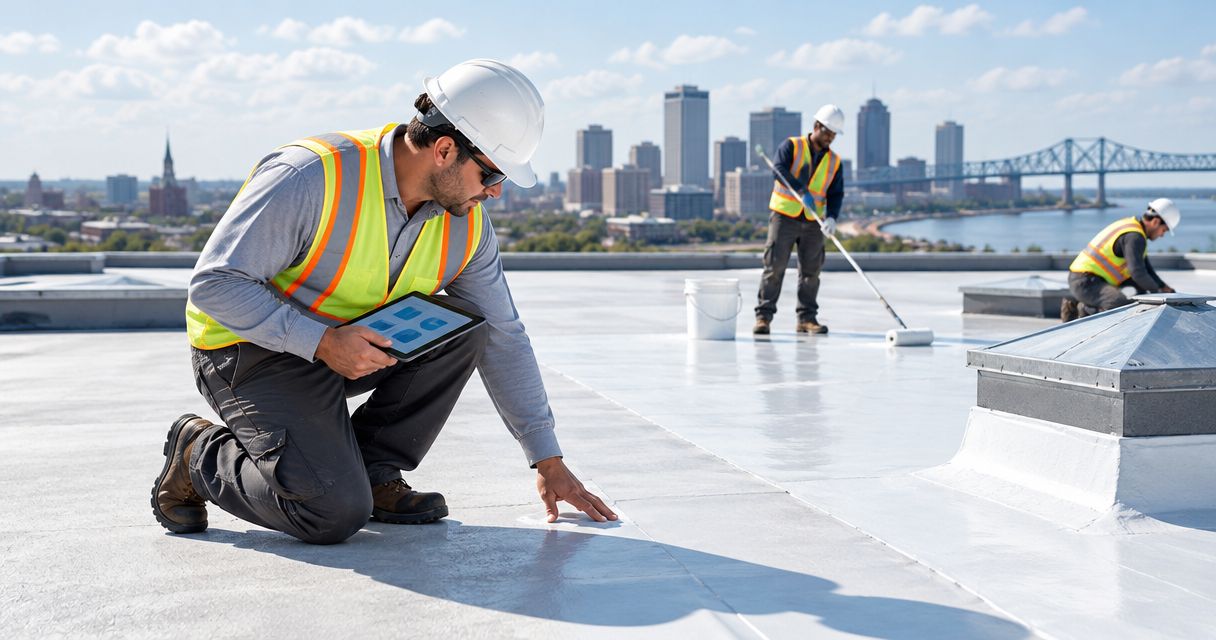
The best commercial roofing contractor in New Orleans, LA is the one who documents your roof’s condition, explains the repair-or-replacement decision, and puts the full scope in writing. Murray Roofing is a fit for New Orleans commercial property owners seeking inspections, repairs, replacement, maintenance, and financing through one contractor.
- For the best commercial roofing contractors New Orleans LA search, prioritize documented findings over promises.
- Murray Roofing provides commercial roof inspections, repairs, replacement, maintenance, insurance-claim support, and financing.
- Choose repair for documented localized damage; evaluate replacement when the existing roof cannot support a lasting repair.
- Confirm Louisiana credentials, project-specific warranty terms, drainage details, and building protection before signing.
Why this matters in New Orleans
Choosing a commercial roofer means choosing how your building, occupants, and business operations will be protected during the work. A proposal that names a roofing material but ignores drainage, rooftop equipment, or access leaves important decisions unresolved.
New Orleans property owners also need a clear plan for rain and wind exposure. For a 2026 project, ask how the contractor will protect open roof areas, secure materials, and respond when weather interrupts work. A promised completion date is not a substitute for that plan.
The same standard applies to offices, restaurants, warehouses, healthcare buildings, schools, retail properties, hotels, multifamily buildings, and other commercial properties. Choose the scope your building needs—not the sales presentation that sounds most confident.
What makes the best commercial roofing contractor?
Use these criteria before comparing proposals:
- Documented diagnosis: The inspection identifies observed defects, affected areas, and any conditions requiring further investigation.
- Relevant experience: The contractor can discuss work involving your roof type, building use, and operational restrictions.
- Verifiable credentials: Confirm the applicable Louisiana contractor credentials and current insurance for the proposed work.
- Complete scope: The proposal addresses removal, preparation, drainage, flashing, rooftop penetrations, cleanup, and exclusions.
- Building protection: The contractor explains access control, weather protection, debris handling, and occupant communication.
- Written accountability: Warranty terms, payment milestones, change-order procedures, and closeout documents are clear before approval.
Request 3 written proposals when you need a competitive selection process. Give each contractor the same project information; otherwise, you are comparing different jobs rather than different contractors.
Commercial roofing choices at a glance
The right contractor should explain which service fits the inspection findings. These are different decisions, not interchangeable ways to address every roof problem.
| Service | Best for | Main benefit | Main limitation |
|---|---|---|---|
| Commercial roof inspection | Owners who need a documented starting point | Establishes visible condition and next questions | Concealed conditions can require additional investigation |
| Targeted roof repair | Localized defects in an otherwise serviceable roof | Addresses defined problem areas without full replacement | Does not renew the rest of the roof |
| Full roof replacement | Roofs that cannot support a lasting repair strategy | Allows broader correction of roofing-system problems | Requires more planning around removal and business activity |
| Planned maintenance | Owners managing a serviceable roof over time | Creates a routine for observation and corrective work | Cannot reverse existing widespread deterioration |
Do not approve a replacement solely because a roof is old. Do not approve another patch solely because replacement is inconvenient. Ask for the findings behind either recommendation.
1. Commercial roof inspection: best for an uncertain roof condition
An inspection is the right starting point when you have recurring leaks, incomplete maintenance records, storm concerns, or a major capital decision approaching. Murray Roofing offers commercial roof inspections in New Orleans, along with repair and replacement services.
Ask for a written explanation that separates observed damage from suspected concealed problems. Interior staining, roof-surface defects, and moisture within an assembly are different findings; the report should not treat them as interchangeable.
Inspection advantages:
- Gives your decision-makers a shared record of observed conditions.
- Helps define the work before you request competing proposals.
- Identifies questions that need further investigation.
Inspection limitations:
- A visual inspection cannot establish every concealed condition.
- An inspection report does not guarantee future performance or insurance coverage.
Best for: Owners who need evidence before choosing repair, replacement, or continued maintenance.
Verdict: Start here when the roof’s condition is uncertain. For a 2026 capital plan, request findings that distinguish urgent work from items suitable for continued observation.
2. Targeted roof repair: best for a defined, localized defect
Commercial roof repair addresses specific problems rather than replacing the entire covering. Examples include damaged flashing or a localized defect around a rooftop penetration, subject to inspection and material compatibility.
The contractor should explain both the repair boundary and its limits. A proposal should identify the defect being addressed, the preparation required, and which surrounding areas remain outside the work.
Repair advantages:
- Limits work to the documented problem area.
- Preserves serviceable roofing outside the repair scope.
- Gives owners a defined corrective action to evaluate.
Repair limitations:
- Leaves the remaining roof in its existing condition.
- Does not resolve unrelated drainage or assembly problems.
- Repeated repairs require a fresh review of whether the overall strategy still makes sense.
Best for: Owners with localized damage and evidence that the surrounding roof remains serviceable.
Verdict: Approve a repair when the diagnosis and boundaries are clear. Hold the proposal if it describes only a generic patch without explaining the source of the problem.
3. Full roof replacement: best for a roof needing broader correction
Replacement deserves serious consideration when inspection findings show that localized repairs cannot provide a sound solution. It also creates an opportunity to assess insulation, drainage details, perimeter conditions, and rooftop penetrations as parts of the same project.
Require the contractor to explain what will be removed and what will remain. Those decisions affect preparation, disposal, concealed-condition handling, and the final assembly.
Replacement advantages:
- Addresses the roofing system more broadly than isolated repairs.
- Allows inspection of underlying conditions as work exposes them.
- Provides an opportunity to correct documented deficiencies within the agreed scope.
Replacement limitations:
- Requires coordination around occupants, access, deliveries, and weather.
- Concealed conditions can require approved changes after removal begins.
- A new roof still needs maintenance and clear warranty responsibilities.
Best for: Owners whose roof condition supports replacement rather than another isolated repair.
Verdict: Choose replacement when the documented condition justifies it. For a 2026 project, approve the building-protection plan and change-order process alongside the roofing scope.
4. Planned maintenance: best for managing a serviceable roof
Maintenance is a management process, not a promise that leaks will never happen. A useful plan sets out what gets inspected, what routine work is included, how findings are documented, and how additional repairs are authorized.
Match the plan to the building. A restaurant roof with equipment and exhaust penetrations presents different inspection details from a warehouse roof, but neither property type deserves a generic checklist with no attention to actual conditions.
Maintenance advantages:
- Creates a consistent record of roof condition.
- Gives managers a process for reporting and addressing defects.
- Helps organize future repair and replacement decisions.
Maintenance limitations:
- Does not restore a roof that already needs replacement.
- Does not automatically include every repair or emergency response.
Best for: Owners and managers responsible for keeping a serviceable roof under regular observation.
Verdict: Choose a written maintenance scope, not an undefined annual visit. Confirm how deficiencies become approved work orders.
How to evaluate Murray Roofing for your project
Murray Roofing serves commercial property owners in New Orleans and offers inspections, repairs, replacement, maintenance, insurance-claim support, and financing. That service range makes the company relevant when you need to evaluate more than a single repair option.
The practical advantage: You can discuss the inspection findings, immediate work, and longer-term replacement needs with the same contractor. Financing is also available to discuss as part of project planning.
The decision boundary: A service list does not establish the right assembly, schedule, or warranty for your specific building. Request a project-specific proposal and confirm financing terms before making a commitment.
The company identifies a 50-year Golden Pledge warranty and a 10-year labor warranty among its trust signals. Do not assume either applies to a proposed commercial roof: ask which warranty is available for the exact assembly, who issues it, and what conditions apply.
Best for: New Orleans commercial owners seeking inspection-led guidance and a contractor offering both repair and replacement services.
Check the details that matter locally
Drainage and rooftop equipment
Ask the contractor to address drains, scuppers, gutters, and discharge points that affect the proposed work. Standing water deserves an explanation, not an automatic recommendation to cover the existing surface.
Rooftop equipment also creates coordination questions. Identify who handles equipment access, disconnection, lifting, reconnection, and any work by other licensed trades.
Wind and weather protection
For a New Orleans commercial roof, ask how the proposed assembly addresses applicable wind requirements. Request the relevant assembly documentation rather than accepting a general claim that a roof is storm-resistant.
The work plan should also explain how the crew limits exposed areas and protects the building during interruptions. No contractor can guarantee a storm outcome.
Permits and property restrictions
Confirm who determines permit requirements, obtains required approvals, and coordinates inspections. If the property has historic-district restrictions or other approval conditions, resolve them before authorizing material selections.
For your 2026 contractor review, verify credentials and insurance directly rather than relying only on a logo or an undated document.
Move from inspection to an approved scope
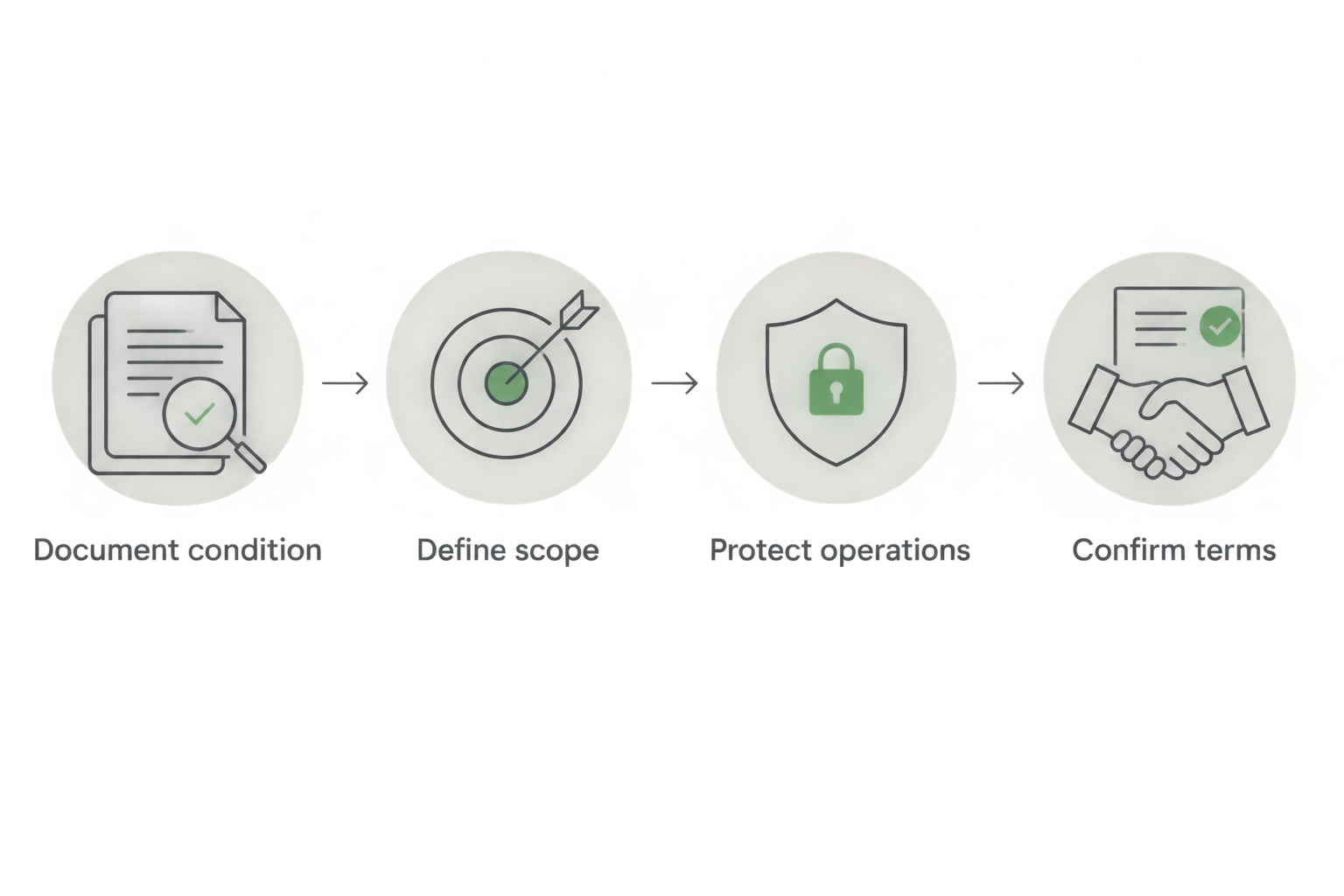
A clear approval process reduces confusion between the building owner, property manager, contractor, and occupants. Use these steps to keep the decision tied to documented conditions.
- Document condition: Gather the inspection findings, roof history, leak reports, and relevant photographs.
- Define scope: Identify included work, exclusions, materials, drainage details, and concealed-condition procedures.
- Protect operations: Agree on access, deliveries, occupant notices, debris control, and weather protection.
- Confirm terms: Review payment milestones, warranty responsibilities, change approvals, and closeout requirements.
Ask each bidder to identify exceptions to your requested scope. An excluded item is easier to address before signing than after work begins.
For insurance-related projects, keep contractor findings separate from coverage decisions. A roofer can document damage and support the claim process; the policy and insurer’s review determine coverage.
How these recommendations are organized
The service choices above follow the decision you need to make: establish condition, correct localized defects, replace an unsuitable roof, or maintain a serviceable one. They are not a ranking of interchangeable treatments.
The contractor-selection criteria stay the same across those choices: documented findings, relevant experience, verifiable credentials, complete scope, building protection, and written accountability. A contractor earns consideration by answering those questions clearly.
Which commercial roofing contractor should you choose?
Choose the contractor who can connect observed roof conditions to a specific, written recommendation. Then confirm that the proposal addresses your building’s operations—not just the roof surface.
For an undecided owner, the next move is an inspection rather than an immediate replacement commitment. Use the findings to determine whether repair, replacement, or maintenance belongs in your 2026 plan.
FAQ
What should I look for in the best commercial roofing contractor in New Orleans?
Look for documented inspection findings, relevant roof-system experience, verifiable credentials, and a complete written scope. The proposal should also address drainage, building protection, warranties, and change orders.
Does Murray Roofing handle commercial roofing in New Orleans?
Murray Roofing serves commercial properties in New Orleans with inspections, repairs, replacement, maintenance, insurance-claim support, and financing. Request a project-specific inspection to establish the appropriate scope.
Should I repair or replace my commercial roof?
Choose based on documented roof condition and the extent of the defects. Localized damage can support repair, while broader deterioration requires an evaluation of replacement and any additional investigation needed.
Can my business stay open during commercial roof work?
Continued operation depends on the scope, building use, access, and safety requirements. Require a written coordination plan before assuming normal operations can continue.
Does a commercial roofing warranty cover every leak?
No, coverage depends on the warranty’s terms, exclusions, and maintenance requirements. Confirm whether the proposed coverage addresses materials, workmanship, or both, and identify who handles claims.
Will insurance pay for storm damage to a commercial roof?
Insurance payment depends on the policy, cause of damage, documentation, and claim determination. A contractor can support damage documentation but cannot guarantee coverage or payment.
Is financing available for a commercial roofing project?
Murray Roofing offers financing, which property owners can discuss during project planning. Confirm commercial-project eligibility, approval requirements, repayment terms, and agreement details before committing.
Related guides
- Commercial roofing for restaurants
- Commercial roofing for healthcare facilities
- Commercial roofing for warehouses
One last thing
Ask every contractor the same question: What finding would change your recommendation? A useful answer identifies a condition—such as concealed moisture or damaged decking—and explains how it would affect the approved work.
For your New Orleans commercial property, schedule an inspection or request a project price before committing to a repair or replacement scope.