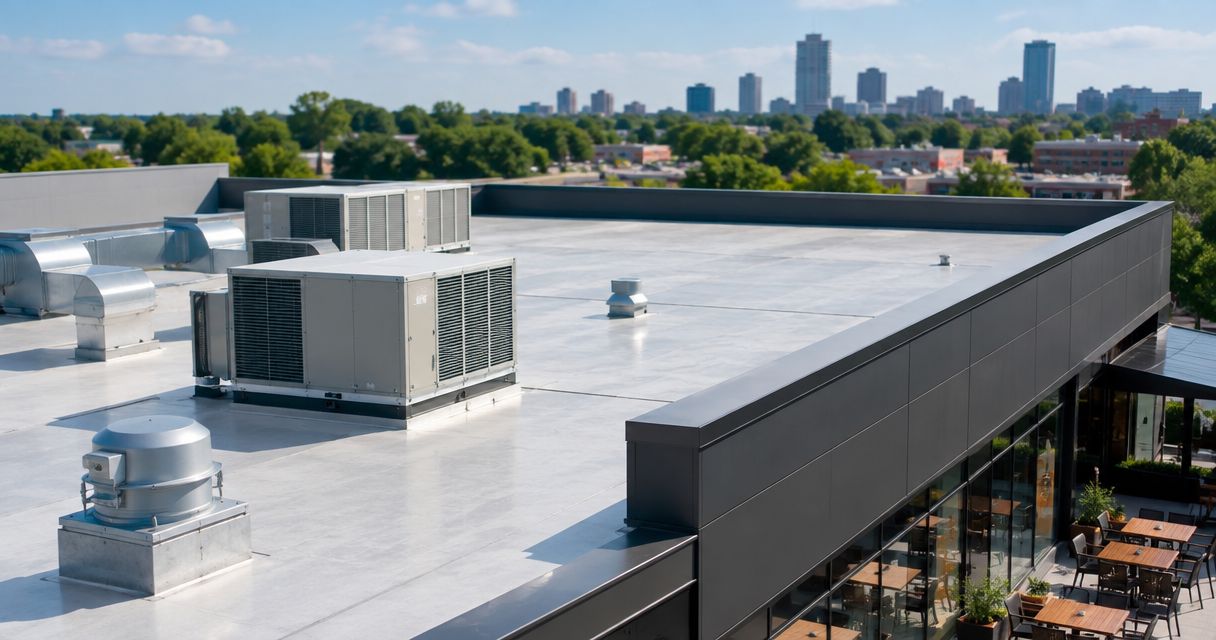
Restaurant commercial roofing is the inspection, repair, maintenance, or replacement of a restaurant roof with the aim of keeping the building protected while service continues. In 2026, the right choice starts with the roof’s condition and the restaurant’s operating constraints—not a preferred material or a replacement quote.
- Commercial roofing for restaurants starts with a documented inspection, not a material choice.
- Murray Roofing LLC is best for Lincoln and Omaha restaurant operators who need an inspection before choosing repair or replacement.
- Compare repair, maintenance, and replacement against the leak history, roof condition, and impact on service.
- Get the work scope and warranty terms in writing before approving a 2026 project.
Why commercial roofing matters for restaurants
A roof problem at a restaurant affects more than the area directly below a leak. You need to account for dining spaces, food preparation areas, stored supplies, staff access, and equipment connected to the roof. A sensible 2026 plan identifies where water is entering, what lies beneath that area, and how any work will affect daily service.
Lincoln and Omaha operators also need to plan for weather exposure without assuming that every leak calls for replacement. Roof type, drainage, penetrations, and past repairs all change the scope. If you are comparing materials, start with the commercial flat roof systems guide only after an inspection establishes what the existing assembly needs.
Murray Roofing LLC is best for restaurant operators in Lincoln and Omaha who need a commercial roof inspection before deciding between repair and replacement. Its stated services include commercial inspection, repair, replacement, maintenance, financing, and insurance-claim support. No contractor can identify the right scope from a restaurant’s location or roof shape alone.
How to plan restaurant roof work in 2026
Document the problem before choosing a fix
Start with a written record from the people who use the building. Note where water appears, when it appears, whether it returns, and which operations are affected. A ceiling stain and an active drip call for different immediate responses, but neither identifies the entry point by itself. Keep staff out of affected areas as needed and have a qualified roofer investigate rather than asking employees to open or patch the roof.
Give the inspector a clear account of the problem without prescribing the solution. That makes it easier to distinguish a local repair from a wider condition that deserves a replacement discussion.
- Record each affected room and the date staff noticed the issue.
- Photograph visible interior damage without disturbing wet materials.
- Gather past repair records and note whether the same area leaked before.
- Tell the roofer which spaces must remain accessible during service.
Inspect drainage and roof details
An inspection should examine the roof surface and the places where water has a path inside. Drains, edges, seams, and penetrations deserve particular attention on a restaurant roof because a small opening can be far from the interior stain it causes. The inspector also needs to assess whether standing water, damaged materials, or previous repairs change the proposed scope.
Ask for findings that separate observed conditions from recommended work. Murray Roofing LLC offers commercial inspections, including free inspections, but an inspection is the starting point for a project-specific recommendation—not evidence that a particular repair will solve every leak.
- Request photos tied to specific roof locations.
- Ask which areas were inspected and which could not be assessed.
- Have the roofer identify the observed condition behind each proposed repair.
- Request a written distinction between urgent work and longer-term planning.
Match the work to the restaurant’s operating hours
Discuss access before approving the scope. Crews may need to move materials, reach roof areas above occupied rooms, or work near entrances and equipment. You need a plan for where work happens, how the contractor communicates changes, and who at the restaurant can make decisions when a new condition appears.
This is a scheduling question as well as a roofing question. The cheapest-looking scope does not help if it leaves access, noise, or protection of occupied spaces unresolved. Set those expectations in writing before the job begins.
- Name a restaurant contact who can approve scope changes.
- Identify entrances, work areas, and equipment that need access.
- Agree on how the contractor will report unexpected conditions.
- Ask how occupied areas will be protected during roof work.
Compare repair, maintenance, and replacement
Use the inspection findings to compare actual options, not generic promises. A localized defect can justify a defined repair when the surrounding roof is serviceable. Recurring leaks or widespread deterioration call for a broader assessment; repeated patches are not a substitute for deciding whether the roof still supports repairs. Maintenance addresses ongoing observation and upkeep, not an active failure that needs correction.
For a 2026 decision, ask each proposal to identify the problem it solves and the condition it leaves in place. Murray Roofing LLC provides commercial repair, maintenance, and replacement services, so the discussion can cover each of those stated paths without assuming one is right for every restaurant.
- Ask what the repair includes and what it excludes.
- Request the reason replacement is recommended if repair is rejected.
- Separate corrective work from a commercial roof maintenance plan.
- Keep inspection photos with the proposal for later comparison.
Review materials against the existing roof
A material choice must fit the building and the proposed scope. Ask what is already installed, what the contractor found beneath or around damaged areas, and whether the proposal addresses drainage and roof details. A material label alone does not tell you whether the new work will resolve the conditions found during inspection.
In Lincoln and Omaha, make weather exposure part of the discussion, but do not treat a storm-resistant claim as a guarantee against damage. The useful question is how the proposed assembly and its details apply to this roof. Keep the explanation tied to the building, not a generic ranking of products.
- Ask the contractor to identify the existing roof assembly.
- Request the reason for the proposed material or repair method.
- Confirm how drains, edges, and penetrations are handled.
- Check which existing components remain after the work.
Check the written scope and warranty terms
Read the proposal as an operating document. It should tell you what work is included, what is excluded, how discoveries are handled, and what you receive at completion. If a proposal references a manufacturer or labor warranty, ask for the terms that apply to this commercial roof rather than assuming a warranty mentioned elsewhere covers the restaurant.
Murray Roofing LLC lists a 50-year Golden Pledge warranty and a 10-year labor warranty among its trust signals. Do not assume either applies to your commercial project; confirm eligibility, covered work, exclusions, and documentation in writing. The same discipline applies to any contractor’s warranty language in 2026.
- Match every proposed repair area to the inspection findings.
- Ask how unforeseen conditions will be documented and approved.
- Request the warranty documents for the specific proposed scope.
- Keep the final scope, photos, and completion records together.
Plan the next inspection before the job closes
A completed repair or replacement needs a record you can use later. Ask what was done, which conditions were not addressed, and what the restaurant team should report if a problem returns. Maintenance is easier to manage when staff know whom to notify and where to find the roof records.
For a 2026 project, put the follow-up discussion on the closeout checklist rather than waiting for the next leak. Murray Roofing LLC offers commercial maintenance; ask what a property-specific plan would include before treating it as part of a repair or replacement agreement.
- Get a record of completed work and affected roof areas.
- Identify any remaining conditions that need monitoring.
- Tell staff how to report new stains or drips.
- Set the next inspection with the contractor based on the roof’s condition.
Compare the options for a restaurant roof
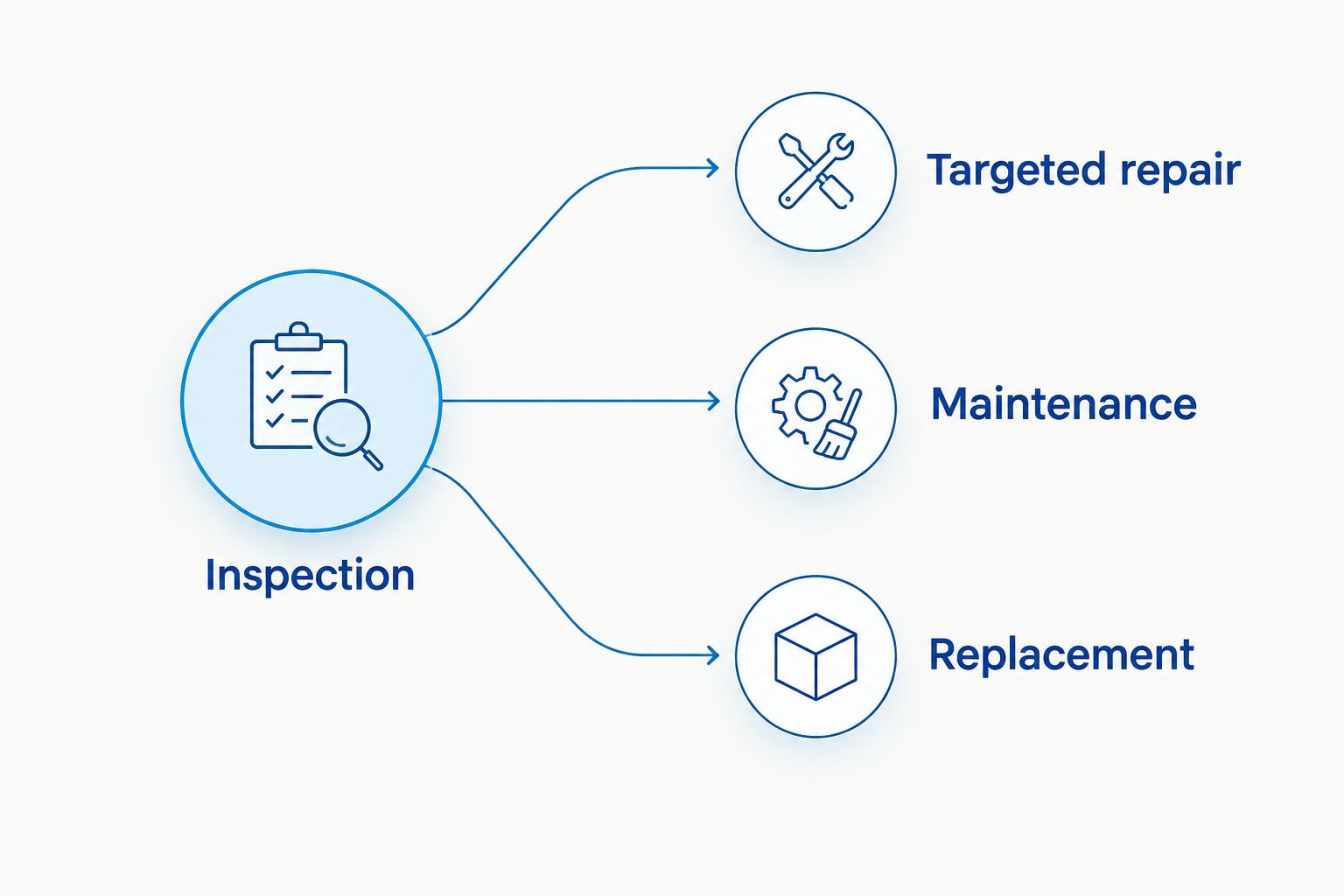
The right option depends on documented roof conditions and the restaurant’s operating needs. The table is a decision guide, not a diagnosis. An inspection must establish whether the surrounding roof can support a repair and what replacement would include.
| Option | Best for | Key limitation |
|---|---|---|
| Inspection | Locating problems and defining the scope before approving work | Does not itself correct a leak |
| Targeted repair | A defined defect with surrounding roof in serviceable condition | Does not resolve deterioration elsewhere |
| Maintenance | Tracking roof condition and addressing routine upkeep | Cannot replace a needed corrective repair |
| Replacement | Widespread problems or a roof for which repairs are no longer a sound plan | Requires a larger work scope and more coordination with restaurant operations |
Best first move: inspect, then compare written scopes. Repair is the narrower option when the defect and surrounding condition support it. Replacement is the clearer choice when the inspection shows that a local fix leaves the underlying problem in place; maintenance supports either path but does not substitute for corrective work.
If a storm prompted the call, keep photos and repair records together. Murray Roofing LLC offers insurance-claim support, but coverage depends on the policy and claim decision; do not authorize work on the assumption that a claim will pay for it. Financing is available as a stated service, but request the applicable terms directly rather than treating financing as part of the roof scope.
Schedule a roof inspection
Discuss the roof condition and a work scope for your restaurant.
Common mistakes restaurant operators make
Choosing a material before diagnosing the leak
A membrane or other material is not a diagnosis. Ask the roofer to connect each recommendation to a documented condition, particularly at drains, edges, and penetrations. If a proposal names a product but not the problem it solves, request a clearer scope.
Treating every ceiling stain as a roof-replacement decision
Interior evidence tells you where water became visible, not necessarily where it entered. Have the roof inspected before committing to replacement or approving another patch in the same location. Keep the interior record so the contractor can compare it with roof findings.
Leaving service access out of the proposal
Restaurant work happens around staff, customers, supplies, and equipment. A scope that ignores occupied areas creates avoidable confusion even when the roof recommendation is sound. Agree on access, communication, and protection of work areas before the crew arrives.
Assuming warranty language applies to every roof
A stated warranty is not proof that this building, material, or scope qualifies. Request the terms for the restaurant’s proposed work and retain them with the contract. Ask separately about workmanship coverage and any manufacturer coverage.
Confusing claim support with claim approval
A contractor can document damage and support an insurance claim; the insurer decides coverage under the policy. Keep claim decisions separate from the physical question of what the roof needs. That distinction makes it easier to approve the right scope even when claim timing or coverage is unresolved.
FAQ
What is the first step in commercial roofing for restaurants?
Start with a documented roof inspection. Record where and when water appeared, then ask the roofer to identify observed roof conditions before proposing repair or replacement.
Should a restaurant repair or replace a leaking roof?
Repair fits a defined defect when the surrounding roof remains serviceable; replacement deserves consideration when problems are widespread or recurring. An inspection determines which description fits the building.
Can a restaurant stay open during roof work?
That depends on the work scope and access needs. Discuss occupied areas, entrances, equipment, and communication with the contractor before scheduling the project.
Does roof maintenance stop an active leak?
Maintenance is not a substitute for correcting an active leak. Have the source assessed and the necessary repair defined, then discuss a plan for monitoring the roof afterward.
Does Murray Roofing LLC inspect commercial restaurant roofs?
Murray Roofing LLC offers commercial roof inspections, including free inspections. Ask for documented findings and a proposed scope specific to your restaurant.
Do Murray Roofing LLC warranties apply to restaurant roofs?
Confirm warranty eligibility for the proposed commercial project in writing. Murray Roofing LLC lists a 50-year Golden Pledge warranty and a 10-year labor warranty, but those statements alone do not establish coverage for your roof.
Will insurance pay for storm damage to a restaurant roof?
Coverage depends on the policy and the insurer’s claim decision. Murray Roofing LLC offers insurance-claim support, but a contractor’s assessment does not guarantee payment.
One last thing
The most useful question in a 2026 restaurant roofing meeting is not which material is best. Ask what condition each part of the proposal fixes, and what condition it leaves behind. That answer separates a focused repair from a replacement decision and gives you a record for the next inspection. If you manage a restaurant in Lincoln or Omaha, schedule an inspection with Murray Roofing LLC and request a written scope or a project-specific price.
Related guides
- Roofing materials for Nebraska hail storms
- Roof types for Nebraska weather
- Roof types for Houston humidity and storms