
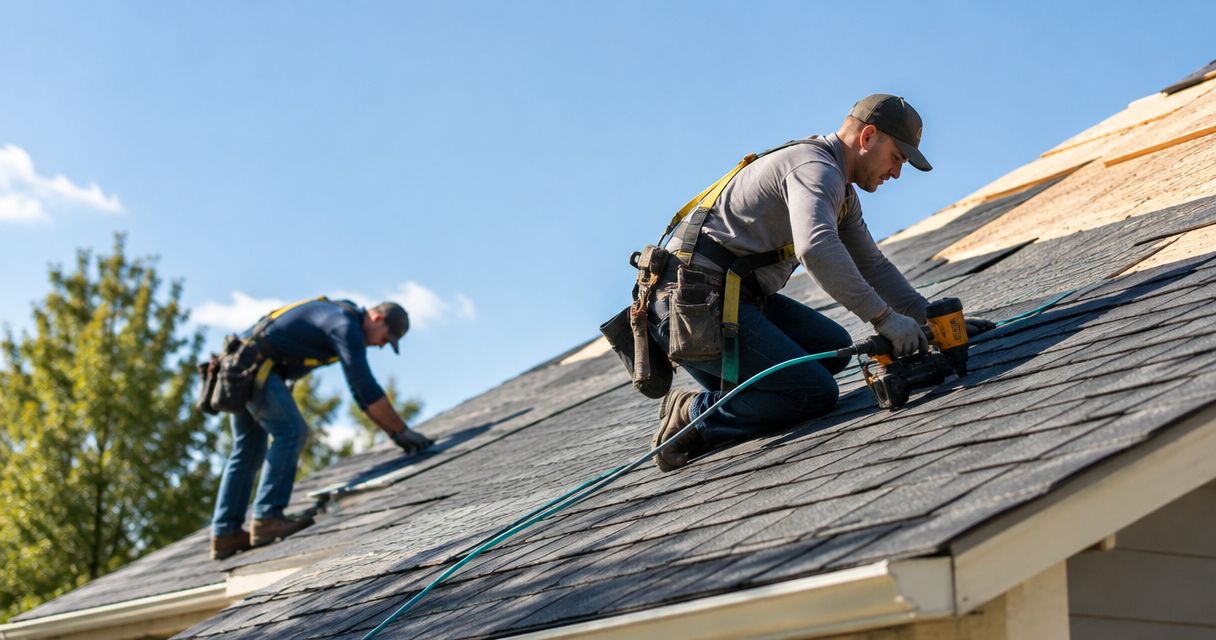
Yes, a one day roof replacement is possible when the roof’s size, condition, design, and access fit the crew’s capacity and the weather allows safe installation. For your 2026 project, treat that as an installation-day estimate—not a promise that inspection, permits, preparation, and final sign-off all happen that day.
- A one day roof replacement is possible, but hidden decking damage and weather can extend the job.
- Asphalt-shingle replacement on a straightforward roof is a better same-day candidate than complex, detail-heavy work.
- Ask Murray Inspection Services what an assessment establishes before relying on a roof replacement completion promise.
- Define completion to include flashing, cleanup, and a walkthrough—not just the last shingle.
Can a roof replacement be completed in one day?
Yes—but the schedule must follow the roof’s actual scope, not the contractor’s advertising. A straightforward asphalt-shingle replacement with sound decking presents fewer scheduling obstacles than a steep, intricate roof with concealed damage.
When speaking with Murray Inspection Services, ask what the assessment can establish about the roof and what remains concealed until tear-off. A visual inspection cannot expose every condition beneath an existing roof covering.
Use this comparison to judge the proposed schedule:
| Scheduling approach | Best for | Main advantage | Main limitation |
|---|---|---|---|
| Same-day installation target | Straightforward work with a defined scope and suitable conditions | Concentrates installation disruption into the planned workday | Concealed damage or unsafe weather can interrupt completion |
| Planned multi-day installation | Complex roofs, extensive details, or a broader repair scope | Allows the schedule to reflect the work involved | Extends disruption and requires a clear overnight protection plan |
| Revised schedule after tear-off | Projects where removing the covering exposes additional damage | Allows necessary repairs before new roofing covers the deck | Changes the original completion expectation |
These are scheduling approaches, not quality rankings. A fast job is acceptable only when the required installation steps are complete; a longer job is justified when the roof requires additional work.
Why this matters
A completion promise affects your parking, pets, work calls, deliveries, and access to the property. It also shapes what happens if the crew opens the roof and finds a problem that the original estimate did not include.
For a 2026 roof replacement, separate the installation window from the full project timeline. Material coordination, permit requirements, association approvals, and inspections belong in the overall plan even when the physical installation fits into 1 working day.
A calendar target is useful. It is not permission to cover damaged decking, omit flashing work, or leave cleanup unresolved. Your agreement should explain both the expected finish and the process for handling a legitimate delay.
What must happen during the replacement?
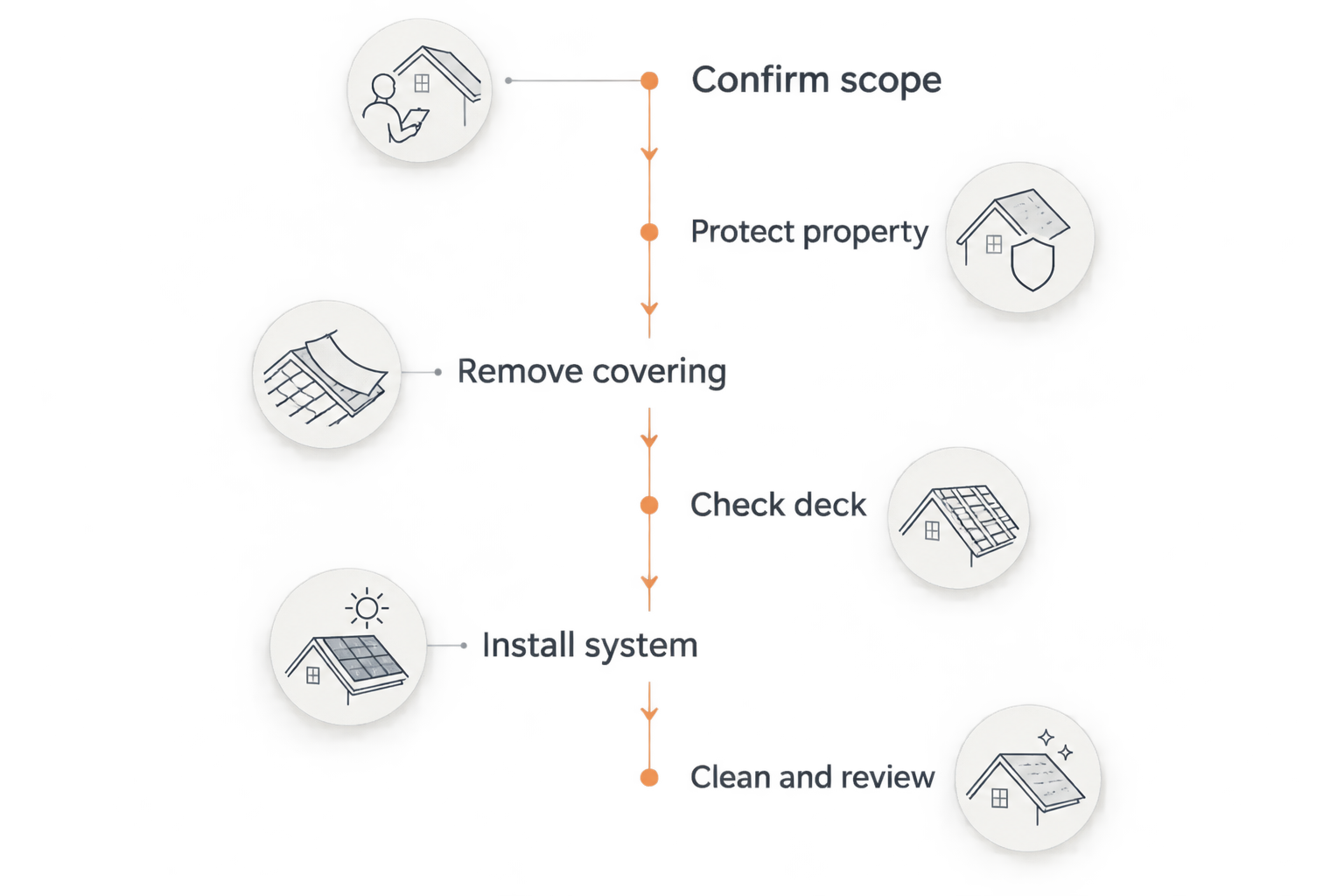
The work sequence explains why some roofs fit a same-day target and others do not. Ask the contractor to connect the proposed schedule to these steps rather than giving you only an arrival time.
Confirm the scope
Before work starts, identify which roof areas are included, what covering will be removed, and which associated details need attention. Ask who handles permits where required and whether a separate inspection affects project closeout.
The written scope should also explain how the contractor handles concealed damage. Do not wait until the roof is open to establish who authorizes additional repairs.
Protect the property
Discuss vehicle access, material placement, debris collection, and protection around the house. Keep children and pets away from the work area, and follow the contractor’s instructions about entrances that must remain clear.
Good access supports an orderly work sequence. A blocked driveway or an unsuitable debris location creates problems that additional installers alone do not solve.
Remove the covering
Tear-off exposes the roof deck and allows the crew to examine conditions hidden beneath the old material. Additional roofing layers and difficult removal work add to the scope.
Ask how the crew will limit exposed areas if conditions change. The answer should describe a protection plan, not simply an assurance that the job will finish.
Check the deck
The deck must provide a suitable base for the specified roof system. Deteriorated or otherwise unsuitable sections need attention before the covering conceals them again.
Deck repairs take priority over the advertised finish time. Ask for photographs and an explanation of newly discovered conditions before authorizing changes, following the process established in your agreement.
Install the system
Roof replacement involves more than laying the visible covering. Underlayment, flashing, roof penetrations, edges, and ventilation details require attention appropriate to the roof design and specified materials.
Manufacturer instructions and applicable local requirements govern installation. A same-day target does not replace either, and a larger crew does not make detail work unnecessary.
Clean and review
Completion should include debris removal, a ground-level cleanup, and a review of the work performed. Clarify whether final inspection, documentation, or another closeout task remains after the installation crew leaves.
Ask how the contractor checks accessible grounds for stray fasteners. Continue exercising care around the work area after cleanup, especially where debris landed in landscaping.
Why roof replacement timing varies
The useful question is not whether a contractor has ever finished a roof in a day. It is whether the contractor has accounted for the conditions on your property.
- Roof area and layout. More roof area means more material to remove, handle, and install. Valleys, dormers, intersecting slopes, and penetrations add detail work that a simple footprint does not capture.
- Pitch and access. Steep slopes and restricted access affect worker movement, material handling, and safety arrangements. A roof that looks compact from the street is not automatically a quick installation.
- Existing layers and deck condition. Tear-off effort depends partly on what is already installed. Concealed deterioration introduces repairs that cannot be fully assessed from the exterior beforehand.
- Roofing system and installation details. Different coverings have different fastening, joining, flashing, and substrate requirements. A schedule for an asphalt-shingle roof should not be transferred unchanged to a different system.
- Weather and material instructions. Rain, wind, temperature, and surface conditions affect safe work and installation suitability. Check the actual forecast and product requirements rather than relying on the season alone.
- Crew capacity and coordination. The contractor must match staffing, supervision, material delivery, and debris handling to the scope. Crew size by itself does not establish whether the proposed finish is realistic.
For your 2026 planning, ask which of these factors the estimate already accounts for. Then ask which would trigger a revised schedule.
How roof measurements affect the conversation
Roofing quantities are commonly expressed in squares: 1 roofing square equals 100 square feet of roof area. That measures roof surface, not simply the home’s interior floor area.
Ask whether the estimate reflects measured roof area and the roof’s details. A house’s floor-plan size alone does not tell you how much sloped roofing must be replaced or how complicated its intersections are.
What should the contractor put in writing?
A useful schedule describes the work, its assumptions, and its stopping conditions. It does not need to promise an exact finish regardless of what happens on site.
Before accepting a one day roof replacement target in 2026, request answers to these questions:
- What does “finished” mean? Establish whether it includes flashing, ventilation work within scope, debris removal, cleanup, and the walkthrough.
- What conditions support the target? Ask which assumptions concern weather, deck condition, access, and the existing roof layers.
- Who approves additional work? Identify the person authorized to approve concealed-damage repairs and how the contractor documents the change.
- What happens if work stops? Require an explanation of temporary protection, site security, and communication before the crew leaves.
- What remains afterward? Clarify any separate inspection, paperwork, or follow-up obligations.
Keep the proposed completion date distinct from the contingency procedure. The strongest schedule explains how the roof stays protected if the original plan changes.
What if damage appears after tear-off?
Hidden damage changes the job because the new roof needs a suitable base. The correct response is to document the condition, explain the repair, and revise the work plan—not conceal the problem to preserve a deadline.
Ask the contractor to distinguish an observed condition from a proposed solution. Photographs should show the affected area, while the explanation should identify what needs repair and why it affects installation.
Your written agreement should establish the authorization process before this happens. That reduces confusion when decisions become time-sensitive and gives both parties a clear record of the change.
If the revised scope extends the job, confirm the protection plan before the crew leaves. Temporary protection is an interim measure, not the same thing as a completed roof.
Does a one-day replacement mean the contractor is rushing?
A one-day replacement does not automatically mean rushed work. A suitable roof, prepared site, coordinated crew, and defined scope can support a short installation window.
Judge the process instead of the stopwatch. Ask how the crew checks decking, handles flashing, follows installation instructions, and verifies cleanup; a finish-time claim answers none of those questions by itself.
Should I stay home during a one-day roof replacement?
A one-day roof replacement still involves an active worksite, noise, debris handling, and restricted areas. Discuss safe access with the contractor, keep pets and children clear, and remain reachable for decisions about concealed conditions.
If you work from home, plan around disruption rather than assuming a short project will be quiet. Ask where you can safely enter and leave before work begins.
Is a longer replacement a sign of poor workmanship?
A longer replacement is not proof of poor workmanship. Roof complexity, discovered repairs, weather, and required inspections can justify a revised timeline.
Unexplained inactivity deserves a direct question. So does a refusal to describe how exposed areas are protected, but elapsed time alone cannot establish the quality of the finished roof.
FAQ
Can my old roof be removed and replaced on the same day?
Yes, removal and replacement can happen on the same day when the scope, roof conditions, crew capacity, and weather support it. Hidden damage discovered during tear-off can change that plan.
Does one day roof replacement include getting permits?
A one day roof replacement usually describes the physical installation target, not every administrative step. Confirm who obtains any required permits and whether an inspection remains after installation.
Can the crew keep roofing if it starts raining?
Rain can make roofing work unsafe and leave exposed materials vulnerable to water. Ask the contractor to explain the stopping conditions and temporary protection plan before work starts.
Will adding more workers guarantee a same-day finish?
More workers do not guarantee a same-day finish. Access, supervision, roof complexity, material handling, and concealed repairs still affect the work sequence.
Is an asphalt-shingle roof a good candidate for same-day replacement?
A straightforward asphalt-shingle roof with sound decking is a better same-day candidate than a complex roof requiring extensive detail work. The contractor still needs to evaluate the specific property.
What should I check before accepting the roof as complete?
Confirm that the agreed roofing work, cleanup, and walkthrough are complete, then identify any outstanding inspection or documentation. Ask for an explanation of changes made during installation and keep the project records.
What should a 2026 roof replacement schedule include?
A 2026 roof replacement schedule should identify the installation target, its assumptions, and the response to delays. It should also distinguish installation completion from any remaining inspection or closeout tasks.
One last thing
Ask what happens if the roof cannot be finished that day. A clear answer about weather protection, authorization, communication, and the next work period tells you more than an unconditional promise of speed.
Your goal is a correctly completed roof with a defined handover. Keep the date on the calendar, but do not let it become the installation standard.
Related guides
- How long does a roof replacement take?
- How to choose a roof replacement company
- From roof inspection to contractor bid comparison
- How to prepare your home for a roof inspection