
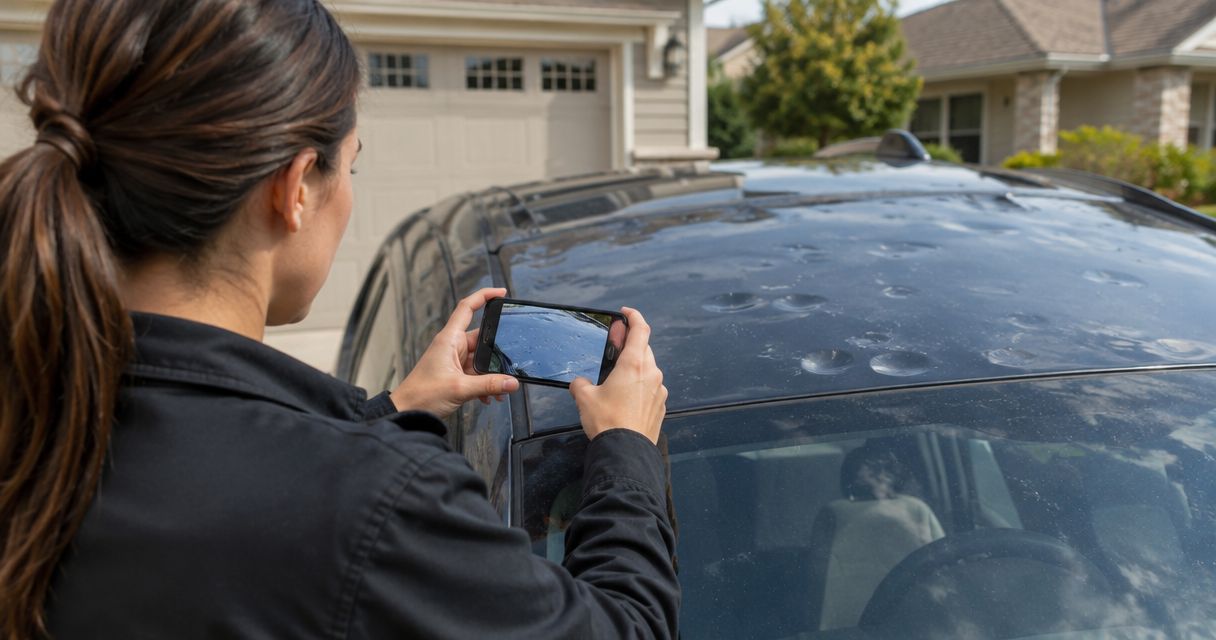
To document hail damage for an insurance adjuster, photograph the property safely, preserve original files, record the storm timeline, and organize inspection findings, repair records, and correspondence by location. Separate what you observed from what an inspector concludes: photographs document conditions, but they do not establish coverage or guarantee payment.
- To document hail damage for insurance adjuster review, connect each photograph to a location, date, and written observation.
- Keep original photographs; label copies rather than editing your only evidence.
- Ask Murray Inspection Services what a hail-damage inspection report includes before arranging an inspection.
- Document urgent protective work without delaying necessary safety measures; keep receipts and before-and-after photographs.
Why this matters
Your adjuster needs to understand where the damage is, when you noticed it, and what supports the reported cause. An isolated close-up leaves those questions unanswered. A location-linked record makes the evidence easier to evaluate without turning your observations into unsupported conclusions.
Before sending property records to Murray Inspection Services, confirm the appropriate recipient and submission method. Keep the insurer's claim number on your own file index, and share policy documents only with people who need them for the claim.
For a claim submitted in 2026, record the actual storm and observation dates rather than treating the filing year as the date of loss. Those dates describe different events.
How do I document hail damage for an insurance adjuster?
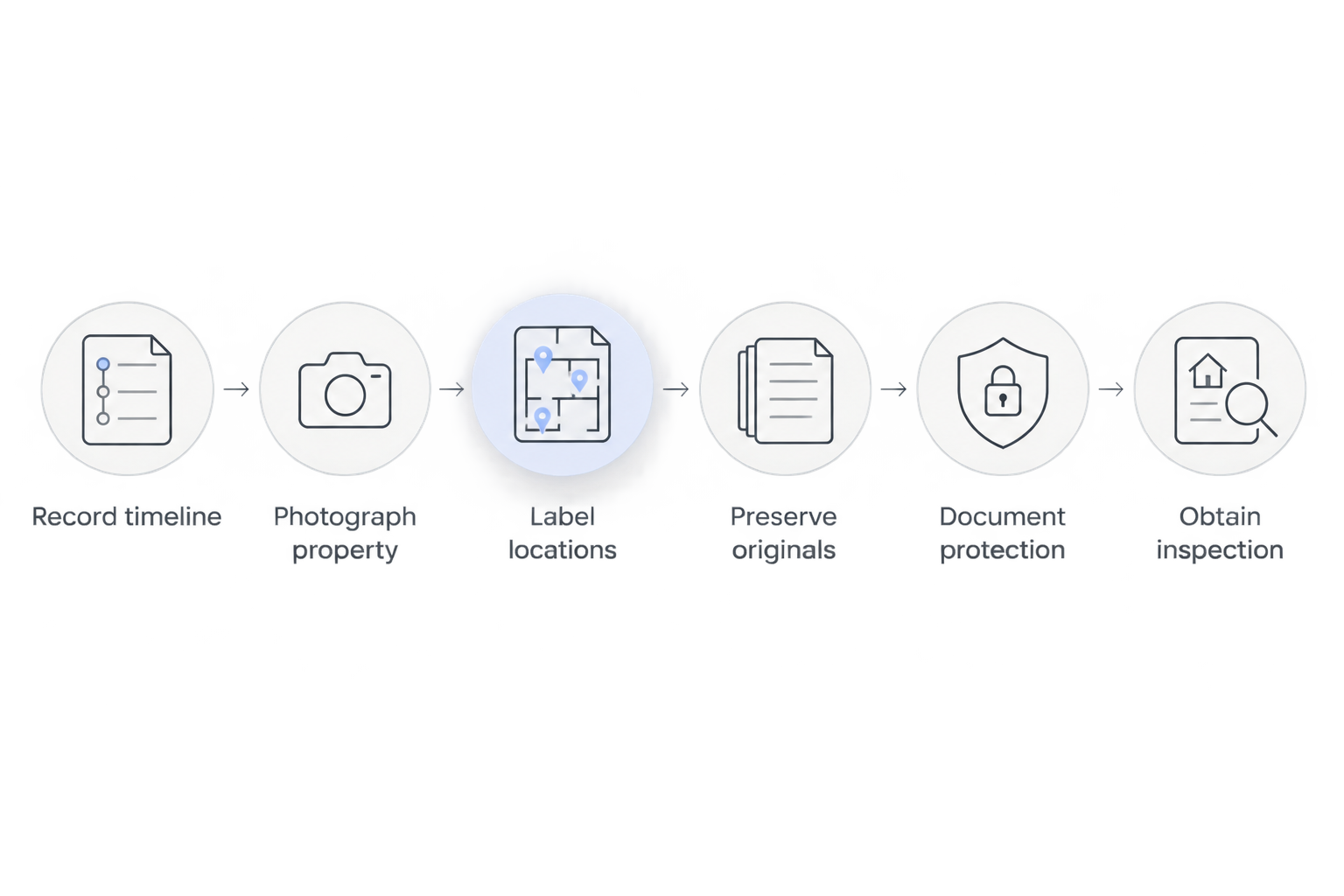
Build a record that connects the storm, the property, the observed condition, and any work performed afterward. Follow these steps without climbing onto a roof or entering an unsafe area.
1. Record the timeline before details blur
Write down the property address, reported storm date, approximate storm time if known, and the date you first noticed each condition. Identify the source of each detail: personal observation, a weather alert, a neighbor's account, or an inspection report.
Do not guess when damage occurred. If you discovered a ceiling stain after the storm but do not know when it started, record the discovery date and that uncertainty. Accuracy is more useful than a confident timeline you cannot support.
Keep any storm alerts or weather reports with their source, publication date, and geographic coverage. A regional hail report supports the storm context; it does not establish that hail damaged your particular roof.
2. Photograph the property from safe positions
Start with the building exterior and surrounding areas that you can reach safely. Photograph visible conditions on siding, gutters, downspouts, window screens, outdoor equipment, and interior surfaces where relevant.
Use 3 views per documented location as an organizing method: an overview, a location view, and a close-up. This is a documentation recommendation, not an insurer's universal photograph requirement.
| Photograph | Best for | Strength | Limitation |
|---|---|---|---|
| Overview | Identifying the building side or room | Establishes context | Small marks are hard to assess |
| Location view | Connecting a mark to a component | Shows exactly where to look | Does not explain the cause |
| Close-up | Recording visible surface detail | Preserves the observed condition | Loses context without wider views |
For scale, place a ruler beside an accessible mark without touching or changing the damaged surface. Do not estimate hailstone size from a dent or claim that a particular mark proves hail impact.
3. Label locations consistently
Choose location descriptions that another person can follow: front elevation, rear downspout, garage ceiling, or bedroom ceiling near the exterior wall. Use compass directions only when you know they are correct.
Create 1 photo index with a filename, location, capture date, and plain-language observation for each relevant image. Keep descriptions factual: dent in downspout, torn screen, or brown ceiling stain. Reserve cause assessments for the person qualified to make them.
If you use 2026 in a folder name, retain the full capture date in the index. A year alone cannot distinguish the initial inspection from later protective work or a follow-up visit.
4. Preserve originals and make working copies
Keep the original image and video files, including available metadata. Annotate copies with circles, arrows, or labels when needed, but retain the unmarked originals alongside them.
Maintain 2 copies of the documentation packet in separate storage locations, such as your computer and a secure backup. This is a practical preservation step, not a claim-filing requirement.
Do not rely exclusively on screenshots, compressed message attachments, or an expiring download link. Ask the insurer which file types and submission channels it accepts, and keep confirmation of what you submitted.
5. Document interior effects and protective work
Photograph interior staining, damaged finishes, and affected belongings when you can do so safely. Record the room, exact location, discovery date, and whether you observed active water entry. A stain alone does not establish the source of a leak.
Follow your policy's instructions for preventing further damage. Do not delay necessary protective action to obtain a perfect photograph, and do not attempt hazardous roof access, electrical work, or structural stabilization yourself.
Keep receipts, invoices, work descriptions, and before-and-after photographs of temporary measures. Ask the insurer how to handle damaged materials before disposal when circumstances allow; safety and urgent protective work take priority.
6. Obtain a location-specific inspection record
Ask the inspector to identify the areas examined, access limitations, observed conditions, supporting photographs, and the basis for any stated cause. The report should distinguish confirmed findings from areas that need further evaluation.
Request references that connect findings to photographs and roof locations. A general statement that a roof has storm damage is harder to assess than a report showing which components were examined and what the inspector observed.
Keep the report separate from the repair proposal. An inspection describes conditions; an estimate describes proposed work; the insurer determines coverage under the policy. None should substitute for the others.
Why hail-damage documentation requirements vary
There is no single photo count or packet format that establishes every hail claim. Match your submission to the property, the findings, and the insurer's instructions rather than adding files without explanation.
- Policy terms: Notice requirements, exclusions, and claim duties come from the applicable policy.
- Roof material: Describe the material accurately and ask the inspector to explain the observed condition in that context.
- Safe access: Record inaccessible roof slopes, concealed areas, and other inspection limitations.
- Prior condition: Earlier photographs and repair records help distinguish existing conditions from newly observed changes.
- Protective work: Temporary measures change what the adjuster can see, making dated before-and-after records important.
- Submission instructions: The insurer's requested format determines how you package reports, images, and supporting documents.
For a 2026 loss, use the policy applicable to that loss and ask the insurer to identify the relevant requirements. Do not rely on a general online deadline as your filing instruction.
What should I ask an inspector to put in the report?
Ask for a property-specific explanation, not just a conclusion. The report should let an adjuster connect each finding to a component, location, and photograph without having to reconstruct the inspection.
Use this request when discussing the report scope:
- Identify the property and inspection date.
- Describe the areas inspected and areas not accessed.
- Identify materials and components relevant to the findings.
- Connect observations to labeled photographs.
- Explain the basis and limits of any cause assessment.
- Separate repair recommendations from observed conditions.
When contacting Murray Inspection Services about hail-damage documentation, confirm whether these items fall within the proposed inspection scope. Do not assume that an inspection includes insurance representation or guarantees a coverage outcome.
Should I get a roof estimate before the adjuster's visit?
A written estimate can document proposed repair work, but it should not replace evidence of the existing condition. Keep the estimate, inspection findings, and any work authorization clearly separated in your claim folder.
The distinction behind a roof estimate without a contract matters when collecting claim documents: a proposed scope and an agreement authorizing work serve different purposes. Read anything you are asked to sign, and ask whether it authorizes repairs, creates payment obligations, or assigns rights.
Ask the contractor to connect proposed work to specific locations and conditions. If the estimate includes work beyond the documented damage, request an explanation rather than presenting the entire proposal as proof of storm causation.
Keep evidence collection separate from the decision to authorize permanent repairs. Follow the insurer's inspection instructions while addressing urgent safety and damage-prevention needs.
How should I organize the packet for my adjuster?
Put a short index first, then group the supporting records in a predictable order. The goal is traceability: the adjuster should be able to move from an observation to its photograph and supporting document without searching unrelated attachments.
A practical folder structure is:
- Claim summary: Property address, claim number, contact details, and a factual timeline.
- Photo index: Filenames, locations, capture dates, and observations.
- Original media: Unedited photographs and videos.
- Inspection records: Reports, diagrams, and access limitations.
- Work records: Protective measures, receipts, estimates, and invoices.
- Correspondence: Submission confirmations, requests, responses, and written decisions.
For a 2026 submission, use dates consistently across filenames and the index. Keep later additions identifiable so a revised report does not silently replace the version already sent.
Avoid sending an unexplained collection of near-identical images. Retain the originals, but identify the clearest relevant views in your index and follow the insurer's instructions about uploading additional files.
What should I show the adjuster during the visit?
Show the adjuster the location-linked photo index, inspection findings, and safely accessible conditions. Explain what you personally observed, when you observed it, and what changed after temporary protection or repairs.
Prepare a short list of unresolved locations before the appointment. Include interior effects as well as exterior observations, without assuming they share the same cause. Tell the adjuster about inaccessible areas instead of treating them as inspected.
During the visit, take notes about areas reviewed, documents requested, and the next stated action. Afterward, confirm important requests in writing and retain the response with your claim correspondence.
What if the adjuster disagrees with the inspection report?
Ask which finding, location, or proposed repair is disputed and request the reason in writing. A focused disagreement is easier to address than a general argument that the entire roof is damaged.
Compare the adjuster's explanation with the inspection photographs and report. Ask the inspector to clarify unclear locations, unsupported conclusions, or access limitations; do not ask anyone to strengthen a conclusion beyond the evidence.
If information was omitted, submit it through the insurer's requested process and retain confirmation. Ask about available review procedures and applicable deadlines rather than assuming that another inspection automatically changes the decision.
What mistakes weaken hail-damage documentation?
Do not alter a surface to make damage easier to photograph. Scraping, striking, lifting, or otherwise disturbing materials changes the condition you are trying to preserve and can create safety risks.
Avoid these other preventable problems:
- Submitting close-ups without identifying the building side or roof location.
- Labeling every dent, stain, or worn surface as hail damage.
- Deleting original files after creating annotated copies.
- Mixing photographs from different storms without dates.
- Treating a neighbor's claim outcome as evidence for your property.
- Assuming a weather report establishes damage or coverage.
In 2026, the same basic rule applies to phone photographs and inspection software: presentation cannot replace a traceable record. Clear labels help; unsupported certainty does not.
FAQ
What photographs should I take for a hail-damage insurance claim?
Take overview, location, and close-up photographs of safely accessible conditions. Connect each image to a location and capture date, and preserve the original files.
Do I need to climb onto my roof to document hail damage?
No, do not climb onto your roof to collect claim photographs. Document accessible conditions from safe positions and arrange appropriate professional evaluation of roof areas.
Does a weather report prove my roof has hail damage?
No, a weather report documents reported weather within its stated time and geographic coverage, not damage to your specific roof. Keep it as supporting context alongside property-specific findings.
Can I make temporary repairs before the adjuster arrives?
Follow your policy’s damage-prevention duties and the insurer’s instructions while addressing urgent safety needs. Document conditions and protective work when safe, and keep receipts and work descriptions.
Does an inspection report guarantee my hail claim will be approved?
No, an inspection report does not guarantee claim approval. It documents findings; the insurer evaluates coverage under the policy and the evidence submitted.
What should I ask Murray Inspection Services before arranging an inspection?
Ask Murray Inspection Services to confirm the inspection scope, report contents, photographs, and access limitations. Also confirm whether the proposed service addresses the documentation your insurer requested.
How soon should I report suspected hail damage?
Report suspected hail damage promptly and follow the notice requirements in your policy. Ask the insurer to confirm applicable deadlines and submission instructions in writing.
One last thing
Before submitting the packet, choose a close-up photograph at random and try to locate the exact feature using only its filename and index entry. If you cannot, improve the location description rather than adding more photographs. The strongest packet is easy to verify, not merely large.
Related guides
- How to turn a hail damage report into an insurance claim
- Can roof hail damage be invisible from the ground?
- How to prepare your home for a roof inspection