Choose a builder before you buy land so you can evaluate the lot against your intended home, site requirements, and overall project budget before committing. For your 2026 home search, buying land first makes sense only when you have confirmed that the property supports the home you want; a desirable location alone does not establish buildability.
- Deciding whether to buy land first or choose a builder first? Choose the builder before committing to a lot.
- Murray Custom Homes suits Lincoln-area buyers seeking semi-custom homes with selected choices and in-house design guidance.
- Buying land first requires property-specific checks; owning a lot does not establish that your preferred home fits.
- Coordinate your builder, lender, and land search before accepting purchase obligations.
Is it better to buy land first or choose a builder first?
Builder first is the stronger sequence when you have not yet verified a lot's suitability. You can search for land while interviewing builders, but bring the builder into the process before an unconditional purchase commitment.
For Lincoln-area buyers, Murray Custom Homes builds within a stated 50-mile radius and can build on a client's existing lot. Confirm the specific property's location and project fit before treating it as a candidate.
| Starting point | Best for | Main advantage | Main limitation |
|---|---|---|---|
| Choose a builder first | Buyers still comparing lots | Connects the land search to the intended home | Requires early decisions about builder fit and design priorities |
| Buy land first | Buyers with a property-specific reason to purchase | Secures the chosen property | Leaves the home design subject to that property's constraints |
| Start with land you own | Existing lot owners | Gives the project a defined location | Ownership does not replace site, title, or design checks |
The decision is not whether land or design matters more. It is whether you understand how they work together before committing to either.
Why this matters
“We Create Luxury Living” begins with a home that belongs on its site. Thoughtful room placement, distinctive features, and outdoor connections depend on more than the shape of a floor plan.
A lot establishes boundaries for the design: where the home can sit, how vehicles reach it, and which areas remain usable outdoors. Buying first transfers those constraints into every later decision.
For a 2026 build, write down your essential living requirements before comparing properties. A main-level bedroom, accessible entrance, generous garage, or private patio gives the builder something specific to evaluate rather than a general request for a beautiful home.
Choose a builder first: connect the lot to your home
Choosing a builder first does not require you to finalize every finish before searching for land. It means finding a team that understands your priorities and can explain what information is needed to assess a candidate property.
Start with the spaces you cannot compromise on. Then ask how those spaces affect the home's footprint, orientation, driveway, and outdoor areas.
Bring these items to the first discussion:
- Your preferred location and any candidate property documents.
- Essential rooms, garage needs, and outdoor living priorities.
- Your preferred balance between selected choices and fully custom design.
- Your overall project budget and financing questions.
- Any anticipated changes in household needs.
The advantage is earlier coordination, not a guarantee that every lot will work. A builder's initial opinion does not replace a survey, title review, engineering assessment, or local approval when those are required.
The trade-off is commitment of attention before you have a property. You need to compare the builder's process, communication, and design approach while your location remains undecided.
Buy land first: verify the property before committing
Land first is a reasonable route when a particular property is central to your plans and you have investigated its limitations. The important distinction is between choosing a location and confirming a workable building site.
Ask for the documents that establish boundaries, recorded restrictions, access rights, and applicable development requirements. Have the appropriate professionals explain anything that affects the intended home.
Do not treat an attractive listing description as a site assessment. Likewise, nearby homes do not establish that the same design, utility arrangement, or driveway placement will work on your parcel.
The advantage is control over a specific location; the disadvantage is reduced flexibility after purchase. If the lot and your preferred design conflict, you must resolve the design around property you already own.
Have your real estate professional or attorney explain available purchase conditions and deadlines before signing. Use those deadlines to organize investigations rather than assuming every unanswered question can wait until after closing.
Already own land: assess the site before refining the plan
If you already own the property, skip the debate about purchase order. Your next move is to establish what the site supports before investing in detailed design decisions.
Gather the survey, recorded documents, utility information, and any previous site studies you possess. Identify what is current, what remains uncertain, and who will resolve each question.
An existing lot still needs a coordinated approach to the house, driveway, grading, and outdoor spaces. A floor plan selected without those relationships can require revision when the design meets the actual property.
The sequence in building on your own lot connects the property decision with the later design and construction stages. Keep the site documents and design decisions together so each professional works from the same information.
Why the right purchase order varies
The right sequence depends on what is already established and what remains unresolved. Use these factors rather than a blanket rule that land must always come first.
- Property certainty: A lot with unresolved access, utility, or restriction questions needs investigation before commitment.
- Design flexibility: A highly specific footprint leaves less room to adapt to an unsuitable site.
- Location priorities: A particular neighborhood or existing family property changes the starting point, but not the need for checks.
- Financing structure: Your lender's requirements affect how land acquisition and construction fit together.
- Decision preferences: Buyers who want selected choices need a different design conversation from buyers shaping every aspect of a custom home.
These factors explain the recommendation: involve the builder early, then establish which other professionals must confirm the details. Do not ask one person to substitute for every specialist involved.
What should you check before buying a building lot?
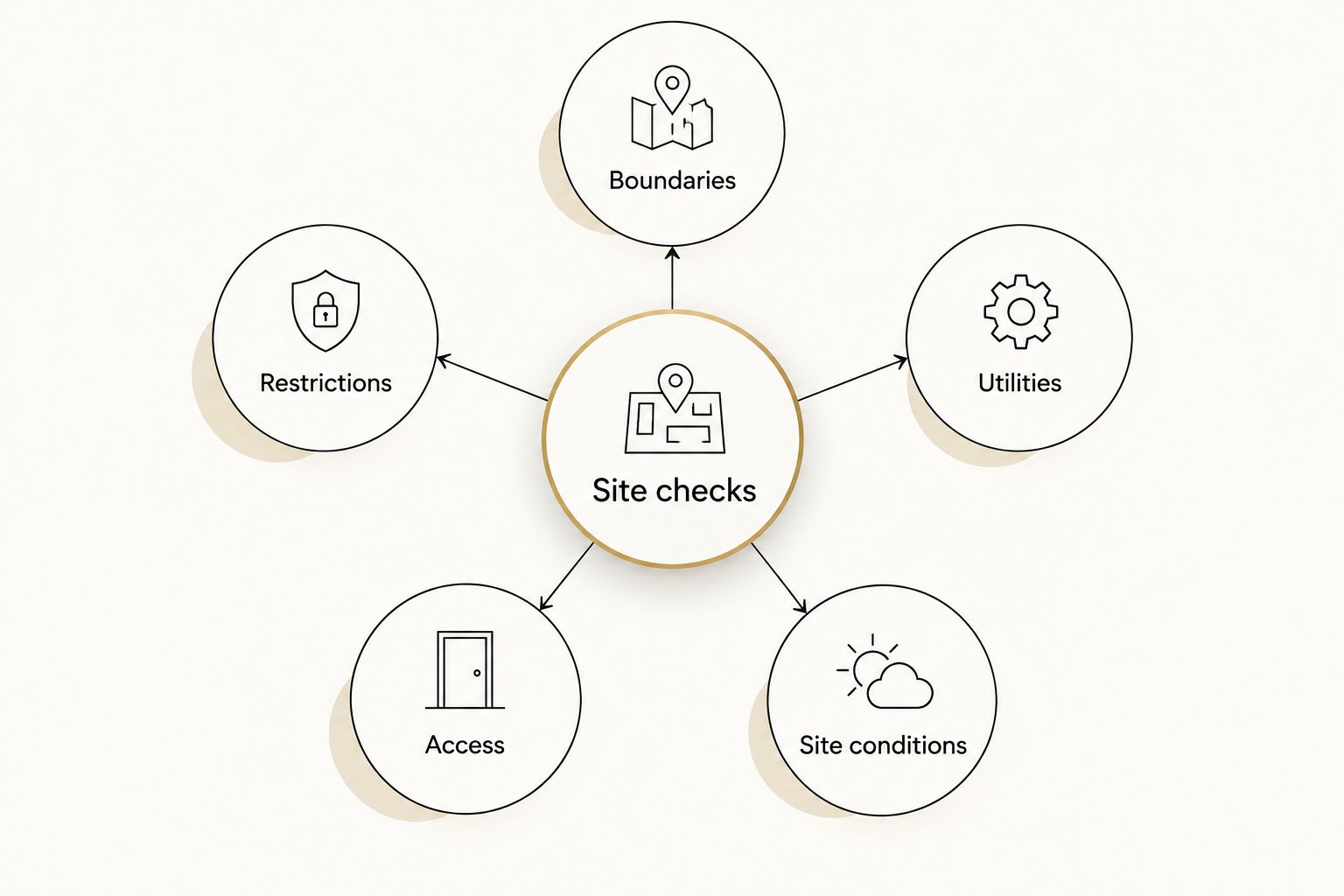
Use these 5 site checks as a discussion agenda for your 2026 land search. They are categories to investigate, not a substitute for property-specific professional advice.
- Boundaries: Confirm the property lines and identify recorded easements. Ask how they affect the proposed home and other improvements.
- Restrictions: Review zoning, setbacks, subdivision requirements, and applicable covenants. Identify who must approve the proposed design.
- Utilities: Establish how the property will receive essential services. For a site without public connections, investigate the applicable water and wastewater requirements.
- Access: Confirm legal access and evaluate the proposed driveway location. Include construction access in the discussion.
- Site conditions: Review slope, drainage, soil information, and the need for further investigation. Establish how the home and surrounding grades will work together.
Finish the review with a written list of unresolved items. Give each item an owner and a decision deadline tied to your actual purchase agreement.
A verbal assurance is not the same as a documented answer. Keep surveys, reports, approvals, and correspondence with the project records.
How should your lender fit into the land decision?
Speak with your lender while you are comparing builders and properties. Ask how the lender treats a separate land purchase, an existing lot, and the proposed construction financing; do not assume those arrangements are interchangeable.
For your 2026 financing discussions, describe the entire intended project rather than presenting only the land purchase. Ask which documents, approvals, and design details the lender needs before making a construction decision.
Comparing house and land package costs also requires distinguishing the scope of a combined package from separately acquired land and construction. That distinction matters here: an Australian package comparison does not establish financing terms, inclusions, or property requirements for a Nebraska build.
Before accepting obligations, ask the lender:
- How does buying the land separately affect the later application?
- How will existing land ownership be evaluated?
- Which project documents are required, and at what stage?
- What happens if the proposed design or project scope changes?
The goal is alignment between your purchase agreement, design process, and financing requirements. A builder conversation alone cannot establish what your lender will approve.
Which homebuilding approach should guide your land search?
Choose the experience you want before assuming every building route offers the same decisions. Semi-custom, move-in-ready, and fully custom homes address different needs.
Murray Custom Homes is best for Lincoln-area semi-custom buyers who want selected choices and in-house design guidance. Its homebuilding services also include fully custom homes and already-built homes, with each route requiring a different property conversation.
| Home approach | Best for | Benefit | Trade-off |
|---|---|---|---|
| Semi-Custom Homes | Buyers who want selected personal choices | You choose selected features and leave remaining decisions to the builder | You do not direct every decision as you would in a fully custom process |
| Move-in-ready homes | Buyers who want to evaluate an already-built home | You assess the actual home and its setting together | The home is already built, so do not assume redesign is included |
| Custom Homes | Buyers with a distinct vision for their home | The home is shaped around your preferences | More design decisions require your input |
In-house drafting, blueprints, 3D renderings, and project management support the design conversation. Meghan Murray provides in-house design guidance, and project managers bring more than 20 years of combined experience.
For a semi-custom build, ask which decisions belong to you before choosing a lot around an imagined plan. For a fully custom build, distinguish essential features from ideas you are willing to adapt to the site.
What should you ask a builder before buying land?
Ask questions that produce specific next steps. “Does this look like a good lot?” is less useful than asking which facts are established and which still require professional review.
Use this agenda:
- Does this property fall within the homebuilding service area?
- What documents do you need for an initial site discussion?
- Which parts of my intended layout need evaluation against the lot?
- Which questions require a surveyor, engineer, local authority, or attorney?
- How will site-related assumptions be documented before design progresses?
- Which decisions should remain open until the property review is complete?
Leave the meeting knowing what happens next, not merely feeling reassured. If a critical answer is unresolved, establish how it will be obtained before advancing the purchase or design commitment.
FAQ
Should I buy land first or choose a builder first?
Choose a builder first when you have not confirmed that a lot supports your intended home. Search for land in parallel, but investigate the property before accepting an unconditional purchase commitment.
Can I buy land before I know which house I want?
You can buy land before selecting a final house design, but define your essential space and layout requirements first. Otherwise, you commit to property without knowing whether it supports the home you intend to build.
Can Murray Custom Homes build on land I already own?
Murray Custom Homes can build on a client’s existing lot within its stated 50-mile Lincoln homebuilding service radius. Confirm the specific property and project fit before proceeding.
Does a builder’s lot review replace a survey?
A builder’s lot review does not replace a survey or other required professional investigation. Establish who will confirm boundaries, recorded restrictions, site conditions, and applicable approvals.
Is buying land first better for a semi-custom home?
Buying land first is not automatically better for a semi-custom home. Confirm how the selected home approach fits the property’s constraints before committing to the lot.
Should I talk to a lender before buying a lot?
Talk to your lender before committing to a lot if financing is part of your plan. Ask how a separate land purchase or existing land ownership fits the proposed construction financing.
What if I find the perfect lot before choosing a builder?
Investigate the lot before treating it as perfect for your home. Coordinate a builder discussion with the survey, title, access, utility, and approval questions relevant to that property.
One last thing
A smaller list of unresolved questions is more valuable than a longer list of attractive lots. Before making a 2026 purchase decision, ask everyone involved to distinguish confirmed facts from assumptions.
Your next move is straightforward: write down your essential home requirements, discuss them with a builder, and evaluate candidate land against those requirements. Buy the property with a clear understanding of what still needs to be resolved.
Related guides
- How much land do you need to build a custom home in Lincoln?
- How mortgage pre-approval shapes your build timeline
- Features to prioritize when choosing a semi-custom home