

We Create Luxury Living. Instead of repeatedly revising a home design around an unconfirmed borrowing limit, arrange mortgage pre-approval for your custom home build, then coordinate the lender’s requirements with your builder’s plans. For a 2026 project with Murray Custom Homes, that means separating your initial borrowing assessment from the property review, final loan approval, and construction funding that follow.
- Mortgage pre-approval custom home build planning establishes financing boundaries; it does not authorize construction.
- Murray Custom Homes offers Semi-Custom Homes for buyers who want selected choices rather than every design decision.
- Confirm construction financing requirements before committing to a lot or finalizing plans.
- Coordinate lender review, builder documentation, and closing requirements before setting a construction start.
Why this matters
Mortgage pre-approval helps define your financing boundaries; it does not establish your construction start date. A lender’s initial assessment concerns your finances. Funding a particular build also requires review of the proposed property, construction documents, and the conditions attached to your loan.
The distinction matters when you plan a move. A design meeting, a pre-approval letter, and a construction start are separate milestones. Treating them as interchangeable creates commitments before the necessary approvals exist.
Murray Custom Homes is best for Lincoln-area custom home buyers who want in-house design, drafting, and project management. Semi-Custom Homes narrow the decisions you make; fully custom homes put more of those decisions in your hands. Neither route removes lender requirements.
For your 2026 planning calendar, record dependencies rather than assuming a universal approval period. Ask who supplies each document, who reviews it, and what must happen before the next milestone.
Before you start
- Confirm the lending scope. Have a conversation with a lender that handles construction financing. Ask what its pre-approval covers, which documents it requires, and when the initial assessment must be refreshed.
- Prepare your financial and property materials. Gather the income, asset, debt, and identification records the lender requests. Bring lot information if you own land, plus your preferred home type and essential design requirements.
- Resolve the hidden dependency: the home itself needs review. Borrower pre-approval does not approve an unspecified house on an unspecified lot. Ask when the lender needs plans, specifications, the construction agreement, and an appraisal before paying for work that depends on financing.
Murray Custom Homes builds within a stated 50-mile radius of Lincoln and can build on your existing lot. Confirm that your location fits before coordinating detailed lender and builder reviews for a 2026 build.
Borrower pre-approval
Establish your financing boundaries
- Identify the intended transaction. Tell the lender whether you are building on land you own, purchasing land for construction, or considering an already-built home. These are different financing situations; do not describe every option simply as buying a house.
- Submit the requested financial records. Use the lender’s secure submission method. Ask which records are still outstanding rather than assuming an uploaded document has completed the review.
- Request the written conditions. Read the pre-approval letter and ask what remains subject to verification. Confirm its expiration date and the events that require an updated review.
- Set your own comfort boundary. Distinguish the lender’s maximum assessment from the payment and cash commitment you want. Discuss taxes, insurance, existing housing obligations, and construction-related financing expenses with the lender.
Create a one-page financing summary containing your lender contact, outstanding conditions, expiration date, and next review milestone. Keep account numbers and sensitive financial records out of the version shared with your builder.
Expected result: You understand what the lender has assessed, what remains conditional, and what financial boundaries should guide design discussions. You do not yet have permission to start construction.
Home scope and lot documentation
Match the home path to your decisions
Choose the home path before requesting detailed financing instructions. The following comparison concerns decision-making and documentation, not a promised completion schedule.
| Home path | Best for | Advantage | Trade-off | Financing question |
|---|---|---|---|---|
| Semi-Custom Homes | Buyers who want selected choices and personal guidance | You choose selected features and leave remaining decisions to the builder | Less individual control than a fully custom design | Which selections must be settled before final review? |
| Move-in-ready homes | Buyers who want to assess an already-built home | You can evaluate the completed property rather than a proposed design | The existing layout and features constrain personalization | What does the lender require for this completed property? |
| Custom Homes | Buyers with specific layout and feature requirements | The home is shaped around your preferences | More design decisions must be coordinated with documentation | When are the plans and specifications detailed enough for underwriting? |
- Write a project brief. Separate essential requirements from preferences. Identify household needs, room relationships, accessibility considerations, and distinctive features that affect the scope.
- Confirm the lot arrangement. State whether you own the land or expect to purchase it. Give the lender the ownership and property documents it requests, and ask how existing land debt affects the transaction.
- Request the project-document checklist. Ask the lender which plans, specifications, agreement details, and builder information it needs. Share that checklist with the builder before assuming the design package is sufficient.
- Assign each outstanding item. Your lender, builder, and closing professionals have different responsibilities. Record the responsible party and the next action beside each requirement.
For a 2026 project brief, label documents by revision date. A clear file name helps everyone distinguish the plan being reviewed from an earlier concept.
Expected result: Your lender and builder are discussing the same home, on the same lot, using an identified set of documents.
Lender and builder review
Coordinate the approval dependencies
A useful planning sequence is Borrower review, Project scope, Property review, and Funding clearance. These are planning checkpoints, not a promise that every lender follows an identical process. Some reviews overlap; ask your lender which dependencies control your transaction.
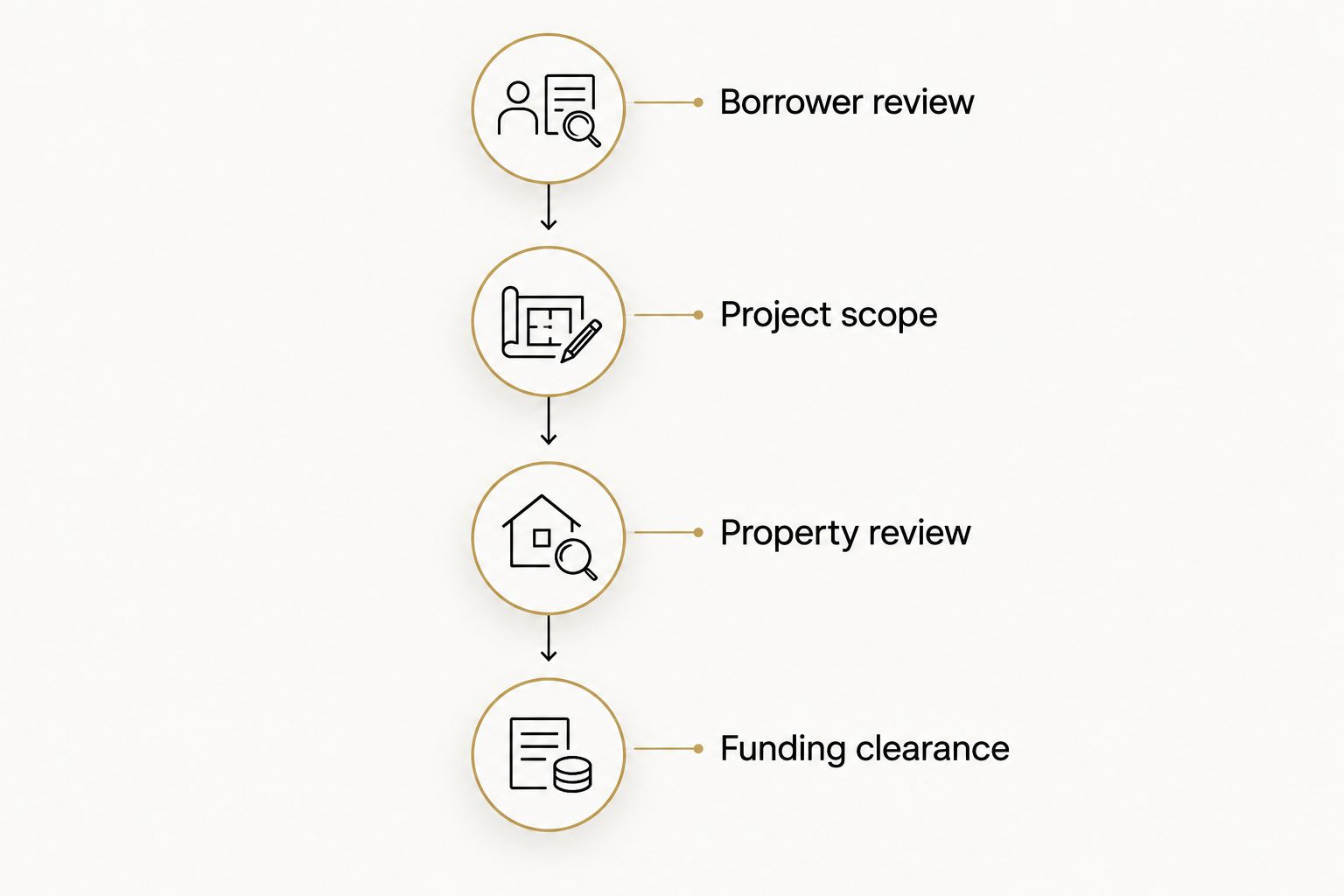
- Align the document versions. Ask the builder which plans and specifications represent the agreed scope. Confirm that the lender receives that same version, including relevant revisions.
- Confirm appraisal requirements. Ask when the lender can order the appraisal and which construction documents must be complete first. Do not treat your borrowing assessment as confirmation of the proposed home’s appraised value.
- Clarify construction funding. Ask who requests disbursements, what inspections or supporting documents are required, and who communicates approval. Do not assume a loan closing makes every construction payment immediately releasable.
- Record unresolved conditions. Maintain an open-items list covering borrower, property, builder, and closing requirements. Ask the lender which items prevent final approval and which prevent funding.
Your builder can explain project scope and construction coordination. Your lender determines lending requirements. Keep that division clear instead of asking either party to make commitments for the other.
Expected result: You can identify the next approval dependency and the person responsible for resolving it. A general statement that financing is progressing is no longer your only status update.
Closing and construction handoff
Confirm what authorizes the next milestone
- Request a current conditions review. Before tying a move or major commitment to a proposed start, ask the lender which conditions remain. Confirm whether an updated financial review is required.
- Check the funding sequence. Ask what happens at closing and what must happen before the initial construction disbursement. Clarify any inspection, documentation, or authorization requirements.
- Coordinate the builder’s start requirements. Ask the builder what must be complete before scheduling construction. Financing is one dependency; the project also needs the applicable site, design, and permitting requirements addressed.
- Set the next communication point. Record who will notify you when a milestone is cleared. Obtain an updated schedule from the party responsible rather than calculating a start date from your pre-approval letter.
Use your 2026 closing checklist to track three separate checkpoints: borrower conditions, property conditions, and construction readiness. Mark a checkpoint complete only when the responsible party confirms it.
Expected result: You know which approvals support closing, which conditions govern funding, and which builder requirements control scheduling. Your calendar reflects confirmed milestones rather than a single estimated approval date.
When your plans or finances change
The adjacent workflow is a financing update whenever the underlying project changes. Use it after a lot change, a substantial design revision, or a change to income, employment, debt, or the funds intended for the transaction.
- Describe the change in writing. Identify the affected plan, financial circumstance, or property detail.
- Notify the responsible reviewer. Send financial changes to the lender and scope changes to the builder; coordinate both when the change affects financing.
- Ask what needs reassessment. Confirm whether documents, appraisal work, underwriting, or scheduling need updating before treating the previous milestone as valid.
The benefit is consistency; the trade-off is additional review. Rechecking a changed project is more useful than preserving a schedule based on documents that no longer describe what you intend to build.
Troubleshooting financing delays
Your letter covers a purchase, not the proposed build
Fix: Ask the lender to confirm the financing structure for your actual transaction. Provide the lot arrangement and intended construction scope. Do not assume a general home-purchase pre-approval answers construction-funding questions.
The design changed after documents were submitted
Fix: Identify the current plan revision and tell the lender what changed. Ask whether the updated scope affects appraisal work or underwriting. Keep earlier drawings clearly separated from the current submission.
The appraisal does not support the proposed financing
Fix: Ask the lender to explain the gap and the options it will consider. Coordinate scope revisions with the builder before assuming a design change resolves the financing issue. Obtain revised approval before proceeding on that assumption.
The pre-approval expires before the project is ready
Fix: Contact the lender before expiration and request its renewal requirements. Keep requested financial records current. Do not assume a previously issued letter remains valid because the design process is still underway.
Online turnaround estimates conflict
Fix: Ask your lender for its current review sequence and outstanding requirements. Geography matters when estimating how long mortgage pre-approval takes: an Australian timetable does not establish a Nebraska lender’s processing commitment. For a 2026 build, use the lender’s own milestones rather than importing another market’s calendar.
Customize your workflow
Start with Semi-Custom Homes if you want selected design choices rather than responsibility for every detail. Keep fully custom homes in consideration when your layout or feature requirements call for a more individually shaped design. Treat an already-built home as a separate property and financing decision.
Murray Custom Homes provides in-house drafting and design, blueprints and 3D renderings, and construction and project management. Meghan Murray provides in-house design guidance, and the project managers bring more than 20 years of combined experience. Those services support project coordination; they do not replace lender approval.
If land is your next decision, use the building-on-your-own-lot guide to frame the property questions you bring to the builder. Confirm lot suitability and lender requirements before treating land ownership as construction readiness.
Discuss your homebuilding plans
Bring your lot details, home priorities, and lender’s project-document checklist.
FAQ
Do I need mortgage pre-approval before designing a custom home?
Arrange an initial lender review before committing to detailed design work that depends on borrowing. Pre-approval establishes financial boundaries, while final approval also depends on the proposed property and the lender’s conditions.
Does mortgage pre-approval mean construction can start?
No. Mortgage pre-approval does not authorize construction or guarantee disbursement. Confirm final lending conditions, funding requirements, and the builder’s construction-readiness requirements separately.
How long does mortgage pre-approval take for a Nebraska custom build?
Your lender must provide the timeframe for your application. Ask separately about borrower review, project-document review, appraisal, and final approval because these are distinct parts of the process.
Can I build with Murray Custom Homes on land I already own?
Yes. Murray Custom Homes can build on a client’s existing lot within its stated Lincoln-area homebuilding service radius. Confirm the location and site suitability with the builder, and ask your lender how land ownership affects financing.
Is a Semi-Custom Home easier to coordinate than a fully custom home?
Semi-Custom Homes narrow the decisions you make because you select certain features and leave remaining decisions to the builder. That reduces the scope of your selection work, but it does not eliminate appraisal, underwriting, or construction-funding requirements.
What happens if I change the floor plan after pre-approval?
Notify the builder and lender before relying on the earlier financing assessment. Ask whether the revised scope requires updated plans, specifications, appraisal work, or underwriting.
Should I use the full amount shown in my pre-approval?
Set your own financial comfort boundary rather than treating the lender’s maximum assessment as a spending instruction. Review the payment, cash commitment, taxes, insurance, and existing housing obligations with your lender.
One last thing
Ask what the next approval permits, not just whether you are approved. A borrower assessment, a reviewed property, a closed loan, and an authorized construction disbursement answer different questions. Writing down the action each milestone permits makes your timeline more useful than collecting approval dates alone.
Related guides
- Features to prioritize when choosing a Semi-Custom Home
- Floor plan features to include in a custom home
- Semi-Custom Homes for busy professionals