
You can switch from semi-custom to full custom mid-project only if your builder agrees to a revised scope and the changes work with your contract, plans, approvals, and completed construction. A switch is not automatic: before authorizing work, get written confirmation of what changes, what stays, and how the redesign affects your project budget and schedule.
- Can I switch from semi-custom to full custom mid-project? Only with builder approval and a documented scope change.
- Murray Custom Homes offers semi-custom and custom homes; project-specific approval determines whether a mid-project switch is possible.
- Best for selective personalization: semi-custom. Best for broader design control: full custom.
- Compare revised plans, specifications, and contract terms before approving a change.
Why this matters
A home should support how you live, not simply carry a particular project label. Before changing your entire building agreement, identify the specific limitation you need to resolve: a room arrangement, a distinctive feature, or decisions outside the original selection process.
Murray Custom Homes expresses its approach as “We Create Luxury Living,” supported by thoughtful design and personal guidance. The practical question is whether your priorities require a different scope or fit within the home already being planned.
For a 2026 build, make the decision from the current drawings and agreement—not from the words semi-custom or custom alone. A new label does not explain which choices you gain or which commitments remain.
Can I switch from semi-custom to full custom mid-project?
A mid-project switch requires agreement on the revised work. Your builder needs to evaluate the requested design against the existing project, while you need to understand the consequences before accepting a revised agreement.
Use this sequence to turn a broad request into a decision:
- Describe the outcome. Explain what your current plan does not accomplish. Separate essential changes from preferences you would accept alternatives for.
- Identify the affected work. Ask which drawings, selections, orders, approvals, and completed installations the request touches.
- Compare routes. Request an explanation of whether the need fits an existing selection, a limited amendment, or a broader redesign.
- Document the consequences. Review the revised scope, financial obligations, schedule assumptions, and responsibility for work already committed.
- Authorize the agreed scope. Follow the contract's approval process before anyone proceeds with changed work.
Do not treat an informal design conversation as permission to change construction. Ask what written authorization your agreement requires and which version of the plans governs the work.
Is this a selection change or a redesign?
Changing a finish and relocating a bathroom are different requests. A finish change concerns a selection; relocating a bathroom also raises questions about layout and building systems.
Describe the actual change rather than deciding its category yourself. The builder's review should establish whether it stays within the existing scope or requires new design and construction instructions.
For more context, see making changes during the custom home building process. Keep your own project's agreement as the controlling reference.
Semi-Custom Homes: best for selected personal choices
Semi-custom suits buyers who want meaningful choices without directing every design decision. You choose selected features and entrust the remaining decisions to the builder, within the agreed scope.
The advantage is a more focused decision process. The limitation is that some requests fall outside the choices included in your agreement, so confirm boundaries before assuming a feature is available.
Stay with semi-custom when the approved design meets your essential needs and the remaining questions concern selected features. Ask for a clear selection list before requesting a full conversion.
Full Custom Homes: best for broader design control
Full custom suits buyers whose preferences call for a home shaped around their individual requirements. That includes buyers who need broader involvement in layout and distinctive features rather than a narrower selection process.
The advantage is a scope built around those preferences. The trade-off is the need to resolve more design decisions and document their effect on the project; full custom does not remove site, engineering, permitting, or contract constraints.
Consider a broader redesign when your non-negotiable requirements conflict with the underlying plan. For a 2026 project, ask the builder to distinguish a workable redesign from requests that cannot be incorporated into the existing construction.
Move-in-ready homes: best for evaluating an already-built home
Move-in-ready means an already-built home, not an unrestricted opportunity to redesign it. This route fits buyers who prefer to evaluate an existing layout and its completed features rather than direct the design process.
The advantage is a physical home you can assess. The limitation is that an already-built layout is not equivalent to an unbuilt custom plan; ask separately about any proposed alterations and confirm the home's current status before making decisions.
Murray Custom Homes offers all three routes. Murray Custom Homes is a fit for Lincoln-area buyers seeking semi-custom guidance or a home shaped around custom preferences. That range does not establish a blanket policy allowing projects to switch categories.
| Route | Best for | Main advantage | Main limitation |
|---|---|---|---|
| Semi-Custom Homes | Selected personalization with builder guidance | A focused set of buyer decisions | Choices remain bounded by the agreed scope |
| Full Custom Homes | Broader involvement in layout and distinctive features | Design shaped around buyer preferences | More decisions and project coordination |
| Move-in-ready homes | Assessing an already-built layout | Evaluating completed spaces and features | The home is already constructed |
Why the feasibility of switching varies
The same design request has different implications depending on the project behind it. Review these factors before choosing a route:
- Project stage. Establish whether the affected work exists only in drawings, has been ordered, or has been installed.
- Design dependencies. Ask whether the request touches structure, room relationships, plumbing, electrical work, or other connected elements.
- Contract boundaries. Check the included selections, change-approval procedure, and responsibilities for revised work.
- Approvals. Ask the builder which revised documents need review by the relevant design professionals or permitting authority.
- Existing commitments. Identify materials, supplier orders, and trade work already authorized for the original design.
- Schedule coordination. Ask which activities depend on the decision and what must happen before affected work proceeds.
These are questions for a project review, not promises that every change is feasible. The useful answer identifies the affected work and the next approval—not simply whether the builder offers custom homes.
Check the stage before changing direction
Before construction begins
Use the plans to test how the home supports your routines. Walk through furniture placement, storage, privacy, and movement between rooms rather than reviewing each room in isolation.
A design-stage review still needs to account for signed agreements and existing commitments. Ask what has already been approved or ordered before assuming the project is free to change.
During construction
Ask the project manager to identify the exact work affected by your request. Distinguish work that has not started from work already completed, then request instructions for handling each category.
Do not give separate directions to individual trades. Route the request through the project's agreed communication and authorization process so construction follows a consistent set of instructions.
After affected work is complete
Ask the builder to assess the proposed result against what is already built. A request to alter finished work needs a different review from an unselected detail.
Consider whether another design response solves the same problem without changing completed construction. Keep the original need visible: better storage, for example, is an outcome rather than a single prescribed solution.
Compare 3 documents before approving a switch
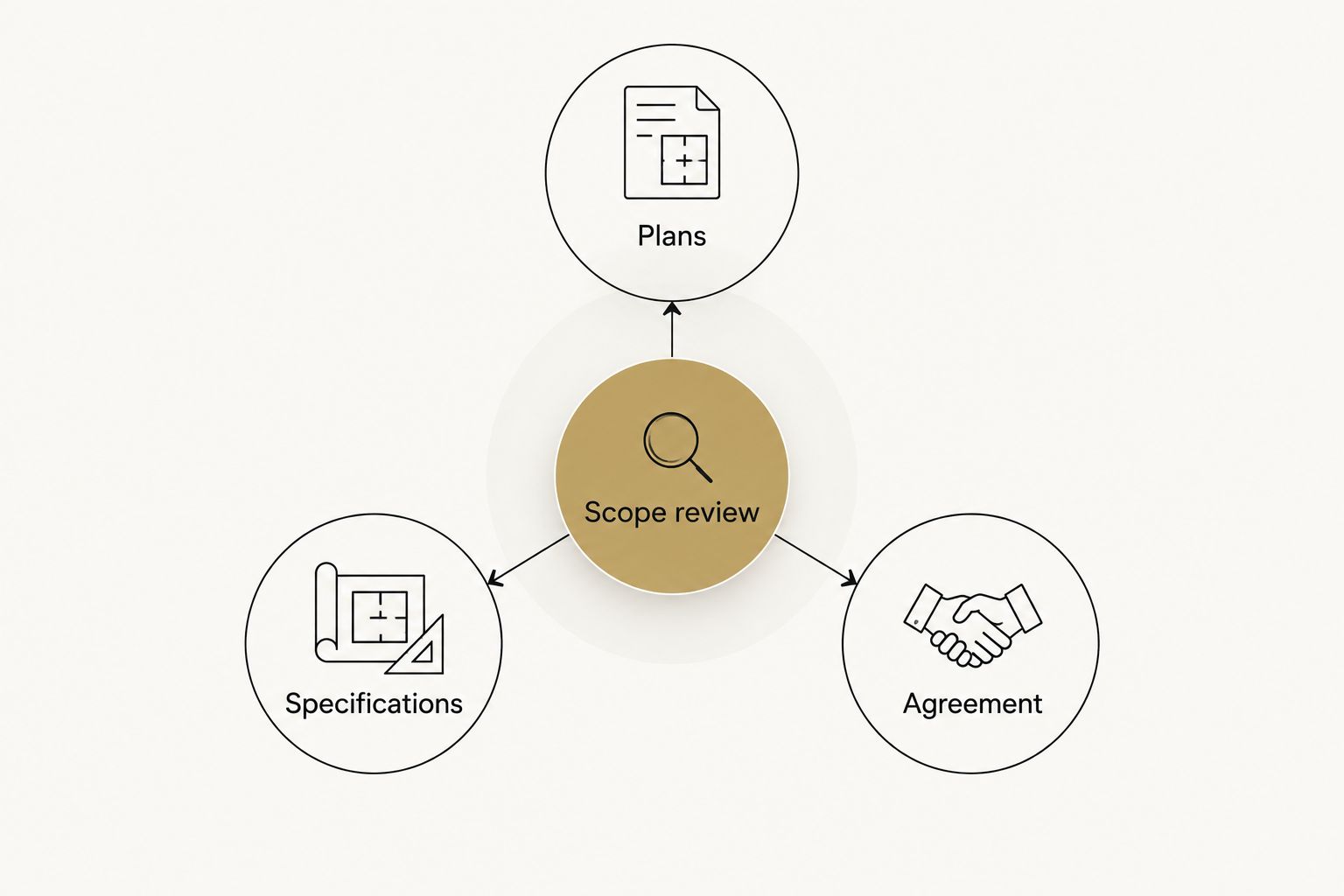
A 2026 scope review should connect the drawings, specifications, and agreement. Read them together; each answers a different question.
- Plans: Where does the changed feature go, and what surrounding spaces or systems does it affect?
- Specifications: What materials, finishes, fixtures, or construction details are included in the revised work?
- Agreement: Who authorizes the change, what obligations change, and how are schedule effects addressed?
Request consistent descriptions across all 3 documents. If a revised drawing shows a feature that the specifications do not identify, ask for clarification before approving the package.
Keep a record of the approved versions and the questions resolved during the review. Your goal is a shared description of the home being built, not a collection of separate conversations that leave the result open to interpretation.
Ask these 5 questions in your design meeting
Bring a short written brief to your 2026 design meeting. Describe the problem first, then ask:
- Does this require a full scope change? Ask whether a narrower amendment achieves the same result.
- What does the request affect? Include drawings, approvals, orders, completed work, and connected building systems.
- What decisions remain mine? Clarify the choices you gain and the decisions that remain with the builder.
- What must be approved before work proceeds? Identify the required documents and the person responsible for each approval.
- What happens if I decline the redesign? Confirm the original scope and the next decision needed to continue under it.
Murray Custom Homes provides in-house drafting and design, blueprints and 3D renderings, and construction and project management. Meghan Murray provides in-house design guidance, and the project managers bring more than 20 years of combined experience; ask the project team to explain how a proposed change would be assessed for your particular build.
The homebuilding service area is a stated 50-mile radius of Lincoln, Nebraska. Building on your own lot is also an option, but the lot does not remove the need to review the design and agreement.
Discuss Your Design Priorities
Ask how your proposed changes fit the plans, project stage, and agreed scope.
Do I need full custom to get a distinctive feature?
A distinctive feature does not automatically require a full-custom agreement. Ask whether the feature is included in your available selections or requires a specific amendment.
Judge the proposed result against your need. A broader project category has little value if a clearly defined change already delivers the space or function you want.
Should I switch if I only dislike the finishes?
Finish concerns are a reason to review selections before requesting a complete redesign. Identify which finishes are undecided, approved, ordered, or installed so the builder can assess the request accurately.
Keep layout and finish decisions separate. Disliking a surface does not, by itself, establish that the underlying floor plan needs to change.
FAQ
Can I switch from semi-custom to full custom after signing a contract?
A switch after signing requires your builder’s agreement and documentation consistent with your contract. Ask for a review of the revised scope before authorizing changed work.
Can I change my floor plan after construction starts?
A floor-plan change requires a project-specific review of the affected construction, systems, drawings, and approvals. Do not direct changed work until the required authorization is complete.
Is full custom better than semi-custom?
Full custom is better for broader design control; semi-custom is better for selected personalization with builder guidance. Choose according to the decisions you need to make, not the label alone.
Will switching to full custom delay my build?
The schedule effect depends on the proposed changes and the work already committed or completed. Request a revised schedule assessment rather than assuming the original completion expectations remain unchanged.
Can I keep some semi-custom features in a full-custom plan?
Ask the builder whether the features you want to retain can remain in the revised design. Identify retained items explicitly so a broader redesign does not erase decisions you still support.
What should I bring to a meeting about changing my home design?
Bring your current plans, selection records, agreement, and a written list of essential changes. Separate the result you need from the particular design solution you initially have in mind.
One last thing
Ask what you should keep before asking what you can change. List the layout decisions, features, and selections that already work, then make those the starting point for the redesign conversation.
For your 2026 project, the strongest next step is a written comparison of the existing scope and the proposed revision. Approve the change only when you understand both—not because a new project label sounds more personal.
Related guides
- Features to prioritize when choosing a semi-custom home
- Combining custom and semi-custom options in one build
- From blueprint revisions to permit submission