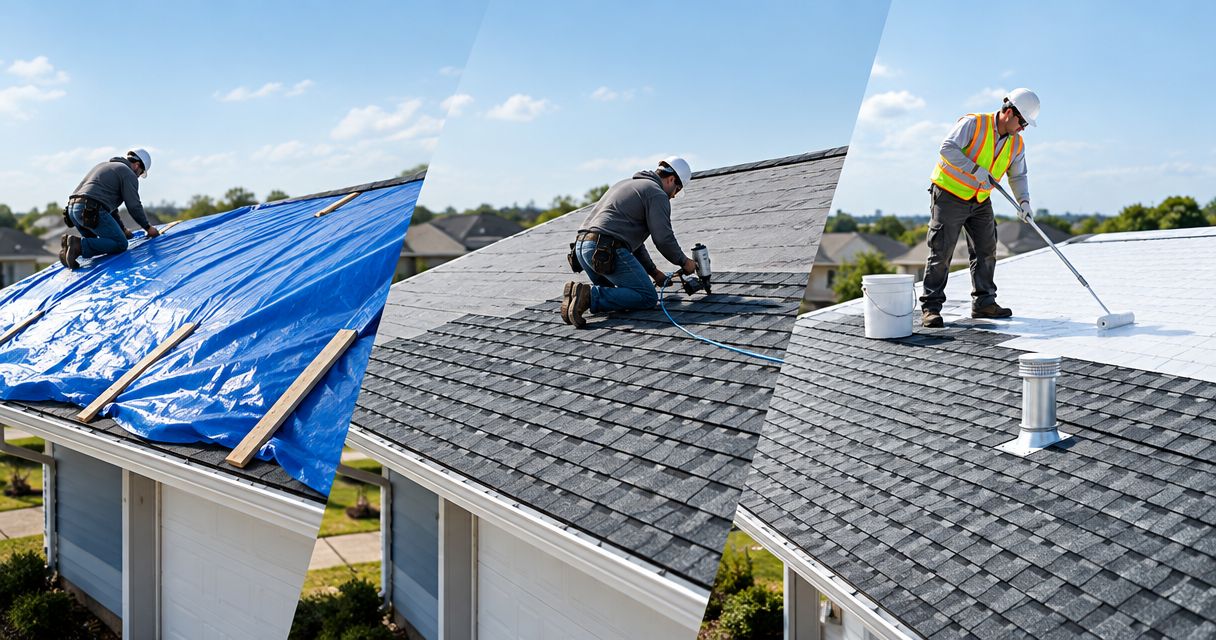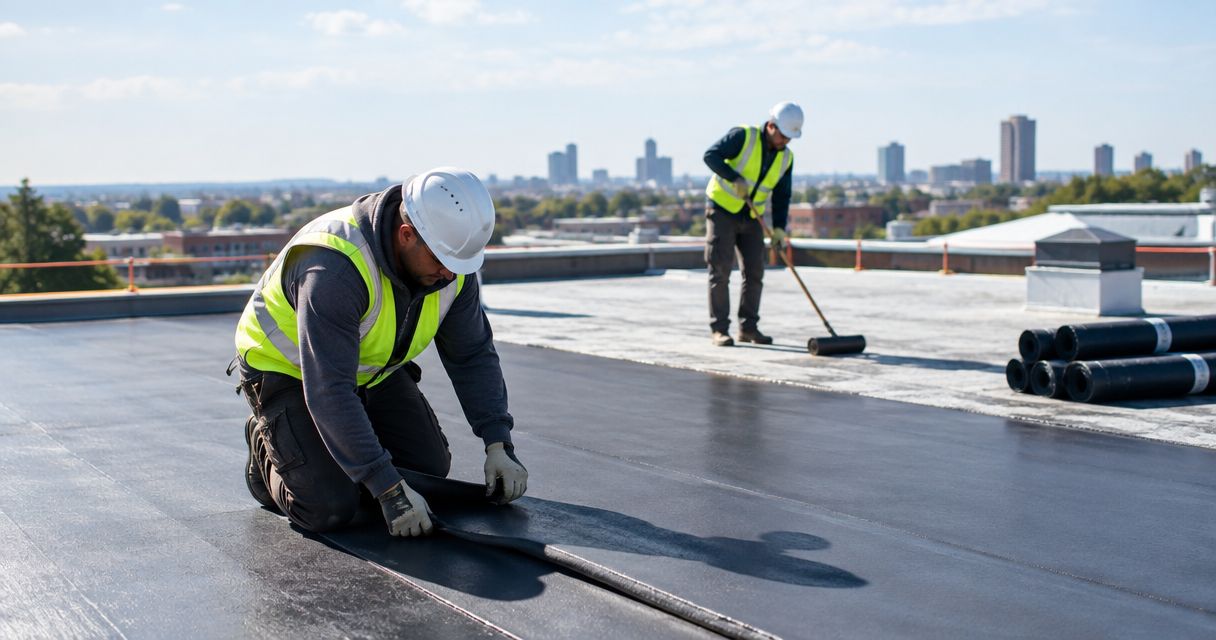
Commercial roof replacement cost per square foot is the total quoted replacement amount divided by the measured roof area—not a universal rate you can apply to every building in 2026. A useful figure includes the specified roof assembly, removal work, installation, and project requirements. Check exclusions for damaged decking, wet insulation, drainage changes, and occupied-building protection before using that figure to approve a budget.
- Commercial roof replacement cost per square foot only compares fairly when roof area and replacement scope match.
- Separate full replacement, roof recover, and coating proposals; they describe different work.
- Murray Inspection Services guide: check roof condition, bid exclusions, and repair allowances before approving a commercial roofing budget.
- One roofing square equals 100 square feet; confirm the measurement unit before comparing bids.
Why this matters
A low unit rate does not establish a low finished-project cost. If one proposal includes removal and insulation replacement while another leaves those items outside the contract, the rates describe different jobs.
For your 2026 budget, organize the decision around three questions: what roof area is included, what work is included, and what remains unresolved. Use this Murray Inspection Services guide to separate those questions before comparing contractor totals.
The best commercial roof replacement bid is the one you can verify against a defined scope, not the one with the smallest headline rate. Keep the unit rate as a comparison tool rather than treating it as the entire purchasing decision.
How much does commercial roof replacement cost per sq ft?
Calculate commercial roof replacement cost per square foot from a written project estimate and a measured roof area. A material-only figure, a full replacement proposal, and a coating proposal are not interchangeable estimates.
Use this calculation:
Quoted replacement total ÷ measured roof area in square feet = quoted replacement cost per square foot.
Before dividing, check what the numerator includes. A complete comparison needs the following breakdown, with each contractor identifying included work, exclusions, and unresolved quantities.
| Scope component | What to confirm | Why it matters |
|---|---|---|
| Roof area | Measured area and included roof sections | Different area assumptions distort the unit rate |
| Existing roof removal | Layers, removal limits, and disposal | A recover proposal does not include the same removal work |
| Deck repairs | Repair criteria and how quantities are verified | Concealed damage creates an unresolved scope item |
| Insulation | Removal, retained materials, and specified replacement | Different assemblies produce different bids |
| Roof covering | Material, attachment, seams, and perimeter details | A material name alone does not define the system |
| Flashing and drainage | Curbs, penetrations, edges, drains, and transitions | Detail work must appear in the installation scope |
| Project requirements | Access, protection, permits, and cleanup | Site obligations belong in the comparison |
Keep the original total visible alongside the calculated rate. The rate helps compare scope; the total shows the amount the proposal asks you to approve.
Confirm the measurement before comparing rates
Roofing estimates use different units. One roofing square equals 100 square feet, so a rate per square is not a rate per square foot.
A roof area measuring 10 feet by 10 feet covers 100 square feet, which is one roofing square. To convert an amount quoted per roofing square into an amount per square foot, divide by 100. This conversion changes the unit, not the work included.
Building floor area is not a substitute for measured roof area. Multiple roof levels, slopes, additions, and separate roof sections require a clearly identified measurement boundary.
Ask every bidder to mark the included sections on a roof plan. If an entrance canopy, mechanical penthouse, or attached section is excluded, record that exclusion beside the total rather than discovering it during installation.
Full replacement: best for renewing the specified assembly
A full replacement proposal should identify what comes off and what goes back on. Do not assume that the word replacement automatically includes removal to the structural deck, replacement of every insulation layer, or correction of every drainage issue.
Best for: a project whose approved scope calls for removal and renewal of the roof assembly. Its advantage is a defined opportunity to address the layers exposed by that removal; its limitation is that hidden deck conditions still require a written repair process.
Require the proposal to identify the intended stopping point for removal. Then check the replacement assembly against that starting condition, including insulation, attachment, perimeter work, and penetrations.
Roof recover: best for an eligible existing assembly
A recover installs a new roof covering over an existing assembly rather than removing the entire existing roof. Eligibility depends on existing conditions, applicable code, and the proposed system's requirements—not the apparent attractiveness of the bid.
Best for: an existing assembly documented as suitable to remain beneath a new covering. Its advantage is reduced removal work; its limitation is that retaining existing materials does not resolve concealed moisture, deterioration, or other unsuitable conditions.
Ask for the basis of the recover recommendation in writing. A proposal should explain which existing materials remain and how their condition was evaluated before treating recover as an alternative to replacement.
Roof coating: best for a suitable restoration scope
A coating proposal is not automatically a replacement proposal. It describes treatment of an existing roof, with preparation and repairs defined by the substrate and coating system.
Best for: an existing roof documented as suitable for the proposed restoration work. Its advantage is preserving a serviceable roof covering; its limitation is that coating does not substitute for repairing damaged underlying materials.
Compare the preparation requirements as closely as the coating description. Cleaning, adhesion requirements, seam treatment, flashing repairs, and treatment of drainage problems belong in the written scope.
| Approach | Best for | Main advantage | Main limitation |
|---|---|---|---|
| Full replacement | A specified assembly requiring removal and renewal | Addresses the layers included in removal | Concealed repairs still need clear authorization terms |
| Roof recover | An existing assembly documented as eligible to remain | Reduces removal work | Unsuitable retained materials undermine the approach |
| Roof coating | A roof documented as suitable for restoration | Preserves a serviceable existing covering | Does not replace damaged underlying materials |
For a 2026 bid comparison, label each proposal by approach before comparing its unit rate. A coating proposal and a full replacement proposal should never occupy the same comparison column without that distinction.
Why commercial roof replacement cost per square foot varies
Commercial roof replacement scope changes with the assembly, the condition beneath it, and the work required around it. These factors explain why matching only the roof area does not produce a fair comparison.
- Roof system: Membrane, metal, and other assemblies require different installation details. Compare complete systems rather than material names alone.
- Deck condition: Deteriorated decking requires a defined repair scope. Specify how exposed damage will be photographed, measured, and authorized.
- Insulation condition: Wet or unsuitable insulation changes the removal and replacement work. Identify what remains and what must be replaced.
- Drainage details: Drains, gutters, slopes, and transitions affect the work needed to manage roof water. Do not leave drainage corrections implicit.
- Roof details: Equipment curbs, penetrations, edges, and walls require specific flashing work. A broad installation description leaves those obligations unclear.
- Building use: Occupied commercial properties need an agreed plan for access, protection, staging, and work coordination. Put those requirements into every bidder's scope.
These are scope questions first. Resolve them before using a unit rate to rank proposals.
How do you compare commercial roof replacement bids fairly?
Use the same roof plan and scope checklist for every bidder. Ask contractors to identify deviations instead of quietly substituting different assumptions.
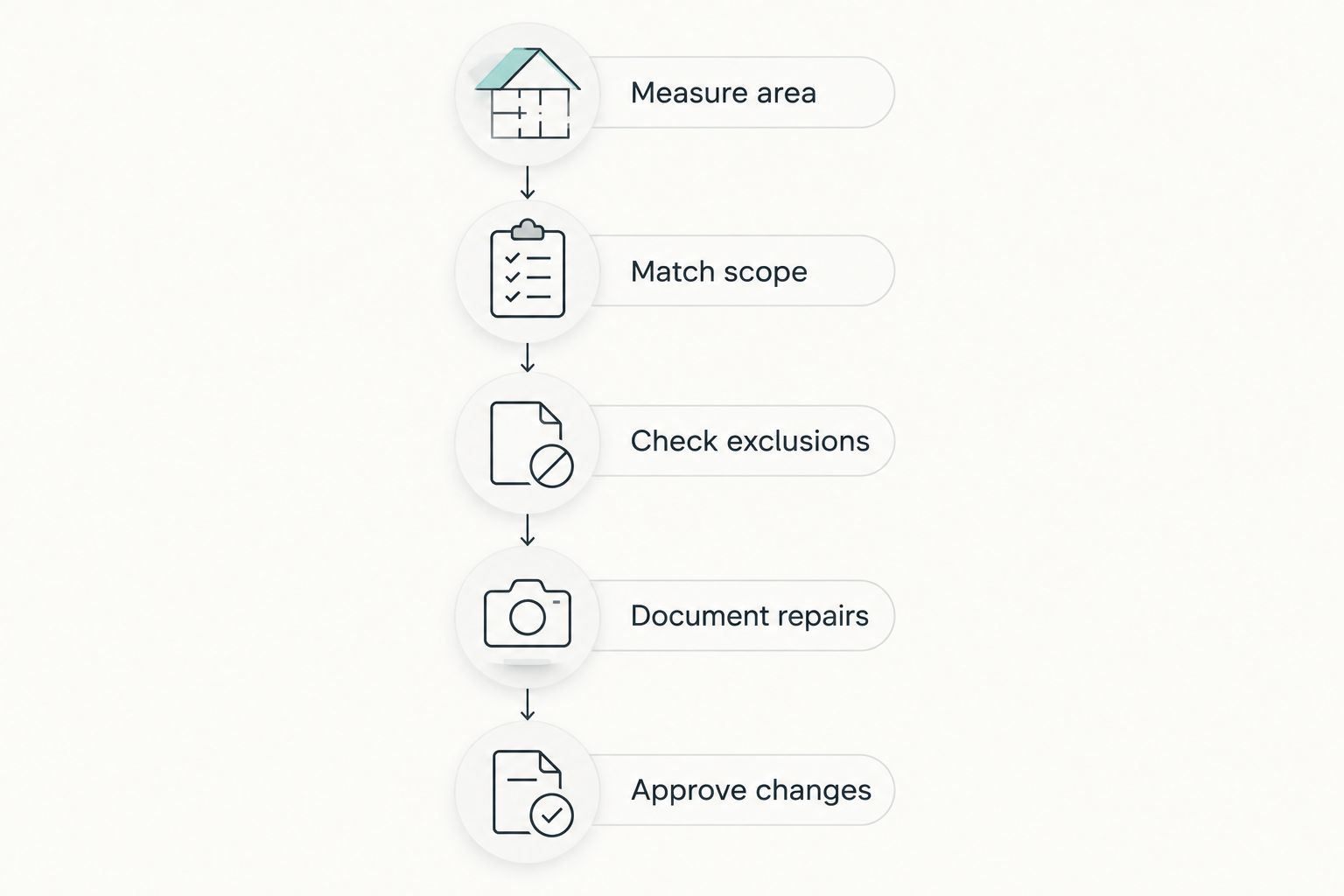
- Measure area. Confirm the roof sections and square-foot measurement used in each proposal. Resolve differences before comparing rates.
- Match scope. Align removal, insulation, covering, flashing, drainage, protection, and cleanup requirements. Separate alternatives from the base proposal.
- Check exclusions. Highlight omitted work and conditions that trigger additional authorization. An exclusion is not automatically unacceptable, but it must be visible.
- Document repairs. Require a process for concealed deck or insulation damage, including evidence, measurement, and written approval.
- Approve changes. Name the person authorized to approve changed work and require documentation before that work proceeds, except where the contract addresses emergency protection.
The roof inspection to contractor bid comparison workflow is a related guide for organizing the handoff from observed conditions to written proposals. Keep inspection findings attached to the bid request so every contractor can address the same documented issues.
What should your 2026 approval package contain?
Give the decision-maker a proposal they can understand without reconstructing the project from emails. The approval package should connect the condition assessment, chosen approach, measured area, and contract scope.
Include a roof plan, photographs of documented conditions, the proposed assembly, and an explicit list of exclusions. Add the contractor's approach to concealed damage and the building's operating constraints.
Keep financing and insurance decisions separate from the physical scope. A funding arrangement does not establish what roofing work is necessary, and a contractor proposal does not establish insurance coverage.
For readers using Murray Inspection Services to understand commercial roof replacement, the strongest next move is a scope checklist that bidders can answer line by line. That provides a clearer basis for approval than collecting unrelated headline rates.
Is a lower cost per square foot always better?
A lower cost per square foot is better only when the proposals cover equivalent work and acceptable project requirements. Otherwise, the smaller figure simply reflects a different scope or assumption.
Compare exclusions before treating the difference as savings. Check whether removal, insulation, drainage details, and concealed repairs receive the same treatment in both proposals.
Should you compare repair and replacement proposals together?
Compare repair and replacement as different decisions, not interchangeable unit rates. A repair addresses specified defects, while replacement renews the assembly described in the contract.
Ask what condition each approach addresses and what remains afterward. The comparison should make the remaining roof condition clear rather than presenting a smaller job as an equivalent replacement.
Does a roof warranty make two bids equivalent?
A roof warranty does not make two bids equivalent. Compare the installation scope first, then read who provides each warranty, what it covers, and what obligations or exclusions apply.
A warranty heading cannot replace a specified assembly or documented repair procedure. Keep warranty documents with the proposal you are actually approving.
FAQ
How do I calculate commercial roof replacement cost per square foot?
Divide the quoted replacement total by the measured roof area in square feet. Confirm that the total includes the work you intend to compare, and keep exclusions visible beside the result.
How many square feet are in a roofing square?
One roofing square equals 100 square feet. Divide a rate quoted per roofing square by 100 to express it per square foot.
Can I use my building’s floor area to estimate roof replacement?
Use measured roof area rather than assuming the building’s floor area matches the roof. Identify separate levels, slopes, additions, and excluded sections on a roof plan.
Is roof coating the same as commercial roof replacement?
Roof coating is not the same as commercial roof replacement. A coating treats an existing roof and requires a suitable substrate, while replacement renews the assembly specified in the contract.
Does a commercial roof replacement bid include damaged decking?
Damaged decking is included only to the extent described in the proposal. Require written terms for documenting, measuring, and approving concealed deck repairs.
Should I choose the lowest commercial roofing bid?
Choose a bid on matched scope and documented requirements, not the lowest headline rate alone. Check removal, insulation, flashing, drainage, protection, and exclusions before ranking proposals.
What should I prepare before requesting commercial roofing bids in 2026?
Prepare a measured roof plan, documented conditions, operating constraints, and a common scope checklist for your 2026 bid request. Ask each contractor to identify alternatives and exclusions separately.
One last thing
Ask each contractor to describe what will remain on the building when the job is finished—not just what will be installed. That question exposes retained insulation, existing coverings, unresolved drainage conditions, and excluded roof sections.
Use the Murray Inspection Services guide as a decision checklist: match area, match work, and document what remains. Your 2026 approval should rest on those answers before the unit rate becomes the deciding factor.
Related guides
- Commercial roofing for property managers
- Commercial roof inspection to budget approval workflow
- TPO vs EPDM roofing membranes compared