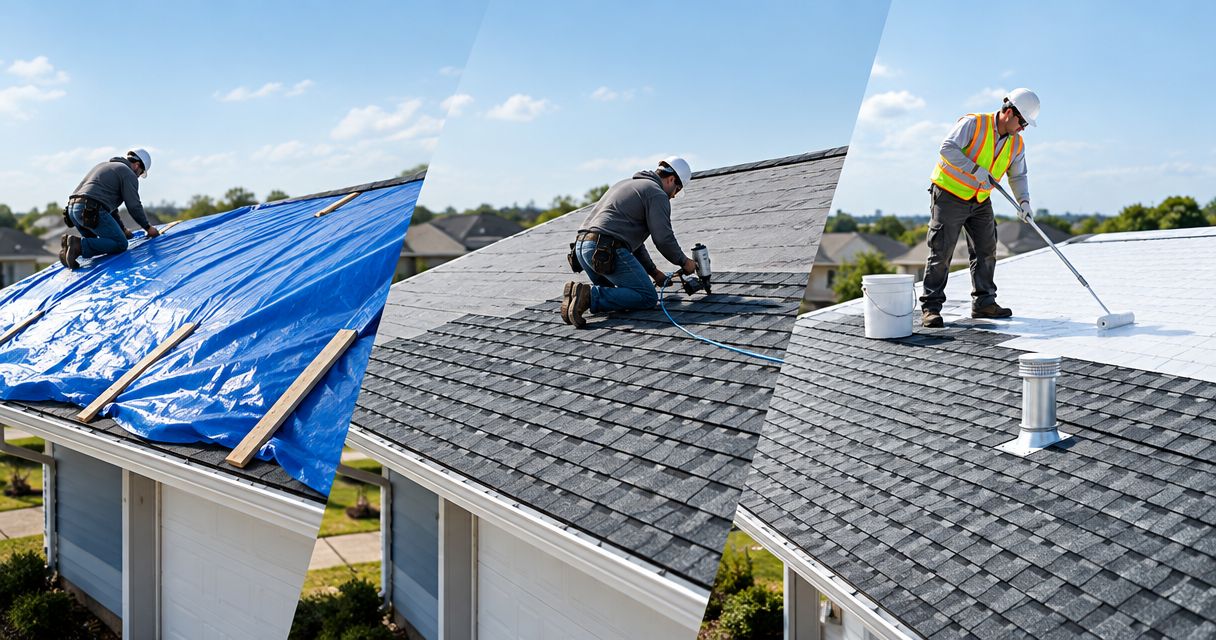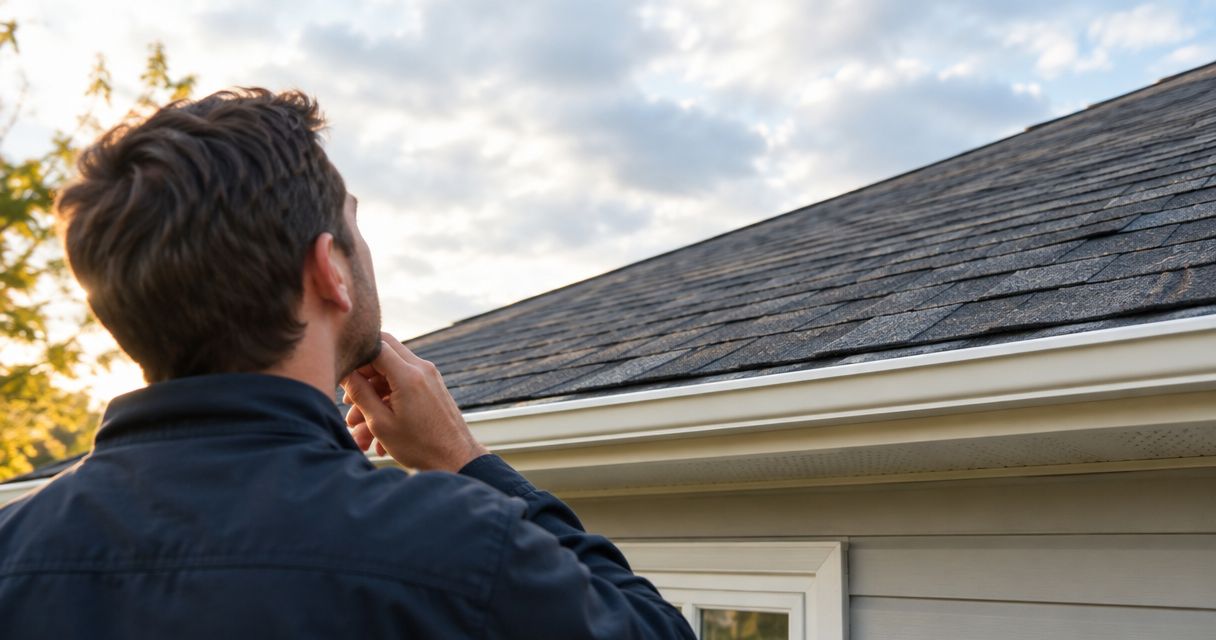
Yes—roof hail damage can be invisible from the ground because distance, roof slope, and surface texture hide small impact marks and cracks. A roof can also have hail-related damage without an active leak, so a dry ceiling and an unchanged appearance do not establish that the covering is intact.
- Invisible roof hail damage cannot be ruled out by a ground-level check or the absence of leaks.
- Asphalt shingles need close examination because granule loss alone does not establish hail damage.
- Dented gutters support a storm investigation, but they do not prove the roof covering needs replacement.
- Document roof conditions before deciding on repairs or submitting a hail damage claim.
Why this matters
A ground-level check is a screening step, not a clean bill of health. The distinction matters after a 2026 hailstorm: overlooking a damaged covering and replacing an undamaged roof are both decisions made without enough evidence.
If you contact Murray Inspection Services, make the question specific: what observable evidence distinguishes hail damage from ordinary wear? Ask for the location, photographs, and explanation behind each finding rather than a blanket statement that the roof passed or failed.
Can roof hail damage be invisible from the ground?
Yes. Hail can leave localized damage that blends into the roof when viewed from a driveway or yard. Distance hides detail, while overlapping shingles and changes in roof slope obscure surfaces altogether.
A close examination provides different evidence from a ground survey. Neither an overhead photograph nor an attic check answers every question about the roof covering.
| Examination method | Best for | Main advantage | Main limitation |
|---|---|---|---|
| Ground observation | Initial storm screening | Identifies displaced materials and visible collateral damage without roof access | Cannot resolve small surface defects or concealed areas |
| Drone photographs | Mapping visible roof conditions | Records roof planes and areas difficult to see from the yard | Cannot establish material condition through touch or show everything beneath overlaps |
| Close roof examination | Evaluating suspected impact damage | Allows detailed examination of accessible roofing and flashing | Requires safe access and interpretation of look-alike defects |
| Interior or attic examination | Investigating moisture symptoms | Helps locate staining, dampness, and visible underside conditions | Does not rule out exterior damage when the interior is dry |
Use each method for the question it can answer. A drone photograph can locate a suspicious area; a close examination can evaluate its surface condition. Neither automatically establishes when the defect occurred.
The strongest finding connects the location, appearance, surrounding conditions, and likely mechanism. A photograph of an isolated dark spot is not that explanation.
Asphalt shingles: small marks need context
Hail impacts can dislodge protective granules and damage the asphalt coating or reinforcing mat. From below, a small affected area can disappear into the shingle's normal color variation.
Close examination looks for a pattern consistent with impacts and checks whether the material itself has been damaged. Granule loss, fractures, and other surface changes need interpretation together—not as standalone proof.
Loose granules also occur through aging, weathering, handling, and foot traffic. Finding granules near a downspout after a storm is a reason to investigate, not a diagnosis.
For a 2026 assessment, ask the examiner to separate observed conditions from conclusions about cause. A useful explanation identifies what is damaged, why hail is the supported cause, and what other causes were considered.
Do not press, scrape, or lift shingles yourself to reproduce an inspection technique. Handling can alter the evidence and damage the roof.
Metal, tile, and membrane roofs need different evidence
Hail does not produce the same damage signature on every roof material. A shingle checklist cannot establish the condition of a metal panel, tile, or low-slope membrane.
| Roof covering | Best inspection focus | What the evidence helps establish | Important limitation |
|---|---|---|---|
| Asphalt shingles | Surface condition and material integrity | Whether suspected impacts damaged the covering | Granule loss alone does not establish cause |
| Metal panels | Dents, seams, finishes, and penetrations | Whether deformation affects more than appearance | A dent alone does not establish a leak or replacement need |
| Tile or slate | Cracks, displaced pieces, and overlaps | Whether individual units have fractured or moved | Some areas remain concealed without further investigation |
| Low-slope membranes | Punctures, splits, seams, and underlying support | Whether the waterproofing assembly has visible damage | Surface appearance does not reveal every underlying condition |
A metal roof can show dents without an open water-entry path. Conversely, a small crack or puncture in another covering can matter even when the overall roof looks unchanged.
Match the examination to the material, not to the visibility of the damage from the street. Repair recommendations should explain the affected component and its function.
Why invisible roof hail damage is hard to identify
Several conditions make hail damage difficult to recognize without close examination:
- Viewing distance: Small fractures and surface changes disappear when viewed from the yard.
- Roof geometry: Valleys, upper slopes, and areas behind dormers hide portions of the covering.
- Surface texture: Shingle granules and patterned finishes obscure localized marks.
- Lighting: Glare, shadows, and changing viewing angles alter how impact marks appear.
- Existing wear: Aging, prior repairs, and earlier damage complicate the explanation of new findings.
- Material response: Different roof coverings dent, crack, split, or lose surface material differently.
These factors explain why an unchanged appearance is weak evidence. They do not establish that damage occurred.
Hail size alone is also not a diagnosis. Material condition, impact angle, wind, and the support beneath the covering affect the result. A report should explain the actual roof findings rather than assume an outcome from a storm description.
What should you do after a suspected hailstorm?
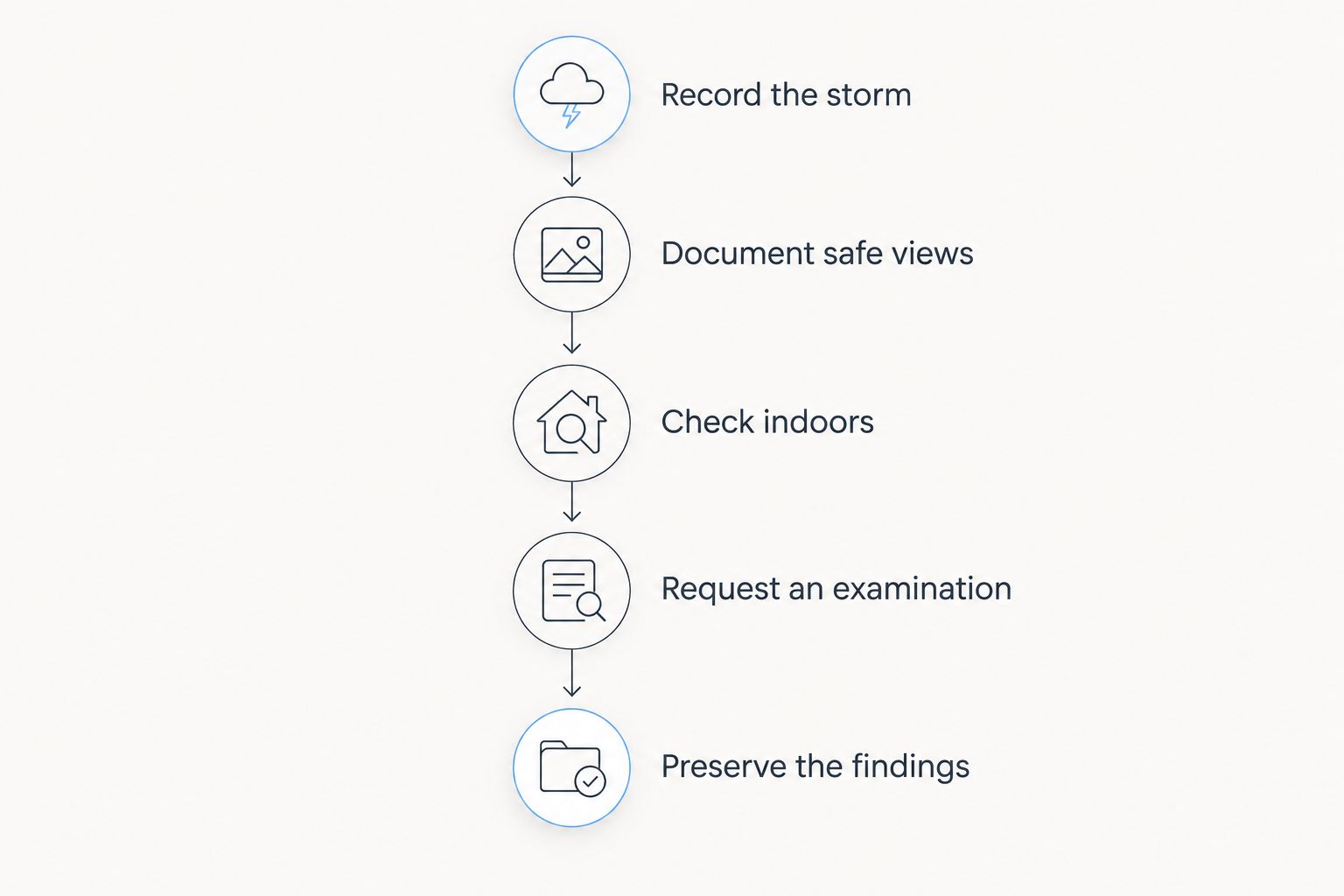
Start with safe documentation, then arrange an examination suited to the roof and the symptoms. Do not climb onto the roof to decide whether an inspection is necessary. Wet surfaces, loose materials, and access hazards make that a poor screening method.
- Record the storm. Note the date, approximate time, and what you observed. Keep original photographs and distinguish direct observations from information supplied by others.
- Document safe views. Photograph roof slopes from the ground, along with visible damage to gutters, downspouts, siding, or other exterior surfaces. Do not enter an unsafe area for a better picture.
- Check indoors. Look for new staining, dripping, or damp materials in safely accessible spaces. Record where each symptom appears, but do not assume it identifies the exterior entry point.
- Request an examination. Describe the storm and symptoms without directing the examiner toward a predetermined diagnosis. Ask what areas can be examined and what limitations remain.
- Preserve the findings. Keep the report, photographs, communications, and any repair documentation together. Ask for clarification before treating an uncertain finding as confirmed hail damage.
The sequence separates your observations from the examiner's interpretation. That distinction keeps a 2026 storm record useful even when the final finding is ordinary wear rather than hail damage.
What should a roof hail damage report actually show?
A report should let you understand the finding without relying on a sales conversation. Photographs need enough context to identify the roof area, followed by close views that show the condition being discussed.
Ask for these distinctions:
- Location: Which slope, component, or roof area contains the finding?
- Condition: What is visibly cracked, displaced, punctured, dented, or otherwise changed?
- Cause: What supports hail as the explanation rather than wear, installation damage, or another mechanism?
- Consequence: Does the condition affect appearance, material integrity, drainage, or resistance to water entry?
- Limitations: Which areas were inaccessible, obscured, or outside the examination's scope?
When discussing invisible roof hail damage with Murray Inspection Services, use those questions to define the information you need. An inspection conversation is more productive when it focuses on evidence rather than a replacement promise.
A damage report and an insurance decision also serve different purposes. The report documents conditions and an opinion about cause; coverage depends on the policy and claim review. The guide to turning a hail damage report into an insurance claim addresses that next stage, but a report does not guarantee approval.
Does the shingle brand change the diagnosis?
The installed product matters when identifying its construction, installation requirements, and suitable repair materials. It does not replace evidence of damage on the actual roof.
Comparisons of asphalt shingle brands concern product selection; a post-storm diagnosis concerns the condition of the installed covering. A familiar brand name, warranty description, or impact-resistance designation cannot establish whether a particular storm damaged your shingles.
If you have installation records, make them available during the assessment. Product identification helps the examiner describe the material and helps a contractor evaluate repair compatibility later.
For a 2026 repair decision, keep those questions separate: first establish the damage, then determine which repair method and materials fit the existing roof. Choosing a replacement product before establishing damage reverses the decision process.
Can hail damage exist without a roof leak?
Yes—hail damage can exist without an active roof leak. An impact can affect the covering without immediately creating a continuous path for water into the building.
Underlayment, overlapping materials, and the location of the affected area influence whether water reaches the interior. A dry attic therefore answers a narrower question than whether the roof covering is undamaged.
The opposite distinction matters too. A leak discovered after hail does not, by itself, prove hail caused it; flashing defects, aging, and other conditions require consideration.
Does invisible damage mean you need a replacement?
No—invisible roof hail damage does not automatically require replacement. The decision depends on the confirmed damage, its distribution, the condition of surrounding materials, and whether a suitable repair is feasible.
A localized defect and widespread damage present different repair questions. Ask why the recommended scope addresses the documented conditions, and what limits a smaller repair if replacement is proposed.
Keep the physical repair decision separate from insurance coverage. A policy decision does not substitute for an explanation of what work the roof needs.
FAQ
Can I rule out hail damage by looking at my roof from the driveway?
No—a driveway view cannot rule out roof hail damage. Distance and roof geometry hide small defects, so ground observation is a screening method rather than a complete examination.
Are dents in my gutters proof that my roof has hail damage?
No—gutter dents do not prove the roof covering is damaged. They support investigating a possible impact event, but the roofing material needs its own examination.
Can a drone find all hidden hail damage?
No—a drone cannot establish every form of hail damage. Photographs document visible conditions, but they do not replace every close examination or reveal all concealed areas.
Should I wait for a leak before arranging a roof inspection?
No—an active leak is not required for hail damage to exist. Arrange an assessment based on the storm evidence and roof conditions rather than waiting for interior water damage.
Does finding shingle granules mean hail damaged my roof?
No—loose granules alone do not establish hail damage. Weathering, handling, and other causes also release granules, so the surrounding roof conditions matter.
What should I ask Murray Inspection Services about suspected hail damage?
Ask Murray Inspection Services what evidence distinguishes hail damage from wear or another cause. Request location-specific photographs, an explanation of the finding, and a clear statement of examination limits.
Will a roof inspection guarantee that insurance pays for repairs?
No—a roof inspection does not guarantee insurance payment. The findings document roof conditions, while coverage and payment depend on the policy and claim review.
One last thing
The most useful question is not whether the roof looks damaged. It is whether the evidence shows a change that affects the roof covering's function.
For homeowners contacting Murray Inspection Services about roof hail damage, the best starting point is a documented finding—not a replacement assumption. Keep that standard for any 2026 assessment, including one that finds no storm-related damage.
Related guides
- How do I know if my roof has hail damage?
- How soon after a storm should I schedule an inspection?
- Can hail damage be repaired instead of replaced?