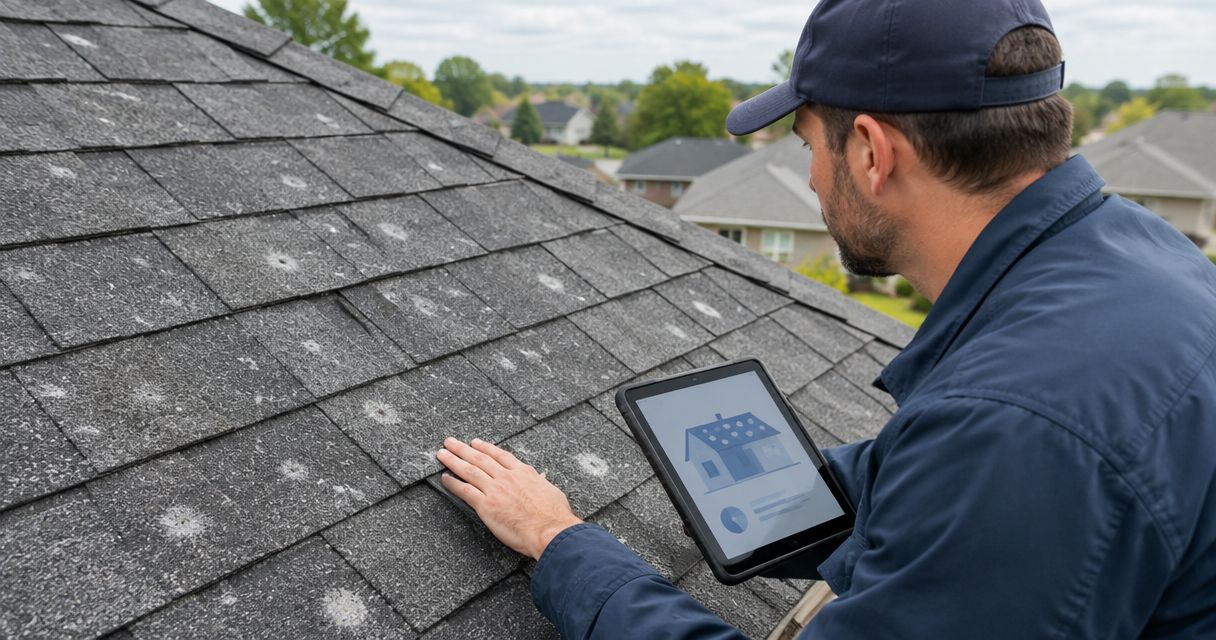
Your roof hail damage repair cost depends on the damaged area, roofing material, access, and whether the work involves isolated repairs or replacement of a larger roof section. Your out-of-pocket expense also depends on your insurance deductible, coverage terms, and any work excluded from the settlement. For a 2026 decision, get a written damage assessment and an itemized repair scope before comparing totals.
- Roof hail damage repair cost depends on documented damage and repair scope, not hail size alone.
- Compare roof repair and replacement bids using the same measurements, materials, and exclusions.
- Insurance deductibles and settlement terms affect your out-of-pocket expense separately from the contractor’s total.
- Considering Murray Inspection Services? Request written findings before comparing hail damage repair bids.
Why this matters
A repair estimate and an insurance settlement answer different questions. The estimate describes the work a contractor proposes; the settlement describes what an insurer accepts under your policy.
Confusing those documents makes a seemingly straightforward repair harder to budget. Before choosing a contractor, separate the physical damage, proposed construction work, and insurance payment into distinct decisions.
If you are considering Murray Inspection Services, ask what the assessment includes and what written documentation you will receive. Do not assume an inspection includes repairs, insurance representation, or a replacement estimate.
How much does roof hail damage repair cost?
There is no single repair total that applies to every hail-damaged roof. The useful comparison is the cost of completing the same documented work—not the difference between unrelated headline estimates. Your 2026 estimate should identify the damaged components and explain why the proposed repair addresses them.
| Repair approach | Best for | Main advantage | Main limitation | What the estimate should establish |
|---|---|---|---|---|
| Localized repair | Isolated damage with surrounding materials that remain serviceable | Limits work to the affected area | Adjacent materials must tolerate the repair process | Exact repair locations and replacement components |
| Roof-section replacement | Damage concentrated on a defined roof section | Addresses a continuous damaged area | Transitions and matching require attention | Section boundaries, tie-ins, and material compatibility |
| Full roof replacement | Widespread damage or conditions that prevent a sound localized repair | Allows work across the entire roof assembly within the agreed scope | Includes more construction work than a localized repair | Evidence supporting replacement and every included layer |
These are scope categories, not interchangeable offers. A contractor proposing replacement should explain why repair is unsuitable; a contractor proposing a patch should explain how surrounding materials will remain intact.
Ask for photographs tied to locations on the roof. A collection of close-up images without orientation is harder to connect to a specific repair quantity.
Localized hail damage repair
Best for: documented damage confined to repairable components. Localized work can include replacing affected roofing pieces or repairing damaged flashing and accessories, depending on the roof system.
The advantage is a narrower construction scope. The limitation is that removing damaged pieces also requires handling surrounding materials, and their condition affects whether the repair is practical.
Ask the contractor to identify the repair boundaries and explain how replacement materials connect to the existing roof. The proposal should distinguish between restoring weather protection and achieving a matching appearance; those are separate concerns.
Do not accept a repair recommendation based only on the absence of an indoor leak. A dry ceiling does not establish that every exterior roofing component remains undamaged.
Roof-section replacement
Best for: damage concentrated on a continuous section where section replacement is technically appropriate. This approach replaces a defined portion of the roof rather than scattered individual pieces or the entire covering.
Its advantage is a clearer construction boundary. Its limitation is the transition between new and existing materials, especially around ridges, valleys, walls, and adjoining roof sections.
Request a drawing or marked photographs showing exactly where the work starts and stops. The estimate should explain which flashing, underlayment, and accessories belong to that section and which existing components will remain.
A section-level proposal should not leave you guessing whether associated drainage details are included. Resolve those boundaries before signing, not after materials are removed.
Full roof replacement after hail damage
Best for: documented widespread damage or a roof condition that makes localized repair unsuitable. Replacement should follow the findings, not simply the fact that a hailstorm occurred nearby.
The advantage is the ability to address the agreed roof assembly across the entire replacement area. The limitation is a broader project, with more materials, removal work, and opportunities for exclusions to affect the final scope.
Ask whether the proposal includes removal of existing roofing, disposal, underlayment, flashing, ventilation components, and treatment of damaged decking. Not every component automatically requires replacement, but every inclusion or exclusion should be explicit.
If replacement is proposed, request an explanation that connects observed damage to that recommendation. Storm timing alone does not describe the condition of your roof.
Why roof hail damage repair cost varies
For your 2026 comparison, examine the construction variables before discussing financing or insurance reimbursement. These factors explain why two roofs—or two proposals for the same roof—can involve different amounts of work.
- Damage extent: Scattered component damage creates a different scope from damage across several roof sections.
- Roofing material: Shingles, metal, tile, and membrane systems require different repair methods and connection details.
- Roof geometry and access: Slope, height, valleys, penetrations, and staging conditions affect how crews reach and perform the work.
- Underlying condition: Damaged decking or other concealed deterioration adds work when it falls outside the original scope.
- Removal and disposal: A proposal that includes tear-off and debris handling is not equivalent to one that excludes them.
- Required construction details: Flashing transitions, underlayment, ventilation, and applicable code requirements affect what a complete repair includes.
Roof measurements also need consistent units. One roofing square equals 100 square feet of roof surface. Roof surface area is not the same as the building’s floor area because slope, overhangs, and roof shape affect the measurement.
Pitch describes slope rather than damage severity. A 4:12 roof pitch rises 4 inches for every 12 inches of horizontal run; it does not mean a roof needs replacement. Ask contractors to identify their measured area and explain any material allowance separately.
What should a hail damage estimate include?
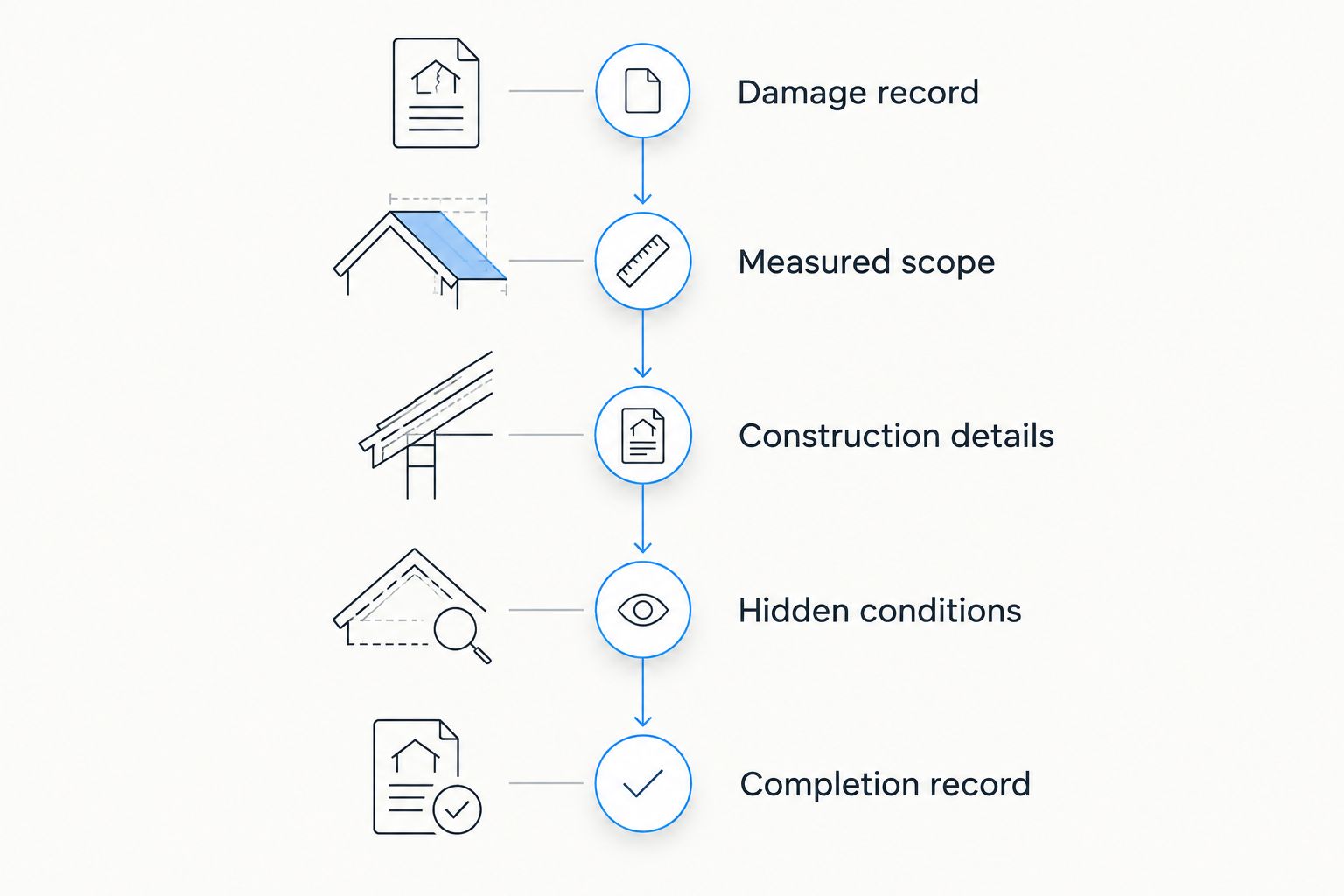
A usable estimate lets you connect each task to a damaged location or a necessary construction detail. Use this sequence to review a 2026 proposal before you authorize work.
- Damage record: Match photographs and written observations to identifiable roof areas. Separate suspected hail impacts from other observed conditions.
- Measured scope: Confirm the repair area, material quantities, and components scheduled for removal or replacement.
- Construction details: Identify underlayment, flashing, fasteners, transitions, ventilation work, and disposal where applicable.
- Hidden conditions: Require a written process for documenting concealed damage and approving additional work.
- Completion record: Agree on the photographs, invoices, and warranty documents you will receive when the work ends.
Keep the original assessment alongside the proposal. If the scope changes, ask for the reason in writing so you can distinguish a newly discovered condition from a change in your preferences.
How do you compare repair and replacement estimates fairly?
Start by checking whether the contractors are solving the same problem. An isolated shingle repair and a full replacement are not competing bids until you understand why each contractor chose that scope.
When comparing roof replacement estimates, reconcile roof area, tear-off, flashing, underlayment, disposal, and exclusions before treating the totals as comparable. A shorter proposal does not establish that the same work is included.
Then review the assumptions. One contractor might include replacement of particular flashing while another proposes retaining it; neither description should remain vague. Ask each contractor to explain how the proposed detail will maintain weather protection.
For homeowners considering Murray Inspection Services, the best cost comparison starts with a written damage scope. Keep the assessment separate from the contractor’s sales recommendation so each proposed repair can be checked against documented conditions.
A bid comparison should end with resolved questions, not simply a preferred total. If a contractor cannot explain an exclusion or a replacement recommendation, request clarification before committing.
How does insurance change what you pay?
Insurance changes the payment calculation, not the physical damage. Your responsibility depends on policy coverage, the applicable deductible, the insurer’s accepted scope, and the settlement terms.
Review whether your policy settles covered roof damage on a replacement-cost or actual-cash-value basis. Replacement-cost coverage and actual-cash-value coverage treat depreciation differently; the policy and settlement documents determine how that distinction applies to your claim.
Keep these categories separate when reviewing your 2026 paperwork:
- Contractor scope: The construction work you authorize.
- Insurer-approved scope: The work the insurer accepts under the claim.
- Deductible: The portion assigned to you under the applicable policy terms.
- Depreciation: The adjustment shown in the settlement, including any conditions for recovery.
- Excluded work: Repairs or upgrades outside the accepted coverage.
If the contractor’s findings and the insurer’s scope differ, identify the disputed components rather than treating the disagreement as one unexplained gap. Photographs, measurements, and item descriptions make that discussion more specific.
A hail damage report and insurance claim should connect through documented findings. A report supports the claim review; it does not guarantee approval or payment.
Should you repair the roof before the claim is settled?
Separate urgent protection from permanent reconstruction. An active leak calls for prompt protective action, but you should document the condition and review your policy’s instructions before authorizing broader work.
Photograph visible damage from a safe location, preserve invoices for emergency measures, and notify the insurer according to your policy. Do not climb onto a damaged roof to collect evidence.
For permanent repairs, confirm the work scope, payment responsibilities, and claim status before signing an agreement. Ask how changes will be handled if the insurer’s accepted scope differs from the contractor’s proposal.
Avoid signing a contract you have not read simply because a storm affected the neighborhood. Your roof’s condition, your policy, and the agreement you sign—not a neighboring project—govern your decisions.
Can you estimate hail repair from ground-level photos?
Ground-level photographs can document visible conditions, but they do not establish the condition of every roof component. Close-up examination and roof-specific measurements are needed to define many repair scopes.
Dents on gutters or other exposed metal can support a record of storm impacts. They do not, by themselves, prove that every roof surface requires replacement.
Use photographs to organize questions, not to assign yourself a final scope. If you contact Murray Inspection Services, ask how findings will distinguish observed damage, inaccessible areas, and conditions requiring further evaluation.
FAQ
What determines roof hail damage repair cost in 2026?
Roof hail damage repair cost depends on the documented damage, roofing material, measured repair area, access, and included construction work. Your insurance deductible and settlement terms separately affect your out-of-pocket expense.
Is repairing hail damage better than replacing the whole roof?
Repair is appropriate when the damaged area can be restored without compromising surrounding roofing. Full replacement requires a roof-specific explanation, such as widespread damage or conditions that make localized repair unsuitable.
Does homeowners insurance always cover hail damage?
Homeowners insurance does not automatically cover every hail-related repair. Coverage depends on your policy, exclusions, applicable deductible, and the insurer’s assessment of the claimed damage.
Can my roof have hail damage without leaking?
A roof can have hail damage without an indoor leak. The absence of a ceiling stain does not establish that the exterior covering and associated components are undamaged.
Why are my roof repair estimates so different?
Roof repair estimates differ when contractors use different measurements, repair boundaries, materials, or exclusions. Compare the written scopes before comparing totals, and ask each contractor to explain repair versus replacement recommendations.
How many square feet are in a roofing square?
A roofing square equals 100 square feet of roof surface. Ask whether the estimate separates measured roof area from additional material allowances.
What should I ask Murray Inspection Services before arranging an assessment?
Ask Murray Inspection Services what the assessment includes, what documentation you will receive, and which areas can be evaluated. Confirm whether any repair estimate or follow-up evaluation is a separate service.
One last thing
Before approving a 2026 hail repair proposal, ask: What happens if removing the damaged material reveals another problem? The answer should identify who documents the condition, who authorizes additional work, and how the scope changes.
That question exposes uncertainty before construction begins. A clear change-approval process protects your ability to make decisions when the roof is open and the original estimate no longer describes every necessary task.
Related guides
- How do I know if my roof has hail damage?
- From roof inspection to contractor bid comparison
- How to use a roof inspection to negotiate an insurance settlement