
Yes, you can customize a move-in ready home before closing if the seller or builder agrees to the specific changes in writing. An already-built home does not include an automatic right to alterations; confirm the work, responsibility, and effect on closing before you commit.
- Can you customize a move-in ready home before closing? Yes, with the seller’s written agreement—not an automatic entitlement.
- Murray Custom Homes offers Semi-Custom Homes for buyers who want selected features without directing every design decision.
- Separate requested upgrades from unfinished work and defects; document each category independently.
- Choose an already-built home for its existing layout, not for alterations the seller has not approved.
Why this matters
A home can feel almost right while still missing something important: different cabinet hardware, more useful storage, or a kitchen finish you prefer. The question is whether that difference belongs in the purchase agreement, a later renovation, or a different home search.
Murray Custom Homes expresses its approach as “We Create Luxury Living,” supported by in-house drafting, design guidance, blueprints, and 3D renderings. For buyers considering a 2026 purchase, the practical starting point is deciding how much design participation they want—not assuming an already-built home can become a blank canvas. Learn about the builder’s background on the About Us page.
Choose the home for what it is today, then negotiate any changes you need before closing. That distinction keeps a desirable finish from distracting you from a layout that does not fit your life.
Can you customize a move-in ready home before closing?
Yes, when the seller accepts your request and the purchase documents reflect the agreement. Ask about customization before making your offer dependent on a particular result. A conversation about possibilities is not the same as authorization to proceed.
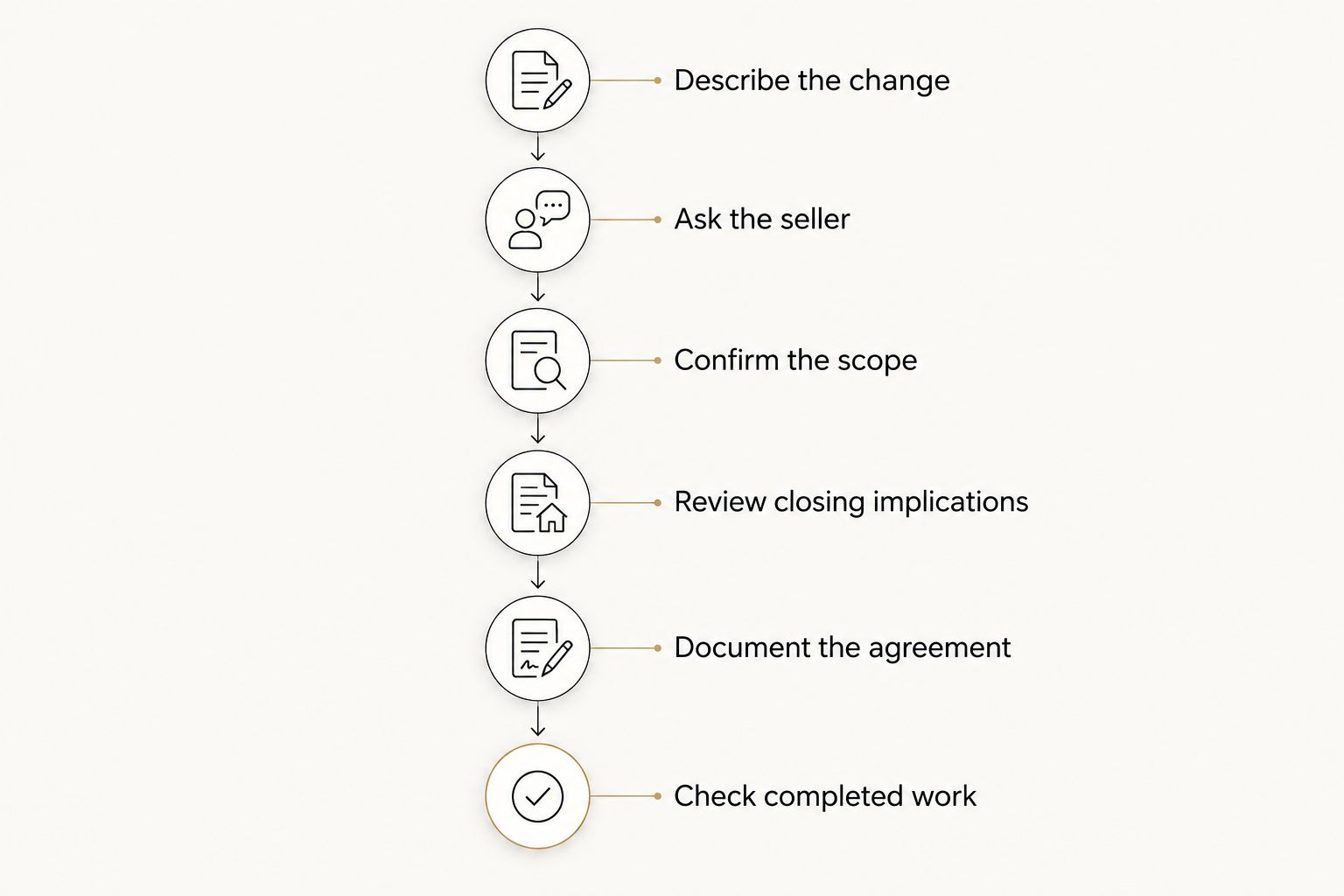
Use this sequence to turn a preference into a clear decision:
- Describe the change. Identify the room, existing feature, desired replacement, and any work you expect it to include.
- Ask what the seller will consider. Establish whether the request belongs before closing or after you own the home.
- Confirm the scope. Specify materials, finish, installation responsibility, and what happens to removed items.
- Review closing implications. Ask your agent, lender, and closing professional which approvals or documents your transaction needs.
- Document the agreement. Put the accepted scope and completion expectations into the appropriate written documents.
- Check the completed work. Compare the result with the agreement rather than relying on memory during the walkthrough.
For a 2026 purchase, make this a transaction-specific checklist. A seller’s answer about one home does not establish what another seller—or another completed home—will allow.
Which home option gives you the right amount of choice?
Murray Custom Homes Semi-Custom Homes are best for buyers who want to choose selected features and leave remaining decisions to the builder. That is a different buying experience from negotiating changes to an already-built home.
Keep these three options distinct when deciding where to focus your search:
| Home option | Best for | Main advantage | Main limitation |
|---|---|---|---|
| Semi-Custom Homes | Buyers who want selected design choices | You participate in selected features without directing every decision | Not every feature is a buyer selection |
| Move-in-ready homes | Buyers who prefer to evaluate an already-built home | You can assess the existing rooms, finishes, and layout | Pre-closing changes require separate agreement |
| Custom Homes | Buyers who want a home shaped around their preferences | Design begins with your priorities and distinctive features | You need to participate in a broader set of decisions |
If your wish list concerns selected finishes, start by discussing Semi-Custom Homes. If you love a completed home as it stands, assess that home without assuming alterations. If your priorities require a different layout or a distinctive combination of spaces, keep Custom Homes in the conversation.
The guide to features to prioritize when choosing a semi-custom home helps frame those preferences before you settle on a purchase path.
Why pre-closing customization varies
There is no universal customization menu for completed homes. Your request needs an answer tied to the specific property, the proposed work, and the transaction.
Focus your discussion on these factors:
- Existing construction: Identify what is already installed and what must be removed or disturbed.
- Requested scope: Distinguish a finish substitution from work affecting cabinetry, walls, plumbing, or electrical systems.
- Seller agreement: Establish whether the seller accepts the work and who has authority to approve it.
- Closing requirements: Ask the professionals handling your purchase how the proposed work affects their requirements.
- Completion responsibility: Identify who performs, checks, and accepts the work, including any follow-up.
- Documentation: Make sure descriptions, selections, and completion expectations match across the relevant documents.
Do not substitute a general promise of flexibility for answers to these questions. An acceptable request has a defined scope and an identified decision-maker. Without both, you are still discussing an idea rather than an agreed change.
What should you put in a customization request?
Write a short scope that someone unfamiliar with your conversation can understand. A photograph can communicate appearance, but it should not replace a written description of the work you expect.
For each requested change, include:
- The room and exact location.
- The existing item or finish.
- The requested replacement or modification.
- The selection details that still need approval.
- Who supplies and installs the materials.
- Whether related repairs or finishing work are included.
- The agreed completion point and method of confirmation.
For example, replacing cabinet hardware is not a complete scope if nobody has addressed existing holes, handle dimensions, or repairs to cabinet fronts. The visible item is only part of the request; the surrounding work matters too.
Keep your 2026 request list separate from your inspection findings. A personal preference asks for a different result. A defect or unfinished contractual item raises a different question: whether the home meets the applicable agreement. Ask your agent to help you document each without blurring the distinction.
Can you change kitchen finishes before closing?
Yes, if the seller agrees to the specific kitchen changes; do not assume that every visible finish is interchangeable. State what you want to retain as clearly as what you want to replace.
Start with the kitchen’s existing layout. Decide whether your concern is appearance, storage, or how the room functions. A different handle finish addresses appearance, but it does not change drawer placement or create more counter space.
When comparing cabinet hardware finishes, consider them alongside the faucet, lighting, and cabinet fronts rather than treating each metal finish as an isolated choice. Then ask the seller to confirm the exact replacement and any work needed to accommodate it. That keeps a styling preference from becoming an undefined installation request.
If the kitchen only works for you after substantial changes, revisit whether this completed home is the right match. Do not let an unapproved kitchen redesign become the reason you buy the house.
Is it better to customize before or after closing?
Before closing is the right point to establish any change your purchase depends on. After closing is an alternative to discuss for preferences you can defer, provided you understand who will perform the work and what approvals it requires.
Neither route removes the need for a written scope. Before closing, the question is whether the seller will agree and how the work fits the transaction. After closing, the question shifts to your own project planning and contractor arrangements.
Avoid treating unfinished pre-closing work as a casual handoff. If someone proposes completing agreed work after possession, ask your real estate and closing professionals to document responsibility, access, completion expectations, and the response if the work is not finished as agreed.
For a 2026 purchase, your decision rule should be simple: resolve essential requirements before committing; plan optional preferences without making unsupported assumptions about completion. Your purchase should still make sense if an optional change is declined.
How do you know when Semi-Custom is the better fit?
Semi-Custom is the better starting point when selecting features matters more to you than purchasing one particular completed home. It lets you discuss choices as part of the homebuilding approach instead of trying to reopen decisions in an already-built property.
Murray Custom Homes provides in-house design guidance through Meghan Murray, alongside drafting, blueprints, 3D renderings, and construction and project management. Its project managers bring more than 20 years of combined experience. Those services give buyers defined subjects to discuss: the design, the selections, and how the project is managed—not an assumed promise that every late change is possible.
The homebuilding service area is a stated 50-mile radius of Lincoln, Nebraska, and the builder can build on a client’s existing lot. For your 2026 plans, confirm the proposed location and the appropriate home option before developing a detailed selection list.
Bring your must-haves and your flexible preferences to a conversation through the Contact Us page. Ask which path fits the decisions you want to make: Semi-Custom, an already-built home, or Custom.
FAQ
Can you customize a move-in ready home before closing?
Yes, if the seller or builder agrees to the specific changes in writing. Confirm the scope, completion responsibility, and effect on closing before relying on the change.
Can I choose different paint or cabinet hardware before I close?
You can request different paint or cabinet hardware, but the seller must accept the request. Document the exact finish, installation scope, and any related repair work rather than assuming a cosmetic change is automatically included.
Can I change the floor plan of an already-built home?
Do not assume that a floor-plan change is available in an already-built home. If a different layout is essential, discuss the proposed work with the seller and compare the property with a Custom Home approach before committing.
Is a semi-custom home better if I want to choose finishes?
A Semi-Custom Home is the better starting point when you want selected feature choices rather than an already-set collection of finishes. Murray Custom Homes describes Semi-Custom as choosing selected features and leaving remaining decisions to the builder.
Should I wait until the final walkthrough to ask for upgrades?
No—raise purchase-dependent upgrades before you commit, not at the final walkthrough. Use the walkthrough to compare agreed work with the written scope and record unresolved items through the appropriate transaction process.
Can I arrange the changes after I own the home instead?
Yes, you can plan optional changes as a separate project after closing, subject to the work’s requirements and necessary approvals. Do not assume the seller will perform that work unless a written agreement establishes the responsibility.
What if the seller refuses a change I really need?
If the seller refuses an essential change, reassess whether the home fits your needs before proceeding. Separate a genuinely necessary feature from a preference you are comfortable addressing later.
One last thing
The most revealing test is not whether the seller will change a finish. It is whether you would still want the home if the answer were no.
Before signing, divide your list into essential before closing, acceptable later, and not necessary. If the first category contains major layout changes, consider Semi-Custom or Custom rather than asking a completed home to become a different house.
Related guides