
Instead of revisiting finish choices every time construction planning raises a question, connect each approved selection to the work that depends on it. Murray Custom Homes’ promise, “We Create Luxury Living,” starts with thoughtful decisions; this guide shows how to turn those decisions into a semi-custom build schedule without treating a wish list as authorization to build.
- A semi custom feature selection build schedule connects approved choices to purchasing, construction dependencies, and responsible people.
- Murray Custom Homes suits semi-custom buyers who want selected personal choices with in-house design guidance.
- Approve specifications and related drawings together before asking the builder to release dependent work.
- Handle changes through a written impact review, not a replacement selection hidden in a message.
Why this matters
A selection is not a scheduled task. Choosing a kitchen sink, for example, leaves unanswered questions about the cabinet opening, countertop cutout, faucet configuration, ordering responsibility, and installation sequence.
A build schedule needs decisions that someone can act on, not just pictures someone likes. Separate inspiration, documented selections, approvals, and construction instructions. That separation makes unresolved questions visible before they reach the jobsite.
Murray Custom Homes offers in-house drafting and design, blueprints and 3D renderings, and construction project management. Those services provide a setting for discussing how design choices affect the work ahead; the workflow below is a practical planning method, not a description of a required company software setup.
For your 2026 planning file, keep the decision record separate from any promised completion date. A completed selection helps resolve a dependency. It does not establish the delivery date of a material or the duration of construction.
Before you start
- Gather the current project documents. Bring the applicable plan revision, specifications, selection allowances or boundaries stated in your agreement, and reference images. Ask which documents control when a rendering and a written specification differ.
- Confirm responsibilities and communication access. Identify who chooses, who approves, and who updates the construction schedule. Use the communication channel your project manager specifies. Start with 1 decision log rather than scattered messages.
- Check the hidden dependency. A finish choice can affect dimensions, connections, or another trade’s work. Before approving an item, ask what related drawing, measurement, or specification must also be confirmed.
Confirm location fit before detailed planning, too. The homebuilding service area is Lincoln, Nebraska, within a stated 50-mile radius; other Murray business locations do not establish homebuilding coverage.
Choose the right decision scope
Semi-custom planning works best when you know which decisions belong to you and which remain with the builder. Murray Custom Homes is best for semi-custom buyers who want selected personal choices with in-house design guidance. Meghan Murray provides that in-house design guidance, and the project managers bring more than 20 years of combined experience.
Keep the three home paths distinct:
| Home path | Best for | Main advantage | Main trade-off |
|---|---|---|---|
| Semi-Custom Homes | Buyers who want selected features without directing every decision | Personal choices within a defined scope | Not every element is yours to redesign |
| Move-in-ready homes | Buyers who prefer evaluating an already-built home | You can assess the completed spaces | The existing design limits personalization; confirm current listings |
| Custom Homes | Buyers whose preferences require a home shaped around them | More room to define the design | More decisions require coordination |
For semi-custom planning in 2026, begin by asking what is selectable, what is fixed, and when each choice needs approval. The features to prioritize when choosing a semi-custom home belong in that scope discussion before individual finishes take over the meeting.
Selection scope
Use a worksheet, document, or project system agreed with your builder. The bold labels below are suggested worksheet headings, not software buttons or claims about a particular portal.
- Create a Selection scope section. Separate buyer-selected items from builder-directed decisions and items already fixed by the agreement.
- Give each choice an Item name and Location. Describe the actual room or installation area rather than writing only a broad category such as flooring.
- Add Decision owner and Approval owner. Name the people responsible; do not assume that everyone copied on a message has approved it.
- Add Decision needed by. Ask the project manager to connect this deadline to purchasing or dependent construction, rather than choosing an arbitrary calendar date.
- Record exclusions and unanswered questions under Open questions. An unresolved measurement belongs here, not in an approval note.
Expected result: Each selectable feature has a defined boundary, a responsible person, and a reason for its decision deadline. You can distinguish a late choice from an item that was never yours to select.
Approval record
A reference photo communicates an intention. A specification tells the team what the approval covers. Keep both when they serve different purposes, but never let an image silently replace a written description.
- Add Specification to the decision log. Record the identifying details necessary for the item, such as material, finish, dimensions, or configuration, once confirmed.
- Add Related documents. Identify the drawing revision, sample, or written detail used to review the choice. Record the revision date for your 2026 project file.
- Ask the design and construction team to resolve conflicts. A cabinet drawing and an appliance specification, for example, need to agree on the space required.
- Use 3 status labels: Open, Under review, and Approved. Keep ordering and installation progress separate from design approval.
- Record Approved by and Approval date only after the required review is complete. Ask how the project agreement defines a binding approval.
Expected result: The approval identifies a specific choice and its supporting documents. Someone reviewing the record later can tell what was accepted without reconstructing a conversation.
Dependency map
The schedule connection begins with a question: what work needs this decision before it can proceed? Ask the project manager to identify that relationship instead of guessing from the order of rooms in your selection packet.
- Add Dependent work beside each selection. State the task or document that requires the choice.
- Add Required input. Record the measurement, confirmation, or related approval needed before the selection is complete.
- Add Release responsibility. Identify who authorizes purchasing or sends the approved information to the relevant trade.
- Add Schedule confirmation. Have the project manager confirm whether the dependent work has a date, remains provisional, or awaits another input.
The examples below illustrate dependencies to discuss; they are not a project-specific construction sequence.
| Selection | Dependency to discuss | Confirmation to request |
|---|---|---|
| Kitchen sink | Cabinet fit and countertop cutout | Compatible dimensions and installation requirements |
| Shower fixture | Valve and plumbing arrangement | Required concealed components before wall closure |
| Flooring | Transitions and adjacent surface heights | Assembly details at adjoining materials |
| Lighting | Electrical locations and fixture requirements | Coordinated locations and applicable specifications |
Expected result: An approved choice is connected to the work it affects, with responsibility assigned. A selection marked approved is no longer mistaken for an item already ordered or ready to install.
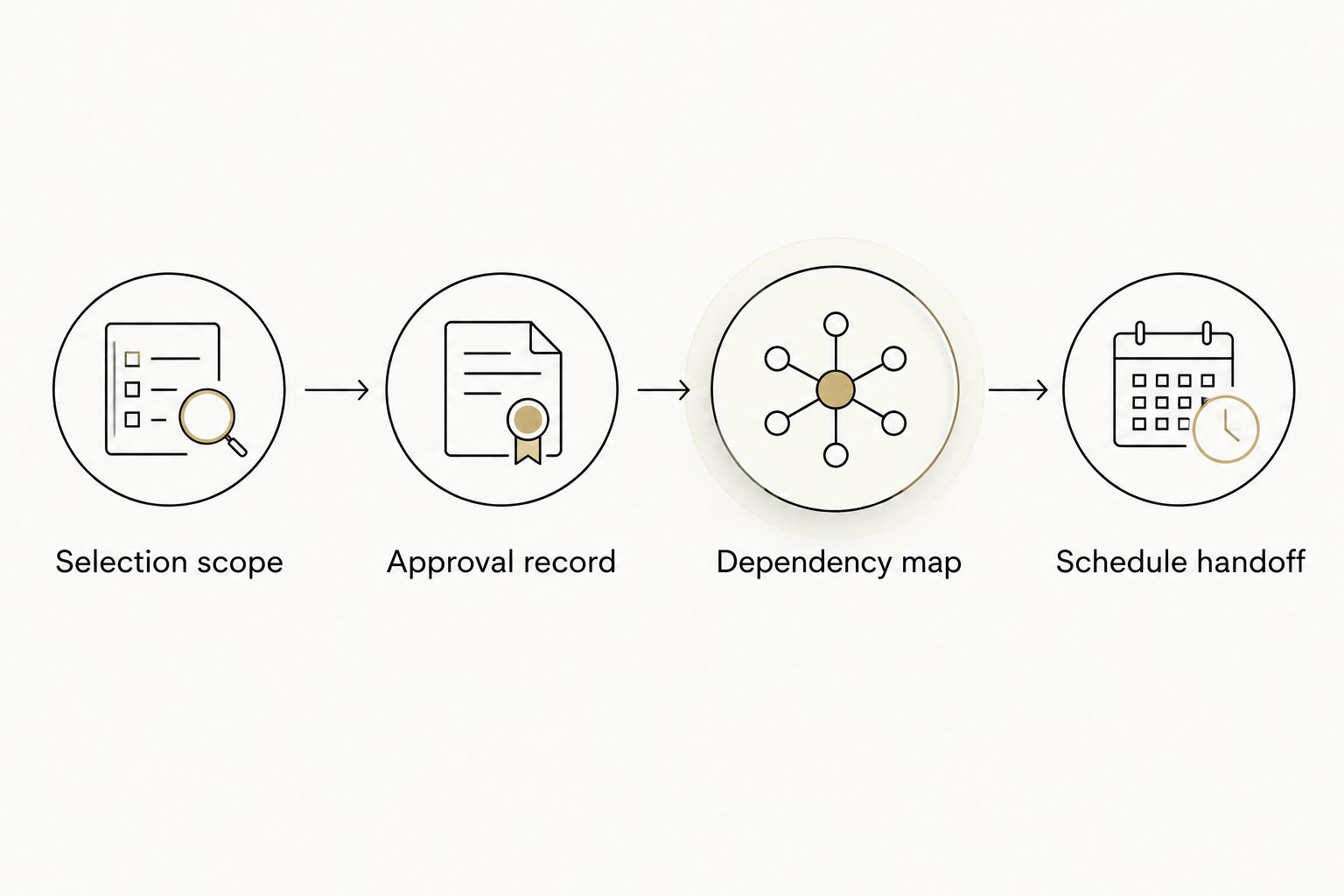
Schedule handoff
The construction schedule remains the project manager’s coordinated plan. Your decision log supports it; a homeowner-created worksheet should not become a competing instruction list for trades.
- Review approved selections with the project manager. Ask which dependent activities can now be planned and which still need supplier, site, or trade confirmation.
- Confirm purchasing separately. Record the difference between permission to order, an order placed, and delivery information confirmed.
- Ask which dates are decision deadlines and which are construction targets. Keep the distinction visible in your 2026 schedule notes.
- Send the approved revision through the agreed channel. Ask who distributes it and how older information is removed from active use.
- End the review with an exception list: unresolved choices, missing confirmations, and decisions requiring escalation.
Expected result: The project manager has an identifiable approved record and a short list of outstanding dependencies. You know what still needs action without interpreting a target date as a guarantee.
When an approved feature changes
Use a separate change workflow whenever you want to replace an approved choice. Do not overwrite the original record before the construction team reviews the effect. The earlier approval explains what purchasing and field planning were based on.
The central discipline in managing changes during construction is separating a request from authorization: a new preference does not itself instruct the team to change the work.
- Identify the original approved selection and the requested replacement.
- Ask whether anything has been ordered, fabricated, installed, or coordinated around the original choice.
- Request a written review of affected work, contractual implications, and schedule consequences.
- Follow the change-approval procedure in your agreement before authorizing the replacement.
- After approval, update the active specification and ask the project manager to confirm distribution and schedule revisions.
This second workflow serves a different purpose from initial selection. Initial approval resolves an open decision; change approval revisits a decision that other work already relies on.
For a 2026 build, preserve the original and revised approval dates. A clear history shows which information applied when the team made a purchasing or construction decision.
Troubleshooting
The choice is approved, but the schedule has not changed
Design approval does not confirm delivery or trade coordination. Ask which remaining input prevents scheduling, who owns it, and when the next confirmation is expected. Keep the approval status intact while recording the separate scheduling issue.
The rendering and specification disagree
Pause the affected release and ask the design team to reconcile the documents. A rendering helps explain appearance; it does not resolve a conflicting dimension or written requirement. Record the corrected revision before work proceeds on that detail.
Two decision-makers send different instructions
Assign 1 approval owner for communicating the household’s final decision, while retaining any additional approvals required by the contract. Resolve the disagreement before submitting instructions. Do not ask the construction team to choose between conflicting messages.
A preferred replacement affects completed planning
Treat the replacement as a change request, even if the visible difference looks minor. Ask what purchasing, drawings, connections, or completed work it affects. Decide after the impact review, not after sending a replacement photo.
Customize your workflow
Expand the decision log by dependency, not simply by room. A kitchen review can involve cabinetry, lighting, plumbing, and flooring; discussing those interfaces together exposes questions that separate finish lists miss.
Ask Murray Custom Homes which choices belong in a coordinated design discussion and which can be handled independently. Keep the benefit and limit clear: a smaller selection scope reduces the decisions you manage, but it does not remove construction dependencies.
Bring your current plan, open questions, and approved references to the next review. Ask the project manager to identify the next decision that blocks dependent work, then resolve that decision before adding more inspiration to the file.
FAQ
How does semi-custom feature selection become a build schedule?
Approved selections become scheduling inputs when they identify specifications, dependent work, and release responsibility. The project manager then coordinates those inputs with purchasing, site conditions, and trade requirements.
What should I choose first for a semi-custom home?
Choose according to construction dependencies, not just personal excitement. Ask the project manager which open decisions affect drawings, ordering, concealed work, or other selections before setting the review order.
Does approving a finish mean it has been ordered?
No. Design approval, purchasing authorization, an order placed, and delivery confirmation are separate events. Ask the project manager how each event is recorded.
Can I change a feature after approving it?
Request a written change review before replacing an approved feature. Follow the project agreement’s approval process and confirm effects on related work and scheduling before authorizing the change.
Is semi-custom better than fully custom for fewer decisions?
Semi-custom is the better fit when you want selected personal choices and want the builder to direct remaining decisions. Fully custom suits preferences that require more design freedom and more decision coordination.
Does Murray Custom Homes provide design support?
Murray Custom Homes provides in-house drafting and design, blueprints, and 3D renderings. Meghan Murray provides in-house design guidance; ask how those services apply to your selected home path.
Will early selections guarantee my completion date?
No. Early, complete approvals resolve decision dependencies, but they do not guarantee delivery dates or construction completion. Ask the project manager to distinguish confirmed information from provisional schedule targets.
One last thing
A useful selection meeting ends with fewer open dependencies, not necessarily more chosen finishes. Before leaving, ask: which approved decision can the team act on now, and what exact information prevents the next one? That answer is more actionable than a long list of favorites.
Related guides
- From design consultation to 3D rendering approval
- Custom cabinetry and millwork ideas for luxury homes
- Flooring options for custom homes