
Instead of manually relaying listings, design changes, and moving dates between your realtor and builder, coordinate your realtor search and custom home build through one shared brief, a builder-reviewed lot shortlist, and written decision checkpoints. “We Create Luxury Living” is the promise behind Murray Custom Homes, a Lincoln-based home builder best for buyers who want personal design guidance with their homebuilding process.
- For a realtor search custom home build, coordinate your agent, builder, and lender before committing to land.
- Murray Custom Homes offers Semi-Custom Homes, move-in-ready homes, and Custom Homes within a stated 50-mile radius of Lincoln.
- Have your builder review shortlisted lots before treating a floor plan or construction schedule as settled.
- Separate the current-home sale, land purchase, construction milestones, and moving arrangements in one shared record.
Why this matters
A realtor search and a construction project follow different tracks. Your agent handles the property search and transaction; your builder evaluates the proposed home and construction scope; your lender explains financing requirements. Coordination means identifying where those responsibilities meet before a decision becomes a commitment.
For a 2026 homebuilding plan, separate your desired move date from a confirmed construction milestone. A preferred date belongs in your brief, but it does not establish when your home will be ready.
Approve the location, home approach, and financing path together—not as unrelated decisions. A lot that suits your preferred neighborhood still needs review against your proposed home, site conditions, and applicable requirements.
Before you start
- Gather your decision-makers and records. Include your buying agent, builder contact, and lender. Assemble your existing-home information, financing correspondence, preferred locations, and any lot documents already obtained.
- Confirm the homebuilding area and approach. Murray Custom Homes serves a stated 50-mile radius of Lincoln and can build on your existing lot. Confirm the specific address, then decide whether Semi-Custom Homes, an already-built home, or a fully custom design deserves the first discussion.
- Check representation before signing. Ask your agent to explain the buyer-representation agreement, its scope, compensation arrangements, and any requirements involving builder introductions. Do not assume that an existing-home search agreement automatically addresses a land purchase or new-construction transaction.
For your 2026 search folder, keep signed agreements separate from working notes. A conversation summary helps coordination, but it does not replace contract language or professional advice about your obligations.
Shared search brief
Start with a brief your agent and builder can both use. You do not need specialized software: a shared document and a calendar are enough to record decisions, responsibilities, and deadlines.
Create the common reference
- Write the home objective. Describe daily needs before architectural preferences: sleeping arrangements, accessibility, work space, storage, outdoor use, and the importance of a particular location.
- Separate requirements from preferences. Mark each item as required, preferred, or open for discussion. Explain the reason behind requirements so your team can evaluate alternatives without losing the underlying need.
- Choose the initial home approach. Use the comparison below to frame the discussion. Keep alternatives visible without asking your agent to pursue every possible route equally.
- Assign 1 decision owner. Choose the person responsible for distributing approved changes. Other household members still participate; the designated owner prevents conflicting instructions from reaching different professionals.
These are suggested document labels, not software buttons or builder portal settings. Add a revision date so everyone can identify the current brief.
Expected result: Your agent can explain what to search for, and your builder can identify which preferences require further design or site review.
Compare the three home approaches
| Home approach | Best for | Main advantage | Trade-off to discuss |
|---|---|---|---|
| Semi-Custom Homes | Buyers who want selected personal choices with fewer open-ended decisions | You choose selected features and leave remaining decisions to the builder | Confirm which choices are yours before expecting fully custom flexibility |
| Move-in-ready homes | Buyers who prefer evaluating an already-built home | You can assess the completed layout and spaces | The design is already established; verify individual listings before planning around a home |
| Custom Homes | Buyers whose needs call for a home shaped around their preferences | Design discussions can center on distinctive requirements and features | More decisions require your attention and coordination |
Start with Semi-Custom Homes when guided choices fit your needs. Keep fully custom design in the conversation when a specific requirement cannot be addressed through selected features; inspect an already-built home when evaluating finished spaces matters more than shaping the design.
Lot review and builder handoff
Your agent's shortlist should become a builder-review queue, not an automatic purchase list. Start with up to 3 candidate lots as a manageable working limit, then narrow the list after reviewing the information available for each property.
Review each site before committing
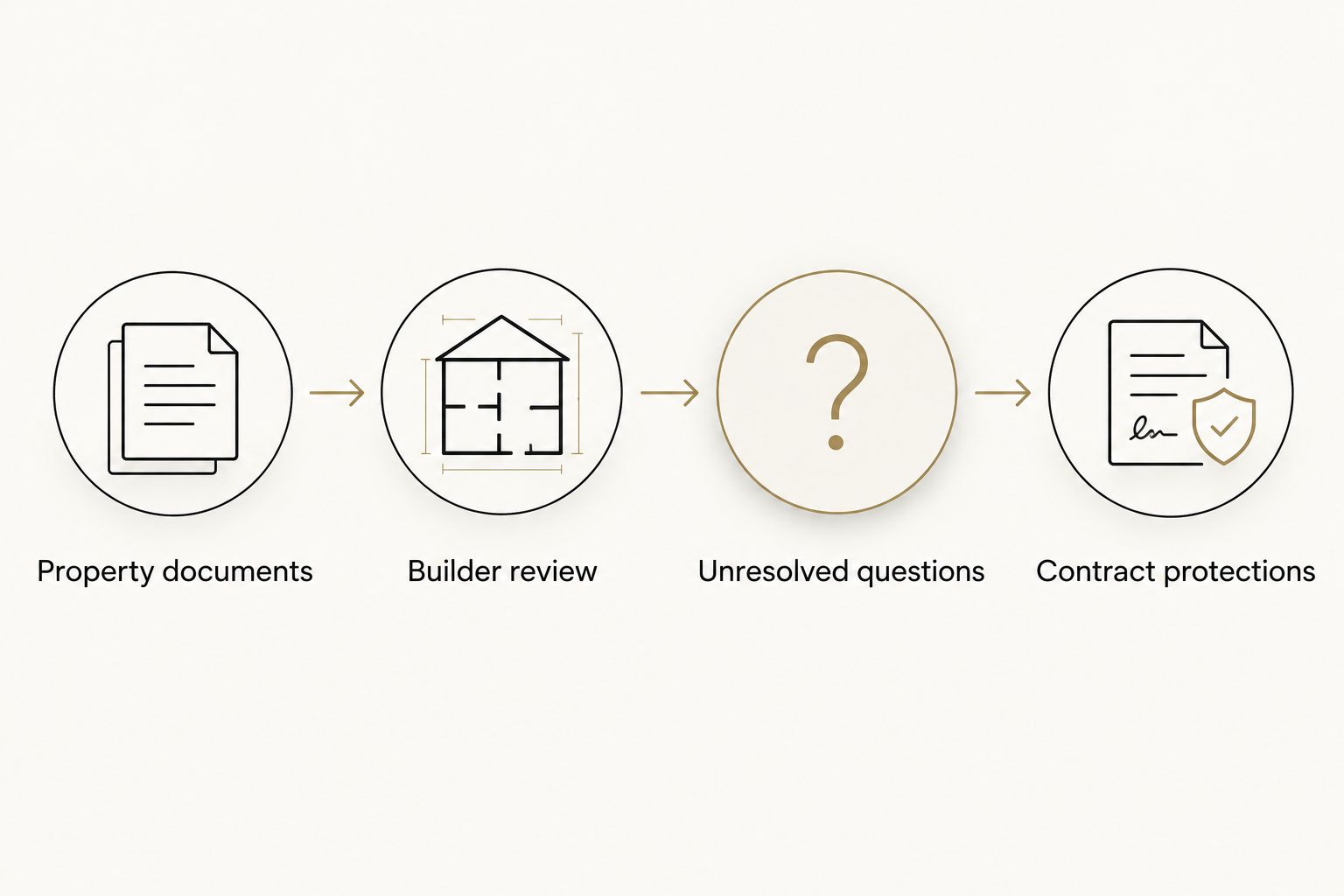
- Ask your agent for the property documents. Request the listing information, recorded restrictions, survey information if available, utility information, and relevant disclosures. Record which documents remain outstanding.
- Send the same packet to your builder. Include the address, proposed home approach, and requirements from your shared brief. Ask what additional site information is needed to assess the project.
- Identify unresolved questions. Discuss access, grading, drainage, utility connections, applicable restrictions, and how the proposed home relates to the lot. Ask the appropriate professional to verify each issue rather than treating a listing description as technical confirmation.
- Discuss contract protections before signing. Ask your agent and, where appropriate, a qualified attorney about review periods, contingencies, deadlines, and the consequences of proceeding with unresolved questions.
Expected result: Each shortlisted property has a written next step: investigate further, proceed subject to agreed conditions, or remove it from consideration.
For a 2026 lot review, use current documents and written confirmations. Information attached to an older listing does not establish the property's present status.
Financing and transaction checkpoints
Keep the land purchase, construction financing, and any existing-home sale visible as separate decisions. Your lender—not your agent or builder—must explain the financing conditions that apply to your situation.
Connect the commitments
- Confirm the financing route. Tell your lender whether you already own land, intend to purchase land, need to sell your current home, or are also considering an already-built home. Ask which documents and approvals each route requires.
- Identify dependencies. Record whether a particular approval, sale, closing, or document is needed before another commitment. Use the lender's actual requirements rather than assumptions about how construction financing works.
- Match deadlines to responsible people. Give every contractual deadline an owner. Your agent tracks transaction obligations; your builder explains construction-related decisions; your lender confirms financing requirements.
- Review the sequence before accepting terms. Ask what happens if your current home sells earlier than expected, financing needs additional documentation, or a construction milestone changes. Discuss alternatives before signing commitments that depend on one exact sequence.
Expected result: You can explain what must happen before the next commitment and who confirms that it has happened.
Keep a dated 2026 financing checklist alongside the search brief. Do not share sensitive financial records through a broadly accessible coordination document; use the secure channels your lender specifies.
Design decisions and schedule updates
A shared schedule should distinguish requested dates, contractual dates, and builder-confirmed milestones. Combining them into one undifferentiated calendar makes a preference look like a promise.
Maintain the decision record
- Establish a design reference. Identify the current drawings, specifications, and approved selections. In-house drafting, blueprints, and 3D renderings are part of Murray Custom Homes' services; ask how the current design will be documented for your project.
- Record changes before distributing them. Describe the requested change and ask your builder to explain any effect on scope, approvals, or scheduling. Do not send a revised preference to your agent as though the builder has accepted it.
- Request milestone confirmation. Ask your builder which dates are confirmed and which remain estimates. Give your agent the distinctions needed to discuss your existing-home sale or moving arrangements accurately.
- Close completed decisions. Save the approved version, record who confirmed it, and mark the earlier version as superseded. Leave unresolved items visibly open.
Expected result: Your agent, builder, and household work from the same approved decisions without mistaking a proposed change for an accepted instruction.
A brief update should answer four questions: What changed? Who confirmed it? What does it affect? Who acts next? Keep design discussion separate from permission to make a contractual commitment.
When your current home sells during the build
Run a second coordination track whenever the sale of your current home changes. This is an adjacent workflow, not a reason to restart the design process.
- When you receive an offer: Ask your agent to explain the proposed closing and possession terms, then check the implications with your lender and builder before responding.
- When a sale deadline changes: Update the shared schedule and identify the commitments affected. Do not assume the construction schedule moves with the sale.
- When moving arrangements need a decision: Check the latest builder-confirmed information and discuss a fallback if the dates do not align.
- When a sale falls through: Ask your lender which financing assumptions need review, then tell your builder and agent which decisions require a pause or revision.
Treat the existing-home sale and construction completion as separate events. Ask your agent about temporary housing or possession arrangements when needed; have the relevant agreements reviewed before relying on them.
Troubleshooting coordination problems
Your agent finds lots outside the building area
Confirm the specific address with the builder before continuing detailed design discussions. A nearby city name alone does not establish that a lot falls within the stated homebuilding radius.
The listing says the lot is ready to build
Request the supporting documents and ask your builder what remains to be checked. Treat the phrase as a starting point for verification, not confirmation that your proposed home fits or that all site work is resolved.
Your agent and builder have different drawings
Stop distributing additional revisions until you identify the approved set. Mark the shared reference clearly, archive superseded files, and ask everyone to acknowledge the current version.
A move date becomes a construction promise
Correct the shared schedule immediately. Label the date as requested, estimated, contractual, or confirmed, and ask the responsible professional to explain the next verification point.
You cannot tell who owns the next action
Turn the open question into a named task with a responsible person and a due date agreed by that person. Ask for a written response, then record the answer where the whole coordination group can find it.
Customize your workflow
For an existing lot, replace the property-search stage with a site-document review. For relocation, add travel constraints and the decisions you need to make during each visit. For an already-built home, shift attention from design selections to property review, financing, and transaction terms.
Bring your shared brief to a homebuilding conversation before expanding the search. Ask which home approach fits your requirements, what lot information is needed, and which decisions you should resolve first.
Murray Custom Homes provides in-house design guidance through Meghan Murray, alongside drafting and project management. Use that guidance to test how your requirements translate into rooms, circulation, and selected features—not just an inspiration collection.
FAQ
Should I find a realtor or a custom home builder first?
Bring your realtor and builder into the discussion before committing to land. Your realtor handles the search and transaction, while your builder reviews how the proposed home relates to the site.
Can my realtor help me buy land for a custom home?
Ask whether your realtor handles land purchases and how the representation agreement covers that work. A land search also needs builder input and appropriate verification of site conditions, restrictions, and utilities.
Can Murray Custom Homes build on a lot I already own?
Yes. Murray Custom Homes can build on a client’s existing lot and states a 50-mile homebuilding service radius around Lincoln; confirm the specific address and proposed project.
Is a semi-custom home better than a fully custom home?
A Semi-Custom Home fits buyers who want selected personal choices while leaving remaining decisions to the builder. A Custom Home fits buyers who want the home shaped around their preferences and are prepared for more design decisions.
Should I sell my current house before construction starts?
Base that decision on your lender’s requirements, your sale obligations, and your housing arrangements. Ask your agent, lender, and builder to review the sequence before committing to a closing or possession date.
What should I send a builder before buying a lot?
Send the property address, listing information, available surveys and restrictions, utility information, and your home requirements. Ask the builder which additional documents or professional evaluations are needed before you proceed.
Can I use a proposed completion date to schedule my move?
Do not treat a proposed completion date as a confirmed moving date. Ask your builder what the date represents and discuss a fallback before making commitments that depend on it.
One last thing
A shared calendar does not resolve a disagreement about what a date means. Before your next 2026 planning meeting, label every important date as requested, estimated, contractual, or confirmed—and identify who has authority to confirm it.
The most useful handoff is a decision, its supporting document, and the person responsible for the next action. That is what turns a collection of listings and design ideas into a coordinated homebuilding plan.
Related guides
- From land purchase to move-in: building on your own lot
- Features to prioritize when choosing a semi-custom home
- Custom homes for relocating professionals