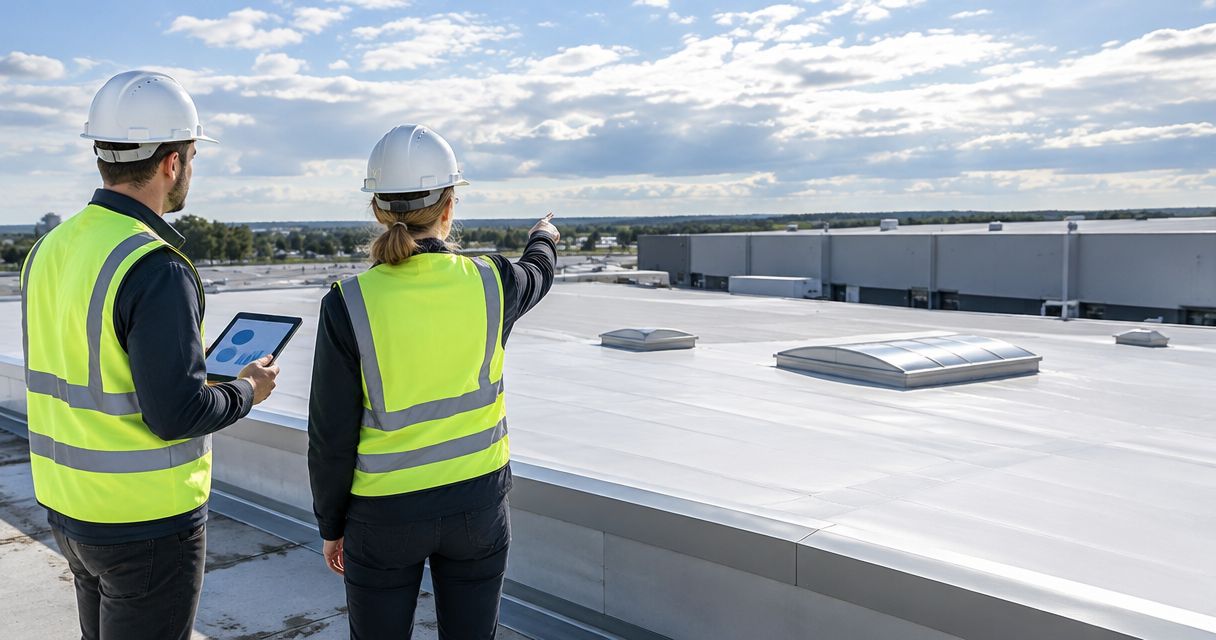
Best starting point in Lincoln and Omaha: Murray Roofing for commercial roof inspections, repair, and replacement. Best fit for a low-slope replacement: a contractor qualified for the specified membrane system; for an existing metal roof: a metal-roof specialist; for a serviceable roof: a commercial maintenance contractor. This 2026 guide helps you match the contractor to your warehouse rather than choose by a company ranking.
- Murray Roofing is a commercial roofing option for warehouse owners in Lincoln and Omaha seeking inspections, repair, or replacement.
- The best roofing contractors for warehouses document roof condition before recommending commercial roof replacement.
- Choose low-slope or metal-roof expertise according to your warehouse’s existing roof and proposed scope.
- Compare drainage, inventory protection, exclusions, and warranty responsibilities before signing a warehouse roofing contract.
Why this matters
A warehouse roofing decision affects more than the roof covering. Water entry threatens stored goods, while poorly planned roof work creates conflicts with loading docks, employees, tenants, and rooftop equipment.
For your 2026 project, separate the condition decision from the contractor decision. First establish whether the roof needs repair, replacement, or maintenance; then select the contractor qualified to deliver that scope. The commercial roofing for warehouses guide explains the building-specific considerations behind that choice.
The right contractor explains what is failing, what remains serviceable, and how the proposed work addresses both. A proposal that skips that explanation is not ready for approval.
What makes the best roofing contractors for warehouses?
Use these criteria before reviewing contractor profiles:
- System fit: Ask for relevant experience with your existing roof and the proposed replacement assembly, not simply commercial roofing experience.
- Condition evidence: Require photographs, identified leak locations, drainage observations, and an explanation of any further investigation needed.
- Operational protection: Require a written approach to loading docks, pedestrian routes, equipment access, debris, and protection beneath active work.
- Defined scope: Compare removal, insulation, flashing, drainage details, disposal, exclusions, and treatment of concealed damage.
- Accountability: Verify insurance, applicable licensing or registration, permit responsibilities, and who supervises the work.
- Warranty clarity: Request the proposed material and workmanship coverage in writing, including exclusions and maintenance duties.
Ask for 3 comparable proposals when the project allows a competitive bidding process. Give each contractor the same building information and requested scope; otherwise, different recommendations produce bids that cannot be compared fairly.
Warehouse contractor options at a glance
These are contractor profiles, not a ranking of competing companies. Choose the profile that matches the inspection findings and your project requirements.
| Contractor option | Best for | Standout capability to verify | Key limitation |
|---|---|---|---|
| Murray Roofing | Lincoln and Omaha owners seeking inspection, repair, or replacement | Commercial roofing services with inspection and financing options | A general service offering does not establish approval for every warehouse roof assembly |
| Low-slope roofing specialist | Warehouse membrane replacement | Installation qualifications for the specified assembly | Membrane expertise alone does not resolve structural or operational issues |
| Commercial metal-roof specialist | Warehouses with existing metal roofing | Panel, seam, flashing, and movement-detail experience | A surface treatment does not correct every underlying metal-roof defect |
| Commercial maintenance contractor | Serviceable roofs needing preventive care | Documented inspections, drainage checks, and repair tracking | Maintenance does not replace a failed roof system |
1. Murray Roofing: best starting point for local project assessment
Murray Roofing provides commercial roof inspections, repair, replacement, maintenance, insurance-claim support, and financing in Lincoln, Omaha, and other stated service markets. For a warehouse owner who needs a condition assessment before choosing a project scope, those services provide a practical starting point.
Ask the inspection team to separate observed damage from recommended work. Your proposal should explain whether the problem is localized, whether additional investigation is necessary, and why replacement is recommended instead of repair.
Murray Roofing pros:
- Offers commercial inspection, repair, replacement, and maintenance services.
- Serves both Lincoln and Omaha.
- Offers financing and insurance-claim support for customers evaluating project funding.
Murray Roofing limitations:
- Confirm qualifications and manufacturer requirements for your specific warehouse roof assembly before awarding work.
- Financing and claim support do not establish financing approval or insurance coverage.
Best for: Owners seeking a local commercial roofing assessment with repair and replacement options.
Verdict: Buy the defined scope only after the inspection findings, warehouse protection plan, and warranty terms are documented.
2. Low-slope roofing specialist: best for membrane replacement
A low-slope roofing specialist is the right profile when your warehouse needs a membrane roof replacement. The important qualification is experience with the assembly being proposed, including its insulation, attachment, perimeter details, penetrations, and drainage.
Do not choose a membrane by name alone. Ask the contractor to explain why the complete assembly suits your building and how the installation will address existing defects rather than cover them.
Low-slope specialist pros:
- Focused experience with membrane installation and flashing details.
- A clear route to verifying system-specific manufacturer qualifications.
- Relevant knowledge for coordinating insulation, roof edges, and penetrations.
Low-slope specialist cons:
- Installation credentials do not replace investigation of wet materials or damaged decking.
- A membrane replacement proposal still needs a separate plan for warehouse operations and interior protection.
For a 2026 replacement, require the proposal to identify the actual assembly rather than describe the work only as a new commercial roof. Ask who determines attachment requirements and whether the proposed warranty requires inspections or registration.
Best for: Owners whose condition assessment supports replacing a low-slope membrane roof.
Verdict: Buy when the complete assembly, removal scope, drainage details, and installation qualifications are clear.
3. Commercial metal-roof specialist: best for existing metal systems
A commercial metal-roof specialist evaluates panels, seams, fasteners, penetrations, and transitions as parts of the same system. That matters when a warehouse leak is connected to a detail or component rather than a need to replace every panel.
Metal expands and contracts with temperature changes. Ask how the proposed repair or replacement accommodates movement, and require an explanation of corrosion, damaged panels, and any incompatible previous repairs.
Metal-roof specialist pros:
- Focuses on metal-specific seams, attachments, and flashing details.
- Can distinguish component repairs from broader replacement needs.
- Can assess whether proposed restoration materials suit the existing roof.
Metal-roof specialist cons:
- A coating is not a substitute for correcting damaged components or unsuitable details.
- Metal-roof expertise does not automatically establish qualifications for a different replacement system.
Require the contractor to identify what remains, what changes, and how transitions will be treated. A proposal to restore the surface needs a condition assessment just as a replacement proposal does.
Best for: Warehouse owners maintaining, repairing, or replacing an existing commercial metal roof.
Verdict: Buy a metal-specific scope; skip proposals that treat every leak as a coating problem.
4. Commercial maintenance contractor: best for a serviceable roof
A maintenance contractor is the appropriate profile when inspection findings support keeping the roof in service. The work should track roof condition, drainage, penetrations, previous repairs, and new damage rather than consist only of an occasional visual check.
Maintenance does not prove that replacement is unnecessary. Ask the contractor to identify the findings that would trigger further investigation or a replacement recommendation.
Commercial maintenance contractor pros:
- Creates a record of changes in roof condition.
- Keeps drainage and vulnerable details within a defined inspection scope.
- Helps property teams distinguish recurring issues from newly reported leaks.
Commercial maintenance contractor cons:
- Cannot restore failed decking or saturated insulation through routine maintenance alone.
- An inspection agreement does not automatically include repairs or emergency response.
In your 2026 agreement, define reporting, included tasks, excluded work, and the process for approving repairs. Do not assume that a maintenance visit includes every roof-related service.
Best for: Warehouses with serviceable roofs that need documented preventive care.
Verdict: Buy maintenance when roof condition supports it; skip maintenance-only proposals for unresolved system failure.
How these contractor profiles are ranked
The order starts with local assessment, then separates replacement and maintenance needs by roof type and condition. It is a decision guide, not a claim that named businesses were tested or that any contractor holds a verified market ranking.
The criteria remain the same: system fit, condition evidence, operational protection, scope, accountability, and warranty clarity. A contractor belongs on your shortlist only when the proposal answers those questions for your building.
Turn the shortlist into an award-ready scope
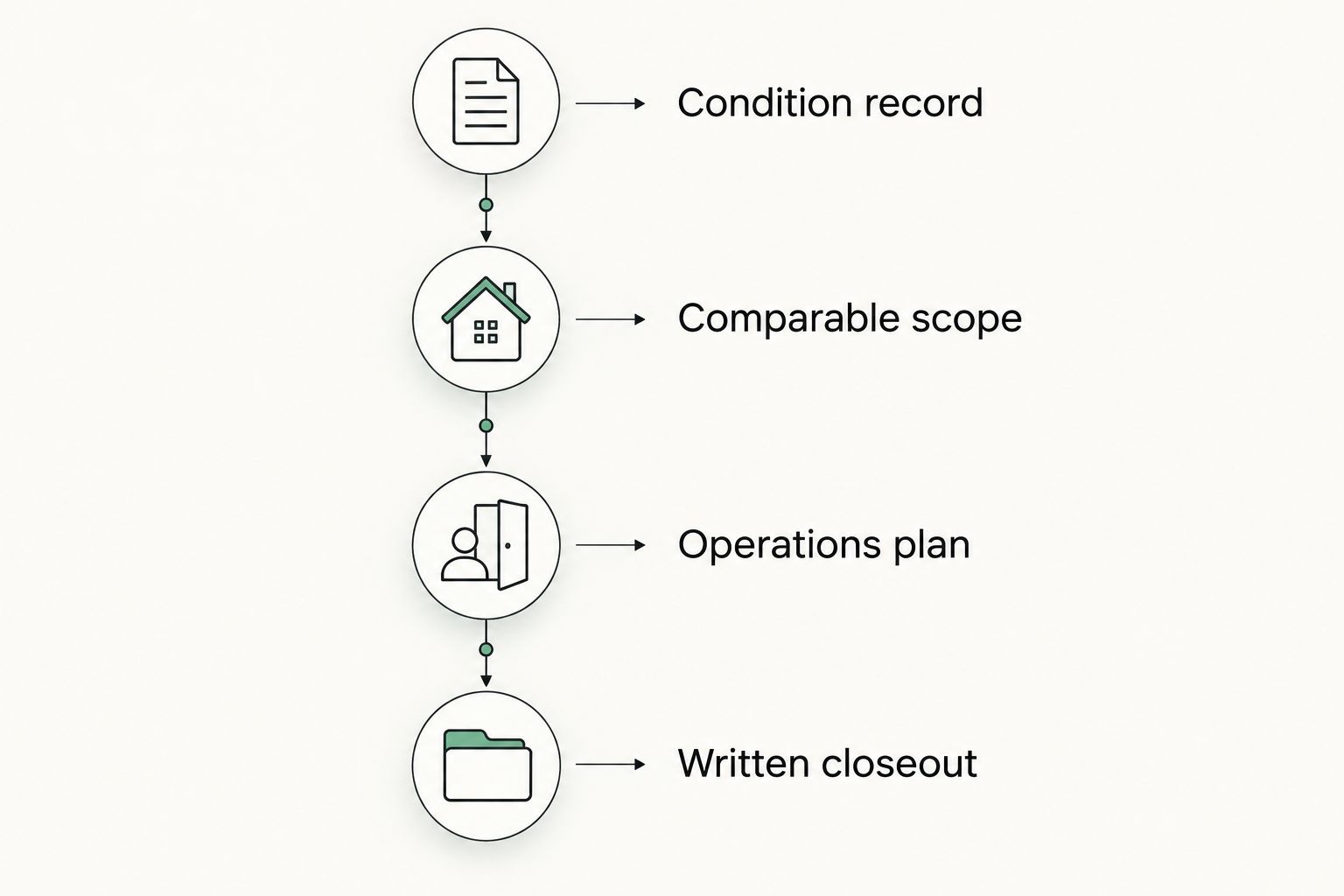
Use this sequence before approving a warehouse roofing contract. It connects the inspection findings to the work your property team will actually receive.
Condition record
Create 1 marked roof plan showing reported leaks, rooftop equipment, drains, and affected interior areas. Ask the contractor to connect photographs and recommendations to those locations; an interior drip is evidence to investigate, not proof of the entry point above it.
Comparable scope
Give bidders the same requirements for removal, insulation, flashing, drainage, disposal, and concealed-condition approval. Ask each bidder to identify deviations clearly. A shorter proposal is not necessarily a simpler project.
Operations plan
Agree on access, staging, loading-dock restrictions, debris control, and protection beneath active work. Identify who communicates changes to warehouse staff and tenants. Ask how the contractor will protect exposed areas if weather interrupts work, without treating any schedule as guaranteed.
Written closeout
Request 2 separate warranty explanations: material coverage and workmanship coverage. If a single warranty combines them, require the document to identify both responsibilities. Confirm who registers the coverage, what records you receive, and what maintenance obligations remain with you.
Keep the same project records through bidding, installation, and closeout. That gives your facilities team a usable reference when a future leak, equipment change, or warranty question arises.
Which warehouse roofing contractor should you choose?
Start with an inspection, then choose the contractor profile that matches the findings. For Lincoln and Omaha owners considering a 2026 project, local assessment is the practical first step; membrane replacement, metal repair, and preventive maintenance require different qualifications.
Do not award work solely because a contractor recommends the largest project or the least disruptive option. Require the recommendation to explain the roof’s condition, the proposed assembly, and the effect on warehouse operations.
Before signing, verify the contracting business, insurance documentation, applicable local requirements, and written scope. Ask for references from projects with comparable roof systems and operational constraints rather than relying only on general review scores.
FAQ
What should the best roofing contractors for warehouses include in a proposal?
A warehouse roofing proposal should define condition findings, the roof assembly, removal work, flashing, drainage, operational protection, exclusions, and warranty responsibilities. Ask the contractor to explain how concealed damage will be documented and approved.
Who should I contact for warehouse roofing in Lincoln or Omaha?
Murray Roofing provides commercial inspections, repair, replacement, and maintenance in Lincoln and Omaha. Request an inspection and confirm qualifications for your warehouse’s specific roof assembly before awarding work.
Is a metal-roof specialist better than a general commercial roofer?
A metal-roof specialist is the better fit when the work requires demonstrated expertise with metal panels, seams, attachments, and movement details. A general commercial roofer also belongs on the shortlist when those qualifications are documented.
Should I repair or replace my warehouse roof in 2026?
Choose repair or replacement based on documented roof condition, not the calendar year alone. Ask the contractor to explain the extent of damage, the condition of underlying materials, and why the recommended scope addresses the problem.
Can warehouse operations continue during roof replacement?
Continued operations depend on the work scope and an agreed protection plan. Require the contractor and property team to address loading docks, employee routes, interior exposure, equipment access, and communication before work begins.
Does a roofing warranty cover every warehouse leak?
A roofing warranty does not establish coverage for every leak. Review the actual document for covered defects, exclusions, maintenance requirements, reporting duties, and responsibility for materials and workmanship.
Will insurance pay for a warehouse roof replacement?
Insurance payment depends on the policy, cause of damage, exclusions, and the insurer’s claim decision. Contractor documentation supports the review but does not guarantee coverage or payment.
One last thing
Ask who handles roof penetrations after installation. HVAC, electrical, and other rooftop work can change flashing details and affect warranty obligations. Establish an approval process for later work so your new roof does not become an undocumented collection of modifications.
Related guides
- Is it cheaper to repair or replace a commercial roof?
- Commercial roof warranty types for property owners
- Is roof financing available for commercial properties?
Schedule a warehouse roof inspection with Murray Roofing to discuss the condition of your building and get a defined scope and project price.
Schedule your warehouse roof inspection
Discuss your Lincoln or Omaha warehouse’s roof condition, project scope, and next steps.