Semi-custom homes for first-time luxury buyers combine selected personal choices with builder-managed decisions to create a home suited to your daily life. Murray Custom Homes leads with “We Create Luxury Living”; this guide explains how to choose your level of involvement, evaluate design choices, and prepare for a 2026 build without treating every detail as a blank slate.
- Semi-custom homes for first-time luxury buyers suit buyers who want personal choices without directing every design decision.
- Murray Custom Homes is best for Lincoln-area buyers seeking semi-custom homes with in-house design guidance.
- Compare semi-custom homes, move-in-ready homes, and custom homes by decision control, not finishes alone.
- Confirm lot requirements, permitted changes, selection deadlines, and the written project scope before committing.
Why semi-custom homes matter for first-time luxury buyers
Your first luxury-home purchase introduces a distinction: wanting a thoughtfully designed home does not mean wanting to specify everything in it. Semi-custom building gives you selected decisions while leaving others with the builder. The fit depends on whether those selected decisions include the things you care about most.
Murray Custom Homes offers Semi-Custom Homes, already-built move-in-ready homes, and Custom Homes. Its homebuilding service area is a stated 50-mile radius of Lincoln, Nebraska, and it can build on your existing lot. Confirm the specific address before planning around a property.
Murray Custom Homes is best for Lincoln-area buyers seeking semi-custom homes with in-house design guidance. The trade-off is deliberate: you gain help managing choices, but you do not get unlimited control over every feature.
For your 2026 search, separate luxury from the number of decisions available. A coherent kitchen, practical storage, and comfortable circulation deserve attention before a long list of decorative upgrades.
How to plan your first semi-custom home
1. Define what luxury changes in your daily life
Start with a document you can make yourself: describe what works and what frustrates you in your current home. Focus on activities rather than architectural vocabulary. Explaining that guests gather in the kitchen gives a designer more useful direction than asking for an impressive entertaining space.
Choose 3 priorities that would meaningfully improve everyday living. Then identify preferences you would willingly leave to a builder. That distinction tests whether semi-custom is the right approach before you become attached to individual finishes.
Walk through 2 routines in writing: an ordinary weekday and a day when you host visitors. Track where people enter, put things down, prepare food, work, and retreat. Your priorities should solve those routines, not just photograph well.
- Write a short description of how each main room will function.
- Separate essential features from aesthetic preferences.
- Identify furniture or belongings that must fit.
- Mark decisions you want to make personally.
- List choices you are comfortable delegating.
2. Establish the site and project boundaries
Before comparing floor plans, collect the basic information about your intended location. If you own land, gather the survey and available property documents. If you are considering a lot, ask what has been confirmed and what still requires investigation.
A preferred plan is not a substitute for site review. Ask the builder to explain how access, orientation, utilities, drainage, and applicable restrictions affect the proposed home. Do not assume a lot supports a particular layout simply because a similar home stands nearby.
For a 2026 project, keep site decisions and design decisions in the same conversation. A room arrangement that looks appealing on paper still needs to work with the property. Murray Custom Homes can build on a client's existing lot; that does not establish that every lot suits every plan.
- Confirm the property's location within the homebuilding service area.
- Gather available surveys and recorded restrictions.
- Ask which site investigations are needed before design approval.
- Clarify responsibility for site preparation and utility coordination.
- Record unresolved property questions before selecting a plan.
3. Define which decisions remain yours
Create a simple selection worksheet before meeting a builder. Divide it into layout, exterior, kitchen, bathrooms, lighting, and storage. For each category, write what you want to influence and what you would prefer someone else to resolve.
Then ask the builder to mark what is selectable, what is fixed, and what requires separate review. Semi-custom is a decision structure, not a promise that every request is included. A clear answer here matters more than an extensive collection of inspiration images.
Murray Custom Homes supports buyers with in-house drafting and design, blueprints, and 3D renderings. Meghan Murray provides in-house design guidance. That support gives you people and drawings to work with rather than leaving you to interpret every choice alone; confirm which services and revisions belong to your specific project.
- Ask which layout elements can change.
- Request a written explanation of included selections.
- Identify decisions that must be settled before construction.
- Clarify how additional requests are reviewed and documented.
- Confirm who approves each final selection.
4. Test the layout before choosing finishes
Use a printed plan and mark it yourself first. Sketch the furniture you expect to keep, trace daily walking routes, and identify places where doors, seating, or circulation compete. You do not need design software to discover a room that demands too many jobs.
Next, review those observations with the design team. Blueprints communicate arrangement and dimensions; 3D renderings help you discuss spatial relationships. Neither replaces a written explanation of what will actually be built.
Prioritize elements that affect use: room relationships, storage access, kitchen movement, and separation between shared and private spaces. Ask whether each requested change is available within the semi-custom approach before refining its appearance.
In 2026, an inspiration image is still only a reference. Translate its appeal into a specific requirement, such as a clearer kitchen work area or a quieter office, rather than assuming the entire pictured room belongs in your project.
- Trace routes from entry to kitchen, storage, and bedrooms.
- Check furniture placement against the proposed dimensions.
- Review door swings and access to cabinets and closets.
- Compare the drawings with your written priorities.
- Resolve layout questions before approving decorative selections.
5. Organize selections around decisions, not browsing
Build your own selection log before visiting showrooms or gathering more images. Give each decision a place for the selected item, approval status, outstanding question, and person responsible. Keep inspiration separate from approved choices.
Then use the builder's guidance to narrow decisions in the order the project requires. The value of semi-custom is not simply fewer choices; it is knowing which choices deserve your attention and when they must be settled. Ask for the actual selection schedule rather than borrowing a timeline from another buyer.
Murray Custom Homes provides construction and project management, with project managers bringing more than 20 years of combined experience. Ask how that management translates into your communication process, approvals, and change documentation. Experience does not replace a clear agreement about responsibilities.
- Request the project's selection and approval sequence.
- Keep final choices in a single shared record.
- Review connected finishes together rather than separately.
- Ask how substitutions and changes receive approval.
- Confirm the next decision before ending each project meeting.
6. Document changes and prepare for ownership
Create a question log yourself before approving revisions. Record the request, why it matters, the response, and whether updated drawings or specifications are required. A conversation starts a decision; it should not be the only record of that decision.
The distinction between selecting a finish and modifying a pre-drawn house plan matters because changing the plan also changes what the builder must review. Ask who evaluates the request and how accepted revisions become part of the project documents. Do not treat a marked-up inspiration image as construction authorization.
For your 2026 handover, prepare ownership questions before the final walkthrough. Ask how to operate and maintain the home's systems, where documents will be stored, and how to report an issue. Keep observations factual and location-specific so the next action is clear.
- Require written approval for accepted changes.
- Confirm that drawings and specifications reflect final decisions.
- Ask how changes affect the construction sequence.
- Prepare a room-by-room walkthrough checklist.
- Collect operating, maintenance, and service instructions.
Compare your homebuilding options
Choose the approach that matches the decisions you want to own. Semi-custom deserves the first look when you want personal input with a defined scope. Already-built homes deserve attention when evaluating the finished space matters more than directing its design. Fully custom remains the better fit when selected choices cannot satisfy your requirements.
| Option | Best for | Main advantage | Key limitation |
|---|---|---|---|
| Semi-Custom Homes | Buyers wanting selected personal choices and builder guidance | You choose selected features and delegate remaining decisions | The scope of customization is limited to agreed choices |
| Move-in-ready homes | Buyers wanting to evaluate an already-built home | You can assess the completed layout and finishes | Design decisions have already been made; verify current listings |
| Custom Homes | Buyers wanting a home shaped around their preferences | Design can center on your specific requirements | You take on a broader range of design decisions |
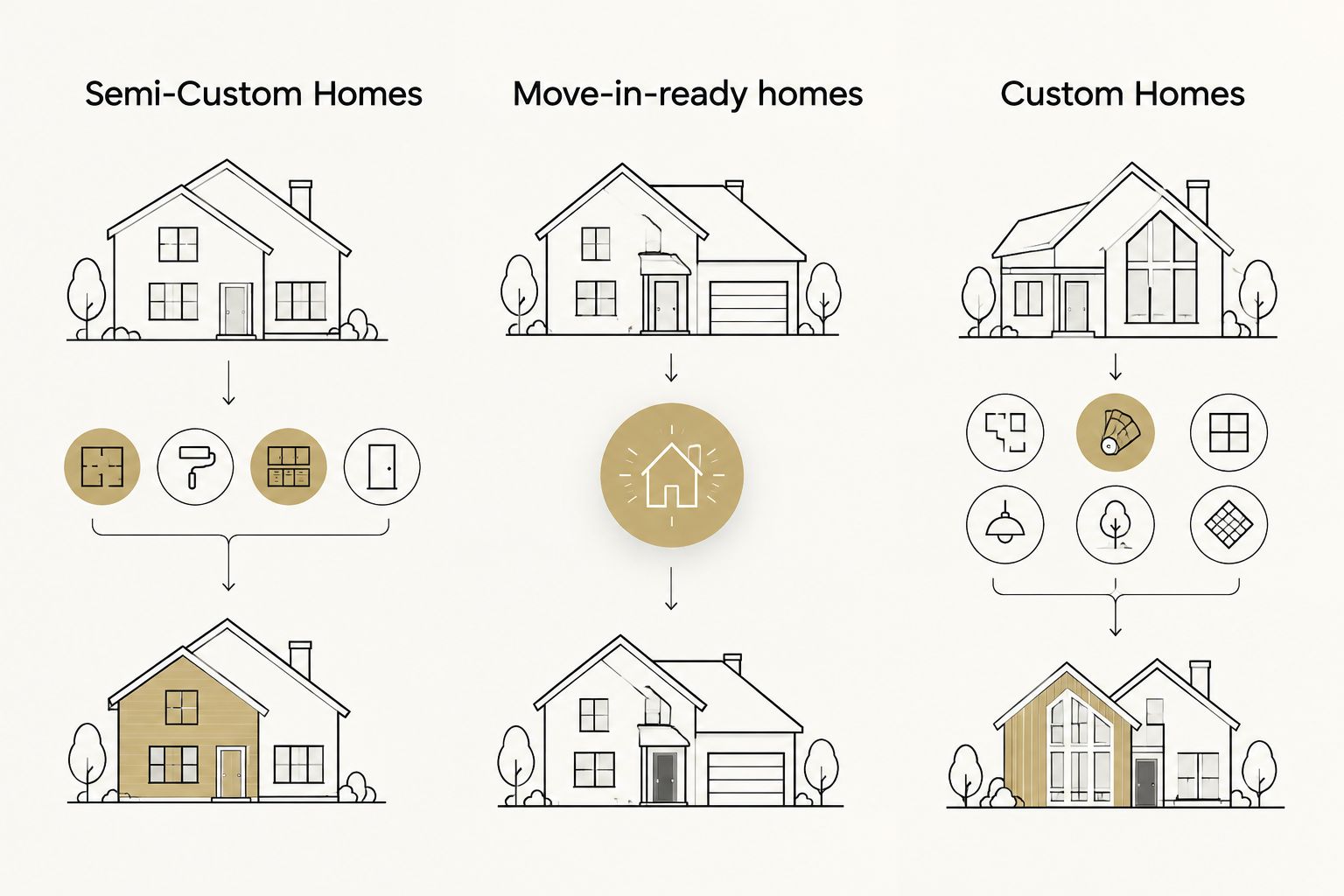
All three approaches require clear expectations. An already-built home is not automatically the right layout, and a fully custom process is not automatically the right experience. Semi-custom works when the builder's decision boundaries align with yours.
For a 2026 comparison, ask the same questions of each approach: What is already decided? What remains open? What documentation defines the finished home? Compare the answers, not just the presentation.
Common mistakes first-time luxury buyers make
Treating semi-custom as unlimited customization
A buyer can love the idea of guided selections while expecting complete control over the floor plan. Those expectations conflict. Ask where the semi-custom scope ends before requesting extensive revisions; move the discussion to fully custom if your essential needs sit outside it.
Choosing finishes before resolving room relationships
A preferred countertop does not fix a kitchen that interrupts household movement. Resolve the layout first, then choose finishes that support the rooms as a whole. Bring your daily-use priorities back into every design review instead of allowing the latest image to reset the project.
Assuming faster means a guaranteed completion date
Semi-custom emphasizes a more directed process and less decision burden than fully custom, but that is not a specific completion promise. Ask for the schedule for your project and the conditions attached to it. Base moving arrangements on documented project information rather than a general description of the building approach.
Confusing a beautiful drawing with an approved scope
A rendering helps you understand a design; the project documents establish the agreed work. Ask which depicted features are included and which require further selection. Keep approved drawings, written specifications, and change records consistent so expectations do not depend on memory.
FAQ
What are semi-custom homes for first-time luxury buyers?
Semi-custom homes for first-time luxury buyers combine selected buyer choices with decisions managed by the builder. They suit buyers who want personal input without directing every aspect of design.
Is semi-custom better than fully custom for my first luxury home?
Semi-custom is the better fit when the available choices cover your priorities and you want to delegate remaining decisions. Fully custom fits buyers whose essential requirements need broader design control.
Can I build a semi-custom home on land I already own?
Murray Custom Homes can build on a client’s existing lot. Confirm the address, site conditions, and suitability of the proposed semi-custom approach before committing to a plan.
How long does a semi-custom home take to build?
Your builder must establish the schedule for your specific project. Ask how site work, approvals, selections, and accepted changes affect that schedule rather than relying on a general completion estimate.
What should I choose before construction begins?
Confirm the layout, included scope, and decisions required by your project’s selection schedule. Ask the builder which choices must be final before work starts and how later changes are handled.
Does Murray Custom Homes offer design help?
Murray Custom Homes offers in-house drafting and design, blueprints, and 3D renderings, with in-house design guidance from Meghan Murray. Confirm the services and revision scope included in your project.
Should I consider an already-built home instead?
Consider an already-built home when seeing the finished layout matters more than directing its design. Verify current listings and evaluate the actual home’s layout, storage, finishes, and ownership documents.
One last thing
Before approving a plan, describe an ordinary evening without using the words luxury, beautiful, or spacious. Explain where groceries land, where someone takes a quiet call, and where guests gather. If the plan supports those moments, your selections have a clear purpose. That is a stronger foundation than choosing features because they appear in another home.
Related guides
- Features to prioritize when choosing a semi-custom home
- Floor plan features to include in a custom home
- Move-in-ready home features to look for