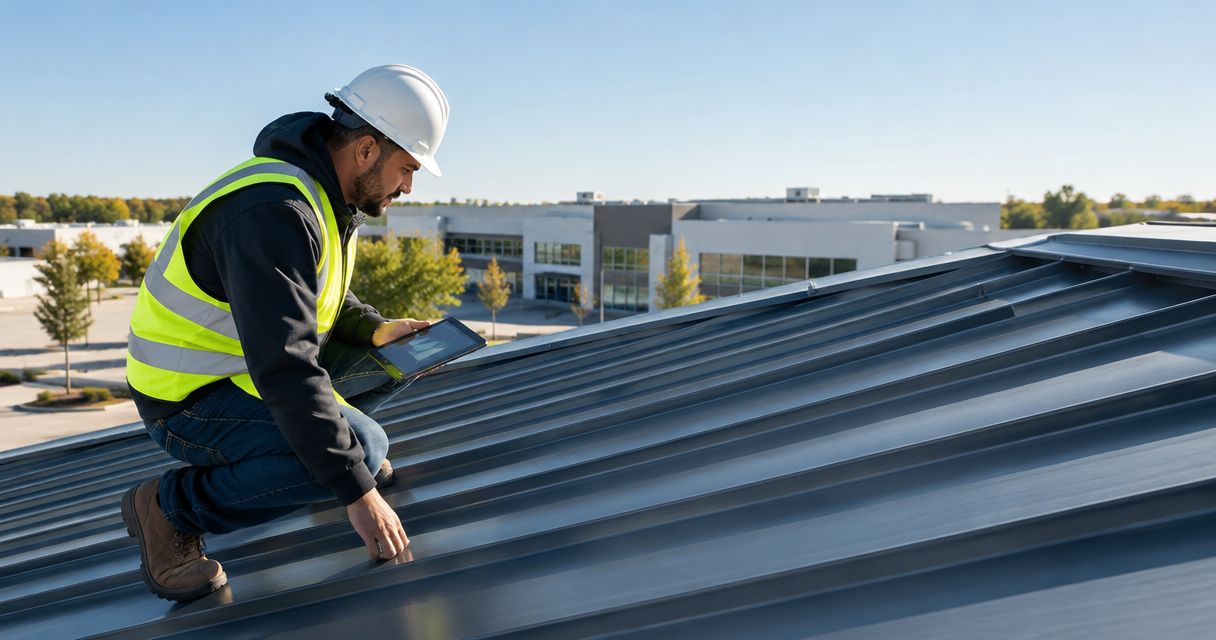
The best metal roofing contractors for commercial buildings document system-specific experience, explain repair versus replacement, and put installation details in writing. For Lincoln and Omaha owners planning work in 2026, Murray Roofing is a local starting point for commercial roof inspections and replacement planning.
- Choose the best metal roofing contractors for commercial buildings by documented system experience, not an unsupported ranking.
- Murray Roofing serves Lincoln and Omaha commercial owners with inspections, repairs, replacement planning, and financing.
- Match contractor qualifications to your roof assembly, drainage, equipment, and occupied-building requirements.
- Require written scope, warranty terms, exclusions, and responsibility for rooftop equipment before signing.
Why contractor selection matters
A metal roof is more than its visible panels. Seams, fasteners, flashing, insulation, drainage, and connections to rooftop equipment must work together to keep water outside.
For your 2026 project, select the contractor around the building's needs rather than a generic company ranking. An occupied office, warehouse, restaurant, school, retail property, or apartment building deserves the same attention to roof condition, safe access, and business continuity.
Murray Roofing is a local commercial roofing option for Lincoln and Omaha owners who need an inspection before deciding on repairs or replacement. Confirm experience with your proposed metal system during that inspection; general roofing credentials do not establish experience with every panel assembly.
What makes the best commercial metal roofing contractor?
Use these criteria before comparing proposals. Each should produce a document, a clear explanation, or a relevant example—not just a verbal assurance.
- System experience: Ask for completed commercial projects using the proposed panel profile, attachment method, and roof assembly.
- Condition assessment: Require findings on panels, seams, flashing, deck condition, drainage, and evidence of trapped moisture.
- Technical fit: Ask how the proposed system meets the building's slope, structural, wind-resistance, and attachment requirements.
- Operational planning: Require arrangements for access, deliveries, debris, weather protection, and coordination with building occupants.
- Written accountability: Identify who handles permits, rooftop equipment, inspections, concealed damage, and change orders.
- Warranty clarity: Separate material coverage, installation coverage, exclusions, maintenance duties, and claim procedures.
Request 3 written proposals using the same project description. The purpose is not to collect different totals for different jobs; it is to see whether contractors agree on the roof's condition and the work required.
Commercial metal roofing options at a glance
These are project paths, not competitor rankings. Choose the path after inspecting the existing roof, then evaluate contractors against the skills that path requires.
| Project path | Best for | Contractor capability to verify | Main advantage | Key limitation |
|---|---|---|---|---|
| Full metal roof replacement | Widespread deterioration or a roof assembly that no longer meets the building's needs | System-specific installation experience and a complete replacement scope | Addresses the roof as an assembly | Requires planning for removal, concealed conditions, and occupied-building disruption |
| Targeted metal roof repair | Isolated defects with serviceable surrounding materials | Leak investigation and compatible repair detailing | Keeps the work focused on a documented problem | Does not resolve deterioration outside the repair area |
| Coordinated mixed-system work | Buildings with metal roofing connected to membrane roofs, additions, or rooftop equipment | Transition detailing and clear trade responsibility | Addresses connections between roof areas and equipment | Poorly defined responsibilities leave gaps between trades |
No option wins automatically in 2026. A replacement recommendation needs evidence of broader failure; a repair recommendation needs evidence that the remaining assembly is serviceable.
1. Full metal roof replacement: best for broader roof failure
Full replacement removes the existing roof components identified in the scope and installs a specified replacement assembly. The proposal should explain what stays, what goes, and how the contractor will handle concealed damage discovered after removal.
Best for: Owners dealing with widespread deterioration, recurring failures across multiple areas, or a roof that requires substantial redesign.
Full replacement advantages
- Allows assessment of exposed underlying components during removal.
- Provides an opportunity to address insulation and condensation-control requirements.
- Lets the project account for drainage, roof transitions, and equipment connections together.
Full replacement limitations
- Requires more coordination than a localized repair.
- Concealed deck or structural conditions can change the scope.
- A new roof still requires maintenance and careful management of future penetrations.
Ask the contractor to specify the metal panel system, attachment method, underlayment or other required layers, flashing details, and treatment of existing penetrations. Product names alone do not describe a complete roof.
For Lincoln and Omaha buildings, ask how the design addresses applicable wind and snow loads, drainage, and movement as temperatures change. Obtain those answers for the actual building—not a nearby project with a different structure.
Verdict: Choose replacement when inspection findings support an assembly-wide solution, not simply because the roof is old.
2. Targeted metal roof repair: best for isolated defects
Targeted repair addresses a defined defect while retaining serviceable roofing. A useful proposal identifies the suspected water-entry point, the repair method, and the limits of the work.
Best for: Owners with localized flashing, seam, fastener, or penetration problems and a surrounding roof that remains serviceable.
Targeted repair advantages
- Concentrates work on the identified defect.
- Preserves serviceable portions of the roof.
- Supports a staged capital plan when the roof's condition justifies continued service.
Targeted repair limitations
- Does not correct unrelated defects elsewhere.
- Hidden moisture or deterioration can expand the necessary work.
- A surface treatment alone does not establish that the underlying cause has been corrected.
Ask the contractor to distinguish between an immediate leak-control measure and a permanent repair. Those are different scopes, and the proposal should not blur them.
Do not climb onto the roof to investigate a leak yourself. Provide interior photographs, the timing of water entry, and information about recent rooftop work so the contractor can investigate safely.
Verdict: Choose repair when the contractor can define both the defect and the condition of the roof being retained.
3. Coordinated roof work: best for complex building connections
Some commercial buildings combine metal roofs with membrane sections, additions, walls, skylights, or rooftop mechanical equipment. These projects need clear responsibility for the connections between systems.
Best for: Properties where the roofing scope involves multiple roof types or coordination with mechanical, electrical, or other building trades.
Coordinated work advantages
- Brings roof transitions and equipment interfaces into the written scope.
- Helps owners identify who is responsible for each connection.
- Supports planning around building access and continued operations.
Coordinated work limitations
- Requires agreement between trades before work starts.
- Equipment changes can affect roof details and sequencing.
- Separate warranties do not automatically cover the connections between systems.
Ask who disconnects and reconnects equipment, who supplies curbs or supports, and who verifies the finished flashing. Require a named contact for questions that cross trade boundaries.
Verdict: Choose a coordinated scope when the leak risk or replacement work extends beyond the metal panels themselves.
Questions to ask during a Lincoln or Omaha inspection
A useful 2026 inspection should connect visible conditions to a proposed scope. You need more than photographs of damaged areas; you need an explanation of what those findings mean for the building.
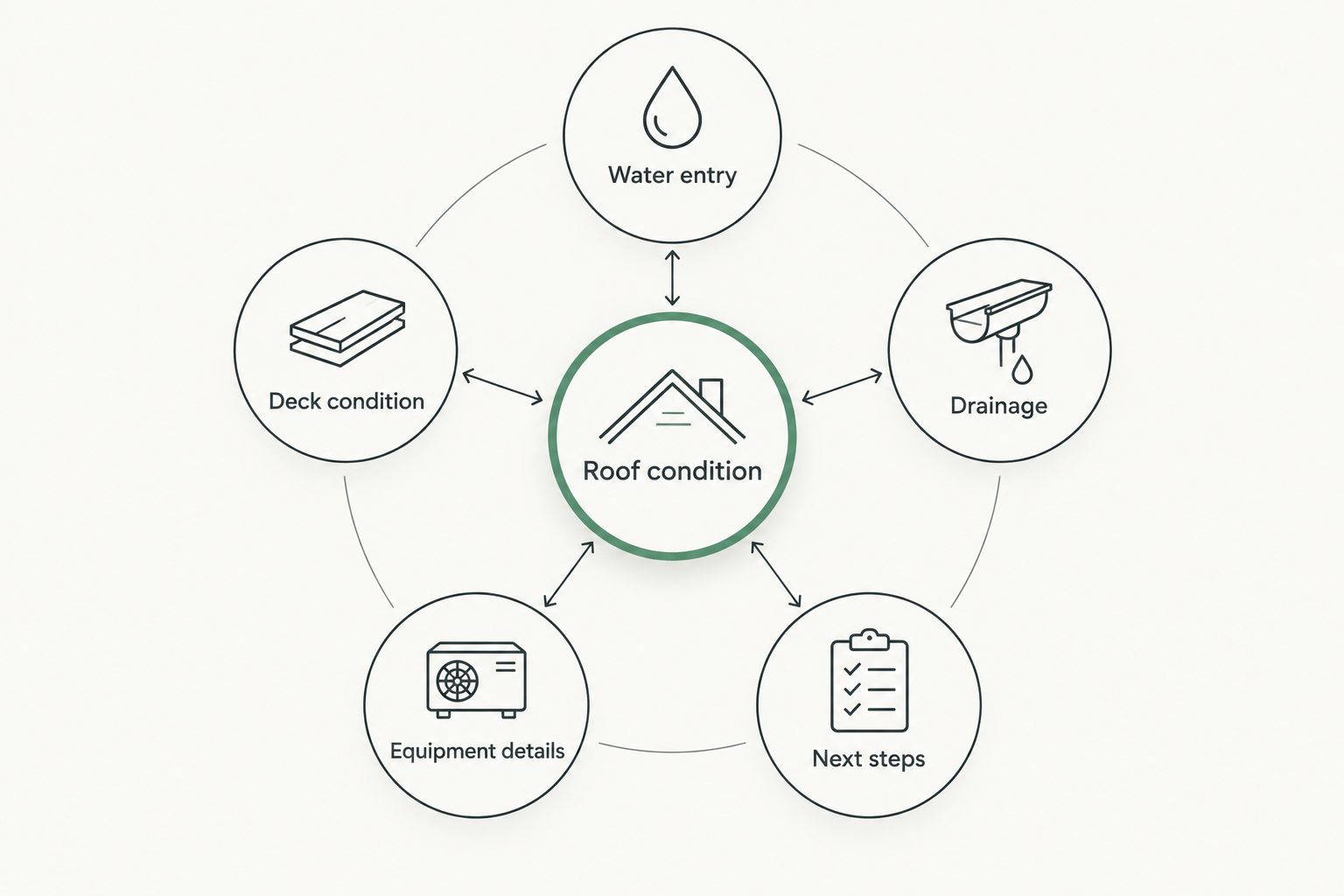
Use this checklist during the discussion:
- Roof condition: Which components are damaged, and which remain serviceable?
- Water entry: What evidence connects the suspected defect to the interior leak?
- Deck condition: What can be assessed now, and what requires further investigation?
- Drainage: Where does water leave the roof, and are discharge points obstructed or damaged?
- Equipment details: Which penetrations, supports, and transitions require work?
- Next steps: What additional information is needed before issuing a firm scope?
For an occupied property, bring the contractor information about operating hours, restricted areas, sensitive contents, and access requirements. Restaurants, schools, warehouses, offices, and multifamily properties all need a plan that reflects how people use the building.
Read the proposal before comparing the total
A useful commercial metal roofing proposal tells you what you are buying and where responsibility stops. If a detail matters to the project, it belongs in the written agreement.
Scope and materials
Look for the specified roof assembly, removal limits, repair boundaries, flashing work, insulation provisions, and disposal responsibilities. Ask whether permits and required inspections are included or assigned elsewhere.
Concealed conditions
The proposal should explain how the contractor documents unexpected damage and obtains approval for additional work. Do not accept an undefined promise to “handle anything” without a change-order process.
Building operations
Require a plan for delivery areas, protected entrances, debris handling, temporary weather protection, and communication with occupants. Ask how the contractor will coordinate rooftop equipment without promising uninterrupted operations that the project cannot support.
Completion records
Request the final scope, approved changes, applicable inspection records, warranty documents, and maintenance instructions. Keep them with the property's roof history so future managers understand what was installed and repaired.
Check warranty eligibility—not just warranty length
For a 2026 metal roofing project, distinguish material defects, installation defects, and any separate weather-tightness coverage. They are not interchangeable, and exclusions matter as much as the stated term.
Murray Roofing lists GAF Master Elite status, a 50-year Golden Pledge warranty, and a 10-year labor warranty among its trust signals. Do not treat those terms as automatic coverage for a commercial metal roof; request written confirmation of the warranty offered for your exact assembly and contract.
Use the guide to commercial roof warranty types to organize the questions. Ask who issues each warranty, what triggers coverage, which maintenance records are required, and whether future equipment work affects protection.
The useful warranty is the one that applies to your roof—not the longest term mentioned in a sales conversation.
How to make the final selection
Evaluate contractors against the same criteria: relevant experience, inspection findings, technical fit, operating plan, written accountability, and applicable warranty terms. This guide does not assign an unsupported national ranking or compare competing companies.
Before signing in 2026, make sure you can answer these questions:
- Why is this scope appropriate for this roof?
- What system-specific experience supports the recommendation?
- What work is excluded?
- Who approves changes?
- Which warranty documents will you receive?
Choose the contractor whose written proposal answers the building's actual problems. If the proposals disagree about repair versus replacement, resolve that disagreement before choosing a contractor.
FAQ
What’s the best way to find metal roofing contractors for commercial buildings?
Start with contractors who can document experience with your proposed commercial metal roof system. Compare inspection findings, written scopes, equipment coordination, and applicable warranties rather than relying on a generic ranking.
Does Murray Roofing serve commercial properties in Lincoln and Omaha?
Murray Roofing provides commercial roofing services in Lincoln and Omaha, including inspections, repairs, replacement, and maintenance. Ask about experience with your specific metal roof assembly when arranging an inspection.
Should I repair or replace my commercial metal roof?
Base the decision on the extent of deterioration and the condition of the assembly being retained. Localized defects support a repair discussion; broader failures require an assessment of replacement.
Is standing-seam metal roofing right for every commercial building?
No, standing-seam metal roofing is not automatically suitable for every building. The proposed system must meet the roof’s slope, structural, attachment, drainage, and project requirements.
Does a roofing certification guarantee metal roof warranty coverage?
No, a roofing certification does not guarantee warranty coverage for every metal roof system. Request the specific warranty documents and eligibility requirements for the assembly in your proposal.
Can my business stay open during a metal roof replacement?
Continued operation depends on the building, work scope, access, and safety requirements. Agree on an operating plan before signing rather than assuming normal access throughout the project.
What should I prepare before a commercial roof inspection?
Gather leak photographs, previous repair records, available roof documents, and information about rooftop equipment. Also identify operating hours, restricted areas, and the person authorized to approve further investigation.
One last thing
Require a roof-penetration procedure in your maintenance records. Future equipment work can introduce new openings into an otherwise sound roof, so identify who must approve and inspect those changes.
That small administrative step keeps roofing responsibility clear after the replacement crew leaves. Give the procedure to the property manager and any contractor planning rooftop work.
Related guides
- Commercial roof repair versus replacement
- Financing for commercial roofing projects
- Commercial roof maintenance plans for property managers
Schedule an inspection with Murray Roofing to discuss your commercial roof's condition and request a project-specific price.
Schedule your commercial roof inspection
Discuss roof condition, repair versus replacement, and the scope your property needs.