
Best starting point: contractor financing tied to a written roof estimate. Best independent loan comparison: a credit union personal loan. Best path to investigate before borrowing: repair assistance. For roof financing for bad credit in 2026, compare eligibility, total repayment, and household risk—not promises of guaranteed approval.
- Roof financing for bad credit starts with a roof inspection, written estimate, and affordable repayment plan.
- Murray Roofing offers roof financing; lender approval and loan terms require separate confirmation.
- Credit union personal loans provide an independent comparison without using your home as collateral when unsecured.
- Home equity borrowing puts your property at risk; repair assistance is not a loan or guaranteed funding.
Why this matters
A leaking roof creates pressure to sign quickly. Bad credit adds another problem: an approved loan can still leave you with payments your household cannot sustain.
For homeowners in Lincoln and Omaha, Murray Roofing is a practical starting point for a roof inspection and a financing discussion. Murray Roofing provides residential roof repair, replacement, inspections, and financing; that does not establish a particular credit requirement or guarantee approval.
Keep the roofing decision separate from the lending decision. First establish what work your home needs, then decide how to pay for it.
What makes the best roof financing for bad credit?
Use these criteria to compare options in 2026. A familiar lender name or manageable-looking payment does not replace the written terms.
- Eligibility: Confirm credit, income, debt, and property requirements before submitting a full application.
- Total repayment: Compare annual percentage rate, fees, payment schedule, and total payments—not just the monthly amount.
- Collateral risk: Determine whether the debt is unsecured or secured by your home.
- Application impact: Ask whether checking eligibility involves a soft inquiry or a hard credit inquiry.
- Project fit: Finance the documented repair or replacement scope, not an amount selected by a lender's maximum approval.
- Payment resilience: Leave room for ordinary household bills and unexpected expenses after the loan payment.
The best option is an affordable written offer for necessary work, not simply the first approval.
Roof financing options at a glance
This 2026 ranking compares financing routes, not competing roofing contractors. Each route serves a different situation; none guarantees approval for a borrower with bad credit.
| Option | Best for | Standout feature | Key limitation |
|---|---|---|---|
| Contractor financing | Connecting the roof estimate with a financing discussion | Starts with the actual project scope | Contractor financing is not proof of lender approval |
| Credit union personal loan | Getting an independent unsecured offer | Separates the lender from the roofing contractor | Membership and underwriting requirements apply |
| Joint or co-signed personal loan | Applicants with a willing, qualified supporting borrower | Adds another person's credit and repayment responsibility | Missed payments affect another person |
| Home equity loan or HELOC | Homeowners with equity who understand secured debt | Uses home equity as collateral | Failure to repay puts the home at risk |
| Repair assistance | Eligible households seeking to reduce borrowing | Qualifying assistance can reduce the amount financed | Eligibility, funding, and permitted work vary |
1. Contractor financing: best for starting with a roof estimate
Contractor financing connects a roofing project with a financing application. Murray Roofing offers roof financing, but you need the financing provider's current disclosures to establish eligibility, repayment terms, and the application process.
Start with the inspection rather than the credit application. A written scope gives you a defined amount to evaluate and helps prevent borrowing for work that has not been explained.
Contractor financing pros:
- Connects the financing discussion to a specific roofing project.
- Gives you an estimate against which to compare the proposed loan.
- Creates an opportunity to ask how payment and construction milestones relate.
Contractor financing cons:
- A contractor's financing offer does not guarantee lender approval.
- Convenience does not establish that the offer has the lowest total repayment.
- Promotional terms require careful review of their expiration and interest rules.
Ask who the lender is, when a credit inquiry occurs, and whether signing the roofing contract creates obligations before funding is confirmed. Get those answers in writing.
Best for: Homeowners who need an inspection, a defined replacement scope, and an initial financing discussion in one place.
Verdict: Hold until the written loan terms and roofing contract both fit your budget.
2. Credit union personal loan: best for an independent comparison
An unsecured credit union personal loan does not use your home as collateral. You apply directly to the lender and use an approved loan to pay for the roofing work under your contract.
Bad credit does not create a universal eligibility rule. Ask the credit union about membership, underwriting, and any prequalification process before authorizing a full application.
Credit union personal loan pros:
- Keeps the lending decision separate from the contractor selection.
- Provides an independent offer to compare with contractor financing.
- Does not pledge your home when the loan is explicitly unsecured.
Credit union personal loan cons:
- Membership and lending requirements limit eligibility.
- Bad credit can affect approval and borrowing terms.
- An approved amount does not establish that the payment is affordable.
Compare offers for the same borrowing amount and repayment period wherever possible. Otherwise, a smaller payment can hide a longer repayment commitment.
Best for: Homeowners who want an outside financing comparison without pledging their property.
Verdict: Hold until you can compare the written offer against contractor financing.
3. Joint or co-signed personal loan: best for shared responsibility
A joint loan or co-signed loan brings another person into the credit agreement. These arrangements differ, so the lender must explain each person's obligations before anyone signs.
The supporting borrower is not merely providing a reference. A co-signer takes responsibility for repayment under the agreement, and missed payments can damage that person's credit.
Joint or co-signed personal loan pros:
- Lets the lender evaluate another person's credit and financial position.
- Creates another application route when individual borrowing is difficult.
- Provides a defined agreement for sharing responsibility when all parties understand it.
Joint or co-signed personal loan cons:
- Puts the supporting borrower's finances and credit at risk.
- Creates relationship pressure if repayment becomes difficult.
- Does not guarantee approval or favorable terms.
Discuss who pays, how payments will be monitored, and what happens after income loss. A private understanding between borrowers does not override the lender's contract.
Best for: Households with a willing, qualified supporting borrower who understands the full obligation.
Verdict: Skip if anyone involved cannot accept responsibility for the debt.
4. Home equity borrowing: best for owners evaluating secured debt
A home equity loan provides borrowed funds secured by your home. A home equity line of credit, or HELOC, also uses the property as collateral but operates as a credit line under its agreement.
Equity does not erase credit requirements. Approval also depends on the lender's assessment of income, debts, property value, and other underwriting factors.
Home equity borrowing pros:
- Offers a financing route based partly on equity in the property.
- Lets you obtain financing independently of your roofing contractor.
- Provides a separate offer to evaluate alongside unsecured borrowing.
Home equity borrowing cons:
- Failure to repay puts your home at risk of foreclosure.
- Fees and processing requirements add complexity.
- A variable-rate HELOC exposes you to changes in borrowing costs and payments.
For a 2026 roof replacement, do not treat home equity as an automatic fallback after an unsecured denial. Understand the security interest, repayment structure, and consequences before proceeding.
Best for: Homeowners with equity, documented repayment capacity, and a clear understanding of secured borrowing.
Verdict: Hold until you have compared unsecured options and accepted the property risk.
5. Repair assistance: best for reducing the amount you borrow
Repair assistance is not conventional roof financing. Local housing agencies, nonprofit organizations, and other assistance providers set their own eligibility and project requirements; investigate whether an applicable program exists before committing to debt.
Do not assume assistance pays for a full replacement. Ask whether roofing is eligible, whether the help is a grant or repayable loan, and whether approval is required before work begins.
Repair assistance pros:
- Offers a route to investigate before taking on market-rate debt.
- Connects eligible households with programs designed around housing needs.
- Helps establish whether some necessary work qualifies for outside support.
Repair assistance cons:
- Eligibility and funding are not guaranteed.
- Program rules can restrict contractors, work scope, and project timing.
- An application does not resolve an active leak or establish a funding date.
For Lincoln or Omaha, contact the relevant local housing office and ask specifically about owner-occupied home repair assistance. Verify current 2026 rules directly with the program administrator.
Best for: Homeowners who meet a program's requirements and can coordinate the project with its rules.
Verdict: Hold off on counting assistance toward your budget until approval is documented.
How these financing routes are ranked
Contractor financing comes first because it connects the borrowing discussion to a documented roofing need—not because it guarantees approval or better terms. Independent unsecured borrowing follows as a comparison, while shared liability and home-secured debt require additional risk decisions.
Repair assistance appears separately because it is not a direct substitute for a loan. Investigate assistance early, even though it sits last in this financing comparison.
From inspection to a financing decision
Use the same sequence whether you need a full replacement in Lincoln or a repair in Omaha. In 2026, keep the project scope, borrowing terms, and household budget together before signing.
- Inspect the roof. Request an explanation of the condition, active damage, and repair-versus-replacement recommendation. Do not climb onto the roof to document damage yourself.
- Confirm the scope. Get the proposed work, materials, exclusions, and handling of concealed damage in writing.
- Compare disclosures. Review the lender, inquiry type, repayment schedule, fees, and consequences of missed payments.
- Check the budget. Test the payment against actual household expenses rather than the lender's approval limit.
- Coordinate signing. Confirm when financing is final and what the roofing contract requires before work starts.
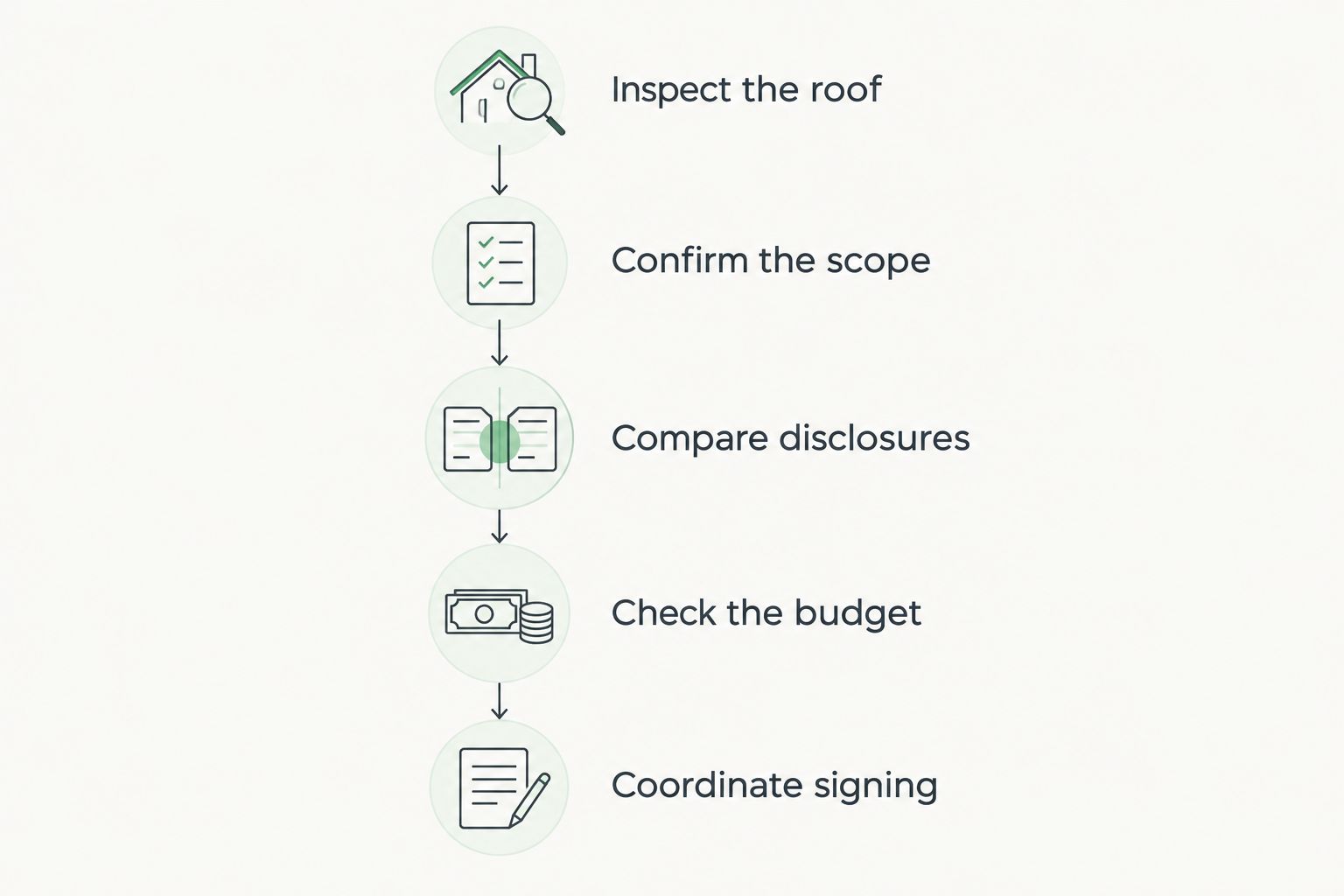
Keep 3 documents together: the roofing estimate, the financing disclosures, and your household budget. If the loan amount differs from the estimate, ask for a written explanation rather than assuming the difference is necessary.
Keep warranties separate from financing
Murray Roofing lists a 50-year Golden Pledge warranty and a 10-year labor warranty among its trust signals. Ask which warranty applies to your proposed roof and request its terms; do not assume every project receives identical coverage.
Those warranty periods describe different obligations from a loan. Financing approval does not establish warranty eligibility, and warranty coverage does not remove your repayment obligation.
Which roof financing option should you choose?
Start with an inspection and written estimate, then compare contractor financing with an independent unsecured offer. Investigate assistance before borrowing if household eligibility is a concern.
Choose shared borrowing only when everyone understands the liability. Consider home equity only after evaluating the risk to your property. If none of the payments fits your budget, ask the roofer whether a documented repair is appropriate—not whether essential work can simply be ignored.
FAQ
Can I get roof financing with bad credit in 2026?
Bad credit does not automatically rule out roof financing, but approval depends on the lender’s requirements and your financial circumstances. Confirm income, credit, debt, and collateral requirements before applying; no option in this guide guarantees approval.
What is the best roof financing for bad credit?
The best roof financing for bad credit is an affordable written offer that covers necessary work without unacceptable repayment or collateral risk. Start with a documented roof estimate, then compare contractor financing and an independent unsecured offer.
Does Murray Roofing offer financing for roof replacement?
Murray Roofing offers roof financing. Ask for the current financing provider’s eligibility requirements and disclosures; the financing offer alone does not establish approval for bad credit.
Will checking roof financing affect my credit score?
A hard credit inquiry can affect your credit score, while a soft inquiry does not. Ask the lender which inquiry applies to prequalification and which applies to the full application before giving authorization.
Is a home equity loan better than a personal loan for a roof?
A home equity loan is not automatically better than a personal loan because it uses your home as collateral. Compare total repayment, fees, payment structure, and the consequences of default rather than choosing solely by the monthly payment.
Should I finance a roof before an insurance decision?
Do not count on insurance proceeds that have not been confirmed when choosing a roofing loan. Coverage depends on the policy and claim decision, and the loan remains a separate repayment obligation.
What should I do if every roofing loan is denied?
Ask the lender for the stated reasons, review your credit reports for errors, and investigate applicable repair assistance. Separately, ask a roofing professional to assess urgent damage and explain whether repair is an appropriate option.
One last thing
A smaller monthly payment is not proof of a better roofing loan. Compare the repayment period and total payments alongside the scope of work; stretching the debt changes the financing, not the roof you receive.
Use these guides to prepare your questions, then request an inspection and a written estimate before choosing a lender.
Related guides
- From roof estimate to financing approval
- Can you get a roof replacement financed with bad credit?
- How to use a home equity loan to pay for a new roof
- Is it cheaper to repair a roof or replace it completely?
Schedule your roof inspection
Get a written roofing estimate and ask about financing for your Lincoln or Omaha home.